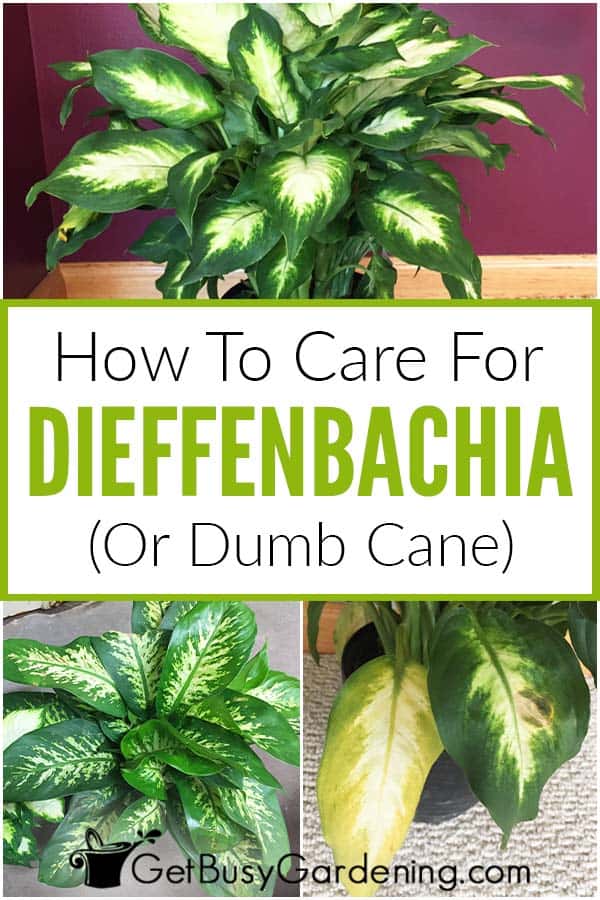
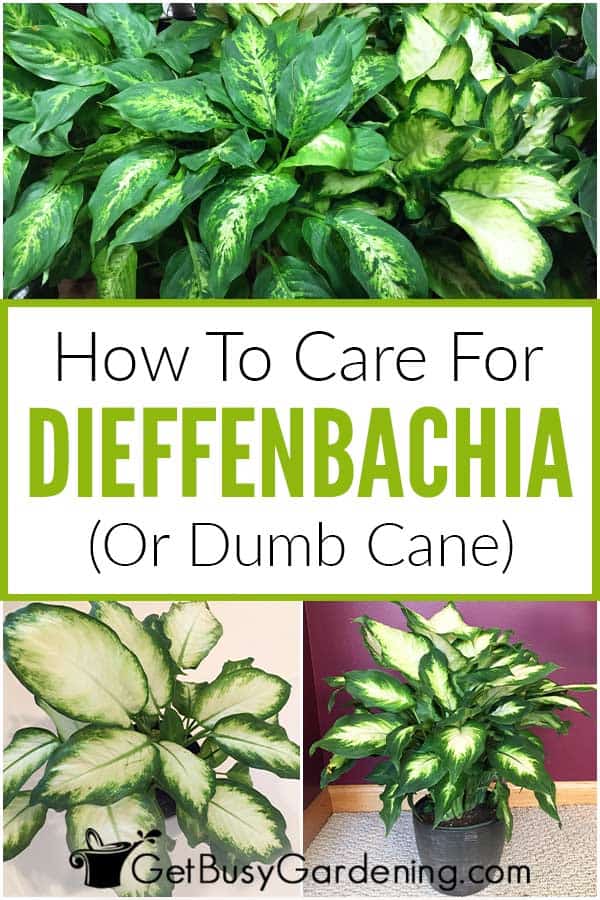
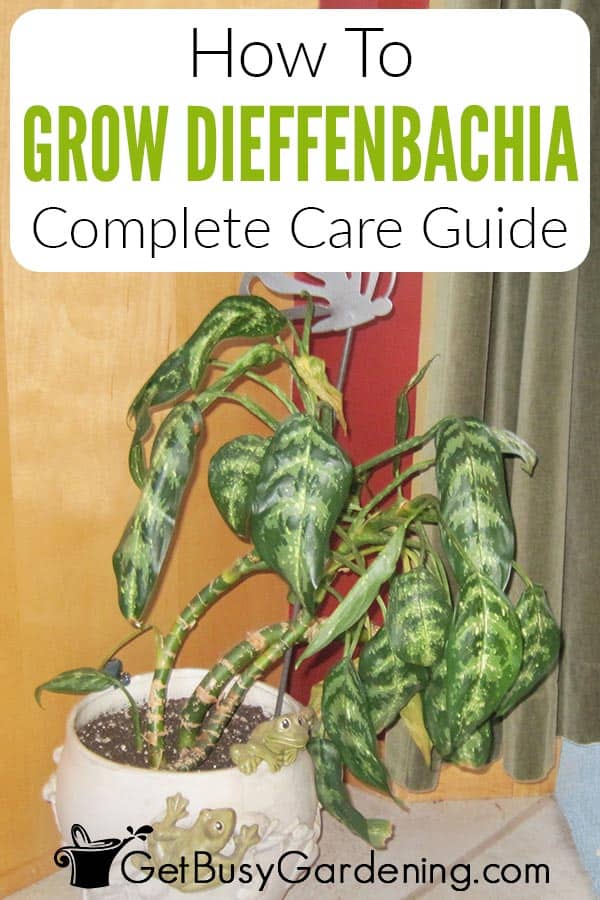
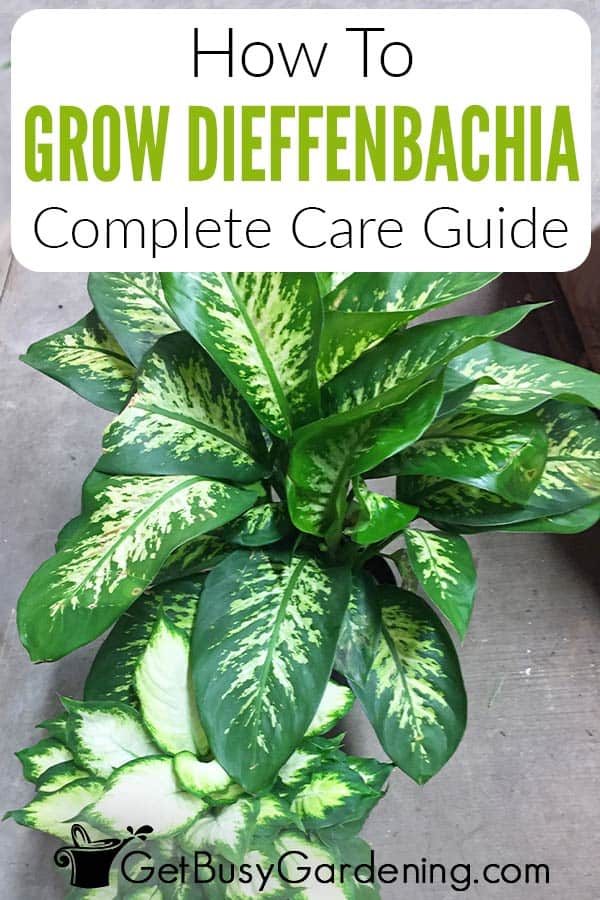
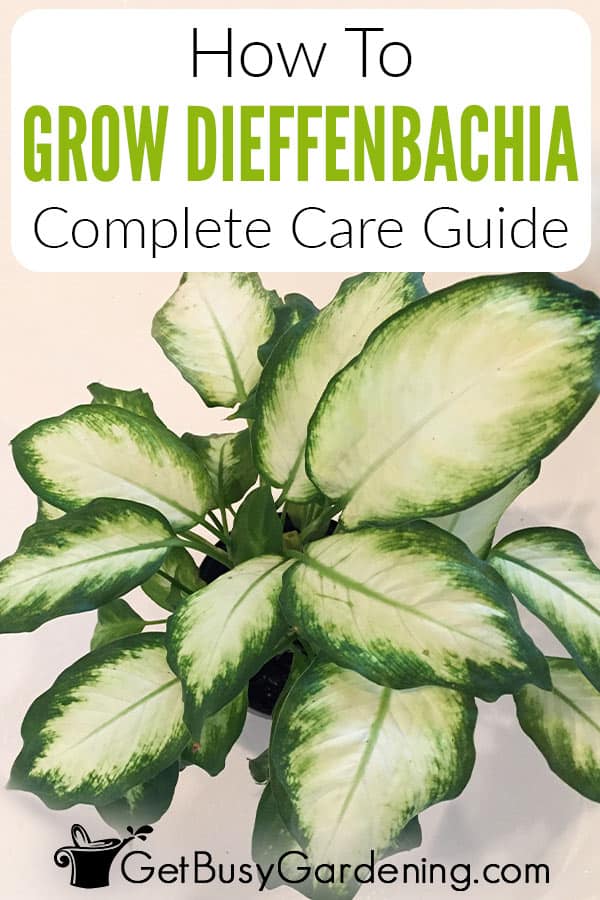
Dumb cane (Dieffenbachia) plants are low maintenance and don’t require any special care. Once you understand the growing requirements, you’ll be able to keep your plant healthy and thriving.
Though they aren’t super fussy houseplants, it’s important to understand exactly what they need so you can enjoy the lush foliage for many years to come.
In this complete care guide, I’ll show all you need to know about how to grow Dieffenbachia. You’ll find information about water, soil, light, fertilizer, pruning, propagation, pest control, and much more.

Quick Dieffenbachia Care Overview
| Scientific name: | Dieffenbachia |
| Classification: | Tropical plant |
| Common names: | Dumb cane, Dumbcane |
| Hardiness: | Zones 10+ |
| Temperature: | 65-80°F |
| Flowers: | Green, blooms spring-summer |
| Light: | Full to partial shade, bright light indoors |
| Water: | Allow soil to dry slightly, do not overwater |
| Humidity: | Average to high |
| Fertilizer: | General purpose plant food spring-summer |
| Soil: | Fast-draining, fertile soil |
| Common pests: | Spider mites, thrips, mealybugs |
Information About Dieffenbachia (Dumb Cane)
Dieffenbachia is a very common indoor plant that is prized for its beautiful foliage and simple care requirements. It’s in the Araceae family of plants, and is native to parts of Mexico, the West Indies, and South America.
It earned the nickname, “dumb cane”, because there is a chemical in the sap that can cause temporary loss of speech if any part of the plant is chewed or eaten.
Though they originate from the tropics, they make excellent houseplants because they can quickly adapt to growing indoors.
Different Types Of Dieffenbachia
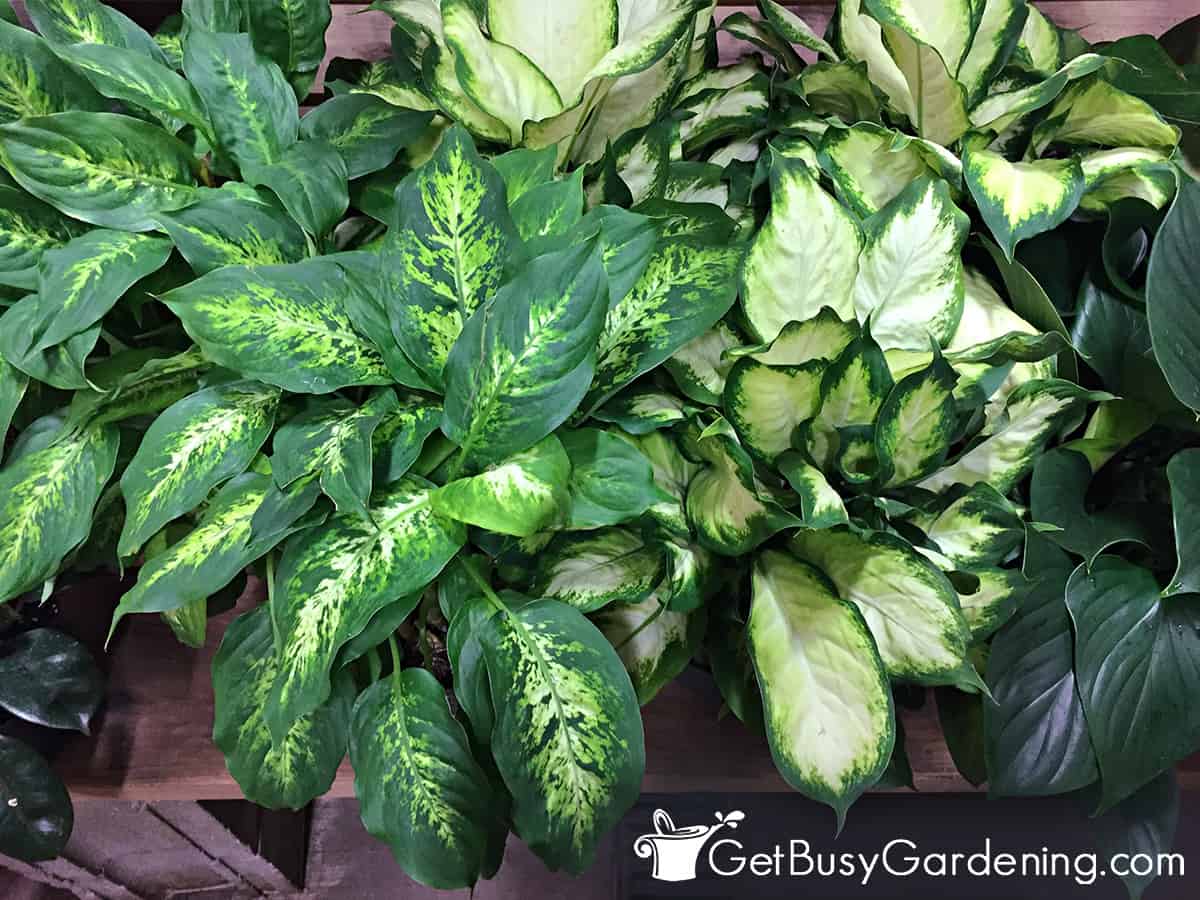
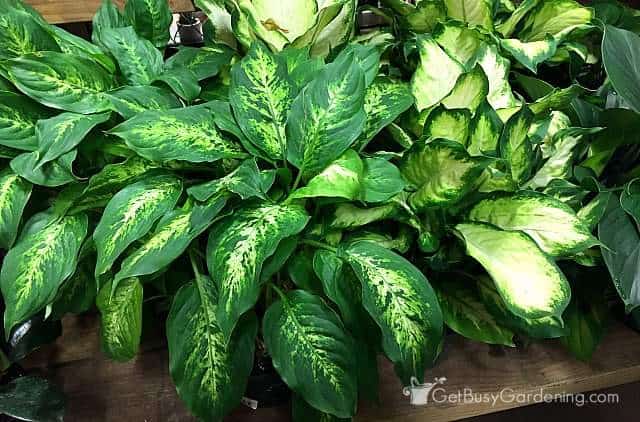
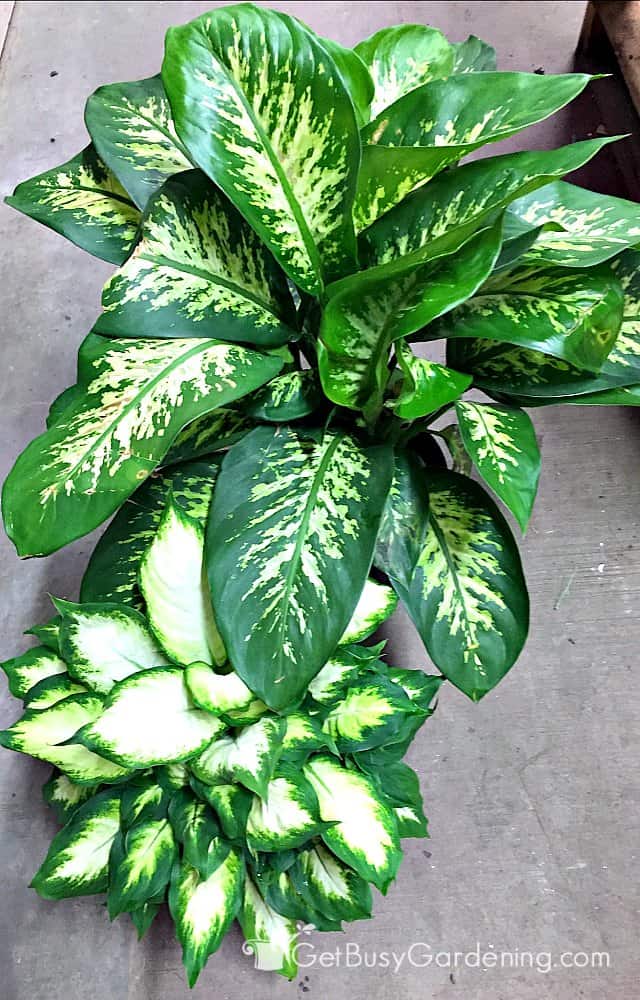
There are lots of different species and cultivars out there these days, and they’re all gorgeous. You can find dumb cane plants in various sizes and foliage colors too.
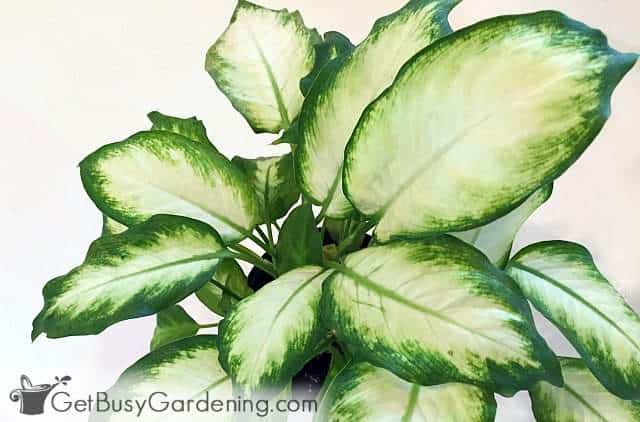
Some have large leaves, and can grow to be several feet tall, while others stay much smaller and more compact. The leaf colors vary by type, ranging from dark or bright green with whitish stripes or spots, to almost white leaves with dark edges.
Common varieties you may come across are Seguine, Compacta, Maculata, Golden Sunset, Camilla, or Amoena. Here’s a great list with more options.
Toxicity
All parts of the Dieffenbachia plant are poisonous when chewed or ingested. According to the ASPCA website, it is also toxic to cats and dogs.
So, if you have animals or small children, then it’s best to keep this plant out of reach, just in case. Check out my list of pet friendly houseplants instead.
Flowers
Though they are best known for their lush foliage, dumb cane plants can also bloom, but the flowers are small and insignificant.
The blossoms are green with a long, white spadix, and tend to appear in the spring or summer. They often blend in with the leaves, so you might not even notice them.
It’s also not very common for a Dieffenbachia to flower indoors. They need the perfect growing conditions, and it can be difficult to get it just right in the average home.
Where To Grow Dumb Cane
Once you bring home a new Dieffenbachia plant, you’ll need to know where to grow it. To have the best success, it’s very important to understand their hardiness and the ideal location.
Hardiness
Dumb canes are not tolerant of the cold, and they will only survive outside year-round in zones 10+. They can handle a very light frost, but if it drops below freezing, the plant will die pretty quickly.
These sensitive plants don’t do well in extremely hot, arid regions either, and prefer a mild, temperate climate. Since they’re so sensitive to any type of extreme weather, it’s usually best to just grow them indoors.
Location
If it’s warm and humid enough where you live, you can grow Dieffenbachia in your garden. Just be sure to choose a shady location where the soil is fertile and well-draining.
Indoors, put your plant in a spot where it will get plenty of bright, indirect light. If you want to move it outside during the summer, bring it back inside before the temperature drops below 60°F.
Dieffenbachia Care & Growing Instructions
Even though dumb canes are fairly self-sufficient, they do require some care from you to grow their best. Follow my detailed tips below to keep your plant healthy and thriving.
Water
Proper watering is a crucial part of Dieffenbachia care, and overdoing it is their #1 cause of death. They need consistent, even moisture, but don’t like to be overwatered.
Let the soil dry 1-2″ deep between waterings, but never let it get completely bone dry. Press your finger 2″ into the soil to check the moisture level before giving it more.
The type of water you use is important too. Dumb canes are sensitive to the salts and chemicals found in tap water, which can cause the leaf edges and tips to turn brown. So it’s best to use distilled or rainwater.
When it’s time, give your plant a good soaking until the water starts to run out of the drainage holes. Then allow the excess to completely drain from the pot. If you struggle with this, I recommend getting an inexpensive moisture gauge to help you out.
Humidity
Since they are from the tropics, dumb cane plants really like high humidity. Though they adapt well to lower levels, if it’s extremely dry, the leaf tips and edges can start turning brown.
So if yours constantly has brown leaves, tips, or edges, then try running a humidifier nearby or misting your plant to see if that fixes the problem.
Light
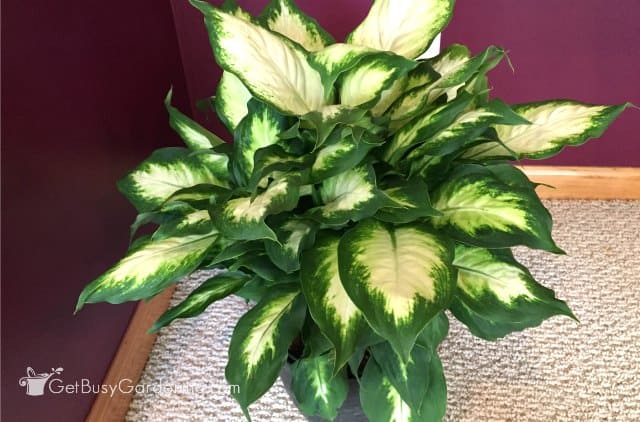
Dieffenbachias are the perfect low-light houseplants because they like the shade, and direct sun will cause their leaves to fade or burn. But if it’s too dark, they’ll quickly grow tall and leggy.
Indoors they need bright, indirect light. A spot next to a sunny window, or an area where your plant will get filtered light through a curtain or blinds would be perfect. If you don’t have a bright room, then you could use a small grow light.
It also helps to rotate the plant once in a while to prevent it from reaching to one side as it grows taller. I rotate mine every time I water, or monthly (or whenever I remember).
Soil
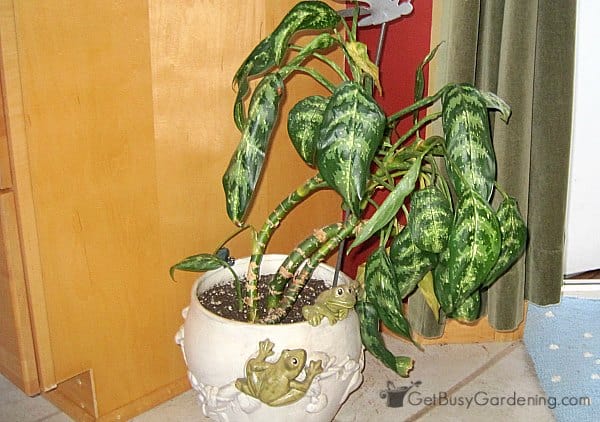
Dumb canes aren’t super fussy about the type of soil you use, any high-quality general purpose potting mix will work just fine. But they do prefer a porous and well-draining medium.
So, if you tend to overwater, then you’re better off using a fast-draining mix. Or you could add some perlite, pumice, or coarse sand to the potting soil to improve drainage.
Repotting
You don’t have to worry about repotting your Dieffenbachia very often, they don’t need it until they’re pot-bound.
You’ll know it’s time when you see roots coming out of the bottom holes, if there are more roots than soil in the container, or if you have to water your plant constantly to keep it from drooping.
Always use a container with holes in the bottom, and only go up one or two pot sizes. If you give it too much room, your plant may have a difficult time becoming established in the new container.
Related Post: When & How To Repot Houseplants
Fertilizer
Another great thing about dumb canes is that they can grow just fine without fertilizer. But they will benefit from being fed during the spring and summer, and it could even trigger blooming.
However, they are very sensitive to chemicals. Overuse of synthetic fertilizers can lead to brown leaf edges and tips, among other issues. So I highly recommend using an organic one instead.
Apply a diluted, liquid houseplant fertilizer or a compost tea monthly, or you can add slow-release granules once in the spring. Stop feeding in the fall and winter to let your plant rest.
Pest Control Tips
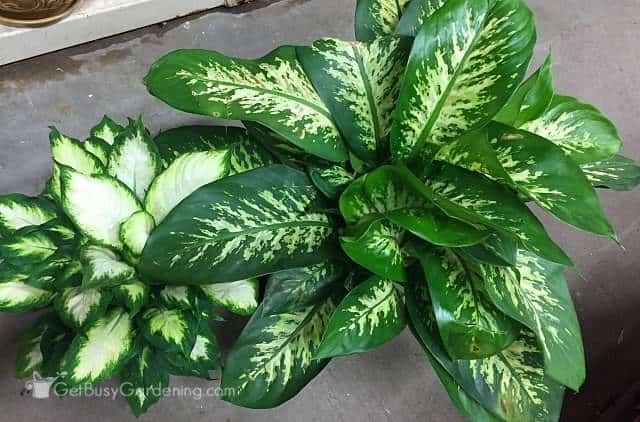
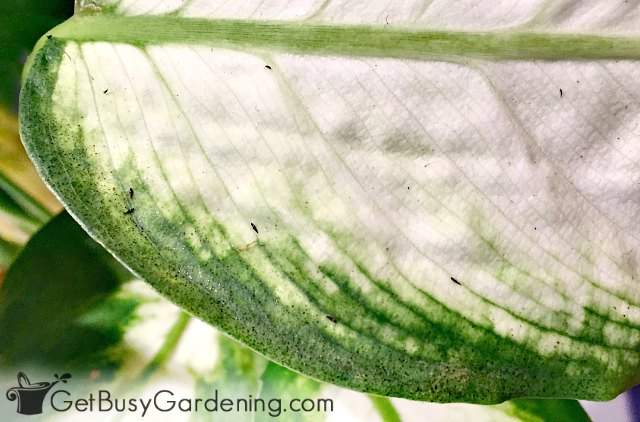
It’s rare for a healthy Dieffenbachia to have problems with bugs, but sometimes spider mites, thrips, or mealybugs can attack them.
If you find bugs, begin treating your plant right away. My favorite product to use is neem oil. It’s a natural insecticide that’s very effective at controlling houseplant pests.
Organic insecticidal soap also works well to knock down an infestation quickly. I make my own by mixing 1 teaspoon of mild liquid soap per 1 liter of water.
Related Post: How To Get Rid Of Houseplant Bugs Naturally
Pruning
Pruning is an important part of Dieffenbachia care, and you should do it regularly. It helps to keep your plant tidy, compact, and healthy. Here are my tips:
- Remove dead or dying leaves and flowers at any time by simply cutting them back to the main stem.
- Trim off brown leaf tips and edges as necessary, following the natural shape of the leaf.
- Clip new growth at the tips every spring to prevent legginess, and encourage your plant to grow more compact and bushy.
- If your dumb cane has grown tall and leggy, you can top the plant, or cut it back anywhere on the stem. New leaves will form just below the spot where you made the cut.
Dieffenbachia Propagation Methods
You can propagate your dumb cane from either stem cuttings or by division. If there are several stems growing in the pot, you can separate them to make new plants.
Rooting cuttings can be a bit tricky. The key is to provide lots of humidity, and keep the soil moist but never soggy.
Take a stem cutting that’s at least 4″ long, and dust it with rooting hormone. Then plant it in a loose, porous soil mix. You’ll know it’s rooted when you see new leaves developing on top.
Troubleshooting Common Dieffenbachia Problems
The most frustrating part about Dieffenbachia care is when your plant is sick, and you don’t know why. Below are some of the most common problems you might run into, and tips for how to fix them.
Brown Leaf Tips Or Edges
Brown leaf edges and tips are usually caused by inconsistent watering, low humidity, or salt and chemical buildup in the soil from using tap water or synthetic fertilizers.
Crusty buildup on the top of the soil or around the inside of the pot are signs of overfeeding or too much salt/minerals from tap water. Switch to an organic fertilizer, and use filtered water or rainwater.
Drooping Leaves
When the leaves or the whole plant start drooping, it’s usually caused by over or under watering. But it could also be from exposure to cold or hot air, plant bugs, or transplant shock after repotting.
Leggy Dieffenbachia
Dieffenbachia naturally gets leggy over time, it’s their normal growth habit. But it can be worse if your plant isn’t getting enough light, so move it to a brighter location. You can also prune the tips regularly to encourage bushier growth.
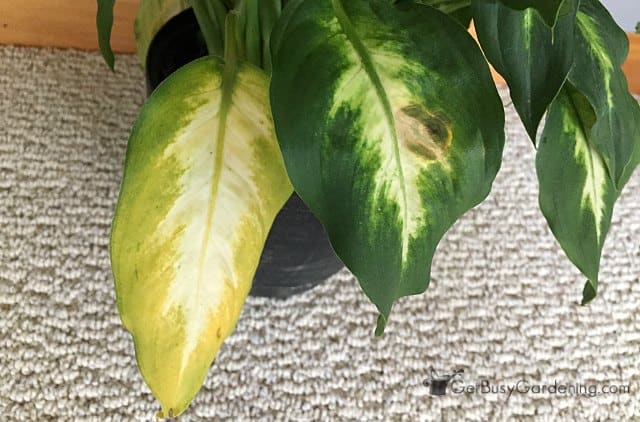
Yellowing Leaves
It’s normal for the lower leaves to turn yellow or brown, and eventually die. Simply trim them off as needed. However, if several of them are yellow, or they aren’t on the bottom, then it’s probably overwatering, insufficient light, pot-bound roots, or bugs.
Inspect the leaves for any signs of an infestation, and then check the soil moisture level. It should never feel soggy or overly wet. If it’s not those things, then make sure your plant is getting bright, indirect light, and check to see if it needs to be repotted.
Now that you know how to properly take care of your Dieffenbachia, you’ll be able to grow these gorgeous houseplants for many years to come.

If you want to learn all there is to know about maintaining healthy indoor plants, then you need my Houseplant Care eBook. It will show you everything you need to know about how to keep every plant in your home thriving. Download your copy now!
Share your Dieffenbachia care tips in the comments section below.

Lizzie M James says
the new leaves that are growing out are brown while still twisted. Is that sunburn and what do I do about it? I did change the window lighting. the leaves are not opening up.
Amy Andrychowicz says
It could be caused by sunburn if they are getting any direct sunlight. Brown edges and tips are a very common problem with dieffenbachias, and could be caused by other problems: inconsistent watering, low humidity, fertilizer…etc. See the bullet point titled “Brown leaf tips and edges” under the “Troubleshooting Common Dieffenbachia Problems” section above for details about that.
Jenifer Axtell says
My cane keeps growing sideways and twisty, until it cant keep standing with the weight, flops over, and keeps growing into twists. There are four or so big stems that do this. The middle of the plant is many little stems that can’t seem to hold their own weight at all. Do you have an idea on how I can get it to grow up rather than out?
Amy Andrychowicz says
Yes, it’s common for dieffenbachias to get top heavy like that as they grow tall and leggy. You can try staking your dumb cane in order to get it to stay upright. Otherwise, you could try topping it and propagating the cuttings to make new plants. As for the smaller stems you describe, it sounds like maybe your plant isn’t getting enough light. I would try moving it to a brighter location and see if that helps to keep it from continuing to grow so leggy.
Aleksina says
My issue is mine is growing very slowly. Its leaves have stayed fairly small, and it has been really slow to get additional leaves.
Could it just be it needs a deeper pot or dusting off leaves more often? It has the tiniest bit of brown at the ends of the leaves, but otherwise it looks healthy. It is right by a north facing window, getting lots of indirect light.
Thanks
Amy Andrychowicz says
It sounds like a very happy plant to me. Don’t worry, dieffenbachias don’t grow very fast. A north facing window doesn’t give a lot of light, so you could move it to a brighter room if you want. But as long as it’s healthy, and not reaching for light, then I think it’s fine.
monica thomas says
My elephant ear dumb cane that I rooted out is growing tiny leaves on a spindly stem base. Please help. It was given to me by my mother from a plant she grew for the past 40 yrs>
Amy Andrychowicz says
When the new leaves are small like that, then it can either be caused by houseplant pests, improper watering, or using too much fertilizer. However, since you mentioned that the stem is also spindly at the base, then my guess is that it’s being overwatered. Check the soil and make sure it’s not too wet, and also make sure the stems aren’t rotting at the base. See the “Troubleshoot Common Dieffenbachia Problems” section above for more details, and also be sure to read the section titled “Dieffenbachia Watering Instructions”.
Aida Gomez says
I left my plant outside for a few nights and now most of the leaves are turning yellow yes it did get a bit cold outside what can I do to help it get green again? Do I cut most of the leafs off? The stems are still green and heathy. I also haven’t watered it because it had to much water which I poored out. Help I’ve had this plant for many years. Love it.
Amy Andrychowicz says
Oh no! Sorry to hear that your dieffenbachia got frost bite! I would definitely not recommend cutting off all of the leaves right away. Let it sit for a while to see how bad the damage it. The leaves that were frozen will likely turn brown or black. After a week or so, I would prune off the brown and black parts of the leaves, but leave the yellow ones on there for now. Once you start to see healthy new growth, you can begin pruning off the yellow leaves.
Lady A says
My Dumb cane plant has grown 6 feet tall with the being 18 inches long and 10 inches wide. The problem is it is top heavy and the pot fell over. I cut the cane to place in another pot I left the cane at 4 feet. By putting the top heavy plant will it continue to grow. Currently it looks like it is in shock. Is there anything I can do to help it to come out of shock. The plant is really healthy.
Amy Andrychowicz says
Yes, new growth should start just below the spot where you cut the cane. It may take a little while for your dumb cane to start growing again after topping it like that. Just treat it like you normally would during this time, and it should start putting on new leaves in no time.
Cindy says
Overnight, leaves on my plant suddenly, at the tip end, turn a funny brownish color and fill with fluid…like a blister! If you touch it, it pops and stinky fluid comes out. What is causing this??
Amy Andrychowicz says
Oh my goodness, that sounds gross! I would check the space where you have it and make sure it’s not near a heat source or a freezing cold window that could have damaged your dieffenbachia and caused the blisters. Since it happened that quickly, I suspect the leaves either froze or were somehow burned. I would also inspect the leaves to see if there are any signs of bugs that could be causing the blisters.
Sofia says
Hey Amy,
Great post, thank you for all these informations!
I have a problem with my diff too: when I took it home from the store it was all big and bushy then we had a spider mites attack, but it seemed like this plant we saved in time. Later I discovered a big whole in one of the stems so I repotted, taking that one stem away (Looked like something bit into it, or was simply rotting from inside out. Didnt really find out what it was, just dealt with the problem).
Since then, it’s doing okay but not great… the lower leaves slowly turning yellow and die. I thought its some sort of bugs on the leaf but it really looks like just dirt . Some of the leaves on the top have brown edges but I think thats pretty normal – of course would be better without:) – but also due to the really hard tap water we have in Berlin. I try to let the water sit since and water the plants with that.
Also, while the lower dieffenbachia leaves yellow and die (I cut them before they fall) there are some new leaves coming up, that are super curled up and also oddly looking.
Hope you can help me maybe 🙂
Amy Andrychowicz says
You’re welcome! It’s normal for the lower leaves on dumb canes to turn yellow and eventually die. However, if you’re concerned about it, read the section “Troubleshooting Common Dieffenbachia Problems” above for more ideas for what could be causing the yellow leaves. The brown edges could be caused by inconsistent watering, over-fertilizing, or maybe even the type of water you’re using. I collect rainwater (or melt snow in the winter) to water my houseplants, and they love it! 😉 You could use filtered water on them instead. As for the new growth… it’s normal for the new dieffenbachia leaves to be curled and look a bit odd as they open. If they look green and healthy, and aren’t brown or yellow, then there’s no reason for concern.
J says
Our dumb can has leaves that start to dry out and turn brown. Something we then also have leaves that turn yellow. I would think maybe I’m over watering but don’t understand why domes leaves would be drying up. It’s in an area that gets afternoon light away from the window. Thanks!
Amy Andrychowicz says
There are a few things that could cause dried up brown leaves on dieffenbachia plants – too much fertilizer, not enough water, or the air is too dry (it needs more humidity). Yellow leaves at the bottom of the plant are normal. As the lower leaves age, they naturally turn yellow, and will usually eventually drop from the plant.
Ashley says
My dumb cane Is about 2 ft tall.
I moved into a new house and the climate is more warm.
The leaves on my plant are as perky as they used to be. What could be the cause of the droopy-ness?
Amy Andrychowicz says
Your dumb cane may just be in shock after the move. Plants don’t like to be moved, and it can take some time for them to get used to their new environment. The best thing to do is to leave it alone until it recovers.
Tracie sanders says
We have a dumb cane at work that is huge and beautiful, our problem is it’s almost to the ceiling and falling over. My question is can we just top it off?? We have replanted it in as deep a pot as we can find so the only option I see is to let it lean which is not pretty or cut the top house out if the middle??
Amy Andrychowicz says
Yes, you can top a dumb cane, and it will grow back from just below the cut. Then you can root the cutting for a new plant if you want to. If there’s no growth below where you plant to make your cut, it can be a bit risky. But if you propagate the cutting, then you won’t have worry if the bottom half survives. 🙂 Also, be sure to use a sharp and sterile knife or pair of clippers to make the cut.
Shelby says
Hey there! I am currently experiencing mine being droopy, not sure if It needs to have more soil added, plant food or what I am doing wrong with it.
Amy Andrychowicz says
When dieffenbachia leaves droops, that usually means it’s either being over watered or under watered. The first thing to do is check the soil by sticking your finger one inch deep. If it’s wet, then let it dry out more between waterings. If the soil is totally dry, then give your dumb cane a good watering, and try to water it a bit more often. An inexpensive soil moisture gauge is a nice tool to help make sure you’re watering your dumb cane plant properly. If the soil level on the pot is really low, then you can certainly top it off with fresh soil, that won’t hurt anything. But I definitely would not recommend fertilizing it until after you figure out why it’s drooping. Fertilizing an already stressed plant can be fatal to the plant. Good luck!
Jan says
My plant has both small yellow leaves but a lot of the leaves are still green but just real limp and droopy.
Just hanging downward and stems that were upright are now leaning off in different directions. We recently moved and had no problems it was by a window with filtered light. I now have it by sliding door which does not open same kind of light so I don’t understand. Why is my dieffenbachia drooping?
Amy Andrychowicz says
Do you live in a cold climate? If so, did you cover your dumb cane when you moved it? Bringing houseplants outside during freezing temperatures, even for a short time can cause severe damage to the plant. Also, make sure the door you have it sitting next to isn’t drafty (with freezing cold air). Here’s a post I wrote about houseplants and drafts – Houseplants Don’t Like Drafts
Sara says
What about AC in bedrooms, does it harm the dubm cane plant too?
Amy Andrychowicz says
Great question! It could if your plant is sitting right next to or on top of where the cold air is coming out. I would definitely recommend you keeping your dumb cane away from the cold air coming out of your A/C unit.
robert says
I am expirencing the problem of your last example of the dieffenbachia leaves turning yellow,driving me crazy.
Aware of overwatering and put on calendar when I water.The proof of overwatering that hits home is there is a store in my area that the owner lost lease and there are two Diffs in the
empty store no one has watered these plants for months and they are not in direct sunlight and they are thriving one is at least five feet tall and well rounded.trying to save my plant the Diffs are so beautiful.
Amy Andrychowicz says
Oh that sounds frustrating, sorry for the troubles you’re having with your dieffenbachia. A good tool that I recommend using to help you with proper watering of your houseplants is a soil moisture gauge. Good luck, and maybe you could see if you can rescue those poor abandoned dieffenbachias and take them home with you! 🙂
Pat says
the new leaves on my dumb cane are not opening……..
Amy Andrychowicz says
Sorry to hear it. It’s hard to diagnose the problem with your dumb cane without more information. What do the leaves that aren’t opening look like? Are they brown or yellow? Does the plant seem to be suffering in any other way? Have you checked for bugs?
dawn says
Also my problem, new leaves or sprouts are both yellow and brown. I have searched in vain for an answer. No bugs, no over watering, has humidity and low light, no over fertilize. I have virtually nothing left to do….but watch its death.
Amy Andrychowicz says
Stunted new leaves like you describe are usually caused by over fertilizing, or bugs like spider mites (which are super tiny and easily overlooked). But if you’re sure there is absolutely nothing else wrong with your dumb cane plant, then it may have some kind of a disease. I would try pruning off the leaves that won’t open, and see if that triggers new growth.
natalia says
i wish mine were so pretty, but I asume I have to plant several in the same pot? mine are leggy and not have so much leaves.
Amy Andrychowicz says
It’s very common for dumb cane houseplants to grow tall and leggy over time, especially when they aren’t getting enough light. To grow their best, they need bright indirect light. If you want to try pruning your dumb cane plant to make it grow bushier, then you can just pinch out the tops of the new growth, and it will encourage the plant to branch out at the top. Or, if you’re really brave, you can cut the stem of the plant several inches below where the bottom leaves are growing and try propagating the cuttings. The stem should grow new leaves just below the cut too.