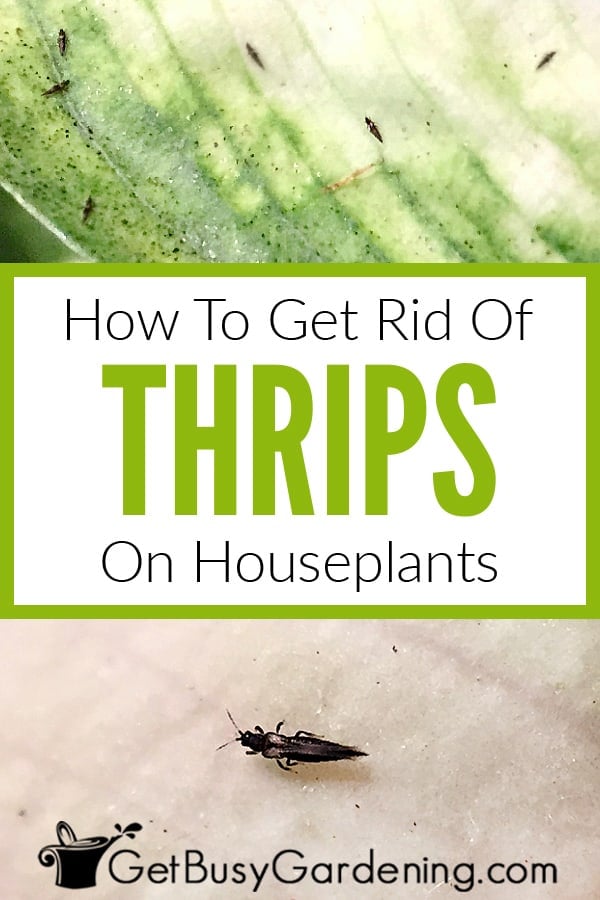
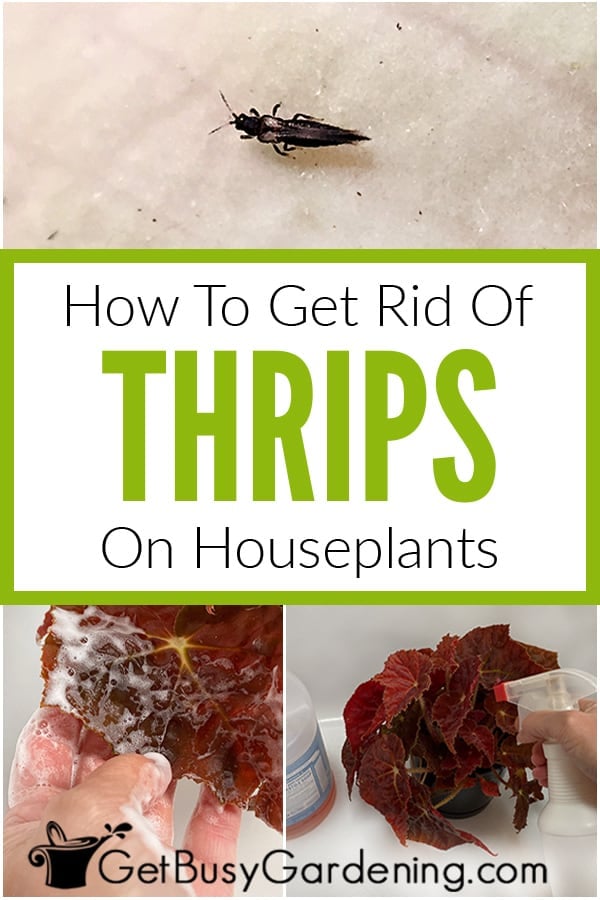
Finding thrips on your indoor plants is disheartening. Not only are these little bugs annoying, they can be extremely destructive.
They multiply very quickly, and can crawl or fly, which makes them difficult to control. So they could infest your entire houseplant collection in a short period of time. But don’t worry, I’m here to help.
In this post, you’ll learn all about thrips: their life cycle, where they come from, what they eat, the damage they cause on indoor plants, and much more. I’ll also show you exactly how to get rid of them, and prevent them from ever coming back.

What Are Thrips?
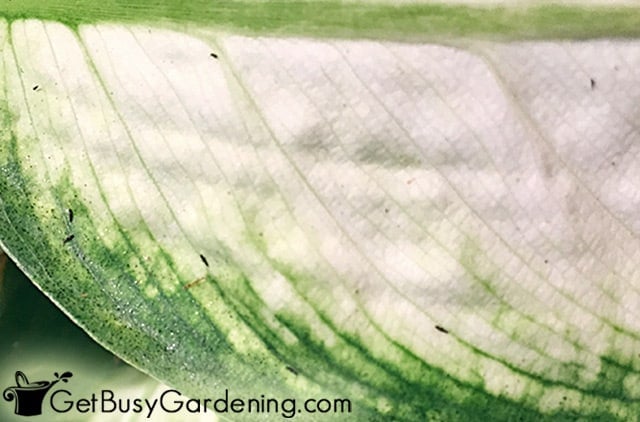
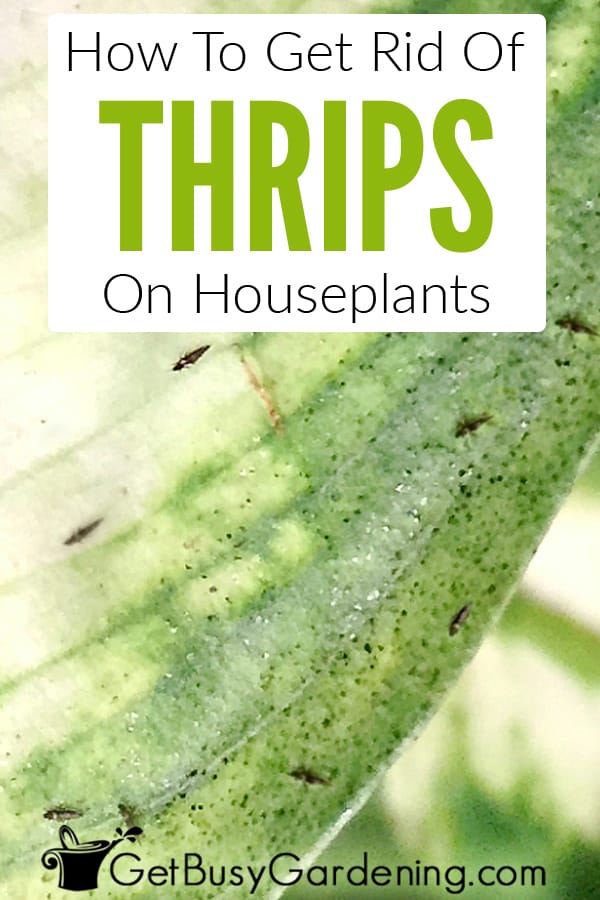
Thrips are tiny bugs that suck the sap out of the leaves, stems, buds, and flowers of houseplants, causing them to look faded or dirty.
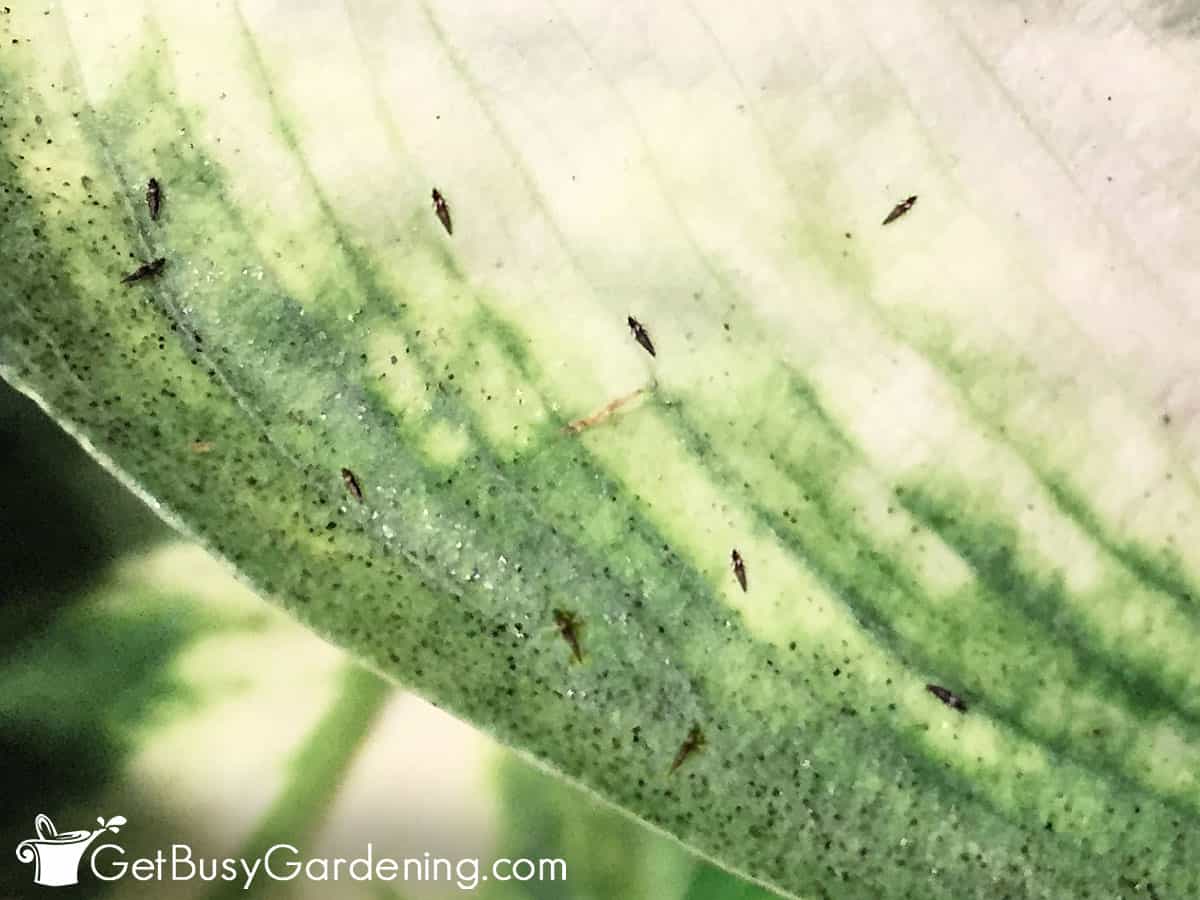
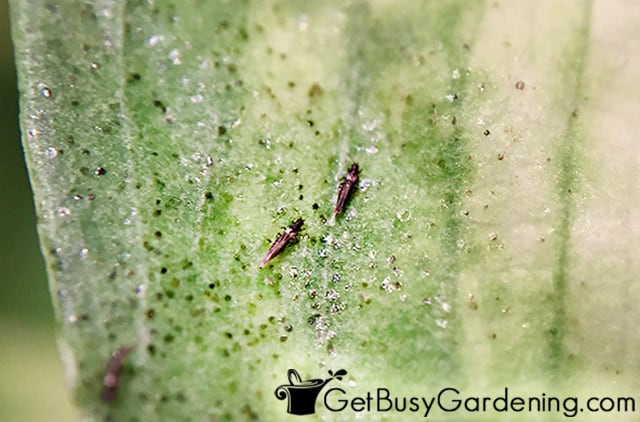
If you look closely, you’ll find them crawling all around the tops or undersides of the leaves of an infested plant.
Since they are so small, they’re difficult to see at first glance. But once you spot them, it’s pretty easy to make a positive ID.
What Do They Look Like?
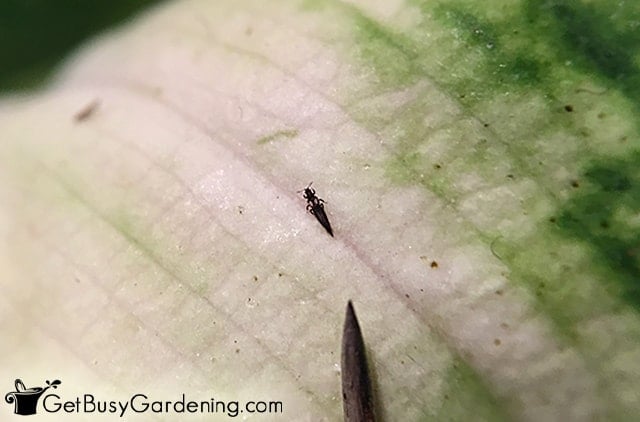
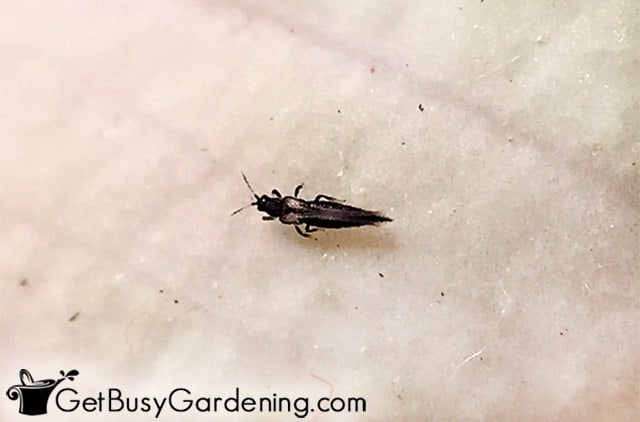
Thrips have long, skinny bodies that are narrow in the middle. They also have slender, pointy tails, antennas on their head, and wings on their backs (which are barely noticeable).
They don’t cluster, and usually start on the undersides of the leaves. Which means you probably won’t notice them until the population has grown very large.
Most of the time they’re black in color, but they could also be brown, white, or greenish-yellow. Though they can fly, they aren’t great at it. So it’s very unlikely that you’ll see them buzzing around.
If you do see tiny black bugs flying around your houseplants, those are probably fungus gnats, and here’s how to get rid of them.
Thrips Life Cycle
Basically, there are four main stages of a thrips life cycle: eggs, nymphs, pupa, and adults. In the right conditions, they can multiple quickly. Their entire life cycle, from egg to adult, can take as little as two weeks.
The adults only live for about a month or so. But there can be several generations going on at the same time, and females can lay hundreds of eggs in their short lives.
Even worse, some of them can reproduce asexually. Which means they don’t need a mate to multiply. Yikes!
Related Post: How To Identify Common Types Of Houseplant Bugs
What Do They Eat?
Though they tend to favor thin-leaved plants, thrips will feed on pretty much any type of houseplant, so be prepared to find them on any of yours.
They suck the sap out of the leaves, stems, flowers, and buds, destroying the plant tissue. Both the nymphs and the adults can feed on indoor plants.
Where Do Thrips Come From?
There are several ways that thrips can get indoors and onto your plants. Here are a few of the most common ones:
- Houseplants that spent the summer outdoors
- A new plant you brought home from the store
- Cut flowers or veggies from your garden
- Through open doors and windows
Related Post: Where Do Houseplant Pests Come From?
Thrips Damage On Houseplants
Usually the first sign of thrip damage is faded or dirty looking leaves. In addition, flower buds may drop, be malformed, or fail to open.
The affected leaves will start by turning white or grayish in color, then eventually they’ll turn brown as the damaged areas begin to die.
Though it’s possible for thrips to kill a houseplant, it’s rare. Mature, healthy plants can handle a pretty heavy infestation, but it will likely stunt their growth.
If any your indoor plants have these symptoms on their leaves, it’s time to take a closer look to check for an infestation:
- Brown stripes or dots
- Faded, splotchy, or pale-colored
- Parts of a leaf are dying
- They start drooping unexpectedly
- New growth is deformed
How To Get Rid Of Thrips On Houseplants
The good news is that you absolutely can get rid of thrips on your indoor plants for good, and prevent them from ever coming back. Woohoo! Here’s how to get started:
- The first thing you should do is quarantine the affected plant immediately.
- Then check all of the surrounding ones, be sure to look underneath the leaves too.
- Always wash your hands after handling an infested houseplant.
- Begin treating them right away to contain the outbreak as quickly as possible.
5 Organic Thrips Treatment Methods
All of the methods I’ve listed below, and highly recommend, are natural and organic. That’s because thrips can build up an immunity to chemical pesticides, which will only end up making your problem worse.
Whatever method you choose to use, you must be persistent. You can’t treat a plant for thrips one time and expect them to go away forever.
Also, always test any type of soaps and sprays on a few leaves first to make sure there’s no damage before treating the entire plant.
Related Post: Natural Pest Control Methods For Houseplants
1. Rinse The Leaves
If you can, take your houseplant outside and rinse the leaves with the hose. Or you could rinse them in the sink or shower indoors.
That will remove many of the bugs, and quickly knock down their population. Be sure to use tepid water, and take care not to drown your plant in the process.
2. Insecticidal Soap
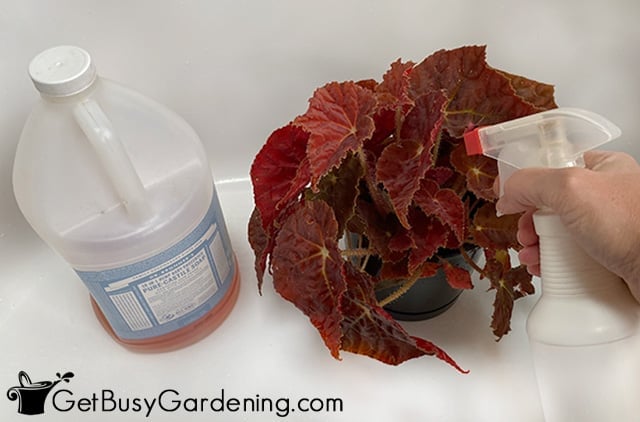
Soap kills thrips on contact, and will help to give you the upper hand. You can use a pre-mixed organic insecticidal soap, or make your own using 1 tsp mild liquid soap to 1 liter of water.
Spray it directly on the leaves to kill the adults, nymphs, and eggs. Soap doesn’t have any kind of residual effect, so it’s important to treat your plant often to completely get rid of the infestation.
3. Wash Your Houseplant
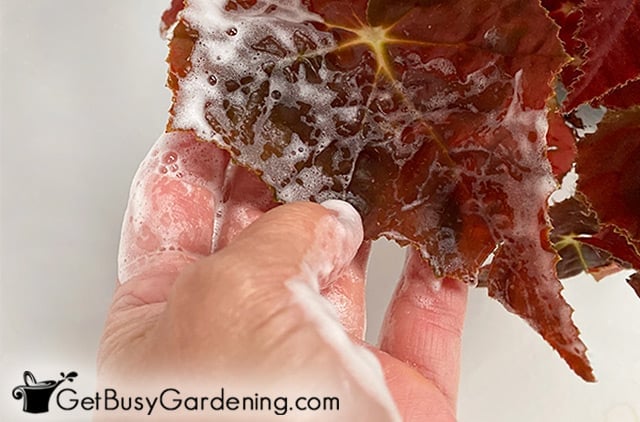
You could also try washing the leaves with a diluted mild liquid soap. This will kill the bugs as well, and help to quickly get them under control.
Make sure you wash the undersides of leaves too, because that’s where thrips like to hide and lay their eggs. Then rinse the plant well to remove all of the suds.
4. Neem Oil
One of my favorite products to use on thrips is neem oil. It’s a naturally occurring insecticide, and also has a residual effect that will help to deter future infestations.
While it will kill some of the bugs on contact, it can take time to eliminate a large population. So you have to treat your plant every few weeks until all signs of them are gone.
Related Post: How To Use Neem Oil On Houseplants
5. Sticky Traps
Since adult thrips are able to fly, sticky traps can work to capture them. Place either yellow or blue ones near the infested indoor plant to attract the pests.
Using sticky traps is also a great way to monitor for future infestations. That way you can detect them much faster and prevent a large outbreak.
How To Prevent Thrips On Indoor Plants
These buggers can be difficult to get rid of. So, once you finally win the battle, you’ll want to keep them from ever coming back. Here are a few easy ways to prevent thrips from infesting your houseplants:
- Inspect your indoor plants for bugs on a regular basis, I do this every time I water.
- Debug all of your plants before bringing them back inside for the winter.
- Keep anything that you bring in from your garden (cut flowers, veggies…etc) far away from your indoor plants.
- Inspect all new plants before bringing them home, then quarantine them for a few weeks afterward.
FAQs
Yes, thrips can bite. However, their bites usually only cause very minor irritation and aren’t harmful to humans or pets. I’ve had them on my indoor plants several times, and I have never been bitten.
Yes. Many species of thrips have wings as adults, and they can fly. However, it’s not very common to see them flying around. They tend to crawl as their main mode of transportation, rather than flying.
It’s very uncommon to see thrips in the soil, and they don’t live there for very long. Depending on the species, the nymphs can drop into the soil for a few days to pupate, and the adults could overwinter in there.
Getting rid of thrips on houseplants can take some time, but it is possible. Just remember to be persistent with your treatments, and take the proper precautions to prevent them from ever coming back.
If you’re tired of battling bugs on your indoor plants, then you need my Houseplant Pest Control eBook. It has everything you need to successfully get rid of any type of infestation. Download your copy today!
More About Houseplant Pests
- How To Get Rid Of Houseplant Bugs Naturally
- How To Get Rid Of Scale Insects On Houseplants
- How To Get Rid Of Whiteflies On Indoor Plants
- How To Get Rid Of Spider Mites On Indoor Plants
- How To Get Rid Of Aphids On Houseplants
- How To Get Rid Of Mealybugs On Your Indoor Plants
- How To Keep Cats Out Of Houseplants
Share your tips for getting rid of thrips on houseplants in the comments section below.

Sally says
Thank you so so much! I once again looked for advice for my plants and i, once again, found answer in your blog. Hope you are doing well, and i wish you a lot of fun with your gardening!
Sally
Amy Andrychowicz says
Awesome, I’m so happy to help!
Linda says
You said they do t live in the soil but if I take my finger and move the soil around I do see them there.
Please explain as this is the first time I’ve experienced the Thrips in my plants. I have found them on the leaves also.
Amy Andrychowicz says
My original answer was unclear, so I update it. I think the confusion comes from the fact that, though thrips can overwinter in the soil, and the nymphs can also pupate in there for a few days, they don’t live in the soil, and it’s pretty uncommon to see them there. If you have a large infestation of continual bugs in the soil, then those are probably fungus gnats rather than thrips.
Eve says
Do you know how often I should apply soap spray or neem oil solution?
Amy Andrychowicz says
It depends on how severe the thrip infestation is. If it’s heavily infested, then I would wash the leaves with soapy water every few days, and also start treating with the neem oil spray. If you use only the soapy spray, then you’ll have to apply more often, because there is no residual effect. For a light infestation, you might be able to get rid of them after only a few treatments of the soapy water spray. Otherwise, you can treat it with neem oil (which has a residual effect) every few weeks until you no longer see any signs of the bugs. Here’s all the details about how to use neem oil on plants.
Lois E Reed says
What soap what mix what oil I can’t take them out it’s to cold and there so big and long to shower please I need help
Stressed girl
Amy Andrychowicz says
See the section above titled “Organic Thrips Treatment Methods” for all of my recommended soap and oil treatment options. Once you start treating them, the key is to be persistent and patient. It will take time to get rid of a large infestation of thrips. Good luck!
Marg says
I just discovered my ponytail palms are infested (there are three plants in one pot). I first noticed that the tops of the plants were pale and wispy and thought it might be an overwatering issue, but then noticed the elongated black bugs crawling all over the plants. It’s in my tub with diluted dish soap on it, but I doubt I’ve doused all the leaves. How much of each plant should I remove? I can’t see not removing quite a bit to get rid of the damaged leaves. Should I cut them down to their bases? This pot was in my spare room with several other plants…. and that makes me nervous. It’s nighttime now; I’ll have to look all the others over in the daylight.
Amy Andrychowicz says
So sorry to hear your plants have thrips, that’s no fun! I wouldn’t prune them back though, they need all the energy they can get to help you fight off the infestation. You can remove any leaves that are completely dead, but keep the others. Killing all of the bugs with only one soapy spray application is highly unlikely, especially with a large infestation. Keep treating it following the instructions in this article, and be persistent. Don’t stop until all signs of the thrips are gone, and then keep a very close eye on it for signs of any new bugs. Good luck!
Jordyn says
Me again, lol.
I keep reading conflicting facts about thrips. Here, and on a few other websites I’ve come across, it says thrips do not live in soil, and don’t mention anything about treating the soil. Other websites have said that they lay their eggs in the soil, then crawl back up to feed on the leaves. And then other sites have said their lay their eggs “inside” the leaves.
Amy Andrychowicz says
Thrips lay their eggs either on or inside of the plant tissue (leaves, stems, flowers, fruit, etc). However, the adults and pupae can overwinter in garden soil outside, and when they reemerge in the spring, they will crawl out to infest nearby plants. So maybe that is where the confusion is coming from. 🙂
Yorkiemom7 says
I’ve been battling thrips for monthes. By the time I knew I had them they were everywhere! I’ve done the neem ,soaps , systemic and chemical sprays . The nymphs can fall into the soil so now I’m taking a couple inches off the soil tops and replacing it with fresh. Thrips are the worst pest to get rid of. And they do bite.
Blu says
Ditto. They are the absolute worst. An insecticidal soap does not affect them at all. Neem oil might slow down how fast they spread, but even if it does, it’s negligible. 70% isopropyl sprayed undiluted (or, not further diluted) will get a few of them…
I bought a USB microscope a while back and have been observing the different treatments and effects up close and personal. Thrips are no joke. I used an insecticidal soap mixed with isopropanol mixed with neem oil combo, and they just keep marching and chewing up everything in their path (note: don’t mix neem oil with insecticidal soap if it has sulfur added, but otherwise, that mix seems really effective on almost every other pest).
Spinosad is supposed to be effective, (which, Amy will be happy to know it’s acknowledged as organic approved since it is made by a soil bacterium). Unfortunately, I am in Canada and it is not readily available to consumers. Any American’s feel like sending me a bottle?
The other strategy I might try is diatomaceous earth on the soil. Since the pupation is generally done at the soil, I’m thinking this might be a bottleneck of the life cycle.
I’ve lost many battles, but I have all intentions of winning the war.
Amy Andrychowicz says
Yes, thrips are no joke and can be difficult to get rid of for sure. Diligence is the key to success. I definitely recommend using pure neem oil, not a brand that has other stuff (like sulfur(??)) added to it. Using natural products is the safest way to be sure there aren’t any weird chemical reactions when mixing your own remedies. Trying diatomaceous earth on the soil certainly wouldn’t hurt. You can also try watering with an insecticidal soap and/or neem oil solution to kill the nymphs/pupae in the soil. Here’s my guide for using neem oil, which will give you the best tips for how to use it to get rid of thrips and any other nasty pest infestation.
Liz says
Thank you for the thorough explanations and treatments options. You were very helpful. I already have product in my home to treat these so I won’t need to make a purchase. You are appreciated!
Amy Andrychowicz says
You’re welcome. I hope you’ll have success eliminating those pesky thrips for good!