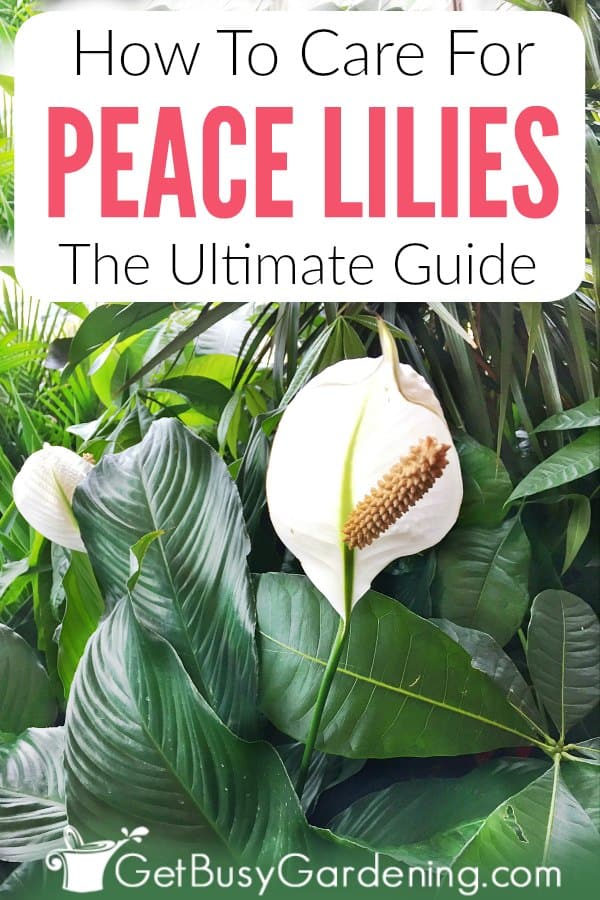




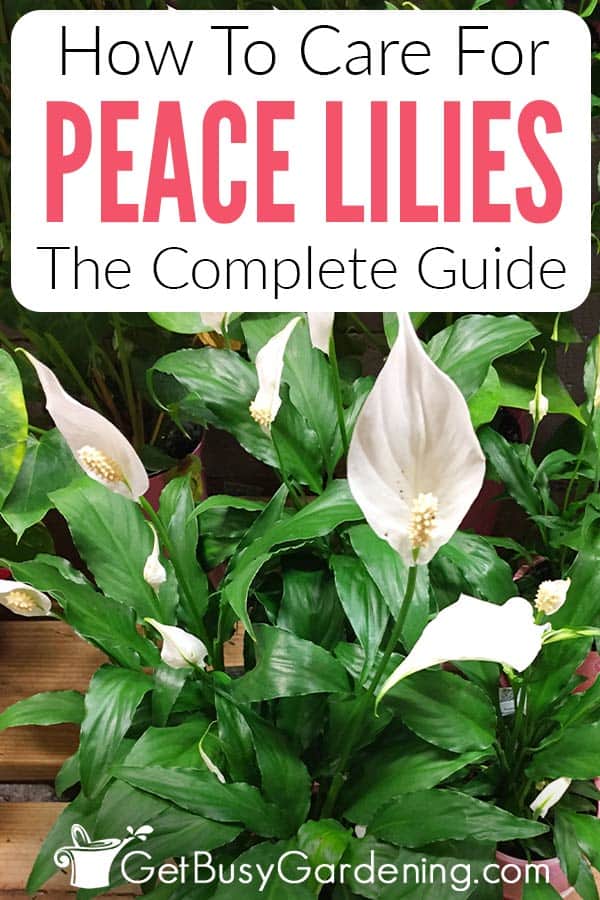
Peace lilies are by far one of the most popular houseplants to grow because they are low maintenance and fairly easy to care for.
They can be a bit fussy though, so it’s very important to understand what they need to thrive. Once you get the hang of it, you’ll be able to enjoy them for many years to come.
In this complete care guide, I’ll show all you need to know about how to grow peace lily plants. Including details about water, soil, light, fertilizer, pruning, flowering, propagation, pest control, and much more.
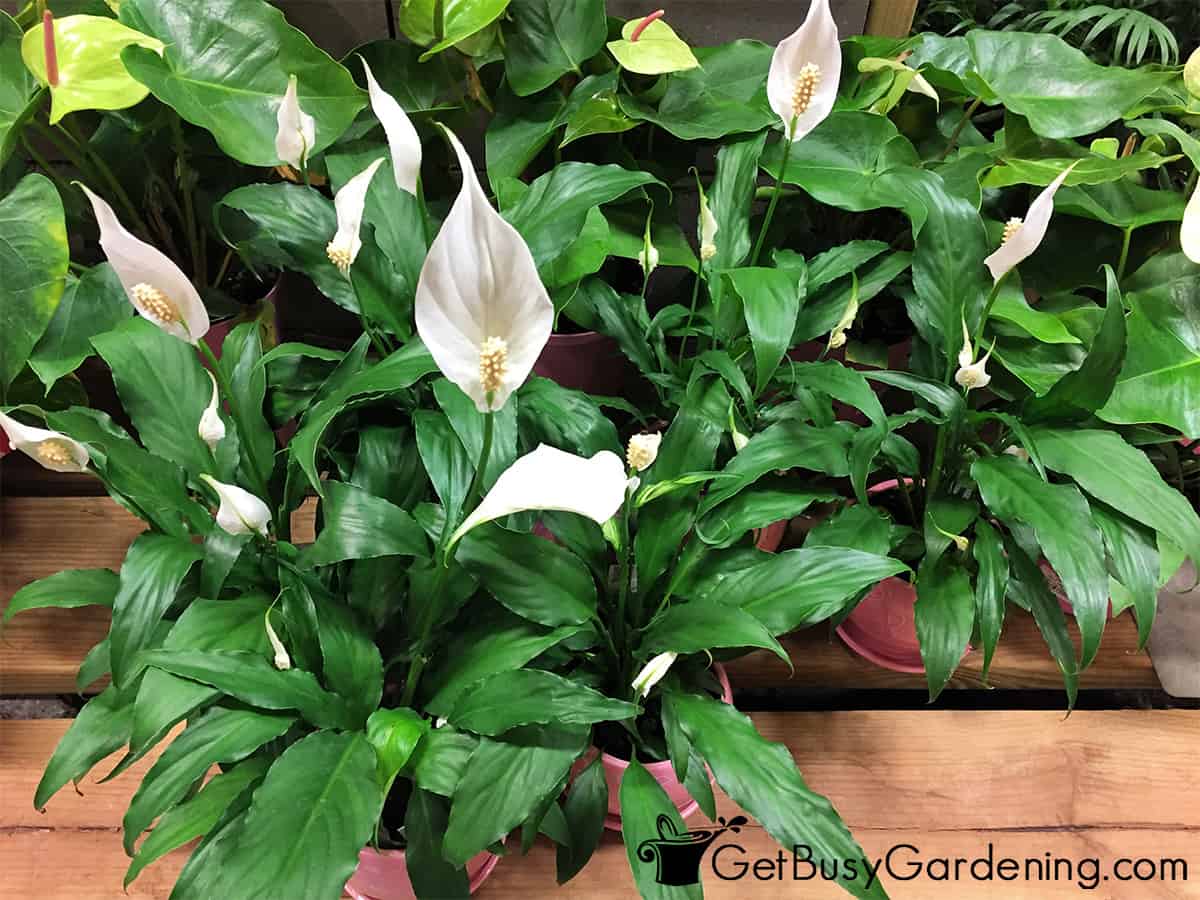

Quick Peace Lily Care Overview
| Scientific name: | Spathiphyllum |
| Classification: | Tropical plant |
| Common names: | Peace Lily |
| Hardiness: | Zones 11+ |
| Temperature: | 65-80°F |
| Flowers: | White, can bloom year round |
| Light: | Full to partial shade, bright light indoors |
| Water: | Keep soil evenly moist, do not overwater |
| Humidity: | Average to high |
| Fertilizer: | General purpose plant food spring-summer |
| Soil: | Fast-draining, fertile soil |
| Common pests: | Spider mites, mealybugs |
Information About Peace Lilies
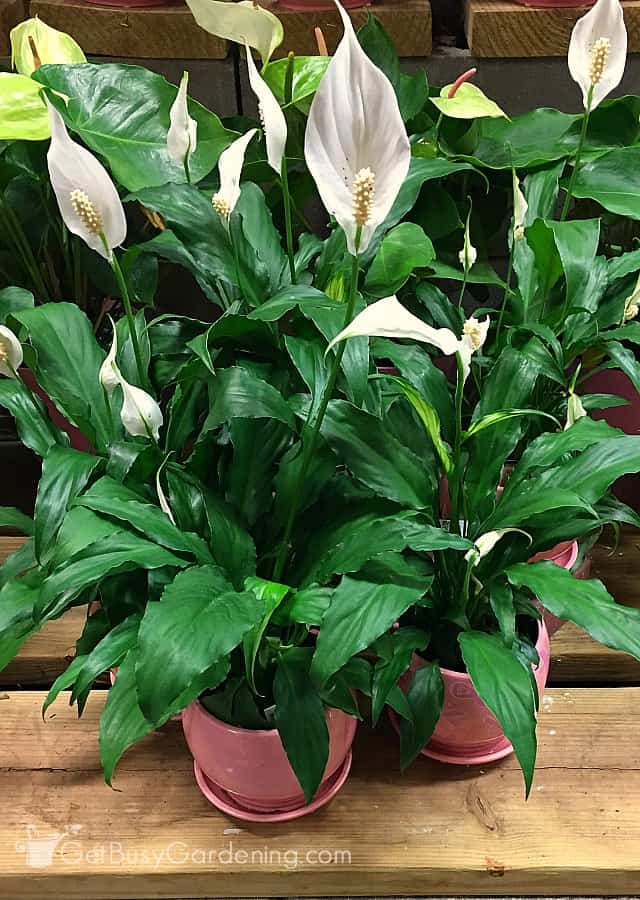
The peace lily (Spathiphyllum) is a very common indoor plant with lovely green leaves and stunning white flowers. It’s in the Araceae family, along with dieffenbachia plants and Chinese evergreens.
Though they are native to the tropical areas of North and South America and parts of Asia, they can easily adapt to growing indoors.
Commonly gifted as sympathy plants, they’ve gained a lot of attention in the past few years because they are air purifying houseplants.
Different Varieties
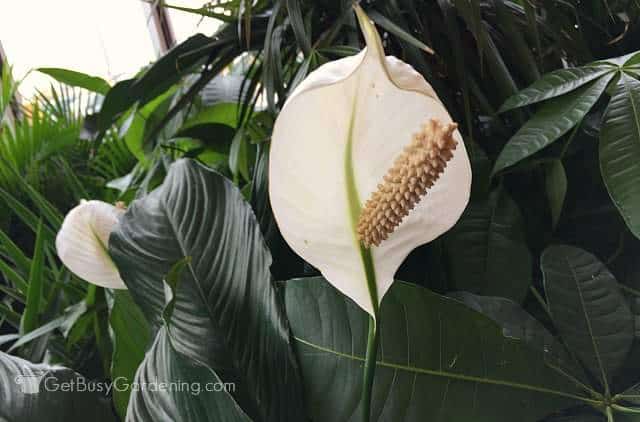
There are several different types of Spathiphyllums, and they all require the same care. They look very similar to each other, but come in a range of sizes and foliage hues.
The sizes can be anywhere from the small varieties that only grow to be a few feet tall, to huge floor plants that are several feet tall. The leaf colors range from very dark to light green, or variegated.
Toxicity
All parts of the peace lily plant can be harmful if eaten. According to the ASPCA, they are toxic to cats and dogs.
If you have pets or small children around, then it’s best to keep this one out of reach. Otherwise, if you don’t want to risk it, check out my list of pet friendly houseplants.
Flowers
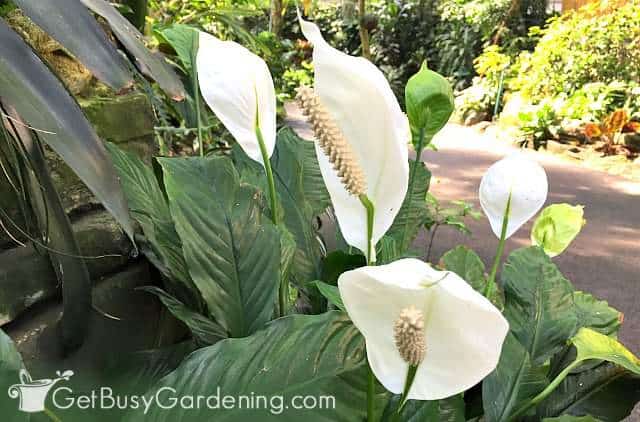
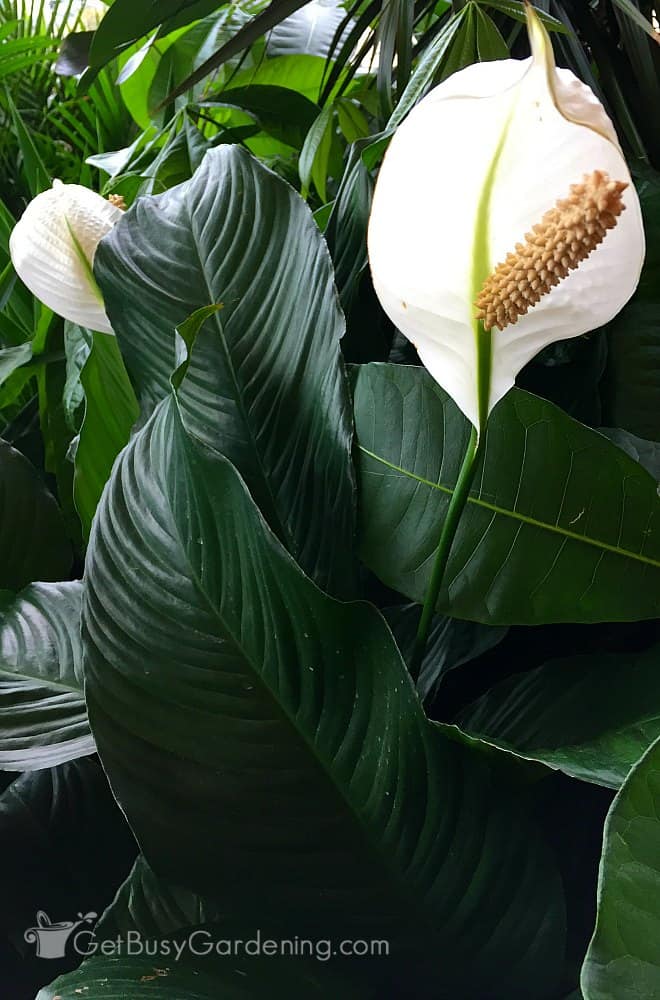
Most peace lily plants will bloom from spring through summer with the proper care. They are prized for their distinctive white flowers that stand above the foliage on tall stems. It’s the feature that most people recognize first.
They need lots of bright, indirect light to bloom. Once they’re done flowering, they usually have a rest period during the fall and winter months.
Peace Lily Care & Growing Instructions
Growing a peace lily isn’t difficult, but it’s important to give your plant the proper care so it will stay healthy and happy. Follow my detailed tips below for the best success.
Water
Proper watering is one of the most important parts of peace lily care, and giving them too much is their #1 cause of death.
They prefer to dry out slightly between waterings, and won’t tolerate wet feet for long. Push your finger 1-2 inches deep into the soil. If it feels damp, then don’t add anymore water. Use a moisture gauge to make it easy.
When it’s time, give your plant a deep drink, and allow the excess to drain completely out of the bottom of the pot – never leave it soaking.
It’s important to note that peace lilies are sensitive to the salts and chemicals in tap water. These additives can cause yellow or brown leaves, tips, and margins. So use distilled, filtered, or rainwater on them if you can.
Humidity
Since they come from tropical areas, peace lilies like a lot of humidity. They can adapt fairly well to lower levels, but extremely dry air will cause brown leaf tips and edges.
You can increase it by running a humidifier nearby or misting the leaves regularly to see if that fixes the problem.
Light
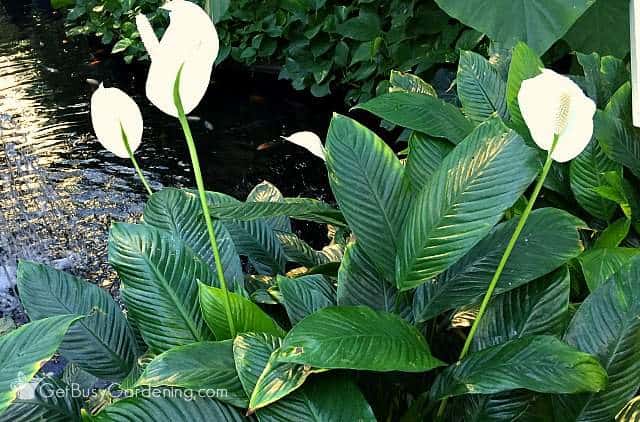
Peace lilies make great low light houseplants because they actually don’t like any direct sunlight. Too much sun will cause the leaves to fade, turn yellow, and/or burn.
However, they won’t grow well or bloom if it’s too dark. They need bright light, and filtered or indirect are the best.
Somewhere near a bright window or in a sunny room would be the perfect spots. If your home is too dark, then you can add a grow light.
Soil
Peace lilies aren’t fussy about the type of soil you use, any high quality general purpose mix will work just fine. But they do prefer one that drains well.
If you tend to overwater, you can mix in some perlite, pumice, or coarse sand to increase drainage. They also like it slightly acidic, between 5.8 and 6.5 is a good range. You can use a probe tool to test it.
Repotting
Another thing that makes a peace lily so easy to care for is that they like to be pot-bound. In fact, they really hate being repotted.
So you should only repot yours if it’s absolutely necessary. When the time comes, it’s best to do it in the spring.
Also, make sure the new pot isn’t much bigger than the old one. They don’t like having too much space, so you should only go up one or two sizes. And always be sure to use a container that has drainage holes in the bottom.
Fertilizer
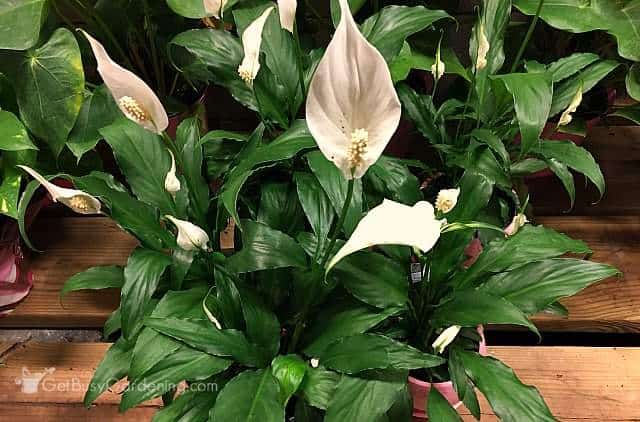
Peace lilies aren’t heavy feeders, but you should fertilize your plant a few times during the spring and summer months to encourage fresh new growth and flowers.
However, they are very sensitive to synthetic fertilizers. These harsh chemicals can cause major problems, like burning the roots, or making the leaf margins and tips turn yellow or brown.
I recommend using organic products instead. A few of my favorites are liquid compost tea, indoor plant food, or general purpose granules.
Tips For Controlling Pests
Healthy peace lily plants rarely have problems with bugs. But sometimes spider mites or mealy bugs can attack them.
If you find these pests, treat the leaves right away. Organic neem oil is a natural insecticide that is very effective at getting rid of them, and I highly recommend it.
Soapy water spray is also great for controlling pests. You can buy an organic insecticidal soap, or use a mixture of 1 teaspoon mild liquid soap per 1 liter of water.
Related Post: How To Get Rid Of Houseplant Bugs Naturally
Pruning
To keep your plant tidy and looking its best, you can prune it as part of your regular peace lily care routine. Here are some pointers:
- Remove brown leaf tips and edges by trimming them at an angle following the natural shape of the leaves.
- Cut dead or dying foliage all the way down to the base of the plant.
- Prune out faded or brown flowers and stems to help encourage more blooms.
Peace Lily Propagation Tips
The only way to propagate a peace lily is to divide the rootball. To do this, remove it from the pot and gently untangle the roots – carefully working to separate the offshoots from the main plant.
If the rootball is really thick and dense, you may need to use a knife to cut it apart. Just be sure that each individual stem has roots, or it will not survive on its own.
Troubleshooting Common Problems
Peace lily care can be a bit daunting when your plant starts having problems and you don’t know why. Here’s a list of some of the most common issues, and tips for how to fix them:
Plant Is Drooping
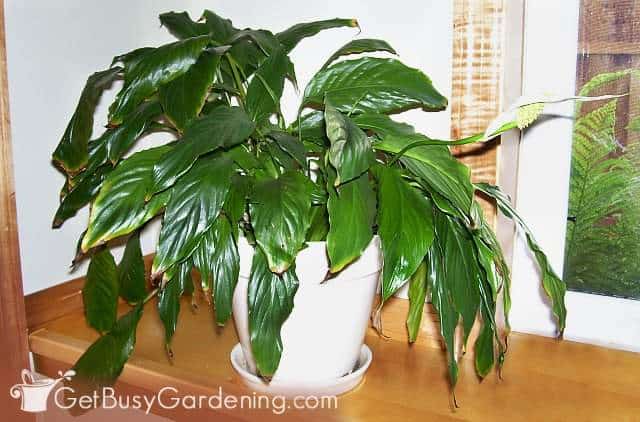
Drooping is usually caused by over or under watering. But it can also be from sudden changes in temperature, or transplant shock after repotting.
If you recently moved it to a new pot, it should recover in a few days. Otherwise, check the soil and only water if it’s dry. Move the plant if it’s in direct sun, near a heat source, or exposed to a cold draft.
Leaves Turning Yellow
It’s normal for the older bottom leaves to turn yellow as they die, so you can simply prune those off. But if others are yellow, or there are several of them that turn at once, then it’s probably from overwatering or bugs.
Inspect the leaves for pests, and check to make sure the soil isn’t overly wet. It should dry 1-2″ deep between drinks.
No Flowers
The most common cause of a peace lily not blooming is inadequate lighting, they need bright light to flower.
Feeding your plant during the spring and summer, and regularly deadheading spent flowers will also help encourage blooming.
Brown Leaves Or Leaf Tips
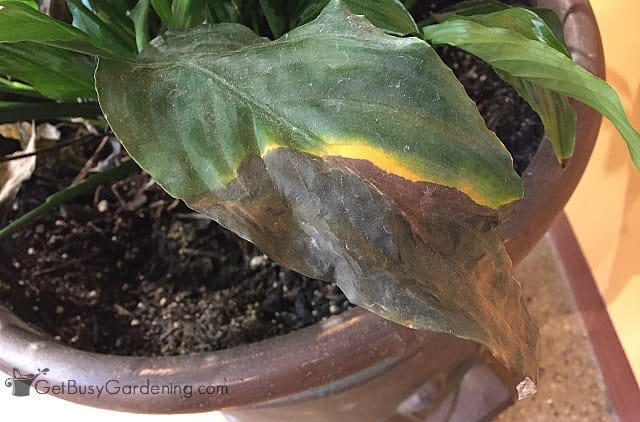
This is almost always caused by improper watering, lack of humidity, or chemical damage from using tap water or synthetic fertilizers.
A yellow or white crust on top of the soil or around the inside pot edges are telltale signs of a salt or chemical buildup. Try using distilled, filtered, or rainwater instead, and switch to an organic fertilizer.
FAQs
Peace lilies can only live outside year-round in the warmest most tropical climates of zones 11+. They are extremely sensitive to cold weather, so if you choose to put yours outside during the summer, be sure to bring it back indoors before it drops below 65°F.
The most common cause of death for peace lilies is overwatering. The soil should dry 1-2″ deep, and never feel wet or saturated. Other common reasons are from chemical fertilizer burn, or prolonged exposure to hot or cold drafts.
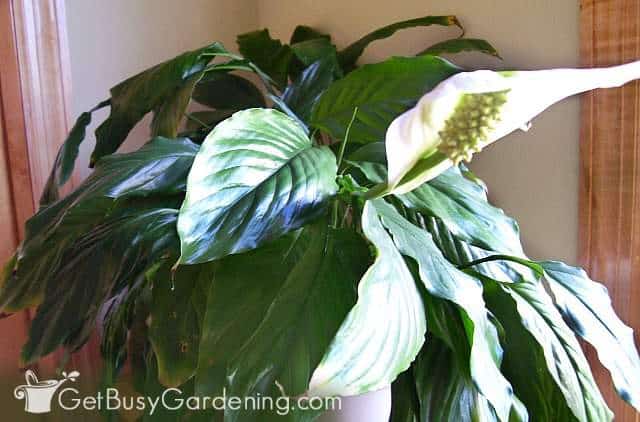
Now that you’ve learned exactly how to care for a peace lily, you’ll be able to enjoy your plant for many years to come. I know it can seem overwhelming, but you’ll get the hang of it in no time.

If you want to learn all there is to know about maintaining healthy indoor plants, then you need my Houseplant Care eBook. It will show you everything you need to know about how to keep every plant in your home thriving. Download your copy now!
More Plant Care Guides
Share your peace lily plant care tips in the comments section below.

Plant Lover says
HELLO Amy,
Can I use water that I have filtered through charcoal and a coffee filter to water my peace lily. Hopefully this will promote good health for my peace lily.
Amy Andrychowicz says
A charcoal filter won’t remove softener salt from the water, which is one of the main things that can damage peace lilies over time. So, if you use water softener salt, then you’ll need a filter that will remove that from the water too.
Plant Lover says
Help my peace lily leaves are getting yellow and some are turning brown, I water it when it starts drooping, I have not added any soil since I got it 2 yrs ago for my son’s funeral, do I need to add soil, I fertilized it over the summer.
Amy Andrychowicz says
Peace lilies are very sensitive to chemical fertilizers. So, if you used a synthetic type (rather than organic), that is probably what’s causing the leaves to turn yellow and brown. Same goes for the type of water you use, as they can be damaged by the salts and chemicals in tap water. Switch to using filtered water and natural/organic fertilizers, and your peace lily will be much happier! 🙂
Araelia says
Hi Amy! My friends got me a peace lily for my birthday. The way I was taught to water flowers is to take them out of the decorative pot, put in the sink and water until water comes out the other side, then leave for 30-60 minutes before putting back. This lilly came in such a tiny decorative pot that in the end I had to take the lilly by the roots to be able to remove the nursing pot. Even the nursing pot seems tiny (can’t really stick my finger an inch in the ground) but then I read that they prefer to be root bound. Should I just buy a bigger decorative pot or repot it? Thanks in advance. The article above has been really helpful.
Amy Andrychowicz says
You’re welcome! If your peace lily is so pot bound that the roots are taking up most of the pot (not much soil left), then I would pot it up into a container that’s one size larger than the current one. You are correct, the do like to be pot-bound. So don’t go too large with the new container.
JODI says
I have a Peace Lily from my sisters funeral. It is doing great, it has had a lot of flowers, but they stay below the leaves and hide. is there a reason for this?
Amy Andrychowicz says
It’s really nothing to worry about, some peace lilies have differing flower heights. If yours is fairly new, that could be the cause. Growers use a lot of chemicals to get plants to bloom before they go out to the consumer. So it may be that your peace lily is weaning itself off the chemicals, and that’s what’s causing the irregular, low/short flowers. I expect that it will go back to normal once it becomes acclimated to living in your home.
choctawmaiden says
How do you get a peace lily to grow more flowers? I’ve had mine about two months and I bought it at a grocery store. It’s beautiful! Has many new green leaves but only two new flowers. I diluted some Miracle Grow plant food and fed it a few days ago. Also to water it I use filtered water from the refrigerator and let the lily sit and drink as it wants too. Are any of these reasons for not having many flowers?
Amy Andrychowicz says
Peace lilies in the store are forced to bloom before they go on the shelves, because blooming plants sell better than non-blooming ones. 🙂 That causes their normal flowering schedule to be out of wack for a while after they are brought home. It will likely take your plant several months before it’ll bloom again on its normal schedule. So you may not see any new flowers until next spring/summer. See the section titled “How To Make A Peace Lily Bloom” in the article above for more details.
Eve says
Hi. My name is Eve. I have more then one peace lily plant. They all do and look different. I try to water them when that get a little drooping. One of them I flush it out with Bottle of water. Waiting to recover. My other one I’m trying to water with mixture of egg shells and water that been sitting for at list 24h. My third one is pretty close to the humidifier which I have been using now almost on regular basis and that seems to help. My biggest issue is the one that I have in my job it’s keep getting loose from the roots and it’s in the extreme big pot. So I’m planning to repot it but it also has a lot of small plants on the bottom of it. The other issue is the leaves turning brown and keep hanging. If you can give me any tips I would appreciate it. ?
Amy Andrychowicz says
I would definitely repot the one that’s loose in the large pot. Put it into a smaller pot, one that is just slightly larger than the rootball of the plant. Good luck, hope it recovers!
Plant Lover says
Hi Amy,
I’m HEARTBROKEN, rat found it’s way into our house (I’m a good housekeeper, no trash lying around, no dirty dishes????) actually 2, one we trapped, anyway, the other one we have trapped in my office/craft room with door closed. Well that MEAN rat ate the leaves off of my peace lily, that was from my Mom’s funeral six years ago, wasn’t growing very well until I asked for your advice, leaves were small but after your advice was doing well, leaves were growing and thriving, don’t know if it’s poisonous to a rat, it also got into a poinsettia. Will the leaves grow back, the rat just bit them off. This part is kind of funny I had candy canes left over from making Christmas stockings, first rat started to eat one, wanted to make sure that was the only one on the house. left one on the floor on purpose, next morning it was gone SERIOUSLY !!
Amy Andrychowicz says
OMG, that is terrible!!! I am so sorry you’re going through that, YUCK!! If all of the leaves were eaten off of your peace lily (and any other plants), then it may not recover. All you can do is continue caring for it as you normally have been doing, and hope for the best. Time will tell
On a side note: I’m happy to hear that your peace lily was recovering after following my tips, that’s wonderful news! The fact that is was growing well before being eaten also means it has a better chance to recover after being eaten. GOOD LUCK!
Plant Lover says
Thank you Amy, will do. Do you think adding fertilizer to my peace lily, would promote new growth?
Amy Andrychowicz says
I would definitely recommend holding off on fertilizing your peace lily until it starts to recover. Once some new leaves begin growing, then you could give it a light dose of fertilizer. But be careful, because fertilizing an already weak/stressed plant can cause shock, and end up being fatal.
Nancy Reever says
I have a peace lily in a vace with water that I used to have a betta fish living. Do these lilies not like growing in water? The leaves keep turning brown & it doesn’t bloom.
Amy Andrychowicz says
Though peace lilies can survive in water for some time, it’s definitely not ideal. I would treat growing them in water as more of a fun experiment, rather than a long-term way to grow peace lilies. If you want to keep it looking its best and see it flower, then I would pot it up into soil. Keep in mind that when a plant grows in water for a long time, it will take some time for it to get used to living in soil again. So, I expect that your peace lily will go into shock, and likely droop for a long time after being potted up. Just baby it, and don’t overwater it during that time. Good luck!
Poulami Majumder says
Hi Amy. Thanks for the article. I’ve a Peace lily 4 months old. I’m trying so hard to care for it to keep it from dying. I’m not sure if i’m over watering or not giving it enough water. Tips of the leaves get brown, the leaves are droop, and then the entire leaf dies. starting with the old growth. It is an indoor plant. I have tried changing water. Please HELP! Thanks.
Amy Andrychowicz says
The best way to tell if you’re over or under watering your peace lily is to stick your finger one inch into the soil. If it feels wet, then you’re probably overwatering it. You could also use a soil moisture gauge to help you get it right.
Elizabeth says
Hello there ? I have a question about my peace lily. My husband bought me one for mother’s day this year and the flowers didn’t last long. I placed it outside and the plant started greening,then drooping Browning and yellowing. Now I’m noticing that in the dirt further are bulbs that are green and clustering together. I don’t know what to do here.
Amy Andrychowicz says
My guess is that your peace lily is suffering due to improper watering, chemical fertilizer burn, and/or a change in temperature. They can be pretty fussy, and many of the signs you describe could be caused by several different issues, or a combo of things. Check out the section above titled “Troubleshoot Common Peace Lily Problems” to see if you can figure out the issue(s). I’m not sure what you mean when you say “…bulbs that are green and clustering together” though. Peace lilies don’t have bulbs. Perhaps those are new leaf clusters?
JoAnn Elmore says
Does a peace
Illy need potassium as a fertilizer?
Amy Andrychowicz says
Yes, potassium is an ingredient in any well-balanced fertilizer, and every plant needs it. I made several recommendations for types of fertilizers in the section above called Fertilizer For Peace Lily, so give that a read.
Sharon Van Zyl says
I have found that rooibos tea that is left in the teapot is like food. I let it cool down, well the bit that is left over and the i open the teabags and i pour the tea into the peace lily’s pot.
Amy Andrychowicz says
Awesome, thanks for sharing your tip for fertilizing your peace lily! 🙂
Didi says
Great guide! I’ve yet to get my Peace Lily to bloom. I didn’t even think about changing its lighting! I was only fertilizing it. Thanks for the tip! I also didn’t know how sensitive they were to unfiltered water. I’m gonna try both of these tips out and we’ll see how it goes. 😀 Thanks!
Amy Andrychowicz says
Awesome, you’re welcome! Hope your peace lily will bloom for you!
Angela says
Hello! This article is very helpful! Thank you! I do have a question about my Peace Lily though. About 3 months ago, I repotted it from the temporary pot it was in when I purchased it. Pretty soon after it started to act sick (probably shock) but it still hasn’t recovered. It’s not dead for sure but it doesn’t look well. I read through your article and realized I did not put it in a pot with drainage holes. So it’s probably not able to fully dry out! How can I remedy this without sending it into shock? Or is the only solution to repot it again?
Amy Andrychowicz says
If your plant isn’t doing well, then I would not repot it just yet. Without drainage holes in the pot, you’ll need to really monitor the moisture level to ensure you don’t overwater your peace lily. I recommend getting a soil moisture meter to help you out. Once your peace lily starts to recover, I would repot it into a container with drainage holes. Keep in mind that they do like to be a little pot-bound, so don’t use too large of a container.
Alicia T. says
Hi Amy. Thank you for this article! I got a peace lily in 2017 and it did very well for a little over a year. Then the leaves started to turn brown. I repotted the plant but the leaves are very small now. Only about 3”. Is there a way to get my leaves to thrive again? I don’t want to lose this plant as it holds very sentimental value to us. Thank you in advance!
Amy Andrychowicz says
It could be that your peace lily is recovering from the shock of being repotted, and it can take a few weeks or more to recover from that. Otherwise, there are a few things that could be causing the smaller leaves: overwatering, lack of light, or lack of fertilizer.
Improper watering is the most common problem with peace lilies. They do like to be pot-bound, so if you repotted it into a large pot where it has a lot of room to grow, the plant can suffer, and it’s pretty easy to unintentionally overwater it. I would stick your finger into the soil at least one inch to check the moisture level (or keep it around 6 on a soil moisture gauge). If it’s really wet, then let it dry out a bit more between waterings. If it’s dry, then try watering it more often.
Though they are low light houseplants, they won’t grow well in the dark. So be sure your peace lily is getting some sunlight (bright, indirect light is the best).
They also benefit from being fed once and a while. So, if you’ve never fertilized it, you could try that. Do not fertilize it if it’s still recovering from transplant shock though. It’s also easy to burn them with the wrong type of fertilizer. See the “Fertilizer For Peace Lilies” section above for my recommendations.
Tash says
If I have made the mistake of planting my peace lilly in a way to big container (probably 2 years ago) would it be worth it to transplant into a smaller container, or just wait for it to grow into it. It has seemed to struggle since moving into the big container.
Amy Andrychowicz says
If it’s been struggling since you moved it into the larger container, then I would repot your peace lily into a smaller pot.