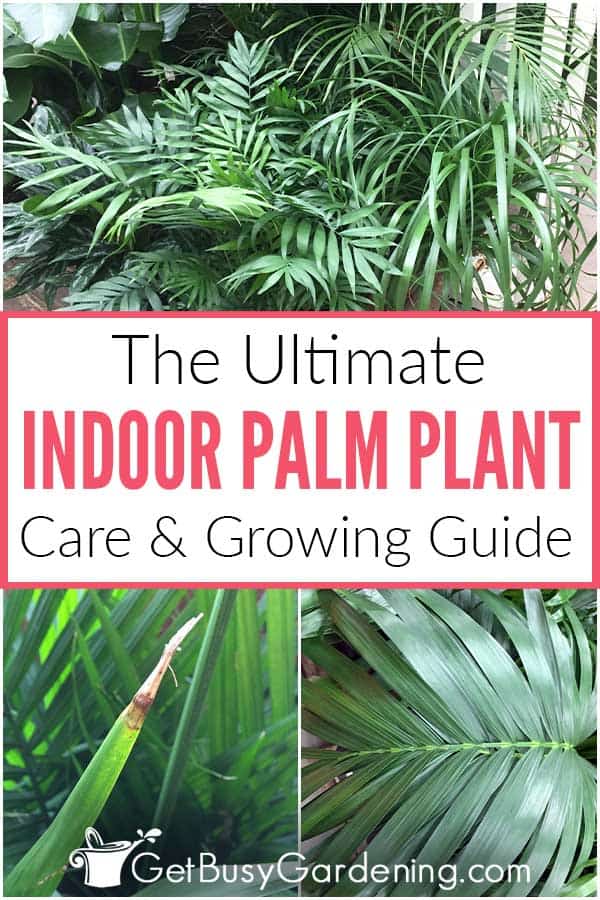
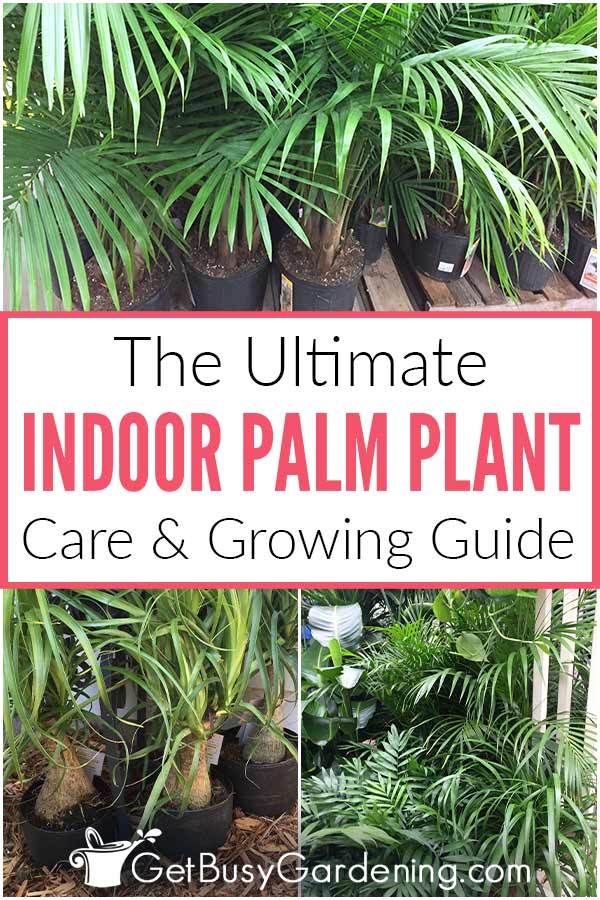
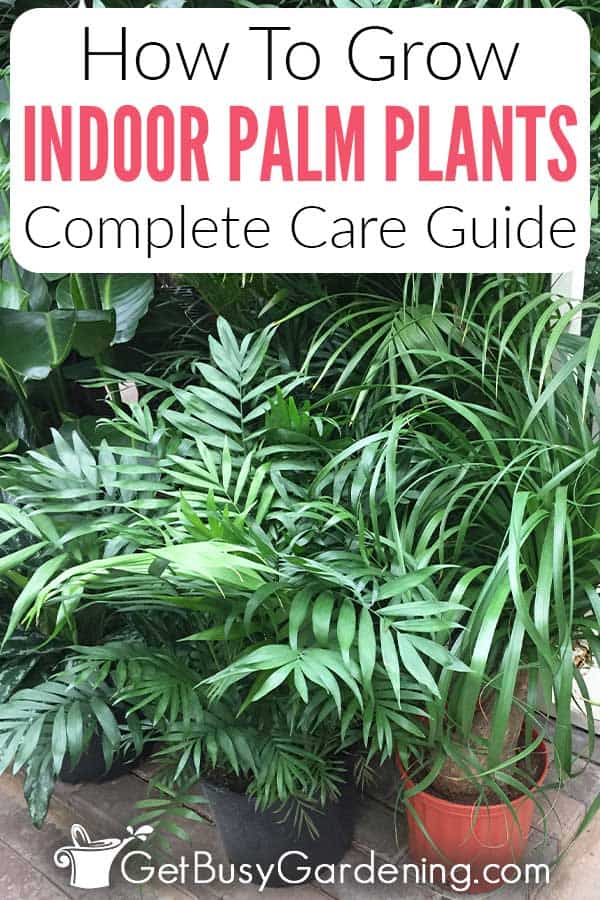
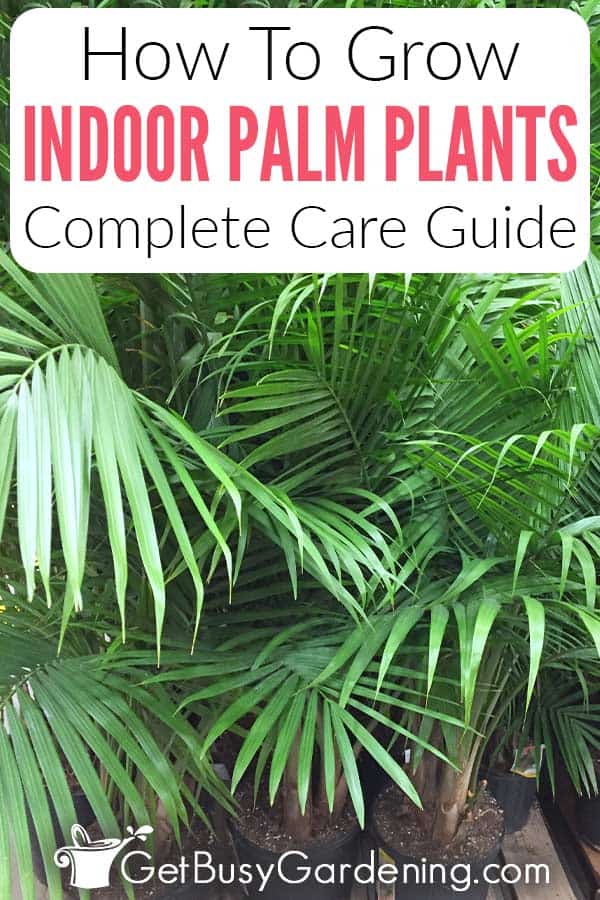
Palm plants add classic beauty to your home, and they’re easier to care for than most people think. They can thrive for decades as houseplants when you understand their needs.
Plus they’re fun to collect, and there are lots of benefits of growing them indoors. This detailed guide is designed to teach you all you need to know about how to care for palm plants indoors.
From water, light, fertilizer, and soil, to pruning, troubleshooting common problems, and pest control – everything you need is right here.

Benefits Of Growing Palm Plants Indoors
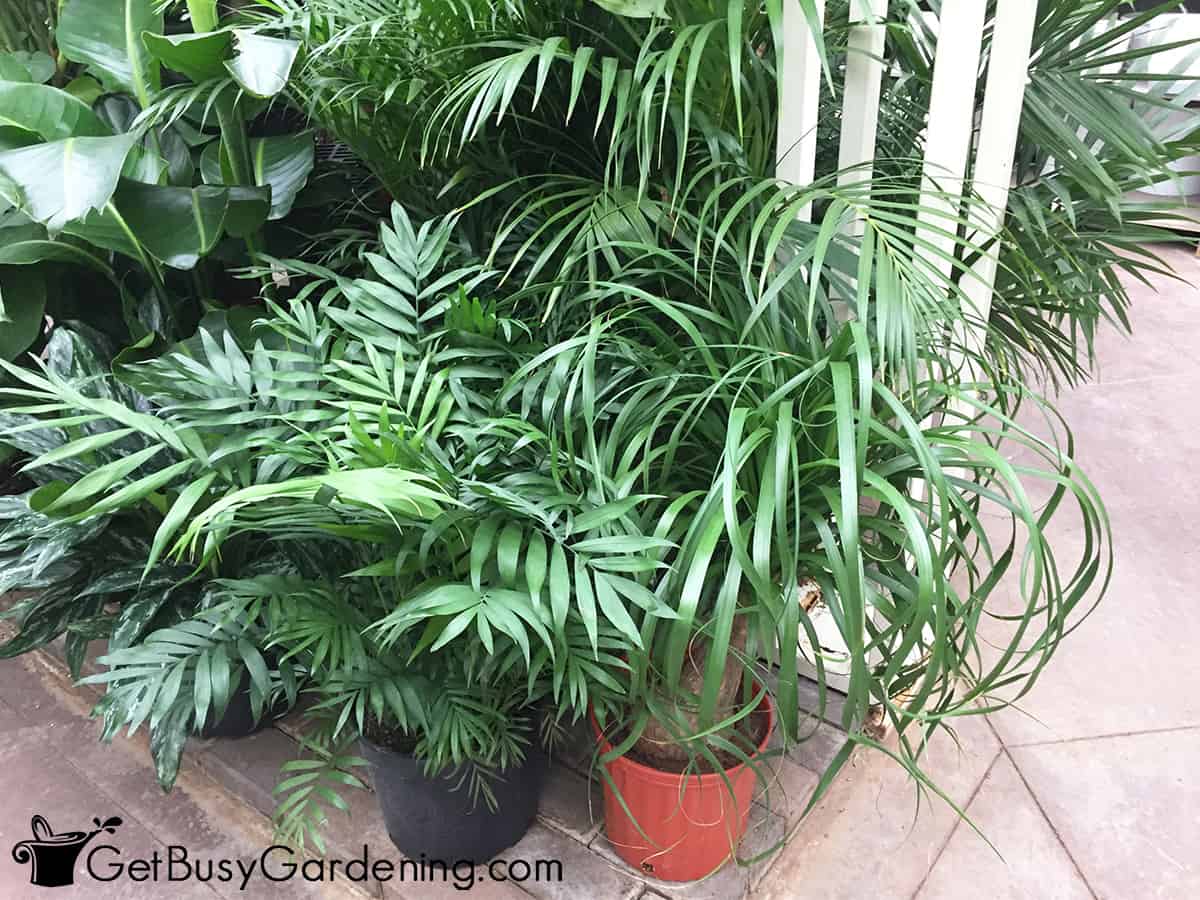
Growing palm plants and trees indoors is very popular these days, and they make excellent houseplants. There are lots of benefits of having them in your home too:
- Palm plants add a lovely tropical feel indoors
- They are tolerant of neglect, and will easily adapt to growing indoors
- Most of them don’t require a lot of light
- Some can help to clean the air in your home
- They can live for many years with the proper care
Different Types Of Indoor Palm Plants
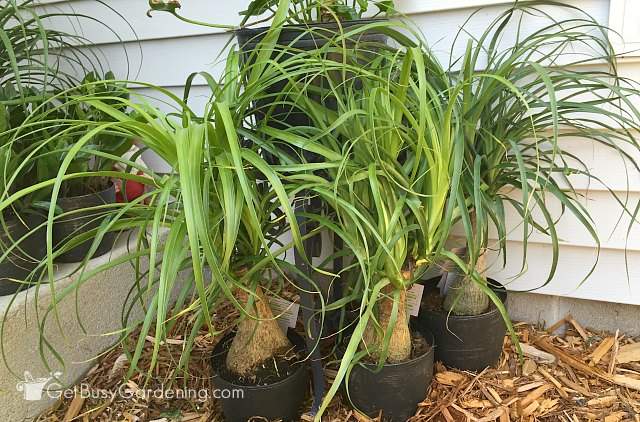
There are lots of different types of palm plants that can thrive indoors. Here are a few of the most common varieties:
Indoor Palm Plant Care & Growing Instructions
Even though there are tons of different varieties of indoor palm plants, they all require the same basic care to grow their best. Follow my tips below to help create the perfect environment for them.
Watering
Palm plants can tolerate being under watered, but they will grow their best with consistent moisture. Be very careful not to over water though, because this is their number #1 killer.
Only let the soil dry out slightly between waterings in the summer, to about 1″ deep. During the winter, you can let them dry out a bit more, or 1-2″ deep.
When it’s time, give your plant a deep drink and allow the excess to drain completely from the holes in the bottom of the pot. If you struggle with watering, I recommend buying an inexpensive moisture gauge to help you get it just right.
Light
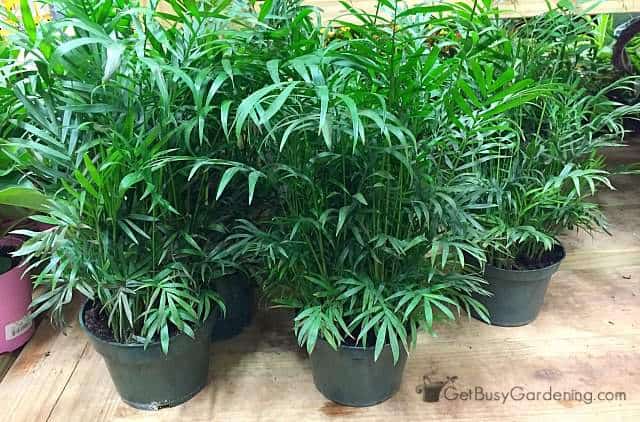
Palm plants can easily adapt to low light conditions indoors. Most of them need bright, indirect light, and their leaves can burn in the direct sun.
They won’t survive in complete darkness though, so if there’s no sunlight in the room, you’ll definitely need to add a grow light.
If you put your palm plant outside during the summer, make sure to keep it in the shade so it doesn’t get sunburn.
Potting Soil
When it comes to the type of soil to use, palm plants aren’t super picky. But the best potting medium for them is a loose, porous mix, such as a combo of peat moss, leaf mold, and shredded bark.
You can also buy a fast draining mix that’s specifically made for them. Otherwise they will do just fine in a general purpose one.
If you tend to forget to water your plants, then you can add some peat moss and/or vermiculite into the soil to help it retain moisture longer.
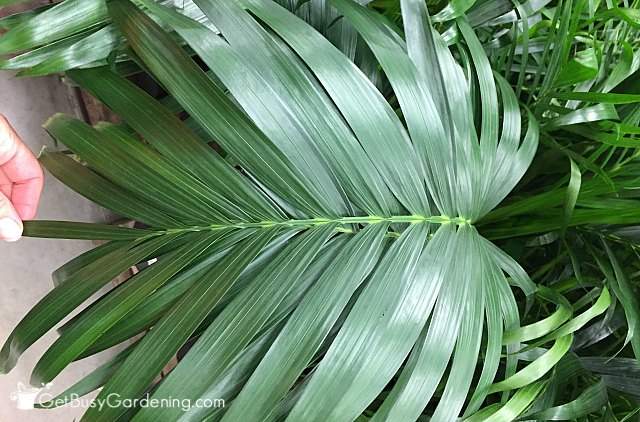
Fertilizer
While they don’t really need to be fertilized, indoor palm plants will benefit from being fed as a part of your regular care routine.
However, they are very sensitive to chemical fertilizers, which can cause brown tips and margins, or easily burn the roots. So it’s best to use an organic option. My favorites are Jobe’s, Espoma, and Dr. Earth.
Whatever type you decide to use, be sure to only feed your plants during the spring and summer, and stop during the fall and winter to give them a rest.
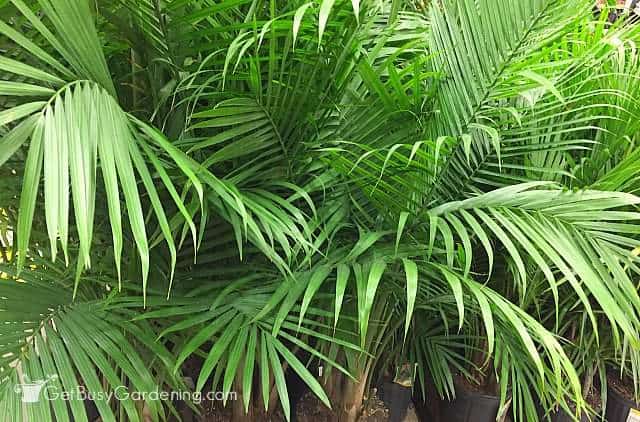
Pest Control Tips
Spider mites are the most common pest that attack indoor palm plants. Keep the humidity level high around the foliage to fend them off. Houseplant scale and mealy bugs can also become a problem sometimes.
If you find any bugs, begin treating them immediately to prevent them from spreading. I recommend using organic neem oil, which is a natural pesticide.
Insecticidal soap also works well, or you can make your own by mixing 1 teaspoon of mild liquid soap with 1 liter of water.
Related Post: How To Get Rid Of Houseplant Bugs
Pruning
You can regularly trim back your indoor palm plants to keep them looking nice, or to maintain their size and shape. Spring is the best time to do maintenance pruning or to remove long, leggy stems.
It’s common for the lower leaves to turn yellow or brown with age, and you can cut off those fronds anytime of the year using regular pruning shears.
Brown tips and leaf edges are also very common. To trim those off, use a sharp pair of bonsai shears or micro-tip snips.
Troubleshooting Common Problems
It’s usually pretty easy to care for palm plants indoors. But sometimes your plant will start to have problems, and you’re not sure why. Below are the most common issues you might run into, with my tips for how to fix them:
Leaves Turning Brown Or Yellow
It’s normal for the lower, oldest fronds to turn yellow, then brown, and eventually die. So you can just prune those off as part of your regular maintenance routine.
However, if the newer, top leaves are turning brown and dying, then it’s usually caused by improper watering (too much or too little), bugs, or lack of humidity.
Let the soil dry 1-2″ deep before watering again, and check your plant for any signs of bugs. If it’s very dry in your home, try running a humidifier in the room or mist the foliage.
Brown Tips & Margins
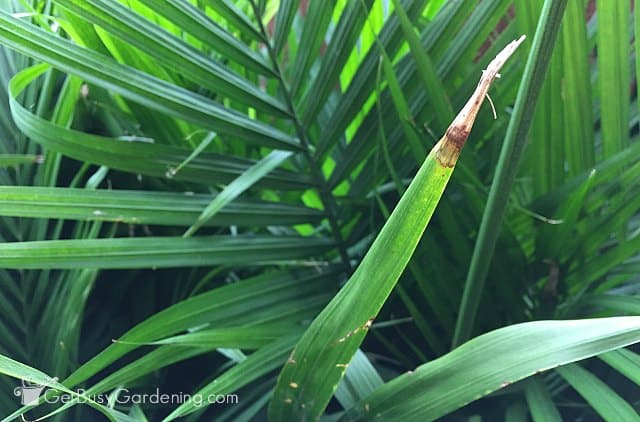
One of the most common problems that indoor palm plants have is brown leaf margins and tips. This is usually caused by lack of water, dry air, chemical fertilizers, or pests.
Check to make sure you’re watering enough, and inspect the leaves for bugs. Use organic fertilizer rather than chemicals, and try to increase the humidity level around the plant.
For some species, brown tips and margins are just a normal part of their life cycle, so it’s not always something you can fix. If they bother you, simply trim them off to keep your plant looking its best.
Indoor Palm Tree Is Dying
There are several things that can cause indoor palm plants to die. The most common one is overwatering, but it could also be a lack of humidity, or inadequate lighting.
The soil should dry slightly between waterings, and never be completely bone dry or soggy.
Ensure your plant gets bright, indirect sunlight, and increase the humidity level if it has brown tips.
Indoor palm trees and plants are very low maintenance, and will thrive for years when you give them the proper care. Follow the tips in this guide for the best success.

If you want to learn all there is to know about maintaining healthy indoor plants, then you need my Houseplant Care eBook. It will show you everything you need to know about how to keep every plant in your home thriving. Download your copy now!
Share your indoor palm plant care tips and advice in the comments below.

Vera says
Hello, I have 2 Pony tail palms. I’ve had both 25-30 yrs. The LG one was completely out growing it’s pot. I repotted it. However, I began having a problem with gnats. I’ve never had that before. With any of my house plants. I purchased the soil at Lowe’s. I’m not sure if they were already in the soil. But like I said. There were not any prior to repotting. I threw out that soil. Rinsed the ball of the palm, well. I let it stay in a pot without soil for a few weeks. It looked fine. I bought soil this time from a reputable nursery. Combined it with cactus soil. Once again, gnats! Only this time, the gnats were out of control. Every morning, we’d find a layer dead on our floor. Threw out that soil. I was told that the larve may still be in the roots of the ball. I have not bought any soil. It’s freezing in NY right now. I don’t trust the soil, so my poor plant is sitting in a pot without soil. But it looks great! I’m at a complete loss. Help!
Amy Andrychowicz says
Fungus gnats are a very common problem with indoor plants, and once you have them, it can be difficult to get rid of them. They thrive in moist soil, so try to keep your palm plants on the dry side (which is best for ponytail palms anyway). Since it’s freezing outside, you can leave the next bag of soil you buy outside until it’s frozen solid, that should kill any gnats that may be in there (just be sure to allow it to warm to room temperature before using it to pot up your palm plant!). But, like I said, if you already have gnats in your plants soil, then you have to take other measures to get rid of them in all of your plants. One great products that I recommend is GnatNix, which is a soil cover specifically made to kill the gnats. Here’s my detailed guide for how to get rid of fungus gnats.
Kathy Deer says
Hi,
I have a palm plant that has been doing great for probably 2 years. This morning, I noticed that the biggest stem was leaning over. As the day progresses, it is leaning farther and farther. I have had no problems with brown leaves, and it has been growing like crazy. It is in front of a somewhat leaky window. Could the cold weather we’ve been experiencing cause this? Seems unlikely to me as it has been colder and has never bothered it before. Any other thoughts?
Amy Andrychowicz says
If it’s just one branch on your palm plant, it might be that it was broken somehow. Maybe someone ran into it, or if you have a pet or kids, one of them accidentally broke it. That would be my guess. As long as the rest of the plant looks healthy. If that one branch is dying back, then I would just prune it off.
Mj Aus says
We’re experiencing the same issue. No kids or broken branch. Is this overwatering?
Amy Andrychowicz says
If it’s just one branch, and the rest of your palm plant looks healthy, then I would just prune it off. If the plant was overwatered, then it certainly could be the cause.
Dawn Manor says
I need help with an indoor Saratoga palm. When I purchased it about two months ago it had a lot of new growth in the top I have noticed the new growth is starting to brown and die can you please help I love this plantI’d be happy to send you some photos.
Amy Andrychowicz says
There are a few things that can cause palm leaves to turn brown and die. Since it’s new growth, I worry that you may be either over or under watering the plant. Stick your finger one inch into the soil to make sure it’s not soggy or bone dry. If it’s wet, be sure to allow the soil to dry out more between waterings. If that’s not the problem, then I would take a close look at the leaves to check for spider mites or some other type of plant bug. If it’s neither of those, then have you been fertilizing it? Brown leaves could be caused by fertilizer burn.
Marjorie says
I have been told that my parlor palm can’t be touching walls because the tips will turn brown. True or False.
Amy Andrychowicz says
I have never heard that before, but I can’t say for sure if it’s true or false. Sorry.
Stephanie says
I have just brought in 3 species of palm (elephant ear, European fan idk the 3rd). Anyway, I have set up grow lights (T5) in my warehouse for the winter, I have a few questions.
What temperature should I keep warehouse at?
How far should lights be from the plants?
How long should the lights be on?
Should I place a humidifier near them?
Thank you in advance
Amy Andrychowicz says
Congrats on your new palm plants, how fun! Since palms are tropical plants, they like a hot and humid environment. But, most types can grow just fine in normal indoor conditions. So, I would keep the temperature in the 70s (at minimum) if it’s possible (but they will do fine even if it gets down into the 60s, especially at night and during the winter). Ideally, the lights should be 6-8 inches above the plants, and leave them on 12-16 hours a day. Yes, a humidifier would be great, they would love that. Also, I’ve never heard of an elephant ear palm, I wonder if you have an alocasia species? Though, there are TONS of different varieties of plant trees and plants, so who knows. 😉
marilyn pawlowycz says
i have just brought a palm plant,a lady was selling hes in really good nick,so thaks for the info,on how 2 keep my new house plant.love it.
Amy Andrychowicz says
You’re welcome! Enjoy your new palm plant! 🙂
Amit Choudhary says
Hi I want to know Rexona palm is indoor or outdoor. When I bought Rexona Palm it was green but after few days start getting yellow. What it need sunlight or not.
Amy Andrychowicz says
I’m not familiar with a Rexona Palm, and I can’t find information about it online. Does the tag on the plant have another name, like a common name for your palm plant?
Jan Stock says
I just bought a majesty plan. Should I report it into a larger pot right away?
Amy Andrychowicz says
No, it’s best to wait to repot brand new plants until they have time to adjust to their new environment. Most palm plants can live a long time in the pots they come in. I would wait to repot your majesty palm until late winter/early spring. Here’s a post I wrote about this very topic… How (and when) To Repot Plants 🙂
Barry Howes says
What fertilizer do you use for indoor palm tree
Amy Andrychowicz says
Scroll up to the section that says “Fertilizer” for more details. My favorite brands of organic palm fertilizers are Jobe’s, Espoma, and Dr. Earth.
Sandra Polachek says
I am looking for information on an uot palm. I have one that is shooting very long, strange looking spires but I cannot find any information on this specific palm. Can you help or tell me where to look? Than you.
Amy Andrychowicz says
I’ve never heard of a “uot palm” before, sorry! Was that the name on the plant tag? Is “uot” an acronym of some sort?
As for the growth you describe, it sounds like your palm plant is flowering, how fun!
Asubonteng Godwin says
Please am from Ghana,and my question is can I bring out my palm plant out for while, because they always have brown tips and also grow lean as u know African weather is hot.
Amy Andrychowicz says
Yes, I move many of my palm houseplants outside during the summer months and they love it. Just be sure to keep it in a shady location or the sun could burn the leaves.
sierra says
hi amy! i have an indoor palm and it is doing quite well but i think it could be doingbetter! i was just wondering on average how much would you think i should water it? at the moment i probably water it like once a week? should i just check to see if the soil is moist and if not water it a bit? thank you 🙂
Amy Andrychowicz says
Yes, the best thing to do is check the soil every time you water your palm plant. Stick your finger at least an inch into the soil. If it feels wet, then don’t water the plant. A soil moisture gauge comes in handy to make sure you’re watering properly.
Don Cavanaugh says
I have a Indoor palm that is 25 yrs old,it’s beaufiful.I bought 3 small plants in 1993 and now it huge!!
Amy Andrychowicz says
Wow, wonderful!
Kathy says
I have a a indoor Palm given to me by my mother in 1986 or 87 it has reached the ceiling now .
sandra crow says
I put sunny deck,i ment to say shady deck!I’m deck is shaded.
sandra crow says
I love the parlor palm,i have three of them my son bought them for me about three years ago.They are doing great. They spend the winter indoors i don’t have to water them very often in the winter only about every two weeks.They are pretty and green,no brown tips.When the weather warms i take them out to my sunny deck,These are lovely plants and easy to care for.
Amy Andrychowicz says
Wonderful, thanks for sharing your experience!! Sounds like you’re doing everything right, that’s awesome!
Cindy Keller says
Amy, thanks for the wealth of information on the palm plant. We had one that we kept indoors but the leaves began to brown and dry over time. Did it happen because we watered too much? – my son had a habit of leaving too much water on the soil.
Amy Andrychowicz says
Sorry to hear your palm plant died. If your son was overwatering it then yes, I would guess that’s why it ended up dying. Who knows though, maybe it was spider mites, or the air was just too dry. You’ll know for next time. 😉