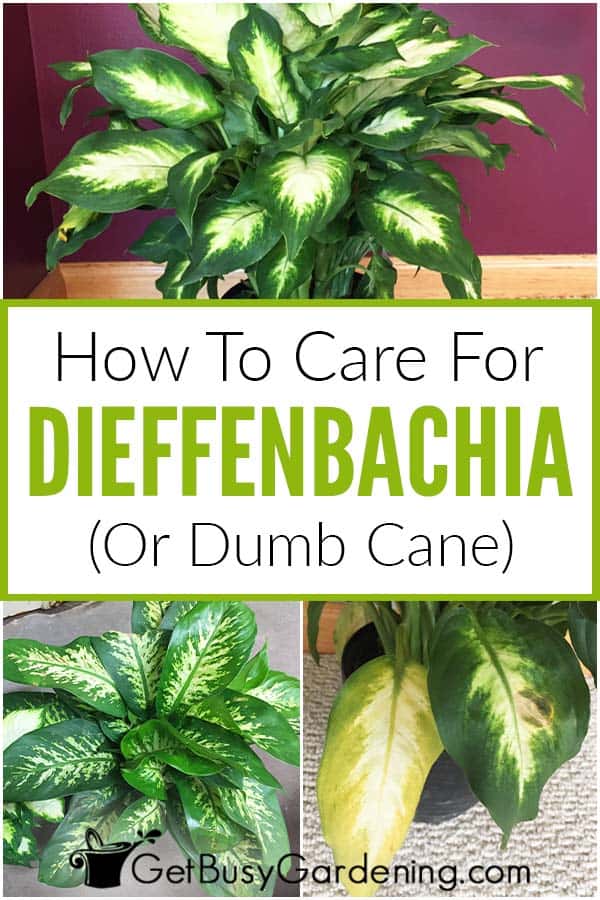
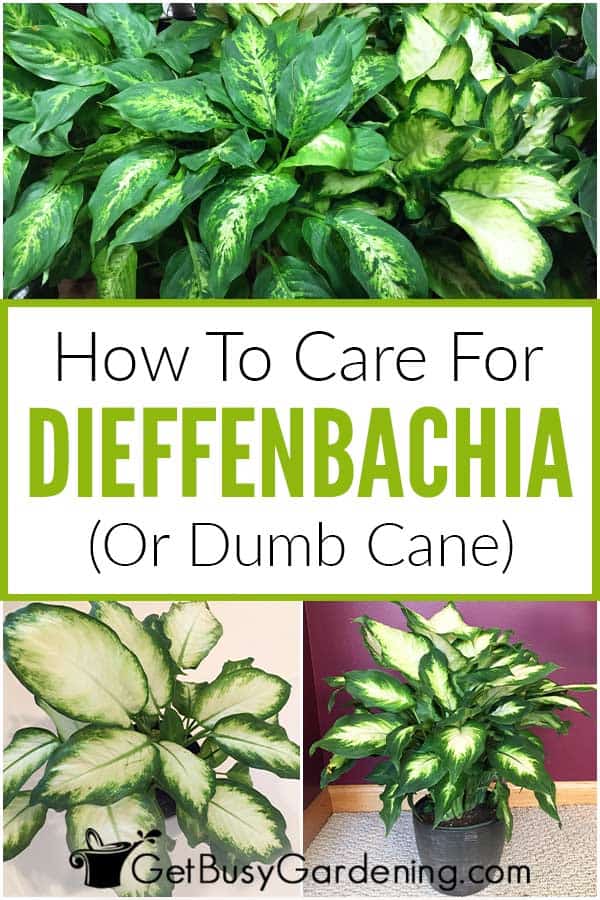
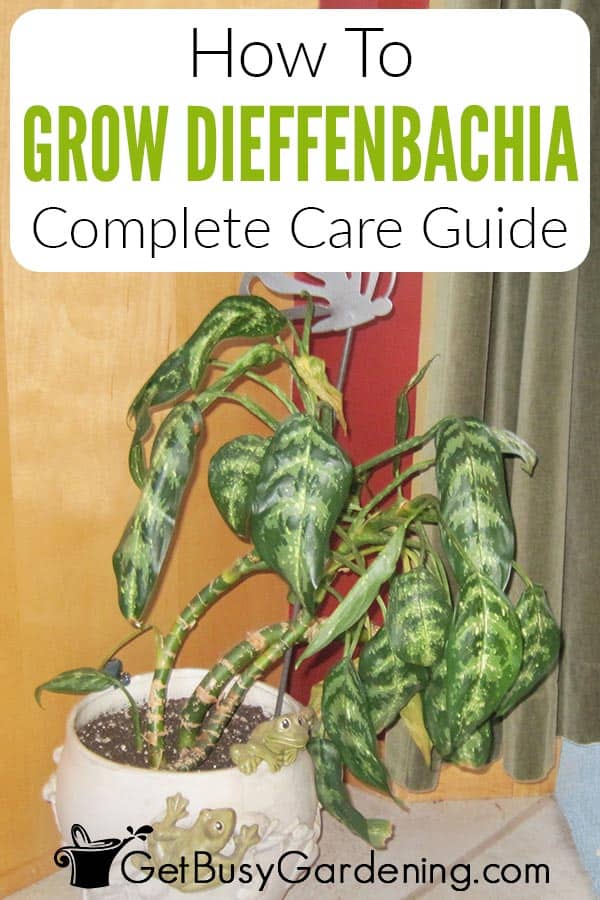
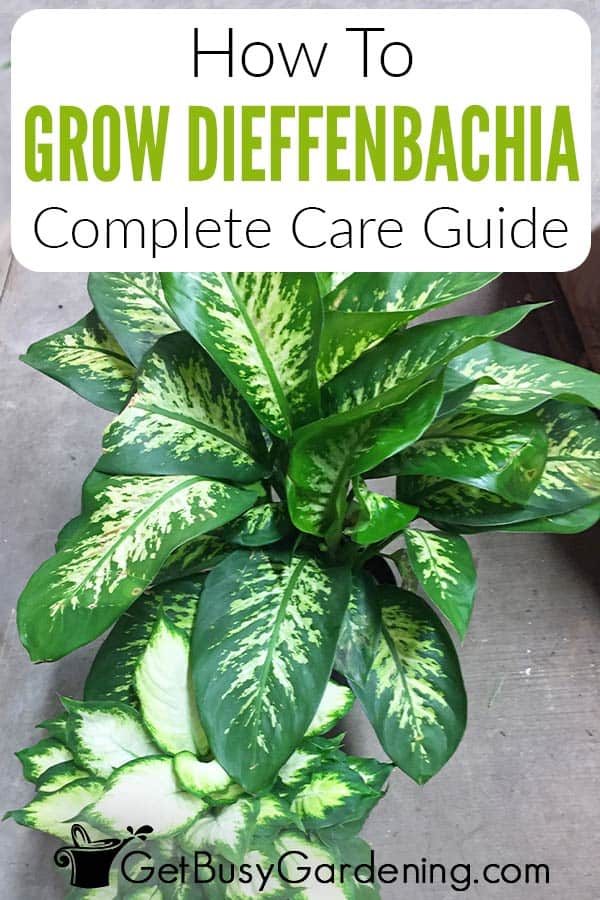
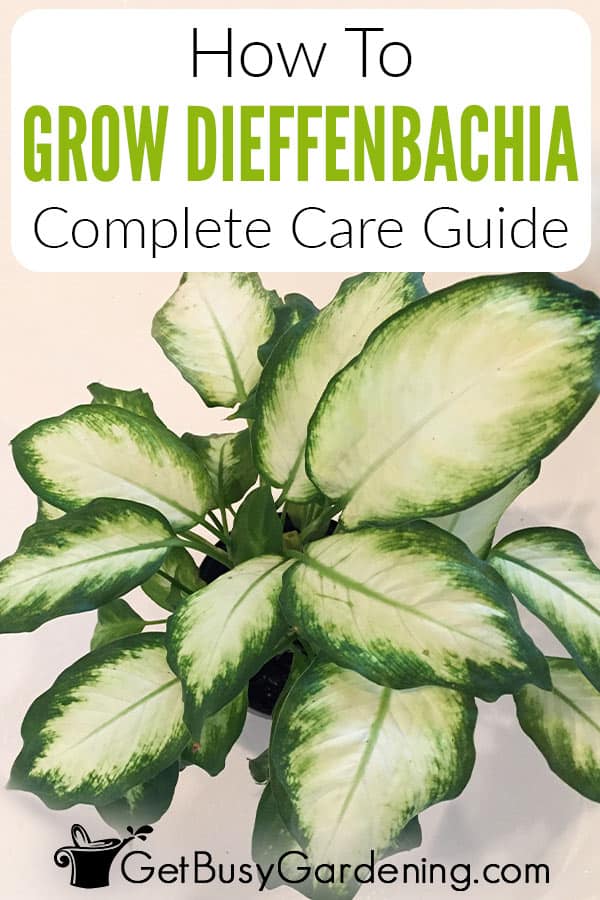
Dumb cane (Dieffenbachia) plants are low maintenance and don’t require any special care. Once you understand the growing requirements, you’ll be able to keep your plant healthy and thriving.
Though they aren’t super fussy houseplants, it’s important to understand exactly what they need so you can enjoy the lush foliage for many years to come.
In this complete care guide, I’ll show all you need to know about how to grow Dieffenbachia. You’ll find information about water, soil, light, fertilizer, pruning, propagation, pest control, and much more.

Quick Dieffenbachia Care Overview
| Scientific name: | Dieffenbachia |
| Classification: | Tropical plant |
| Common names: | Dumb cane, Dumbcane |
| Hardiness: | Zones 10+ |
| Temperature: | 65-80°F |
| Flowers: | Green, blooms spring-summer |
| Light: | Full to partial shade, bright light indoors |
| Water: | Allow soil to dry slightly, do not overwater |
| Humidity: | Average to high |
| Fertilizer: | General purpose plant food spring-summer |
| Soil: | Fast-draining, fertile soil |
| Common pests: | Spider mites, thrips, mealybugs |
Information About Dieffenbachia (Dumb Cane)
Dieffenbachia is a very common indoor plant that is prized for its beautiful foliage and simple care requirements. It’s in the Araceae family of plants, and is native to parts of Mexico, the West Indies, and South America.
It earned the nickname, “dumb cane”, because there is a chemical in the sap that can cause temporary loss of speech if any part of the plant is chewed or eaten.
Though they originate from the tropics, they make excellent houseplants because they can quickly adapt to growing indoors.
Different Types Of Dieffenbachia
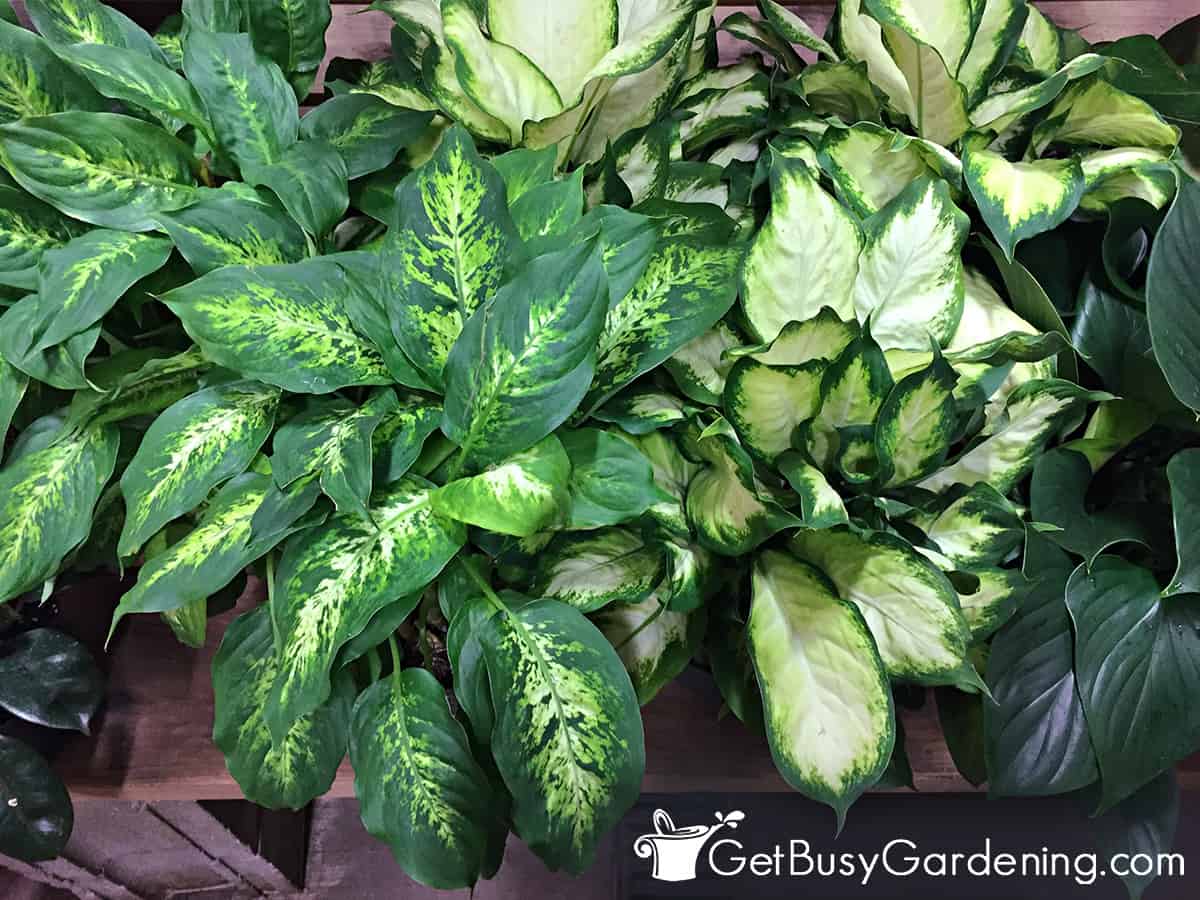
There are lots of different species and cultivars out there these days, and they’re all gorgeous. You can find dumb cane plants in various sizes and foliage colors too.
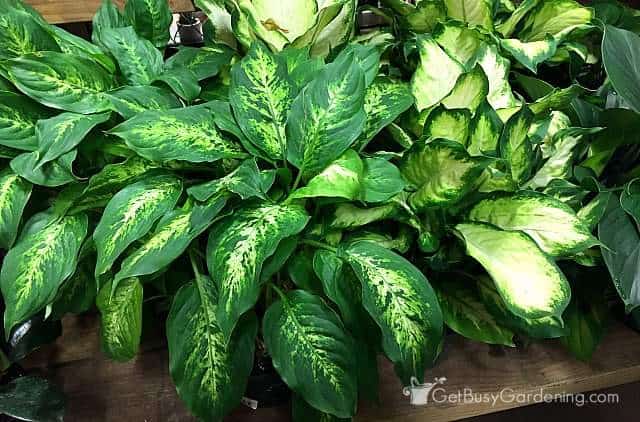
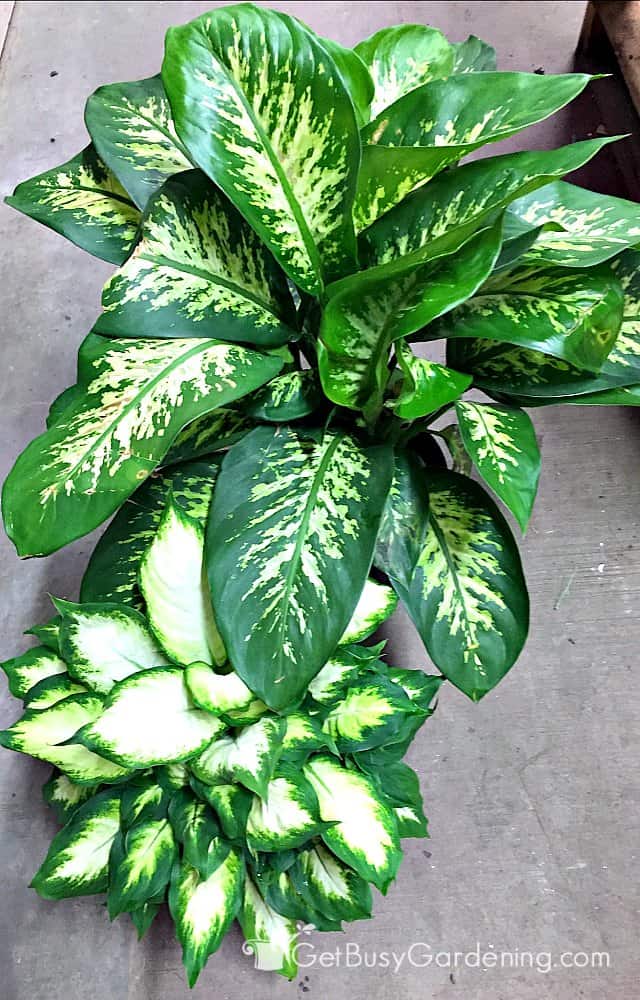
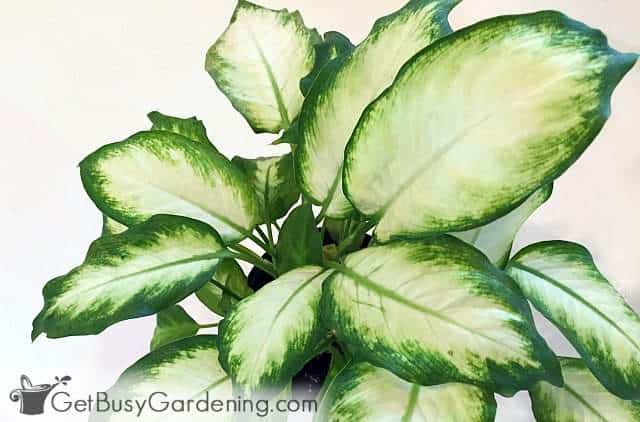
Some have large leaves, and can grow to be several feet tall, while others stay much smaller and more compact. The leaf colors vary by type, ranging from dark or bright green with whitish stripes or spots, to almost white leaves with dark edges.
Common varieties you may come across are Seguine, Compacta, Maculata, Golden Sunset, Camilla, or Amoena. Here’s a great list with more options.
Toxicity
All parts of the Dieffenbachia plant are poisonous when chewed or ingested. According to the ASPCA website, it is also toxic to cats and dogs.
So, if you have animals or small children, then it’s best to keep this plant out of reach, just in case. Check out my list of pet friendly houseplants instead.
Flowers
Though they are best known for their lush foliage, dumb cane plants can also bloom, but the flowers are small and insignificant.
The blossoms are green with a long, white spadix, and tend to appear in the spring or summer. They often blend in with the leaves, so you might not even notice them.
It’s also not very common for a Dieffenbachia to flower indoors. They need the perfect growing conditions, and it can be difficult to get it just right in the average home.
Where To Grow Dumb Cane
Once you bring home a new Dieffenbachia plant, you’ll need to know where to grow it. To have the best success, it’s very important to understand their hardiness and the ideal location.
Hardiness
Dumb canes are not tolerant of the cold, and they will only survive outside year-round in zones 10+. They can handle a very light frost, but if it drops below freezing, the plant will die pretty quickly.
These sensitive plants don’t do well in extremely hot, arid regions either, and prefer a mild, temperate climate. Since they’re so sensitive to any type of extreme weather, it’s usually best to just grow them indoors.
Location
If it’s warm and humid enough where you live, you can grow Dieffenbachia in your garden. Just be sure to choose a shady location where the soil is fertile and well-draining.
Indoors, put your plant in a spot where it will get plenty of bright, indirect light. If you want to move it outside during the summer, bring it back inside before the temperature drops below 60°F.
Dieffenbachia Care & Growing Instructions
Even though dumb canes are fairly self-sufficient, they do require some care from you to grow their best. Follow my detailed tips below to keep your plant healthy and thriving.
Water
Proper watering is a crucial part of Dieffenbachia care, and overdoing it is their #1 cause of death. They need consistent, even moisture, but don’t like to be overwatered.
Let the soil dry 1-2″ deep between waterings, but never let it get completely bone dry. Press your finger 2″ into the soil to check the moisture level before giving it more.
The type of water you use is important too. Dumb canes are sensitive to the salts and chemicals found in tap water, which can cause the leaf edges and tips to turn brown. So it’s best to use distilled or rainwater.
When it’s time, give your plant a good soaking until the water starts to run out of the drainage holes. Then allow the excess to completely drain from the pot. If you struggle with this, I recommend getting an inexpensive moisture gauge to help you out.
Humidity
Since they are from the tropics, dumb cane plants really like high humidity. Though they adapt well to lower levels, if it’s extremely dry, the leaf tips and edges can start turning brown.
So if yours constantly has brown leaves, tips, or edges, then try running a humidifier nearby or misting your plant to see if that fixes the problem.
Light
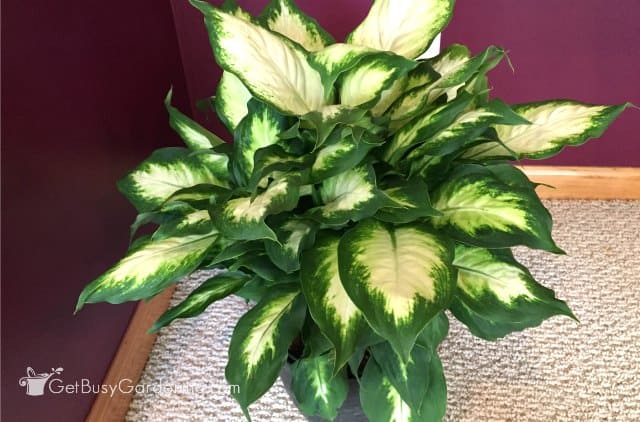
Dieffenbachias are the perfect low-light houseplants because they like the shade, and direct sun will cause their leaves to fade or burn. But if it’s too dark, they’ll quickly grow tall and leggy.
Indoors they need bright, indirect light. A spot next to a sunny window, or an area where your plant will get filtered light through a curtain or blinds would be perfect. If you don’t have a bright room, then you could use a small grow light.
It also helps to rotate the plant once in a while to prevent it from reaching to one side as it grows taller. I rotate mine every time I water, or monthly (or whenever I remember).
Soil
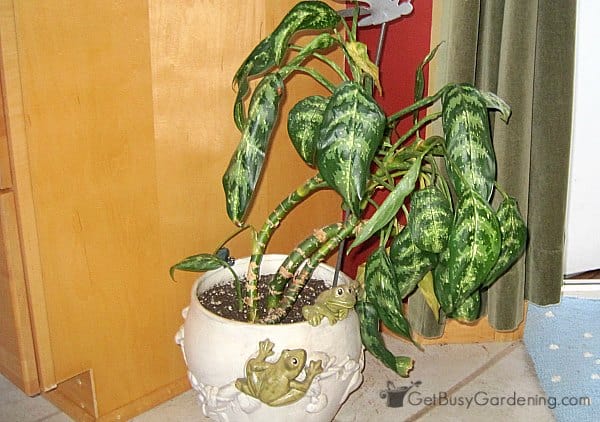
Dumb canes aren’t super fussy about the type of soil you use, any high-quality general purpose potting mix will work just fine. But they do prefer a porous and well-draining medium.
So, if you tend to overwater, then you’re better off using a fast-draining mix. Or you could add some perlite, pumice, or coarse sand to the potting soil to improve drainage.
Repotting
You don’t have to worry about repotting your Dieffenbachia very often, they don’t need it until they’re pot-bound.
You’ll know it’s time when you see roots coming out of the bottom holes, if there are more roots than soil in the container, or if you have to water your plant constantly to keep it from drooping.
Always use a container with holes in the bottom, and only go up one or two pot sizes. If you give it too much room, your plant may have a difficult time becoming established in the new container.
Related Post: When & How To Repot Houseplants
Fertilizer
Another great thing about dumb canes is that they can grow just fine without fertilizer. But they will benefit from being fed during the spring and summer, and it could even trigger blooming.
However, they are very sensitive to chemicals. Overuse of synthetic fertilizers can lead to brown leaf edges and tips, among other issues. So I highly recommend using an organic one instead.
Apply a diluted, liquid houseplant fertilizer or a compost tea monthly, or you can add slow-release granules once in the spring. Stop feeding in the fall and winter to let your plant rest.
Pest Control Tips
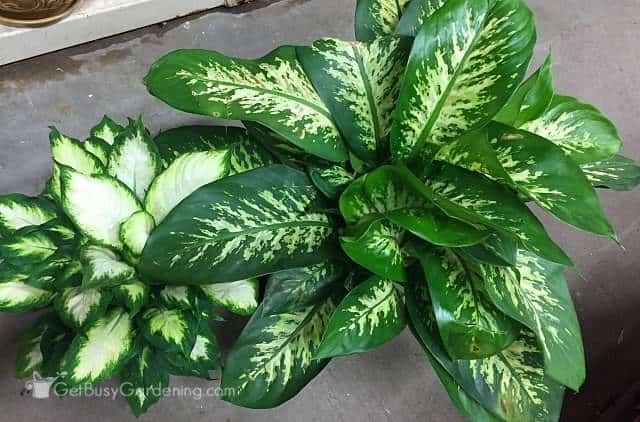
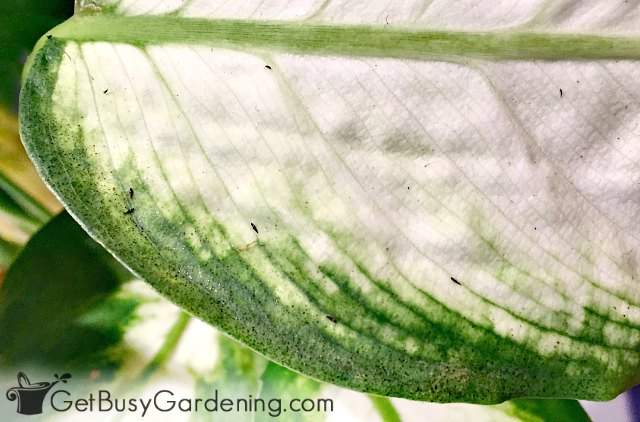
It’s rare for a healthy Dieffenbachia to have problems with bugs, but sometimes spider mites, thrips, or mealybugs can attack them.
If you find bugs, begin treating your plant right away. My favorite product to use is neem oil. It’s a natural insecticide that’s very effective at controlling houseplant pests.
Organic insecticidal soap also works well to knock down an infestation quickly. I make my own by mixing 1 teaspoon of mild liquid soap per 1 liter of water.
Related Post: How To Get Rid Of Houseplant Bugs Naturally
Pruning
Pruning is an important part of Dieffenbachia care, and you should do it regularly. It helps to keep your plant tidy, compact, and healthy. Here are my tips:
- Remove dead or dying leaves and flowers at any time by simply cutting them back to the main stem.
- Trim off brown leaf tips and edges as necessary, following the natural shape of the leaf.
- Clip new growth at the tips every spring to prevent legginess, and encourage your plant to grow more compact and bushy.
- If your dumb cane has grown tall and leggy, you can top the plant, or cut it back anywhere on the stem. New leaves will form just below the spot where you made the cut.
Dieffenbachia Propagation Methods
You can propagate your dumb cane from either stem cuttings or by division. If there are several stems growing in the pot, you can separate them to make new plants.
Rooting cuttings can be a bit tricky. The key is to provide lots of humidity, and keep the soil moist but never soggy.
Take a stem cutting that’s at least 4″ long, and dust it with rooting hormone. Then plant it in a loose, porous soil mix. You’ll know it’s rooted when you see new leaves developing on top.
Troubleshooting Common Dieffenbachia Problems
The most frustrating part about Dieffenbachia care is when your plant is sick, and you don’t know why. Below are some of the most common problems you might run into, and tips for how to fix them.
Brown Leaf Tips Or Edges
Brown leaf edges and tips are usually caused by inconsistent watering, low humidity, or salt and chemical buildup in the soil from using tap water or synthetic fertilizers.
Crusty buildup on the top of the soil or around the inside of the pot are signs of overfeeding or too much salt/minerals from tap water. Switch to an organic fertilizer, and use filtered water or rainwater.
Drooping Leaves
When the leaves or the whole plant start drooping, it’s usually caused by over or under watering. But it could also be from exposure to cold or hot air, plant bugs, or transplant shock after repotting.
Leggy Dieffenbachia
Dieffenbachia naturally gets leggy over time, it’s their normal growth habit. But it can be worse if your plant isn’t getting enough light, so move it to a brighter location. You can also prune the tips regularly to encourage bushier growth.
Yellowing Leaves
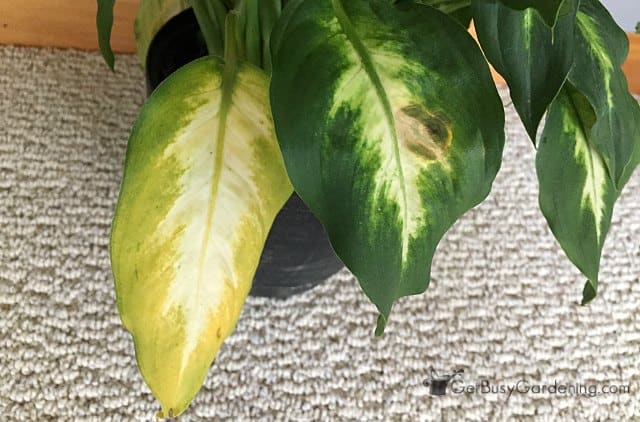
It’s normal for the lower leaves to turn yellow or brown, and eventually die. Simply trim them off as needed. However, if several of them are yellow, or they aren’t on the bottom, then it’s probably overwatering, insufficient light, pot-bound roots, or bugs.
Inspect the leaves for any signs of an infestation, and then check the soil moisture level. It should never feel soggy or overly wet. If it’s not those things, then make sure your plant is getting bright, indirect light, and check to see if it needs to be repotted.
Now that you know how to properly take care of your Dieffenbachia, you’ll be able to grow these gorgeous houseplants for many years to come.

If you want to learn all there is to know about maintaining healthy indoor plants, then you need my Houseplant Care eBook. It will show you everything you need to know about how to keep every plant in your home thriving. Download your copy now!
Share your Dieffenbachia care tips in the comments section below.

Paul Wozniak says
I have a large plant in a hanging pot. It is growing over the side like a vine. I think it’s a dieffenbachia but I can’t really be sure. Is there a way to send photo to you?
Amy Andrychowicz says
You can post photos to my Facebook page, and I’ll take a look to see if I can identify it. 🙂
Veronica says
Hello. I just received a 5 ft. tall plant and it got damaged during transport. A stem broke off and a few leaves. It was also re-potted because I didn’t know any better. It now has 2 brown leaves and 3 yellow leaves. Is it possible that the change of location, the transport damage, and the re-potting is causing this issue? Will it take time for it to recover? It still has about 20 healthy leaves–all on the top. I don’t know what I’m doing. I could use some advice on how to help it thrive in this new location.
Amy Andrychowicz says
Yes, transporting plants is very stressful on them, and it takes time for them to adjust to their new home. Repotting is also very stressful, and doing it as soon as you get the plant home is a double-whammy which can send them into severe transplant shock. The best you can do is leave it in its new location and let it recover. Dieffenbachias are tough plants, so I would expect it should recover as long as you give it the proper care. Good luck!
Richard Hardwick says
I have a dieffenbachia that is about 7 feet tall. It has 20 leaves on the top 4 feet. The lower 3 feet is leggy and has no leaves. (1) Can I cut off the upper 4 feet (with leaves intact) and stick some of the leggy stem into a new pot? Will it grow? Will it be too shocked? (2) The middle section, which is all leggy, can be propagated by cutting the stem into smaller pieces, right? (3) If I leave the existing lower stem, cut off about 6 inches above soil level in the existing pot, will it generate new leaves? Thank you.
Amy Andrychowicz says
1. Yes, you can top your dieffenbachia and root the cutting. 2. Also yes, you can chop the cane up into pieces and try rooting those. They can be finicky so don’t feel bad if they don’t all take. 3. The long stem that’s left after you top it should regrow new leaves right below the cut.
Richard Hardwick says
Thank you. Great advice.
Amy Andrychowicz says
You’re welcome!
Anthony says
I have been cutting off the last 3 new growth in order to contain its shape…do i continualing do this or have to stop and if so, at what point?
Amy Andrychowicz says
Cutting off the new growth on top will get your dieffenbachia to branch out. However, it will just become bushier on the tips. The stems lower down won’t grow anymore. So, if you want it to be even bushier, then you may need to cut the stems back even further. I would recommend doing this one stem at a time, and wait until you see healthy new growth before cutting back the next one. That way you won’t shock the plant too much with a heavy pruning.
Anthony says
Thanks to your advice my D C was doing great, bushy ( by pruning ). Today, I noticed a slight brown ‘circle’ on some of the leaves, otherwise they look healthy. about 2 or 3 weeks ago I read that Epsom salts would do wonders for plants, so upon recommendation, i gave it 1 tbsp of it. Do you think that could be the cause? I do not see any sign of pests. BTW, watering as you suggested by putting your finger at least 1 inch into the dirt, the soil is not wet, but cool …so its difficult to know if that coolness is attributed to water or the near 60 degree temp that has been in the early mornings.
Amy Andrychowicz says
Using epsom salts on plants is very controversial, and not a proven science. Because of that, I never recommend using it to my readers. Dieffenbachias are very sensitive to chemicals and salts in tap water, but I’m not sure how ES would affect them. However, if it’s just one spot on a leaf, then I wouldn’t worry too much. Just prune off that one leaf, and let the healthier ones thrive. If you’re struggling with figuring out how wet the soil is, I recommend getting an inexpensive moisture gauge probe tool (I linked to the one I use above under the “Watering Instructions” section). That will tell you exactly how wet the soil is at any depth, and is super easy to use.
Mary Perez says
Help. My diffenbachia plants are getting grainy white spots, some stringy, Can anybody tell me if this is some kind of bug infestation? And how to treat it.
Amy Andrychowicz says
Sounds like your dieffenbachia could be infested with spider mites, here’s how to get rid of them.
Neerja says
Hello,
My dumbcane leaves have beautiful white spots but now as they grow big those leaves are getting completely green and that too light green. It’s loosing the white spots and the lush dark green look. Only new leaves have it. My pots are sitting in east window and few in west windows. What should I do? TIA!
Amy Andrychowicz says
The first thing to do is inspect your dumb canes leaves for signs of bugs. Faded leaves are one of the first signs of a spider mite infestation. Also, make sure it’s not getting any direct sun on the leaves at any time. That will also cause the colors to fade.
Bassem Mokhtar says
Will it restore back the colour once cause is eliminated??
Amy Andrychowicz says
Discolored dumb cane leaves likely will not change back to their original color, even once the problem has been fixed. You can trim off the damaged parts of the leaf or remove the entire leaf if you want to make it look better. Just don’t remove all of the leaves.
LeAnn BLACKBURN says
Soggy leaf tips ???
Amy Andrychowicz says
If your dieffenbachia leaf tips are soggy, then that’s either from overwatering or they were exposed to freezing temps. If you live in a cold climate, make sure the leaves aren’t touching or sitting in a freezing window at night.
Anthony says
We are in a mild Fall season here in the NYC area and my plant has been outside all Summer and doing great. I have been pinching new growth as they appear and the plant is nice an bushy. I suspect as the weather starts showing is true Fall temps, when should i bring it in? BTW, will it go dormant eventually?
Amy Andrychowicz says
It’s best to bring your dieffenbachia back inside before it gets below 60F. No, they do not go dormant, but are very easy to overwinter as a houseplant. Give it bright light, and keep the soil only slightly moist or on the dry side until spring.
Donna says
My Dieffenbachia bottom leaves are dropping and some of them are falling off the stem. How do I fix this problem, my plant is 5ft and I’ll had if for about seven years.
Amy Andrychowicz says
It’s normal for Dieffenbachia to lose their lower leaves as they age, unfortunately. So it could just be your plant getting older. However, if they are falling off at a fast rate, then it could be from over or under watering. Check the soil by sticking your finger at least one inch deep. If it’s wet, then let it dry more between waterings. Otherwise, if it’s completely bone dry, then you may need to water more often.
Patty Davenport says
The leaves on my dumb cane have browning on the tips. New leaves are unfurling with brown tips. What’s going on?
Amy Andrychowicz says
Brown tips and margins on dumb cane leaves are usually caused by low humidity levels or inconsistent watering. But, it could also be caused by overuse of chemical fertilizers or a buildup of minerals from tap water. Allow the soil to dry slightly between waterings – it should never be bone dry or soggy. If you fertilize it, either switch to an organic brand, or cut down on the usage. And, try using distilled or rainwater instead of tap water.
Bassem Mokhtar says
Hi, I recently got a nice 2 feet one with 7 leaves and one folded baby leaf and happened that 2 days later after arriving home near an indirect window sunlight and in same nursery pot which is not showing any root bound upon inspection, happened for top 3 leaves to get change in colour from tip and edges towards inside and its not yellow or brown but typical to when you have a water coloured paper drying after been rained on then the area of this phenomenon is increasing and jumped to more leaves, is this lack of humidity or because it got extra indirect sun than used to get obviously in plant shop, knowing that i didnt water later on except 5th day whdn 2 inches felt dry on my finger
Amy Andrychowicz says
Since it’s a brand new plant, it’s possible that the unfurled dieffenbachia leaves could have been damaged while in transit. I would just leave it be and let it settle into its new home. The transition from the greenhouse to the store and then to your home is tough on some plants, and sometimes they just need time to adjust.