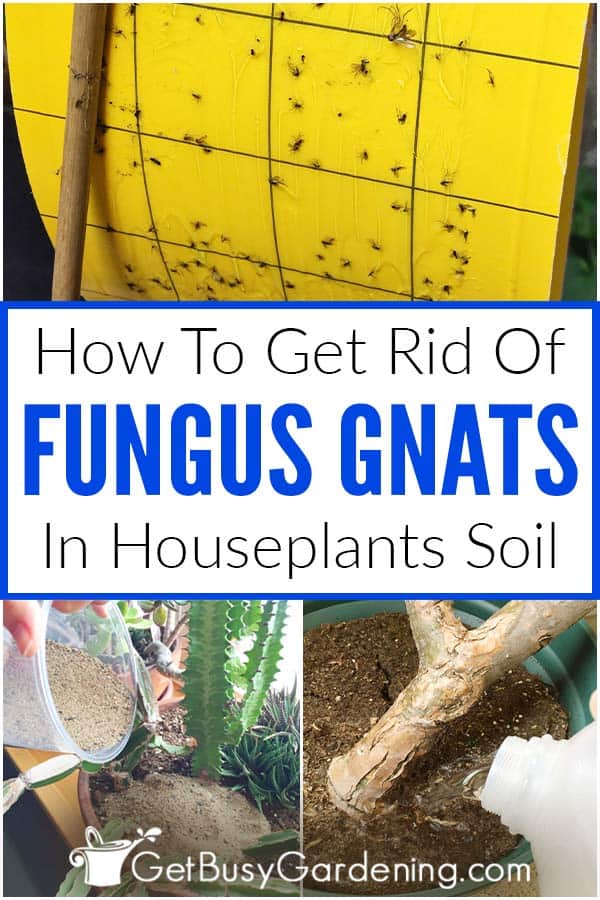
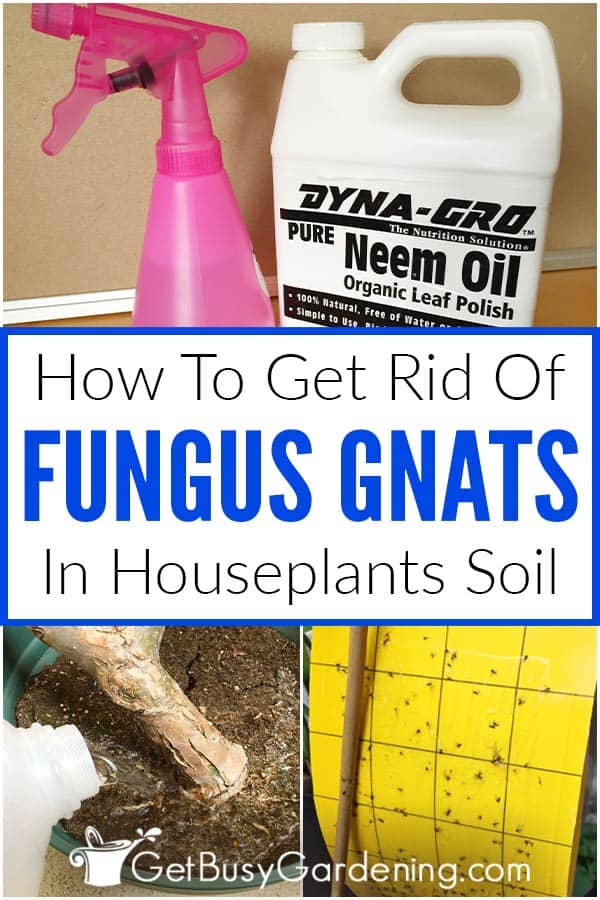
Dealing with fungus gnats in household plants can be a common nuisance, but I’m going to share some simple steps you can take to naturally eliminate fungus gnats—FOR GOOD! From adjusting watering habits to using natural remedies, getting rid of these pesky insects simply takes a bit of diligence and time.

The key to getting rid of fungus gnats is to eliminate the larvae. But it can be tricky to do this naturally. Since the adults only live for a few days, once all the larvae is dead, the infestation will go away pretty quickly.
This is easier said than done though. The adults can fly, jump, or crawl from one plant to the next, so it can be difficult to eradicate them.
So you have to be persistent in treating them, and ensure that you are diligent about keeping your houseplants healthy to prevent recurring outbreaks.
A Bit About Fungus Gnats
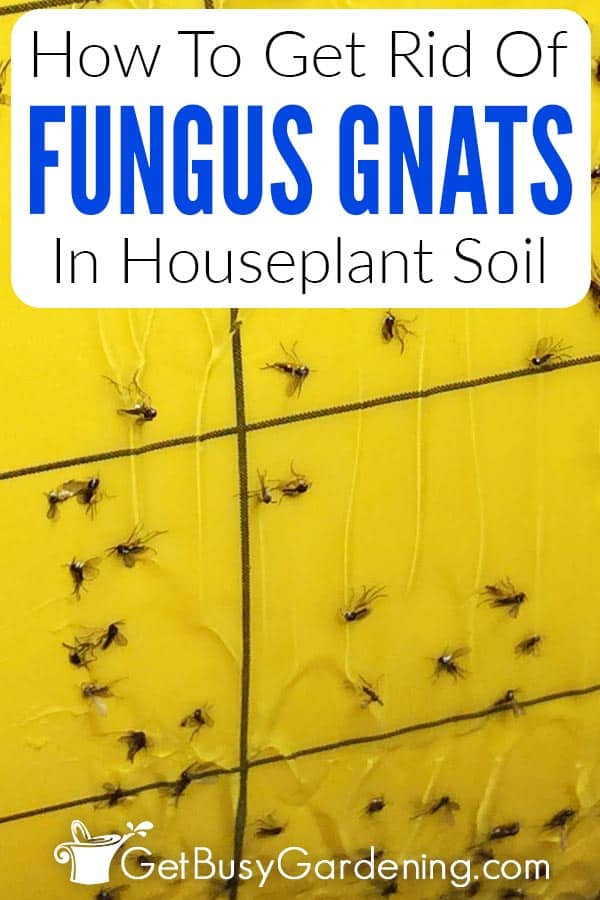
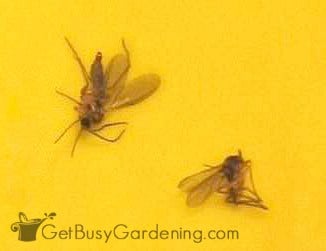
Fungus gnats are tiny black bugs that crawl on top of the soil and fly around your houseplants. They are the most common houseplant pest there is, and they can quickly infest your entire collection. Yuck!
Though the look very similar to fruit flies, they are not the same type of bug. You can read all about how to tell the difference between the two here, so you can make a positive ID.
Fungus Can Multiply Quickly!
There are 4 stages to the fungus gnat life cycle. In the right environment, they can multiply very quickly, and their full lifespan can happen in less than a month.
The adults only live for a week or so, but the females can lay hundreds of eggs during their life. So if you don’t take the right steps to eliminate them, their population can explode in a short amount of time.

9 Natural Fungus Gnat Treatments
There’s no need to resort to chemical pesticides, you can easily fight these pests using natural and organic treatment methods. For the quickest results, you should try all of these:
1. Proper Watering
The #1 reason fungus gnats get into your plants is from overwatering. The larvae thrive in wet soil, and they can’t survive when it’s dry.
So, the easiest and most effective method of eliminating them is to make sure you always water your houseplants correctly. The soil should feel dry to the touch, and never be saturated or soggy.
If you struggle with this, I highly recommend getting an inexpensive moisture gauge to make sure you get it right every time.
2. Water From The Bottom
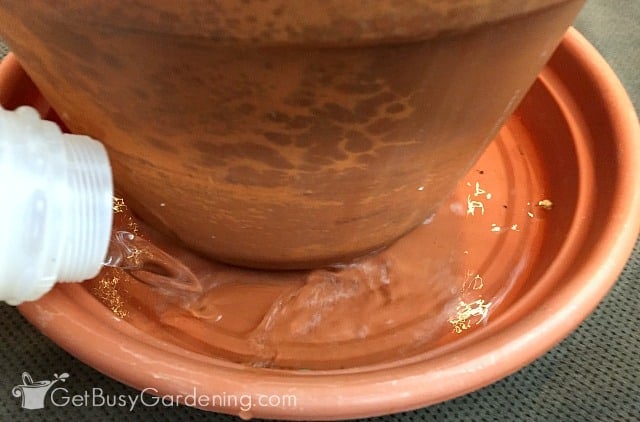
Fungus gnat larvae live in the top 1 inch of the soil, which tends to stay pretty moist when you water plants from the top. So if you have persistent problems, then try watering from the bottom instead.
To do that, simply pour water into the drip tray or cache pot, and allow the plant to soak it up through the drainage holes in the bottom of the container.
Always dump out any remaining water after about 20-30 minutes, and never leave your plant soaking for longer than that.
3. Use Gnat Traps
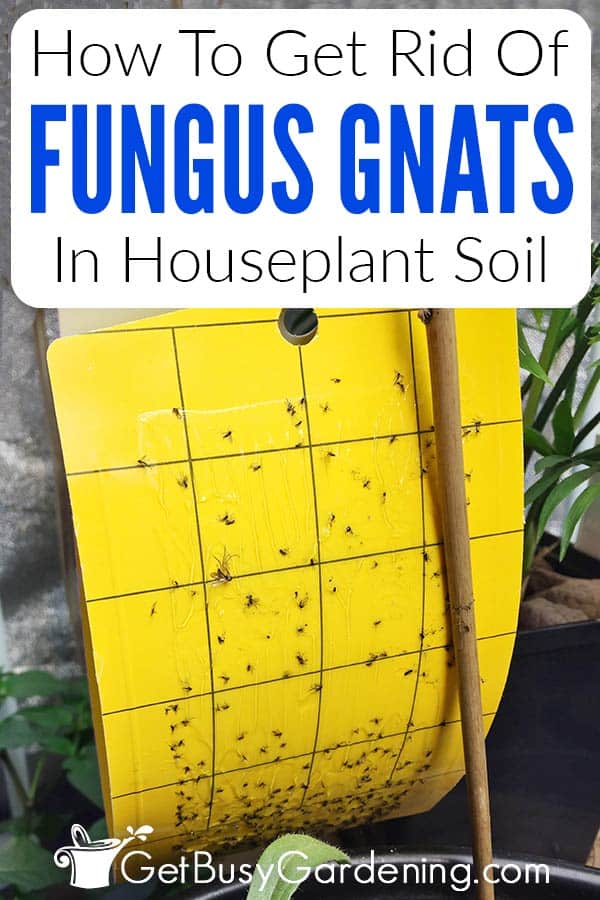
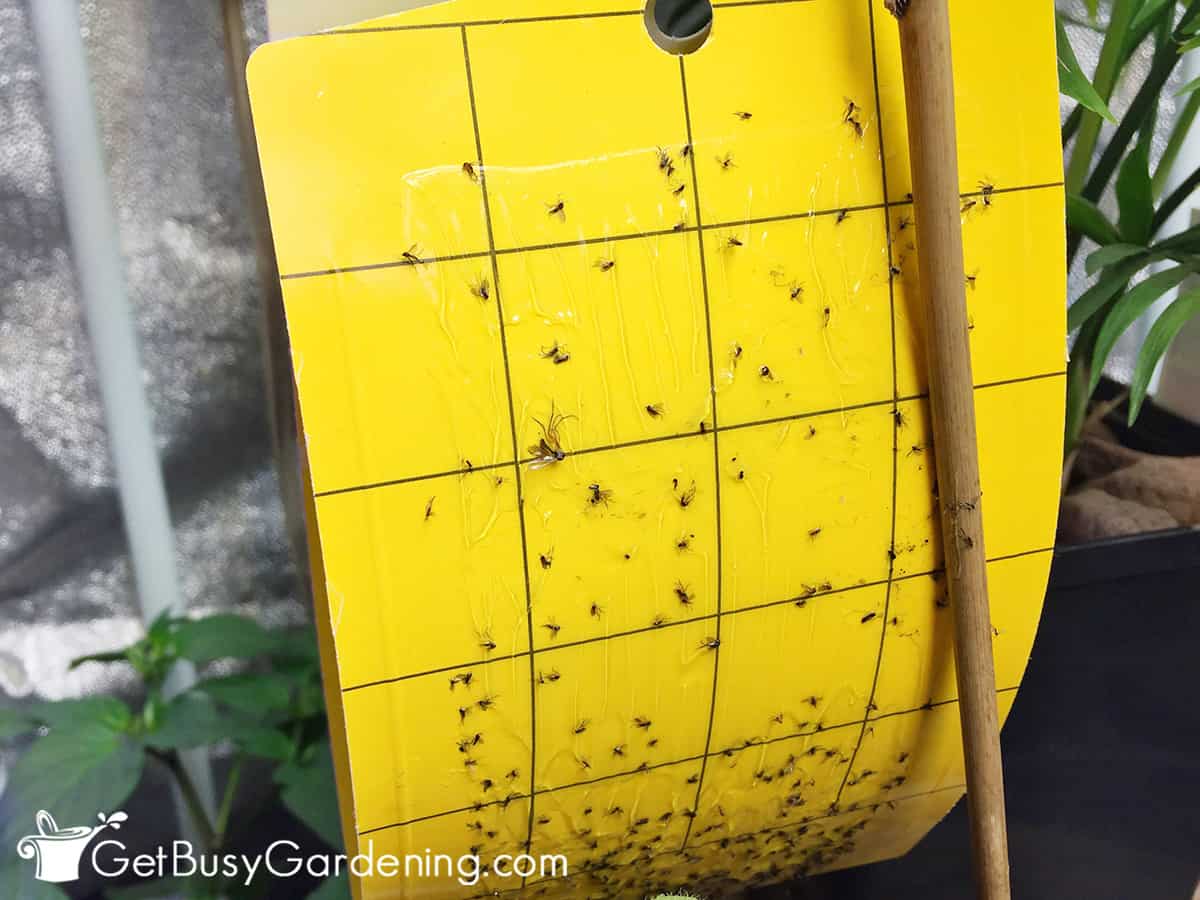
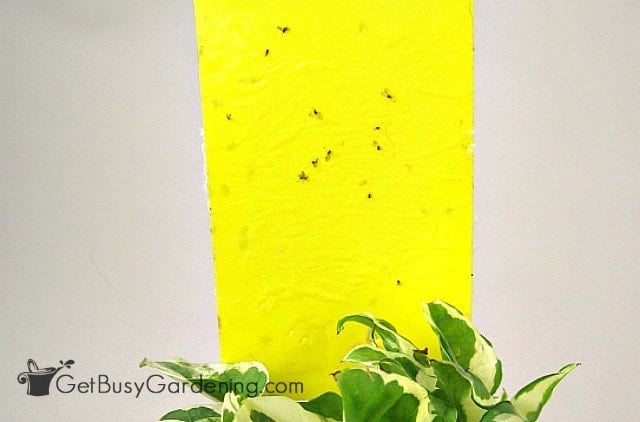
Putting a yellow sticky trap near your indoor plants is a super safe pest control method that will attract and capture the flying adults.
This only works to control the adult population, it will not take care of the problem at the source – the larvae.
But these traps will definitely prevent fungus gnats from flying around to other plants and prevent more larvae from being laid.
Try making your own DIY Fruit Fly Trap!
4. Use Organic Products
There are several organic products that you can pour over the top of the soil to help kill the gnat eggs, larvae, and pupa.
It might take a few applications to see results, and you also have to be careful not to overwater your plants in the process but they are natural. Here are a few of my favorites:
- Insecticidal soap – This will kill any bugs in the soil on contact. You could also make your own by mixing 1 teaspoon mild liquid soap with 1 liter of water.
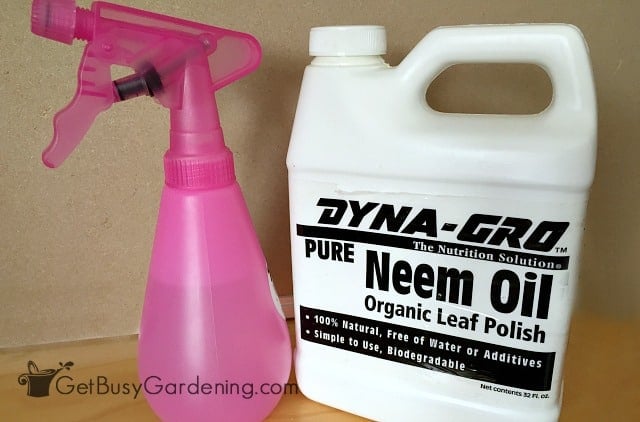
- Neem oil – This is a natural pesticide that works to kill houseplant pests over time, and it has a residual effect to help keep them away.
- Beneficial nematodes – These are microscopic organisms that will feed on the pupa and larvae, and you can simply add them to your watering can.
- Bacillus thuringiensis israelensis (BTI) – Also known as mosquito dunks or mosquito bits, BTI is a bacteria that’s only toxic to the larvae of bugs like fungus gnats. It takes some time for it to be effective but works.
Related Post: How To Use Neem Oil As Organic Pest Control
5. Remove Gnat Infested Soil Entirely
Remove the top inch of soil and replace it with fresh, sterile, and dry potting mix. This will get rid of most of the fungus gnat eggs, larvae, and pupa, and make it easier for you to gain the upper hand.
Just keep in mind that the eggs could still hatch and mature after you remove it from your houseplant, so make sure you take the infested soil outside to the trash right away.
6. Use Soil Covers
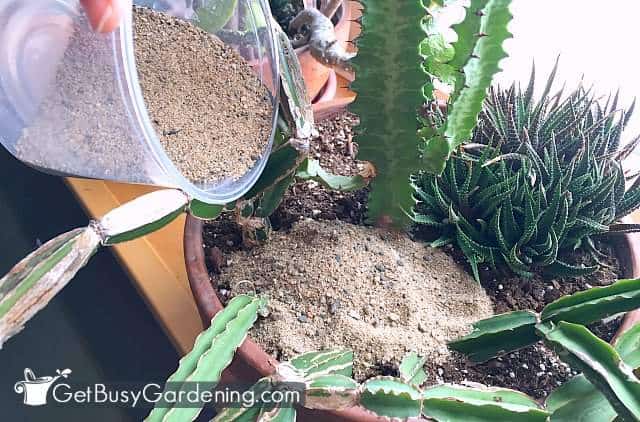
Rather than refreshing the top inch of soil, you can add a dry layer of fine sand, gravel, or crushed granite instead. This will help deter the females from laying eggs. Plus it creates a nice decorative touch.
Or you could try a barrier top dressing, which is a non-toxic product that is specifically made for eradicating fungus gnats.
7. Store Unused Soil In A Sealed Container
Bags of potting soil can become a breeding ground for fungus gnats. So it’s important to store any of your unused mediums in sealed containers, especially if you keep them inside the house.
Fungus gnats can’t survive without oxygen, so make sure the container is airtight. I store mine in five gallon buckets with Gamma seal lids on top.
8. Never Reuse Potting Soil
I know it’s tempting to pinch pennies by reusing soil when you repot your indoor plants or after one dies, but you’re just asking for trouble.
Used soil can harbor all sorts of pests and diseases, and can quickly cause an infestation. So it’s always best to use a fresh, sterile mix, and discard the old stuff.
Related Post: 9 Homemade Insecticides & Bug Sprays For Indoor Plants
9. Use Hydrogen Peroxide as Larvacide
Treating the soil with hydrogen peroxide is a natural and effective method. Try mixing 1 part hydrogen peroxide to 4 parts water and use it to wet the top inch. Keep in mind that this will only kill the larvae and pupa, and not the adults that are flying around your plant.
Other Natural Treatments To Try
I have also heard using baking powder, vinegar, coffee grinds, tea tree oil, lavender oil, garlic, parsley, cinnamon can be effective treatments for ridding of fungus gnats.
Where Do Fungus Gnats Come From?
Though indoor plant bugs can come from anywhere, here are the 4 most common ways that fungus gnats could have gotten into your house:
- From the soil of a new pre-infested plant.
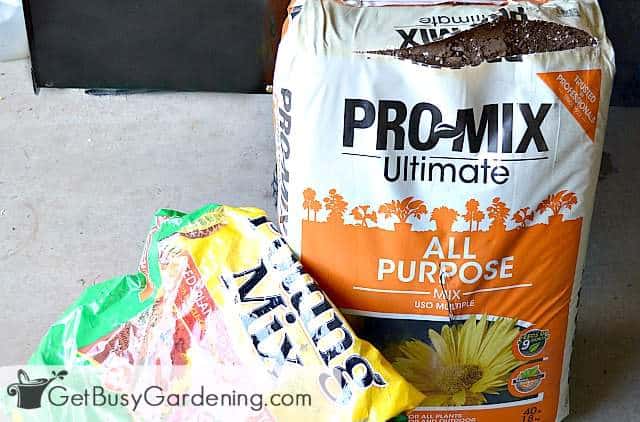
- An infested bag of potting mix.
- Other plants that were outside during the summer.
- Through the screen of open windows or doors.
Related Post: How To Get Rid Of Houseplant Bugs Naturally
Common Questions About Fungus Gnats
While it is possible to get rid of fungus gnats, you have to be diligent with your preventative measures to keep them away permanently. The biggest problem is that they can easily come through window screens and doors. So unless you seal your home year round, it’s possible the fungus gnats will return at some point.
The short answer is no, fungus gnats will not kill your houseplants. They are usually just a nuisance and rarely destructive. Sometimes they can cause minor root damage if the infestation is heavy, but normally they only eat rotting plant material.
Everyone with indoor plants will have to fight fungus gnats at some point, it’s just a part of life. Recurring problems are difficult to prevent, and it can be very frustrating. Your best defense is to make sure you don’t overwater, properly store unused potting soil, and always maintain healthy houseplants.
If houseplant pests are driving you crazy, and you want to learn how to get rid of them once and for all, check out my Houseplant Pest Control eBook. It will help you identify common houseplant bugs, and show you exactly how to eradicate them before they kill your beloved plants. Download your copy today!
More About Houseplant Pests
- How To Debug Plants Before Bringing Them Indoors
- How To Get Rid Of Thrips On Indoor Plants
- How To Get Rid Of Spider Mites On Indoor Plants
- How To Get Rid Of Scale Insects On Houseplants
- How To Get Rid Of Whiteflies On Indoor Plants
- How To Get Rid Of Aphids On Houseplants
- How To Get Rid Of Mealybugs On Your Houseplants
Leave a comment below and share your tips for how to get rid of fungus gnats in houseplant soil.

Lisa Martell says
Hello. Apologies for the length of this comment. I would like to disagree about the fungus gnats not killing plants. At first the problem was minor. I am in Florida and figured that some followed me into the house. I was terrorized every night swatting them all night. Anywhere there was a source if water. Young ones and older ones. It started getting worse and I thought I had it narrowed to the fiddle leaf which I purchased at a local big box garden store which was probably my first mistake. It was doing really well until it wasn’t. Didn’t take long long for it to go on life support. It was clearly dying. Despite the horror of knowing what I needed to do, I took it, the pot and anything near it to the trash. Problem solved? Heck no. Then it got to my beautiful “Ginny”. It was so healthy and vibrant and seemingly overnight, it quickly turned into a sad plant. Also on life support. I finally had to throw my precious and once beautiful Ginny in the trash. Problem still not solved. Now it has attacked my equally precious yucca which is at 4 feet and no longer thriving. My show piece plant. They are in the soil. I have a D-Joy, golden pothos, ZZ, aloe, parlor plant and dragon (among others). I do not know the status of these plants but logic says that they all need to be treated before it is too late.
I do need to note that with the exception of the fiddle, all of my other plants were purchased from a professional grower directly. They have always sent plants of exceptional quality.
With all of this said… I have read through almost everything you have posted and I am going to “throw” everything at the yucca and the others. I have Neem, Dr. Bronners and fly traps on the way. While the other plants will be more challenging given their smaller size, my yucca is my primary concern.
I will remove 1-2 inched of soil from the top.
I will use Neem and Dr. Bronner’s. Is using both okay?
Fly traps placed on a stick in every plant.
I have also planned to put a layer of Spanish moss and top it with a gravel soil cover.
Each plant has it’s own watering schedule with the yucca needing to be watered sparingly and visible growth lightly sprayed more often with water.
Question: Is this a good game plan?
I am not an expert but I have had indoor plants for decades and have never encountered this scourge.
Amy Andrychowicz says
Oh no, sorry to hear that your plants are dying, that’s terrible! Unfortunately, once fungus gnats get into your home, they can quickly spread from plant to plant. It is extremely unlikely that they killed your plants though. Most of the time, they are a symptom of a large problem – overwatering – which is what usually ends up killing the plant. The plant you bought at the store was likely overwatered before you even bought it, and that is why it died (the big box stores don’t take very good care of them). Fungus gnats cannot live in dry soil, so the first thing to do is be absolutely certain the soil isn’t staying too wet. Watering from the bottom is a good way to ensure the top layer of soil stays dry, so the gnats can’t breed there. Always stick your finger at least 1″ into the soil to check the moisture level before watering. If it’s moist, then wait a little longer before giving it more. Other than adding that, your game plan sounds good. And yes, you can use neem and Dr. Bronner’s together, that’s the combo I use.
Barbara Sadowsky says
Hi I think I have fungus gnats in my Egyptian papyrus indoor plant. This plant has to be moist all the time. If I water from the bottom I’m not sure that it will get enough water. If I place a cover over the soil and water is that enough to keep the gnats away? This is after I get rid of them.
Thanks Barb
Amy Andrychowicz says
Bummer to hear that your plant has fungus gnats. Yes, you certainly could try covering the soil to see if that helps to keep them out once you get rid of them. Make sure the soil cover is at least 1″ deep.
Theodora Robinson says
Can you use another soap other than Bronner’s? Like Dawn?
Amy Andrychowicz says
You certainly could try a different type of soap to kill the fungus gnats. However, Dawn has chemicals in it, like detergents and degreasers, which can harm sensitive plants. So, make sure to dilute it well, and test it out on a few leaves first before treating the whole plant. I always recommend Dr. Bronner’s because it’s gentle, and doesn’t contain all of those harmful chemicals.
May Li says
Hi Amy,
We also have been dealing with fungus gnats in our houseplants since we gave them “summer vacation” on our deck last summer. We tried hydrogen peroxide, which helped a bit but not fully. We are also trying the sticky traps with medium success. I’m going to try adding sand on the top and maybe repotting the top inch of soil. Which do you recommend more – watering from the bottom or using neem oil/soap mixture (I imagine this has to be used for top soil watering)? Thanks!
Amy Andrychowicz says
I personally prefer watering from the bottom. That makes it much easier to keep the top inch of soil dry, and prevent fungus gnats from living in there. Yes, the neem/soap mixture would be a top-watering method. You just have to be careful with that one so you don’t accidentally overwater your plants. But, you certainly could use it each time you would normally water them to see if it helps.
Vannessa says
Hi, I need help positively identifying a creature. Lol. Today is the first time I have seen the bugs that look like fruit flies, only about half a dozen near the window. I think I know which plant they came from… a mature philodendron, but on the plant itself, there were no other flying insects. But I do see what ‘seems’ to be larvae size, 100s of teeny things in the soil… is this the same as fungus gnats?
Amy Andrychowicz says
It should like fungus gnats to me, they lay their eggs in the soil and the larvae is tiny like you mention. The adults fly and sometime crawl around on the plant leaves (though they don’t eat them, thank goodness!). But take a look at my post about How To Identify Common Types Of Houseplant Bugs to see if it’s something else on the plant leaves. It’s not uncommon for indoor plants to have more than one bug infestation at the same time. 🙁
Jamea says
I grow herbs indoors. My gnat infestation is driving me CRAZY but I’m afraid to use anything on these herbs. I also have cat nip and cat grass. Are the above mentioned methods safe if the plant is going to be consumed by humans or animals? I have tried the dish soap and water method and it failed. I will definitely start watering from the bottoms only. If the top layer dries out, will it kill them? Thank you so much for all your wonderful reading material!
Amy Andrychowicz says
All of the fungus gnat treatment methods in this article are non-toxic, as long as you use either the products I recommend, or other organic brands. Allowing the top layer of soil to dry out won’t hurt your plants, as long as you don’t let the entire rootball dry out completely. Good luck!
Chris says
Thanks for all your wonderful information! I am
struggling controlling scale and fungus gnats. Last year I lost of half of my veggie and flower starters to fungus gnats. Seeds sprouted, healthy looking seedlings grew to about four inches, and then died. A tell tale sign of a pinched stem alerted me that it were gnats eating the tender roots.
Because I live in the Rockies, all my starters are done indoors under grow lights. Will diatomaceous earth and then flying insect spray work for controlling larvae and flying gnats respectively? Will neem harm tender sprouting seeds?
Amy Andrychowicz says
It is pretty rare for fungus gnats to kill seedlings, but certainly not impossible. However, the way you describe the pinched stem, and the fact that they suddenly died makes me think that the problem was damping off, and not the fungus gnats. Before replanting, you should definitely disinfect your trays and cells to prevent damping off from happening again. The presence of the gnats is a telltale sign of overwatering, which is also a common cause of seedling death. Make sure the soil stays moist, but never soggy or saturated with water. As for the treatment methods you ask about.. Diatomaceous earth won’t hurt the seedlings, but neem oil could. Some are more sensitive than others, so be sure to test it out on one or two cells before treating the entire flat. Potting them up into larger containers will also make it easier to water properly and control the gnats.
Pamela says
Hi! I have been battling fungus gnats for a couple of months. I think they came from a bag of potting soil I purchased over the summer. Can I sterilize the potting soil by baking it at a high temperature to kill the larvae? I’ve tried bombing the house . . . apple cider vinegar . . . dish soap sprayed on the soil . . . I’m getting desperate! ?
Amy Andrychowicz says
Oh no, sorry to hear that you’ve been having such a problem with fungus gnats! If you live somewhere that it gets below freezing, put the bag of soil outside until it’s frozen solid. That will kill them. Just make sure you allow it to warm back up to room temperature before using it to pot up your plants. Otherwise, you could try sterilizing it in the oven, but I don’t have instructions for doing that.
Pamela M Mackowski says
I do live in a cold climate . . . thank you! The potting soil goes outside today! ?
Amy Andrychowicz says
You’re welcome! It’s definitely the easiest way to kill the gnats. I keep mine in the garage all winter. One of the perks of having cold winters, LOL! Also, be sure to store your unused soil in an airtight container from now on to keep it from becoming reinfested.
Kristen says
Can you let me know what the water to soap mixture you use would be? I also purchased neem oil, not sure if it needs to be watered down as well?
Amy Andrychowicz says
For the soap mixture, I use 1 tsp of Dr. Bronner’s with 1 liter of water. As for the neem, here’s a post that describes how to use that… How To Use Neem Oil Insecticide On Houseplants.
Nicole Miller says
Hi! How often do you spray the water + Dr Bronners solution to infested plants?
Amy Andrychowicz says
You can use it every time you water. Just make sure to allow the top of the soil to dry out, it should never stay saturated for very long.
Ray says
Hi Amy, I hope you can advise. I have little bugs in my houseplant soil and they seem to affect the plants ability to grow. They aren’t as big as fungus gnats. Could they be something else. I do have a video I can share.
Amy Andrychowicz says
Fungus gnats are not very big. The larvae and nymph stages are even smaller than the adults, and they don’t fly, they just crawl around in the soil. So, I suspect that you indeed have fungus gnats. Likely the reason your houseplant is having trouble growing is that it’s getting too much water. The presence of gnats in the soil is a sure sign of overwatering. Allow the soil to dry out more between waterings, and I suspect your plants health will improve. Here’s a post that will help you get it right… How To Water Indoor Plants The Right Way.
Rose says
Hello, I have a lot of indoor plants that have tiny white insects coming out of drainage holes of the pot. They are not worms but really tiny white pests. What could this be? Will soil drench help? Thanks in advance for help 🙂
Amy Andrychowicz says
Humm… weird. Usually fungus gnats are the only bugs that live the soil of indoor plants. But check to see if they are mealybugs or springtails, that would be my second guess. If they are only coming out of the drainage holes, then I would wash the bottom of the pot with soapy water, and spray the drainage holes with it until you don’t see the bugs anymore.
Edrena says
Hi
I just wanted you to know that I have received the link and I’ve saved it to my desktop and will print it out. I have an infestation of fungus gnats and noting seem to work I just started using to Dr Bonner soap, but one thing you’ve mention in this article is to remove the top soil and replace with sterile soil which I will do 1st thing in the morning. Thank you for your other suggestions about soil covers which I will also do after removing the infected soil. I have to let you know that out of all the article I have researched your site is the only one that has given me some incite and hope of ridding my houseplant of the pest
I look forward to reading your ebook and Thanks again
Amy Andrychowicz says
I hope that you’re able to get rid of the gnats in your plants soil. It’s super frustrating for sure! Good luck. And thanks for your nice comments about my article, you made my day! Thrilled to hear that you found it so helpful. 🙂
Donna H says
Another sure fire way to get rid of fungus knats is to sprinkle Mosquito Bits in the top inch of soil. This will kill the larvae.
Amy Andrychowicz says
Thanks for your added tip. While this would work, it is not an organic product. Just wanted to make sure I pointed that out for those who are looking to use organic fungus gnat control methods only.
Christine Williams says
Thank you for your wonderful article. I have a pot that doesn’t have a drainage hole at the bottom and the plant has been hard hit with gnats. The plant is really well sized – I hate to lose it. I have been using the yellow stakes/sticky paper in the soil for 2 weeks now. I replaced it for the first time about 3 days ago and I am still getting the gnats. Do I need to throw the plant away before bringing any new plants into the house; do I need to throw the pot away (without the drainage hole) away? Thank you for your help
Amy Andrychowicz says
The presence of fungus gnats means that the soil is staying too wet. Consistently wet soil is a much bigger threat to your plant than the gnats in the soil. It’s very difficult to maintain the right soil moisture level when there’s no drainage holes in the pot. If possible, I would drill a few holes in the bottom of the pot, or transplant it into a container that has drainage holes. And yes, I would wait to get any new plants until you have the fungus gnats under control, or they could just spread to all of the other plants. Good luck!
J.C. Smith says
I ran across this article when researching what I can do to safely reuse my potting soil. I am a single man, and like most, operate on a budget. I have six (6) 10 gallon fabric pots, and I use Fix Farm Ocean Forest soil. The soil is great, and feeds for several weeks, but super soil is costly. I’m not sure how many bags it took to fill all six fabric pots, let’s just say “penny pinching” is out the window, when the pennies it would take to replace the soil.with the same soil, new, would weigh more than I do. Any suggestions on cleaning a soil to recycle/reuse? I supplement feed with advanced nutrients PH-perfect line, so loss of nutes isn’t a great concern when I consider “cleaning” the soil. I just want any gnats, harmful fungus, bacteria, or any other form of Satan’s spawn to die out. And thanks for any ideas/suggestions you may have. Also, if you suggest I tame my “Champaign taste on a beer budget” soil choice that’s ok too!! ?
Amy Andrychowicz says
I personally do not recommend reusing potting soil. It’s a recipe for disaster, not only for breeding fungus gnats, but for other problems like you mentioned. To save money, you could try your hand at mixing your own. Here are instructions, as well as several recipes to try… 7 Easy DIY Potting Soil Recipes To Mix Your Own. I have heard of people either baking or microwaving potting soil in order to kill all the bugs and other yuckies before they reuse it. But for me, it’s not worth the risk.
Margy Rexrode says
What do you consider a mild liquid soap, any particular brand?
Amy Andrychowicz says
Yes, I use Dr. Bronner’s baby mild. It works really fast to kill bugs in houseplants.
Nicole Miller says
What’s the soap to water ratio to use?
Amy Andrychowicz says
Mix 1 tsp of Dr. Bronner’s baby mild with 1 liter of water.
Preetha says
Hi! 🙂 Thanks for this article because I can now confirm that what I have is a fungus gnat infestation only.
But I have another prob also. Something is eating the leaves of my flower plants seedlings. What could it possibly be. If it’s not because of the fungus gnats then what is it? I see tiny greyish crawling bugs, flaying gnats and almost transparent larvae in my soil. If all of these are only fungus gnats and given that they eat only roots, then what is feeding on the leaves? 🙁
Amy Andrychowicz says
You’re welcome. Sorry to hear that you have a fungus gnat infestation, but at least you figured out what it is. Yes, fungus gnats do NOT eat leaves. There are lots of different types of bugs that do, so you’ll have to inspect the leaves to see if you can spot the culprit. Otherwise, it’s really difficult to tell you what type of bug it is.
Preetha says
Thanks for your response Amy! ? I’ll try to look for any other kind of bug that could be biting the leaves.
Amy Andrychowicz says
You’re welcome! Be sure to check under the leaves, and also look at them several times a day (morning, mid-day, evening). Some bugs can move fast and are very sneaky. But, if there’s something eating them, you’ll find it. 🙂 Good luck!