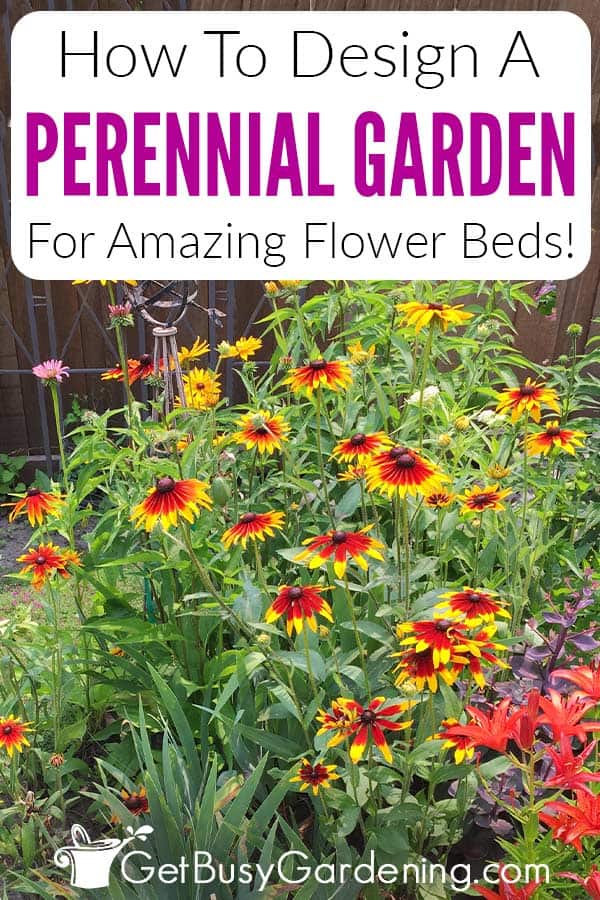
Sometimes you can get stuck in a rut and wonder how to keep your perennial gardens looking beautiful and colorful throughout the entire growing season.
Are you looking for perennials made easy? Like, super duper easy? Then this post is for you! Below I will show you how to design gorgeous ever-blooming flower beds that are full of year-round color.
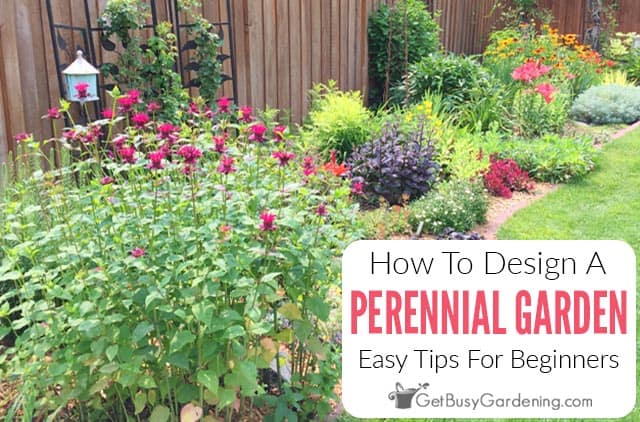

One of the biggest benefits of growing perennials in your garden instead of annual flowers is that they last for many years. But the downside is that they only bloom for a short time.
People are always sending me photos of their boring all-green (e.g.: no flowers) gardens begging me for advice on how to make the bed look better.
They know something is wrong with it, but they aren’t sure what the problem is, or how to fix it.
They go on to explain that their perennial garden looks amazing for a few weeks every summer, but it’s dull and boring the rest of the year because nothing else ever blooms.
Don’t worry, this is very common for newbie gardeners, and it’s caused by something called flower fixation.
Ok, I just made up that term, but it’s a real problem! Let me explain…
In fact, garden centers usually only sell plants when they’re in full bloom. Once those plants are done blooming, they quickly disappear from the shelves (or go on the clearance rack, where I buy them, muahahaha!).
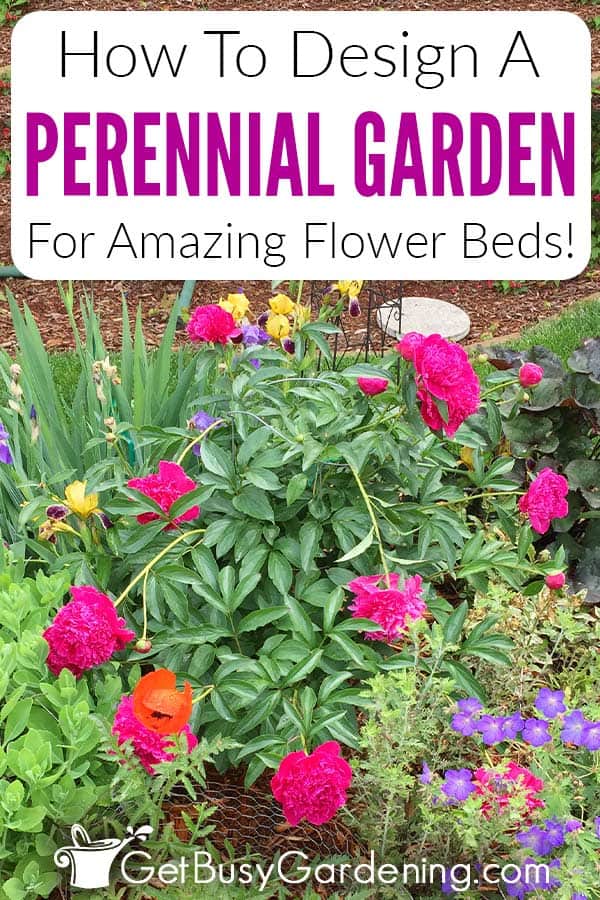
So, for example, when you walk into a garden center during the summer, the photo below is an example of what you might see…
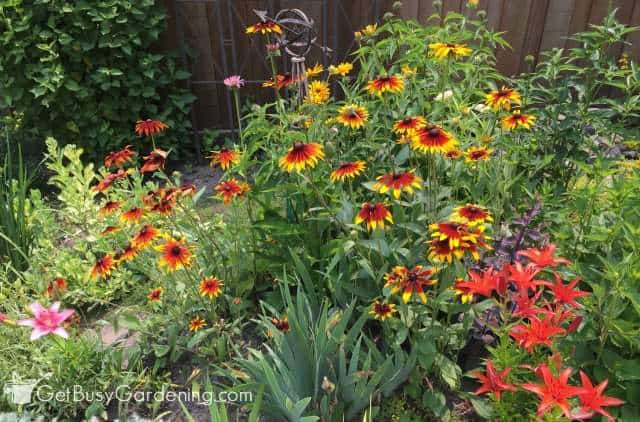
And most people think, “BAM, those flowers look amazing together so I’ll get them for my garden!“.
I mean, how could you go wrong with this amazing color combo, right?!?
Buuuut, since we love to buy plants that are blooming, we tend to forget to think about how long those flowers will last, or what time of the year they will bloom once they’re established in our garden.
And Flower fixation is the number one cause of dull, boring gardens 49 weeks out of the year.
How To Create Gorgeous Perennial Flower Beds
So how can you fix the problem of the boring, mostly green perennial garden? The best thing to do is to first focus on the foliage, and not the flowers.
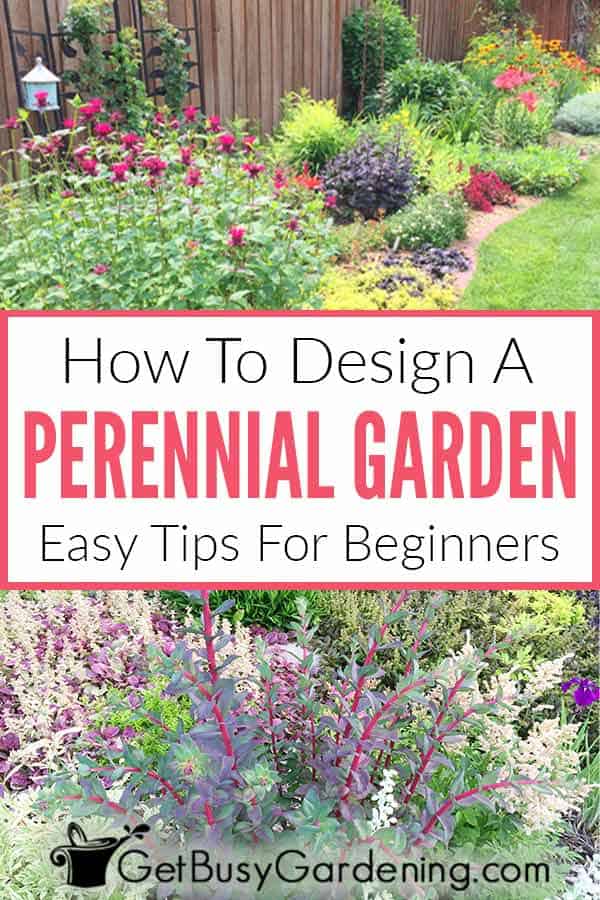
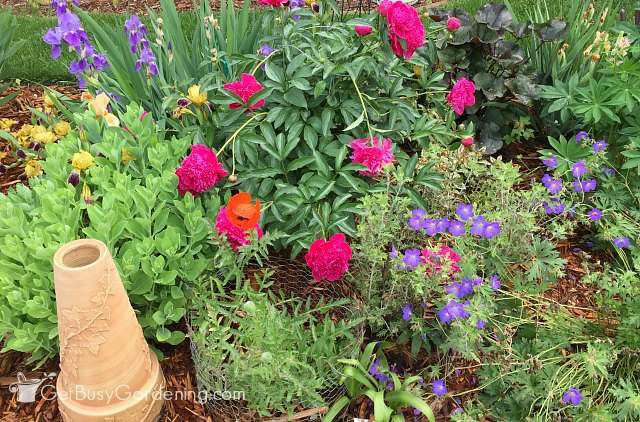
For example, take a look at this garden area…
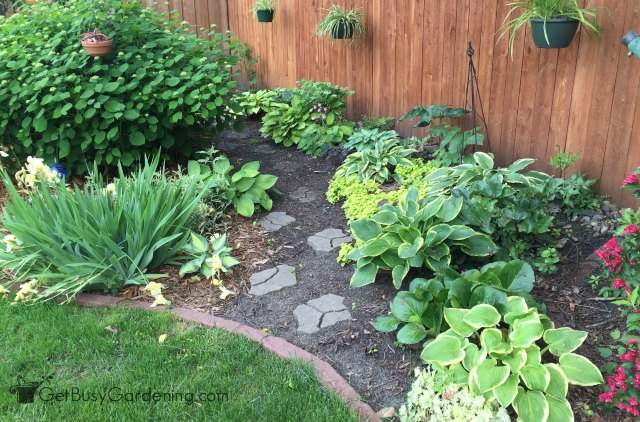
Even though there’s not really anything blooming, this perennial garden is still very colorful and beautiful.
That’s because I mixed in different colors and textures of foliage, rather than everything just being plain, boring green.
There are tons of gorgeous plants out there that add wonderful color to the garden, even when they’re not blooming.
I mean, am I right… BOOM!
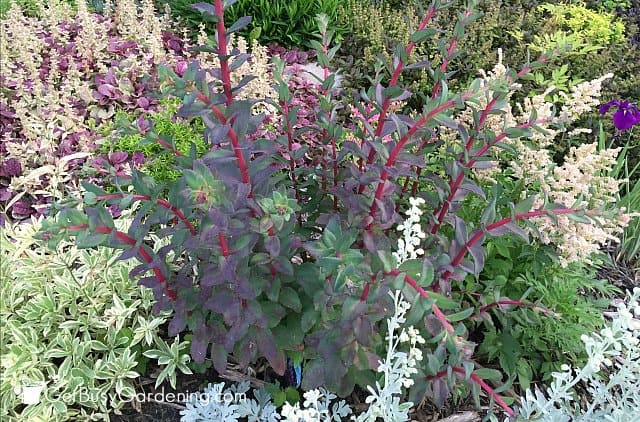
These days, perennial plants come in chartreuse, lime green, dark green, variegated, silver, burgundy, purple, pink, red… well, you can pretty much name your leaf color.
So, the next time you walk into the store, I challenge you to try to ignore the flowers that are all up-in-your-face, and focus only on the foliage.
Think about how you can mix the different foliage colors, textures, shapes, and sizes into your garden.
Try not to put perennials with the same color leaves next to each other, make it your goal to mix in as many contrasting textures and colors as you can.
If you already have a boring, green garden, then adding colorful foliage is the fastest way to rejuvenate the area and add tons of immediate color.
Ok, NOW we can focus on flowers (color AND bloom time!).
Tips For Creating An Ever-Blooming Perennial Garden
Ahhhh flowers, who doesn’t love to see a garden bursting with beautiful flowers?
But be careful, don’t let flower fixation set in again here.
The next thing to focus on is bloom time, NOT how the flowers look in the garden center. Make sure to read every single plant tag before you decide to buy it.
The tag will tell you when you can expect the plant to bloom once it’s established in your garden, and how large it will get (so you don’t have an ugly, overgrown looking bed full of huge plants in a few years).
Sometimes they even give you companion suggestions of what other plants look best when combined with this one.
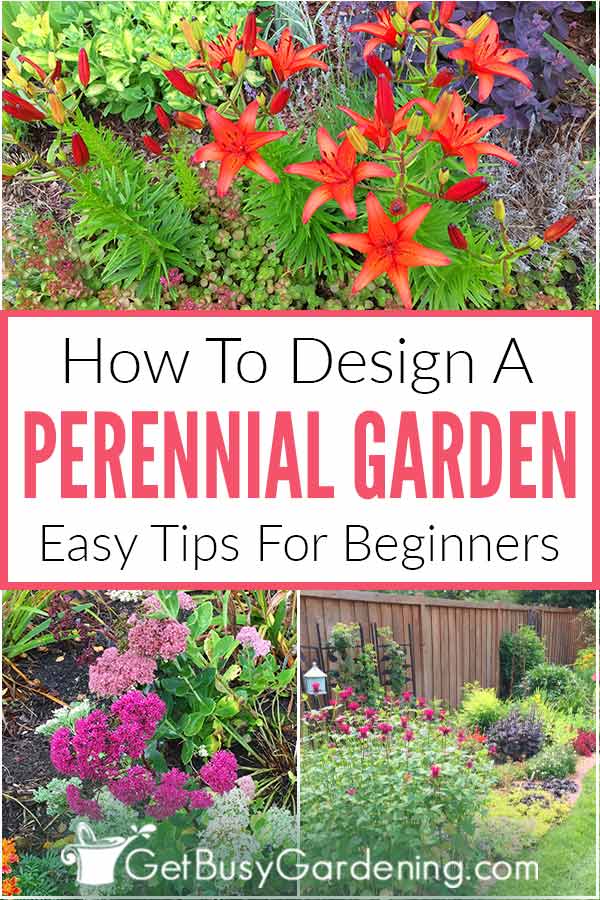
Ok, wait. Let me show you one more example to really drive this home… take a look at the garden area below.
Only one flower is blooming, but look at that amazing, bold contrast of the orange lily against the backdrop of dark purple perennials and variegated sedum foliage, with the variegated iris spikes in the middle.
Related Post: How To Transplant Plants In Your Garden (5 Steps)
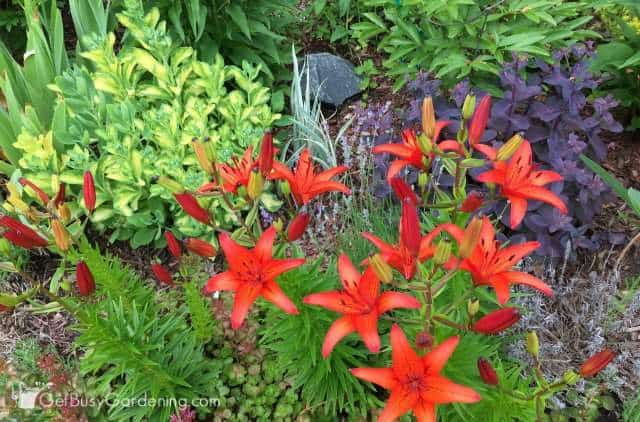
YES! That’s what I’m talking about!
AND, this area looks just as gorgeous in early spring when my irises and peonies are blooming, as it does in the fall once the sedum and lavender flowers steal the show.
See what I mean?
So include perennials that bloom at different times throughout the season. And mix them together as much as you can.
I try not to plant more than 2-3 plants that will flower at the same time next to each other. I like to layer in as much color, height, and texture as I can so my gardens are ever-blooming and gorgeous through the entire growing season.
Ever-blooming color, mixed with all of your contrasting foliage, will create eye-popping perennial flower beds that will be the envy of all your friends and neighbors.
Related Post: 19 Long Blooming Perennials For A More Beautiful Flower Garden
Four Season Perennial Gardens
Flower fixation usually leads to gardens that are gorgeous during the peak of summer… but dull and boring in the spring, fall, and winter.
So, as you select your perennials, think of what your garden will look like during the entire 12 months of the year, and plant accordingly.
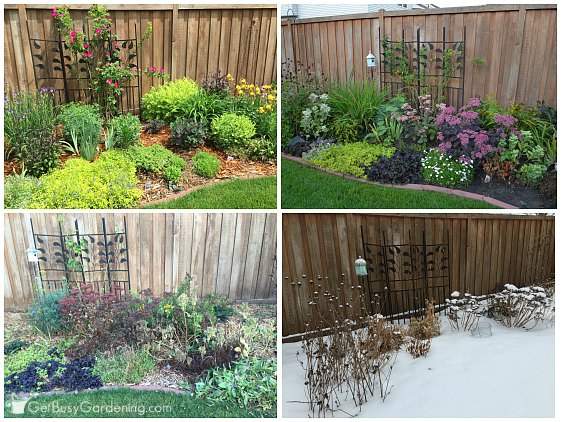
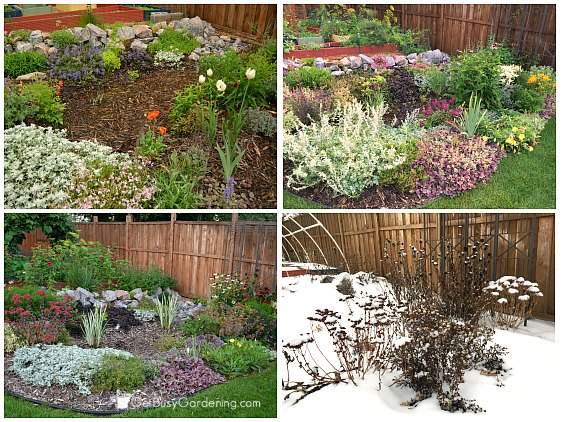
Here are some snaps of a few of my perennial gardens through all four seasons of the year.
Moving left to right starting on top, these collages show you what spring, summer, fall, and winter look like in each of these four garden areas.
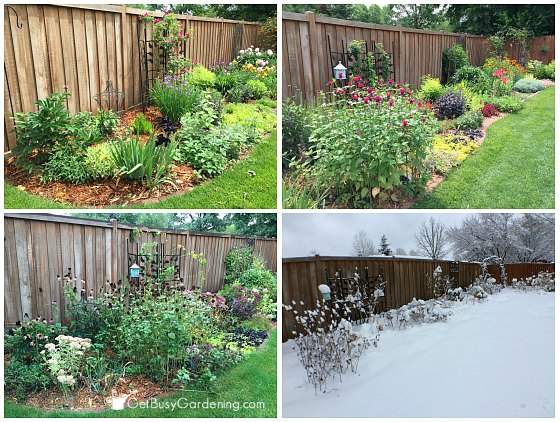
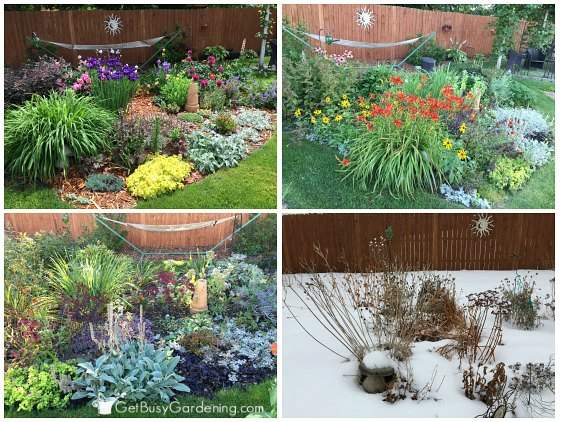
You may never think about what your garden will look like during the winter, but I love to leave a lot of my cleanup chores until spring.
Leaving tall plants in the landscape creates beauty during the winter, and is also great for wildlife (the birds and squirrels are very active in my yard all winter long).
Garden Perennials For Every Season
To help get you started creating your own year-round flower gardens, below I’ve listed some common plants for each season to give you ideas, and get your creative juices flowing.
Early Spring Color
Spring blooming bulbs (like tulips, crocus, and daffodils, for example) will add the first splashes of color in early spring.
Creeping phlox, ajuga, bleeding heart, and colorful foliage plants (like sedums) won’t be far behind.
Related Post: When & How To Plant Your Spring Bulbs
Spring & Early Summer Color
Flowering perennials like peonies, lupine, irises, hardy geraniums, spirea, honeysuckle, weigela, and poppies are great for spring and early summer blooms.
This is also when the foliage colors from hostas, coral bells, sedums, and lungwort really start to pop.
Summer Blooming Perennials
Lilies, coneflowers, hardy hibiscus, rudbeckia, butterfly weed, phlox, liatris, sage, black-eyed Susan… I could go on and on.
But honestly, nobody seems to have trouble finding summer perennial flowers. Be careful adding too much here though, this is the season where flower fixation can really take over.
Fall & Late Blooming Perennials
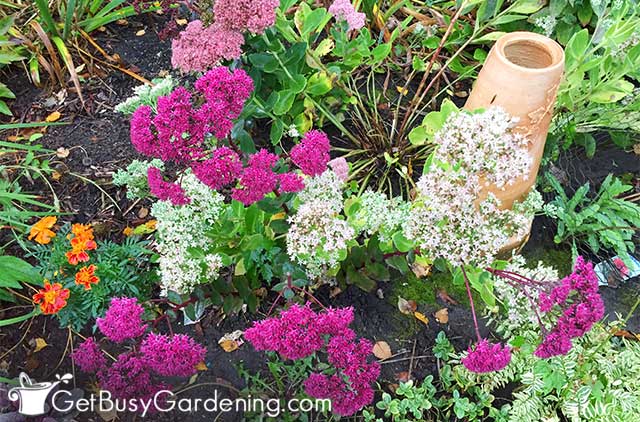
Sedum (the ones with colorful foliage are especially great for adding year-round color), rue, Russian sage, mums, turtlehead, Japanese anemone, and hardy aster are all beautiful fall flowers.
This is a great time to prune spent blossoms and burnt-out foliage from early perennials to help make the fall bloomers and their foliage really stand out.
Perennials For Winter Interest
Leave tall plants like coneflowers, astilbe, rudbeckia, sedum, and hydrangea in the garden to add winter interest.
Some of the flowers contain seeds that feed the birds too, which adds life and movement to your otherwise boring winter landscape.
Maintenance Tips For Perennials Made Easy!
Designing eye-popping perennial beds is the first step. But regular maintenance is the key to keeping them looking amazing. Here are a few quick tips to make it easy for you.
Keep The Weeds At Bay
Mulching your beds will help keep the weeds from taking over, and make maintenance much easier.
It also creates a lovely backdrop for perennials to really make the colors pop. I use a natural hardwood mulch that will break down slowly.
To make it a snap to pull out pesky weeds, I highly recommend getting yourself a Hori Hori knife and also a Cobrahead weeder.
I’ve used a lot of gardening tools over the years, and these are two of the best hand weeding tools I’ve ever used.
Feed Your Plants
Perennials need a lot of energy to look their best, so make sure you fertilize them during the spring and summer months.
I like to use a mix of slow-release granules (either one made for flower gardens or an all purpose blend), and organic liquid fertilizers.
Some my favorite liquid options are compost tea and fish emulsion. Learn more about how to fertilize your flower beds here.
Prune Regularly
Pruning not only keeps the garden looking tidy, it also helps plants look their best by growing bushy, full, and compact, and it can encourage more flowers too.
I recommend trimming your perennials at least once a month to remove any spent flowers and burnt out foliage.
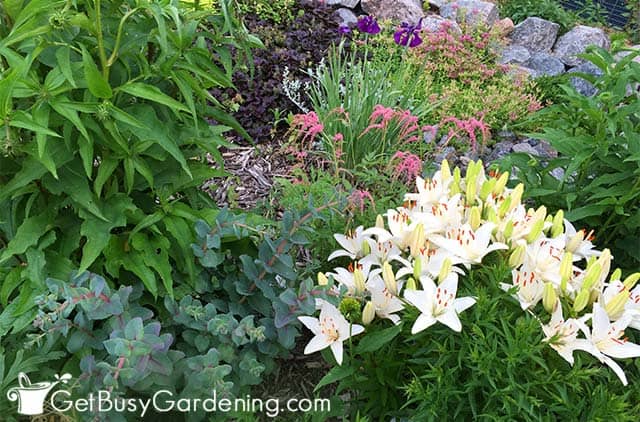
Stake Your Plants
Some perennials can get a little top-heavy when they’re covered in gorgeous blooms, and can flop to the ground under all that weight.
To keep them blooming longer, and your garden looking it’s best, stake any plants that need the extra support.
I find that wire tomato cages or grow through hoops work great for most of my plants. For larger ones, I use heavy-duty metal stakes for extra support.
Related Post: How To Support Peonies To Keep Them From Falling Over
Mixing several plants from this list into one area will ensure your perennial beds will be popping with color all year long, and ever-blooming through the entire growing season. Just remember, avoiding flower fixation will lead to amazing gardens.
Do you have any tips to add to this post about perennials made easy? Please share them in the comments section below.

Meg says
I’m working on developing a garden plan for my front beds. I don’t love my experiment from last year, and so I’m trying to rework and redesign. Thanks for the ideas. I love the idea of planting ground cover on top of the bulbs.
Amy Andrychowicz says
You’re welcome! Have fun with it. ?
Becky says
I live in green country Oklahoma and it gets very hot in the summer. What plants would you recommend that are heat and drought resistant, I don’t mind watering either.this would be for a new garden? Also, my front yard is in the shade from 7 very large 40+ year old Oak Trees. I currently have one garden that has some foliage chocolate ajuga I got from a friend and a lemon mint plant, what shade perennials would you suggest that have flowers? In this same garden I also has 3 small half barrel planters, one has spiderwort the other has Heuchera Grape (Coral bell) and 2 rose of sharon shrubs. Any advise is appreciated.
Amy Andrychowicz says
There are so many options, I can’t possibly list them all here, LOL! But here are a couple of lists of shade plants that should give you some good ideas…
17 Colorful & Gorgeous Shade Garden Plants
15 Shrubs For Partial Shade In Your Garden
40+ Vegetables That Grow In Shade
Don says
Question. I have a lot of daffodils in my perennial garden. The foliage grows two to three feet tall, and then falls over after the blooms die. The fallen foliage pretty much smothers and prevents most plants from growing through it until mid-June when it’s dead and decayed somewhat. Of course, it looks terrible. What would you suggest I do about this?
Amy Andrychowicz says
Yes, that is a common problem! I cut the foliage on mine back to about 1/2 the height. That way, they aren’t so unsightly, but they also keep enough of their foliage to regenerate energy to rebloom next year. Once the leaves are completely dead, then you can prune them out.
Don says
Thank you. I’ve always read not to cut them back, but if trimming off half has worked for you, I’m going to do it too.
Amy Andrychowicz says
Yes, you definitely don’t want to cut them back all the way. They need their green leaves to build energy to flower again in the spring. That’s why I only prune off the tops, and leave the rest until it dies back on it’s own. You’re welcome. 🙂
Tiffany says
I absolutely LOVE how each section you shared looks completely different and interesting during each season! That is exactly what I want the flower beds in my new house to look and act like! Beautiful work! Thank you so much for making this pin for those of us who are newbies trying to figure out where to begin. The house we are moving into the end of November has a TRASHED, tiny flowerbed that runs the entire length of the front patio. It has no interesting shape or anything. Just a straight line of old bricks marking a weedy, mossy mess. This article gave me fantastic advice as to where to start with the plants. I definitely want to change the shape of it also. Add some subtle character instead of just the little strip. But that is information for another pin. Thank you again!
Amy Andrychowicz says
You’re welcome, glad you found the article so inspiring! Good luck re-designing your flower beds and making them beautiful. You’ve got this!
Robin Zabloski says
I live in the Pacific Northwest Zone 7-8. I have a problem with deer. What perennials would you suggest to create my garden beds?
Amy Andrychowicz says
Here’s a post that has a list that has some great perennials for you to try (as well as ones to avoid)… 85+ Deer Resistant Plants For Your Garden
Prossy N says
First of all thank you for doing this Amy. I am falling in love with gardening once again. I grew up gardening and very passionate as well, but move to different country and the land was not accessible for me to continue gardening. However, I recently moved to a new place that has a nice backyard that I am still trying to figure out what to do with it. Reading your article has helped me to start thinking and hopefully next year I will have a garden. Thank you again much appreciated!!
Amy Andrychowicz says
You’re welcome! So glad to hear that this article has helped inspire you to get excited about gardening again! Have fun planning your new perennial garden! 🙂
Sonja says
What would you suggest as a perennial for an area that is shade all morning until 2pm then hammered with that late afternoon sun the rest of the day/early evening?
Amy Andrychowicz says
It’s hard to say, choosing perennials that will work best in your garden really depends on your growing zone.
Jordyn says
What is the best time of year to plant such garden?
Amy Andrychowicz says
Either in the fall or the spring are the best times of the year to plant a perennial garden.
June says
Hi Amy!
I’m from rural North Dakota. Zone 3 to 4. I am working on my perennial gardens. The gardens are in full sun location. I am looking for 4-5 foot perrenniels that are hardy and full. Any suggestions?
Amy Andrychowicz says
You are lucky to have a full sun area to plant, you will have tons of options! There aren’t a ton that will get 5′ tall without staking (unless you start getting in to bushes). But there are several that get up to 4′ tall. Keep in mind that the height of these plants is usually listed by the height of the flowers, and not the foliage – so they won’t be that tall year round.
Here are a few off the top of my head… hardy hibiscus, cone flowers, hydrangea, hollyhock, roses, ornamental grasses, lilies, rudbeckia, aster, astilbe (look for full sun varieties), milkweed, delphinium, poppies, phlox, Russian sage, yarrow, prairie sunflower.
Keep in mind that some varieties of these plants I’ve listed are shorter, so always check the tag. You should also consider adding vine plants, like clematis, honeysuckle, or climbing roses to add height and interest to the garden. You can get some cool arches or trellises for them.
Hope this helps. Good luck, and have fun planning your perennial garden!
Abby says
I love this! Figuring out a beautiful landscape design is so hard, this is helpful!
Amy Andrychowicz says
Yes, designing your own perennial garden can definitely be a challenge. You’re welcome, glad you found it helpful! 🙂
Angela says
Great information. Thanks!
Amy Andrychowicz says
You’re welcome
Diane says
What do you do for weeds and grass besides the mulch? Do you start with laying out plastic or fabric and then mulch over or spray for weeds? I have a bad back and get so frustrated over the amount of weeds I have
Amy Andrychowicz says
No, I do not use landscaping fabric or plastic under the mulch. It’s way too much of a pain to work with when you have to split up perennials or move stuff around. Plus, weeds can still grow right over the top of it. The key is to maintain a thick layer of mulch, at least 3-4″ deep. That keeps the weeds down, and I rarely have to pull very many.
manjiree says
i.m looking for a design with some tall perennials in the middle and smaller ones around
its a semicircle pattern.
for thruout the season blooming, im thinking daffodils, and shasta daisies in the middle,
then peonies, irisis and phlox
let me know if that sounds ok and how would it look. what else would you recommend
Amy Andrychowicz says
Sounds like you’re on the right track for you perennial garden design. Daffodils are pretty short, so you should put those in front or around the borders. Have fun with it!
Trez Klales says
This has been the most helpful article ever!!! I am new at gardening and have been trying to read up on things and also learn as I go — I wish there was a printer friendly option for this amazing article!
Amy Andrychowicz says
Awesome, so glad you enjoyed my article about designing a perennial garden. I don’t have a printer friendly version at this time, maybe some day in the future. 🙂
Crystal says
I love this it is so helpful! Would you be willing to point out what plants are what in your 2nd 4 season flower bed?
Amy Andrychowicz says
Thanks, glad you found this so helpful. Many of the plants in my perennial beds are listed under the section in this article called “Garden Perennials For Every Season”.
Darnell says
Thanks for your information
Very helpful for a first time
Gardener!!!!
Amy Andrychowicz says
You’re welcome!
Barbara says
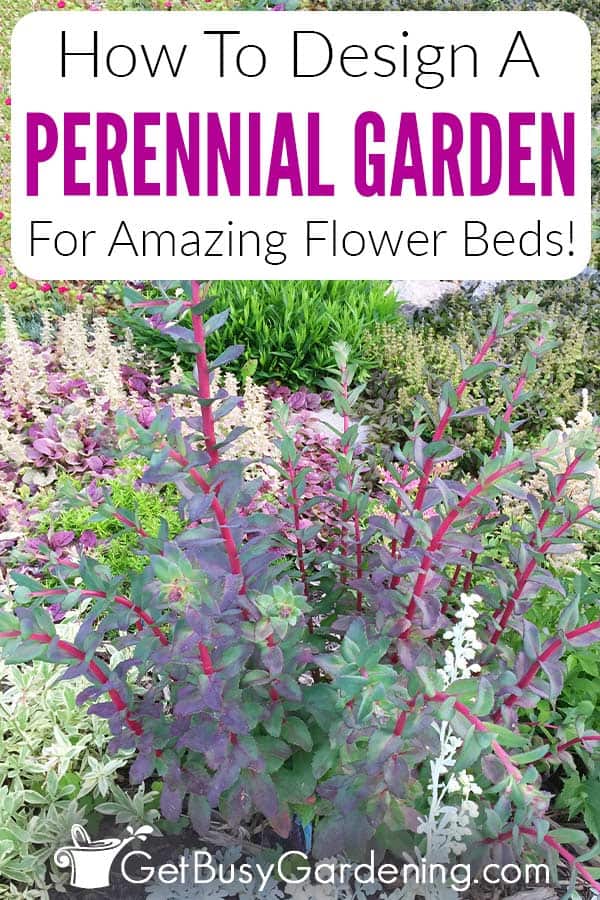
Hi Amy – I live in NC (zone7) and have just located your site. I am curious if you can identify for me the purple plant with red stems that is in the 2nd pic under the PERENNIALS MADE EASY title. It appears that it might be a sedum – just not sure which one … if it is.
Also curious about the purple plant behind the red/orange lily in the pic under TIPS FOR CREATING AN EVER-BLOOMING PERENNIAL GARDEN – Dramatic perennial foliage color heading.
I love reviewing your thought processes and design work in these pictures. Purple is my fav !! that is why i am particularly interested in these two plants.
Thank you very much!
Amy Andrychowicz says
A lot of people ask about those perennials, they are very popular. The one with red stems is sedum telephium ‘Red Cauli’. The dark purple one is also a sedum, and it’s called “Black Jack”.
Barbara says
Thank you bunches! I am searching the internet now.
Amy Andrychowicz says
You’re welcome!
Darnell says
I reside in Buffalo, NY
What plants do you recommend.
Iam new to the area and gardening.
Amy Andrychowicz says
Many of the plants I’ve listed in the post would work in your climate. But the best thing to do would be to go to your local garden center, and talk to them about the perennials to grow in your climate. They should be able to give you lots of great suggestions among the plants they have in stock.