
Peonies are a classic garden plant famous for the huge and highly fragrant flowers. Caring for peonies is pretty easy, and doesn’t require much work.
This detailed peonies care guide has everything you need to know for successfully growing peonies in your garden.


Peonies are one of the most recognizable and unforgettable garden plants that I know of. If you grew up in a cold climate, you probably have wonderful childhood memories about peonies.
I’ve heard many touching stories about people who have had the same plants in their family for generations, passed down from their mothers and grandmothers.
That’s because peonies are long-lived plants that can grow and bloom for 100 years.
Information About Peony Plants
Peonies are prized for their huge sweet smelling flowers that are perfect for cutting, and commonly used in bridal bouquets.
For many, they are a staple in the flower garden, while others dream of growing peonies in their own garden some day.
The good news is that it’s easy to take care of peonies, and they require very little maintenance.
But just like any plant, they will grow and bloom their best when given the right growing requirements.
Different Kinds Of Peonies
There are lots of different varieties of peonies on the market these days. The two broad types are tree peonies and herbaceous peonies.
A tree peony has woody stems, blooms earlier, and the plant is usually larger than herbaceous varieties.
Herbaceous peony plant varieties are the ones where the stems die back to the ground ever year, and those are the ones your grandma used to grow.
In this post, I’ll focus on peonies care for the herbaceous varieties, since those are the most common.
Peony Bloom Time
Peonies season is typically anywhere from mid-May to early June, depending on which growing zone you’re in. Most years they start blooming right around Memorial Day here in MN.
Some types of peonies are early bloomers, and others flower later. So try mixing a few different peony varieties into your garden for longer bloom times.
The flowers usually last for about a week. But if you’re religious about deadheading them, you can extend the bloom time of the plant a bit longer.

Where Can You Grow Peonies?
The peony growing zones range from 2-8. I get asked all the time if peonies can be grown in warmer climates like Florida, Arizona or California.
But the answer is no, they do not grow well in warm climates. In fact, zones 7-8 can even be too warm for some varieties. And pushing the zones can make peonies care much more difficult.
The reason the peonies hardiness zone list doesn’t include warm climates is because they need a cold dormant period to flower. So, sorry to say that this is one that can’t be grown in warm climates.
Where To Plant Peonies
The best place to plant peonies is in a full sun location. Though they will bloom their best in full sun, they will grow just as well in part-shade as long as they get at least 6 hours of sunlight per day.
Another thing to think about when you’re trying to figure out where to grow peonies is to make sure they aren’t crowded.
Giving peonies plenty of room ensures good air circulation around the plants, which prevents disease and mildew issues.
How To Grow Peonies
Before we dive into the details of peony plant care, let’s talk about planting them so they will grow their best.
When To Plant Peonies
The best time to plant peonies is in the fall after the heat of summer, but before freezing temperatures arrive. The second best time to plant them is as soon as the ground has thawed in early spring.
If you must, you can plant them at any time during the growing season, but transplant shock will be worsened by the heat if you plant them during the summer.
So, if you can’t wait until fall, then the best time for planting peonies in summer is on a cloudy day when there’s rain in the forecast. And be sure to keep them well watered until they recover from any transplant shock.

How To Plant Peony Roots
Planting peony tubers too deep is a big problem, and one of the main reasons the plants won’t flower. So it’s important to get this part right.
The proper peony planting depth for bare root tubers is just below the surface of the soil, less than two inches deep.
To plant a bare root peony, first dig a hole that is twice the size of the tubers. Pack down the soil before placing the tubers to ensure they won’t settle deeper than two inches.
Then place the roots on top of the compacted soil with the peony eyes facing up. Cover them with about an inch and a half of soil, and give them a good drink of water.
It can take 2-3 years for a plant to become established and start blooming after planting bare root peonies, so be patient.
Tips For Moving Peony Plants
Peonies hate to be transplanted, so it’s best to only move them if it’s absolutely necessary. The best time to transplant peonies is in the fall.
But, if you can’t wait until fall, then wait until after they are done flowering before moving peonies in spring.
Of course, they can be moved any time if you absolutely need to, but they may have a harder time getting established if you move them in the summer.
Just remember, if you plant peonies too deep, they won’t flower, and this rule applies to transplanting peonies too.
When transplanting peony plants, be sure to plant the rootball at the same depth as it was in the old spot, never plant it deeper.
If you’re transplanting them from a pot, the top of the soil of the rootball should sit even with the top of the soil in the garden.
Just make sure the soil in the hole is packed down before planting peony bushes so that your plant won’t settle deeper into the hole.
It can take a year or two for peonies to recover after being transplanted, so they may not flower the first year. But you should begin to see flowers again the second year.
Peonies Care & Growing Instructions
Now that you have the perfect spot picked out for growing them, and you know when and how to plant them, let’s talk in details about how to care for your peonies.
Best Soil For Peonies
You don’t have to worry too much about the specific soil type for peonies, they aren’t super fussy.
But it’s best to plant them in a rich, fertile and fast draining soil, and peony soil ph should be neutral.
If you don’t know what type of soil you have, you can test it using an inexpensive soil test kit, or a use soil ph meter.
If your soil is hard clay or really sandy, then it would be a good idea to amend it with compost before planting to make peonies care easier.
Also, they won’t tolerate wet soil for very long, so be sure to plant them in a location where the soil drains fairly quickly.
Tips For Watering Peonies
Watering is another important part of peonies care. They hate to be overwatered and despise having wet feet, so take care to never overwater peonies.
Also, be sure you don’t plant them in an area where the soil stays wet for long periods of time. A soil moisture gauge is a handy tool to help you monitor how wet or dry the soil is.
When it comes to watering your peonies, it’s best to water the plants from the bottom rather than over the top of the leaves to avoid issues with mildew and disease.
Deadheading & Pruning Peonies
Pruning peony bushes is not absolutely required, but it helps to keep the plant looking it’s best, prevent disease and mildew issues, and extend their flowering.
So it’s a good idea to make pruning a regular part of your normal peonies care schedule. Here are some quick tips for how and when to cut back peonies…
Deadheading peonies in the spring can help to extend the flowering time of the plant.
There are a couple of buds per stem, and the smaller side buds will bloom more reliably if you remove the larger center flower once it has started to fade.
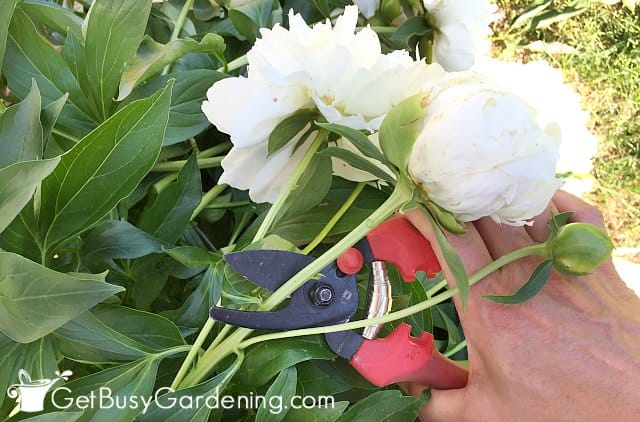
To deadhead a peony, simply cut off each of the single flowers with a clean and sharp pair of pruning shears as soon as they begin to fade.
Pruning peonies after blooming – Once the plant is done blooming, prune peony stems back to below the height of the bush so the empty stem isn’t sticking out all summer long.
At this time, you can also prune back the entire bush a few extra inches to keep it shapely, and thin it to improve airflow.
Don’t cut peonies down to the ground during summer pruning though, your plant needs to have leaves to generate plenty of energy to bloom again next year.
You can cut back each stem individually using hand pruners, or you can use hedge shears or electric hedge trimmers to make the job easier.
Pruning peonies in fall – Pruning is an important part of fall care for peonies. You should remove all the leaves and stems in the fall after a killing frost rather than waiting until spring.
Cutting back peonies in the fall is especially important if your plant was infected with mildew or disease, as they can overwinter on the plant leaves and infect the plant again next year.
Peony Fertilizer Requirements
Peonies thrive on neglect, and don’t need to be fertilized, especially if you amended the soil before planting.
But, if they are planted in a poor quality soil, or you’ve never fed them before, then they will definitely benefit from it.
The best time for feeding peonies is after they are done blooming in early summer. A yearly side dressing of compost or aged manure, as well using an organic all-purpose fertilizer is really all they need.
Never apply compost over the top of the main rootball though, otherwise the plant could act as if it’s been planted too deep stop flowering.
As for the best fertilizer for peonies, I always recommend using organic fertilizers because they work better than synthetic ones, and there’s less risk of burning your plants.
My favorites types of organic fertilizer for peony plants are compost tea (you can buy pre-made liquid compost tea concentrate, or buy compost tea bags for brewing your own).
Or try a general purpose one (you can buy liquid fertilizer, or use slow-release granules if you would rather).
Related Post: How To Fertilize Your Flower Garden Beds
Peony Plant Supports
Peonies require very little care, but one thing they do need is extra support when they’re blooming so the flowers don’t flop to the ground as soon as they open.
So you’ll definitely want to add this task to your regular peonies care routine.
The best time to add plant supports for peonies is either in the fall right after you cut them down, or in early spring before the plant starts growing.
Of course, you can add plant supports at any time, but it’s much easier to do it when the plant is dormant.
Otherwise you can risk damaging the stems or blooms by staking them once they’ve started growing.
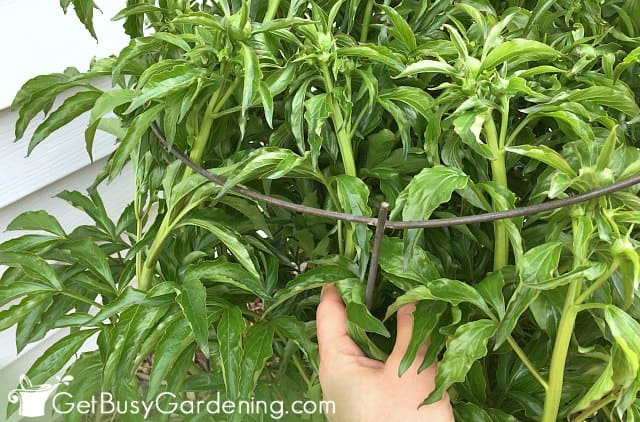
You can get a hoop ring, or simply support them using garden stakes and twine or flexible plant ties.
Learn more about peony supports, and get step-by-step instructions for exactly how to stake peonies here.
Peony Pest Problems
Peonies don’t have many problems with pests, so this is something you shouldn’t have to worry about as part of your peonies care routine.
In fact, peonies are rabbit and deer resistant, which is awesome for those of us who have to battle these furry pests.
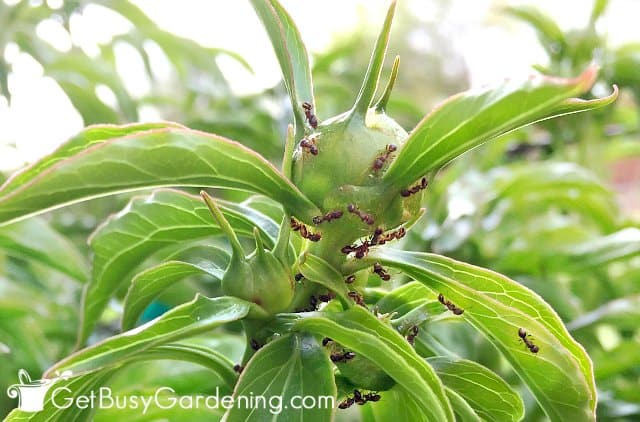
One bug that readers ask me about all the time is ants on peonies. There is an old wives tale that people still share today claiming that peonies need ants to bloom. This is totally not true, it’s a gardening myth.
Ants (and the wasps at my house) like to eat the sweet nectar that is excreted as the peony buds are forming.
But the ants have no effect on the plants at all, positively or negatively – and don’t worry, they’re definitely not eating the flower buds.
If ants are a problem on your peonies, simply shake or wipe them off before bringing the flowers into the house. Otherwise, you can just leave the ants alone.
How To Propagate Peonies
The only reliable method of propagating peonies is by division, and their roots are fairly delicate.
Take care when dividing peonies so that you don’t cut or break off more roots than you need to.
Unlike many other perennial plants, peonies don’t need to be divided on a regular basis.
But they can be split if you want to share peony starts with friends, or to create new plants for a different garden area.
You can divide the entire rootball, or just remove a few of the tubers for planting. Just be sure the peony root tubers have three to four eyes each to get the best results.
Troubleshooting Common Peony Problems
Even though peonies care is very easy compared to many other types of perennials, they aren’t completely care-free.
When it comes to growing peonies, the biggest issues you’ll probably run into are mildew/mold, disease, peonies not flowering, or the flowers falling to the ground as soon as they open.
Here are some tips for troubleshooting the most common peony problems.
Peonies Not Blooming
Lack of flowers can be caused by two things, either the roots are planted too deep or your plant isn’t getting enough sun. Peonies won’t bloom in shade, they need at least 6 hours of sunlight to flower.
The more sun they get, the better they will bloom. If you’re worried you planted your peony too deep, then you can replant them shallower.
Also, take care when mulching peonies to be sure that you’re not burying your plants. If they are covered with mulch or compost, it has the same effect as if they were planted too deep.
Keep in mind that it can take 2-3 years for peonies to bloom after planting them, so if your plants are new, they may just need more time.
Mold/Mildew Or Spots On The Leaves
Most of the time, any type of peony disease or mildew issues can be treated by simply trimming peony bushes in the summer to allow for better air circulation around the leaves.
As soon as you see any spots on the leaves, or notice powdery mildew on peonies, remove the infected parts and destroy them. You can also try using an organic fungicide to help control it.
Also, be sure to clean up all of the foliage in the fall and destroy it to so that the spores can’t overwinter on the plant.
Cutting down peonies in the fall and removing all of the foliage from the area helps prevent the disease/fungus from overwintering on the plant.
Peony Wilting After Transplant
When a plant droops or wilts after planting, this is called transplant shock. The best thing to do is make sure your plant is well watered during this time, but otherwise leave it alone.
Wait to prune or fertilize your plant until it has perked back up again, and recovered from the shock.
Transplanting peonies in the early spring or fall is the best way to prevent transplant shock. See the When To Plant Peonies section above for more details.
Flowers Crash To The Ground As Soon As They Open
This is the biggest peony problem that most people will have, it’s very common, and it’s an important part of proper peonies care.
The huge flowers are too heavy for their stems to hold up, especially when they become wet after a rainfall, so they fall to the ground.
The best way to prevent this problem is by staking them, or using some kind of a support.
Where To Buy Peony Plants
If you’re wondering where to buy peonies, you should be able to find potted peony plants for sale at your local garden center.
They are most commonly sold during the spring and summer, as long as they are hardy in your growing zone. Many times you can also find peony roots for sale in the bulbs and tubers section too.
You can also talk to your local garden center to see if you can order peony plants. Of course, you can always buy peonies online too, which is probably where you’ll find the best variety.
When it comes to fragrant flowers, peonies are hard to beat. The sweet smell and huge flowers are what makes them so popular.
Even when they’re not blooming, the dark foliage makes a gorgeous background for other flowers. Plus peonies care is so easy, and they require very little maintenance, which is always a huge plus for me. As long as you live in the right climate, you really can’t go wrong with peonies.
More About Flower Gardening
- How To Care For A Voodoo Lily Plant
- How To Care For Russian Sage
- Bird Of Paradise Plant Care & Growing Guide
- How To Care For Butterfly Weed (Asclepias tuberosa)
- When & How To Plant Spring Bulbs
- Annuals vs Perennials: What’s The Difference?
- False Goat’s Beard: How To Grow & Care For Astilbe
Share your peonies care tips in the comments section below.


Radine Klein says
This article was so helpful. I have been growing peonies for many years, but have never tried to transplant any. I ordered 2 plants this year from a bulb company and have planted them in a new, full sun garden in the front yard. I’m hoping that they will perhaps produce a bloom or two. One is a beautiful pink and the other is a deep red. Looking forward to reading your continued articles, which are so interesting and helpful.
Amy Andrychowicz says
Awesome, I’m so happy to hear that you found this article helpful! Good luck with your new peonies, I hope they will grow well for you. They sound beautiful!
Gari Stewart says
Don’t tell my peony it can’t grow in Texas. It is planted in an elevated area of clay soil next to a storm shelter. I rd had it about 4 years. This year it has 17 blooms. Light pink with double blossoms. Beautiful flowers! But it rained the day after blooms started opening. My husband is out there right now staking them up. Thought about overturning a large garbage can over them during the rain. They only bloom once a year, then I just cut the blooms off and leave the plant until the hot Texas sun cooks it.
Amy Andrychowicz says
LOL! Yes, sometimes peonies can find the perfect micro-climate in areas they aren’t supposed to be able to grow. There are also some new heat-resistant varieties that are bred for warmer climates, so maybe you have one of those. I sure do wish they would bloom more than once per year, love them!
Sue Stickley says
My peony bush has 6 blooms & they won’t open! Any suggestions?
Amy Andrychowicz says
When peony buds don’t open, it could be due to a few common issues. First, make sure it’s getting full sun. They won’t bloom in the shade. Also, peonies hate being transplanted, and that can stunt the blooms for a few years. So, if you moved it recently, then that could be the problem. In that case, it should be back to normal in a year or two. Also, if they’re planted too deep, the buds may not open. One other thing to think about is your climate. If you live somewhere warm, then that might be the problem. Peonies need a period of cold dormancy to bloom. If you have short or mild winters, or it’s in a protected spot where it stays too warm, then it may be getting cold enough to bud, but not flower.
Tam says
Mine were given to me by my mother and I had no idea they were peonies!! There was only the green foliage for the past 2 years so I thought they were ornamental. This year to my great wonder I have the first beautiful pink bloom!! I live in zone 7. They get morning sun/ afternoon shade. How many blooms could I expect this 1st blooming year?
Amy Andrychowicz says
How fun! Yes, it definitely can take a few years for newly transplanted peonies to bloom, so that is totally normal. I can’t tell you how many flowers your peony plant will get in this first year of blooming. But, it will definitely be more and more each year, until they are covered in flowers. 🙂
Dyana says
Three of our peony plants are very close to 100 years old. Am I really going to lose them?
They came from our great grandmothers yard. We planted them in our garden 25 years ago. Compared to newer versions I’ve planted over the years, they have much deeper red shoots in the spring, much thicker stems and much darker pink flowers. The blooms are always crazy enormous. The plants are very tall. Like a very big shrub. Every year it has more flowers than the last. I support them with diy frames. I deadhead or actually the truth is – I literally just cut them before or when they flop over every year to make flower arrangements for special events. Should I divide them again or do something special to them before it’s too late? Everyone else who got them from her garden never managed to keep them growing. Not sure why we were so lucky but we sure are grateful to still have them.
Amy Andrychowicz says
Oh, that timeframe is just a rough gauge. Peonies can live for a very long time. As long as yours are healthy and happily blooming every year, then you don’t have to worry. Since you split them 25 years ago, then I would consider them 25 rather than 100 years old. 🙂
Sue Daley says
I tend to plant single as opposed to double peonies and they have never needed staking. I did have a problem with Scarlet OHara years ago I think it got a fungus and went from a gorgeous 5’ by 5’ beauty to total destruction in a month. It broke my heart. I treated the soil with fungicide for several years and haven’t had the problem since.
Amy Andrychowicz says
Great to hear that your single peonies don’t need staking. Mine do here, but they definitely don’t get as heavy as the double peony flowers do. I’m glad to hear you were able to save your Scarlet OHara from the fungus that infected it. It can be a big problem for them, especially if they are too crowded, or growing up against a house or fence.
John Richardson says
We have flies on our peonies and they chased away the ants.The flies are green and copper in color. My neighbores do not have this problem.
Amy Andrychowicz says
If the flies aren’t causing any damage to your peonies, then I wouldn’t worry about them.
June Fiorito says
I planted a Yellow Peony 5 years ago. After two years of waiting, the plant produced beautiful flowers, two years in a row. Then for two years there have been no flowers or leaves! No signs of growth this year as yet. The branches were never pruned or cut down. What did I do wrong? Can it be remedied? HELP, PLEASE! I don’t want to lose this plant!
Amy Andrychowicz says
Oh no, sorry to hear your peony isn’t doing well. If there wasn’t any growth at all last year, then it may not have survived. Keep an eye on it this year. But if there’s still no signs of life… then it’s a goner. Lack of pruning won’t kill a peony bush. If it grew that well for a few years, then slowly declined before it died, my guess is that the soil was too wet, and the tubers rotted. Check the drainage of the soil in the location where you were growing it to see how wet it is. If you want to try again with a new peony, be sure to plant it in a full sun location that has fast draining soil. Peonies won’t grow well in soggy soil.
Cinny says
Shhhhh! Don’t tell my peonies they can’t grow in CA (Zone 9b) because they’ve been doing GREAT for YEARS. They do get afternoon shade, though.
Amy Andrychowicz says
Haha! That’s awesome to hear! I have never tried to grow peonies anywhere but here in MN, but all my southern friends say they can’t grow them in warm climates. So it’s fantastic to hear that you have great success growing peonies in California! Thanks for sharing. 🙂
Amita says
After reading your earlier post on supporting peonies, I bought 2 circular wire systems in late spring. But my peony plants were already too big, so I customized the support systems using some more wires & twines. And this year my peonies didn’t flop, they looked beautiful for days & lasted longer!!!! I deadheaded some & got even more blooms :). Thanks for all the information on your blog…I am now able to take care of my plants properly.
Amy Andrychowicz says
Awesome! You’re welcome! So glad to hear that your peonies didn’t flop over again this year. Woohoo! They are so much more enjoyable when you know how to care for them. 🙂