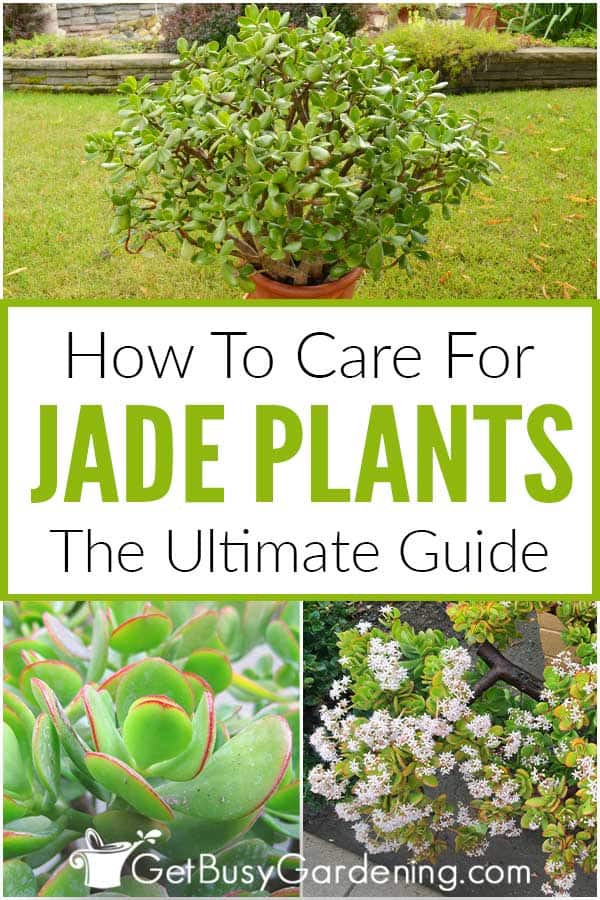
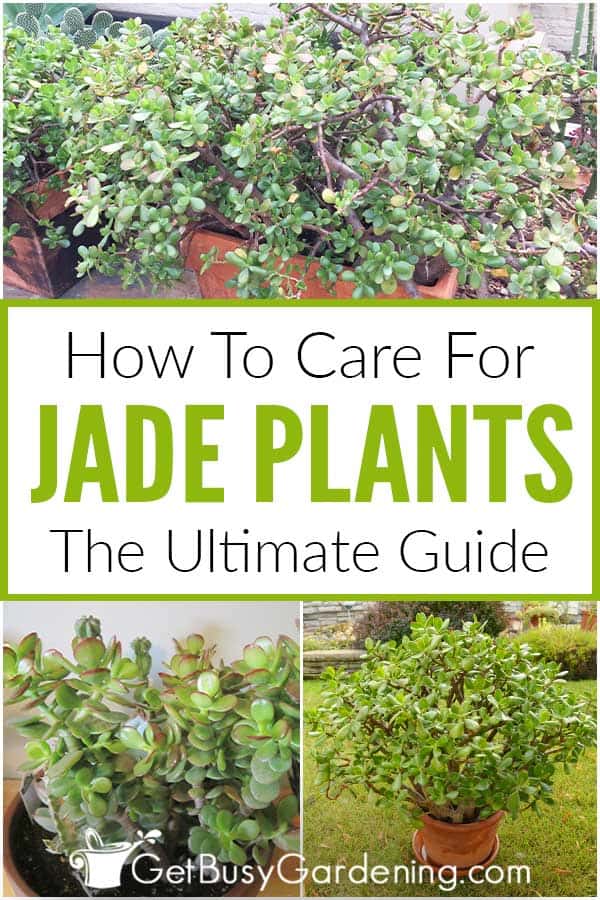
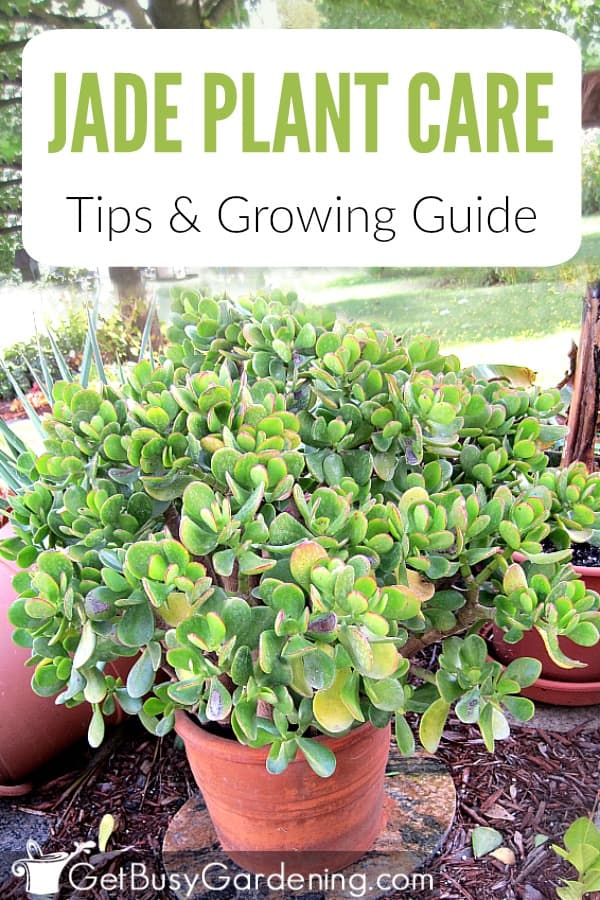
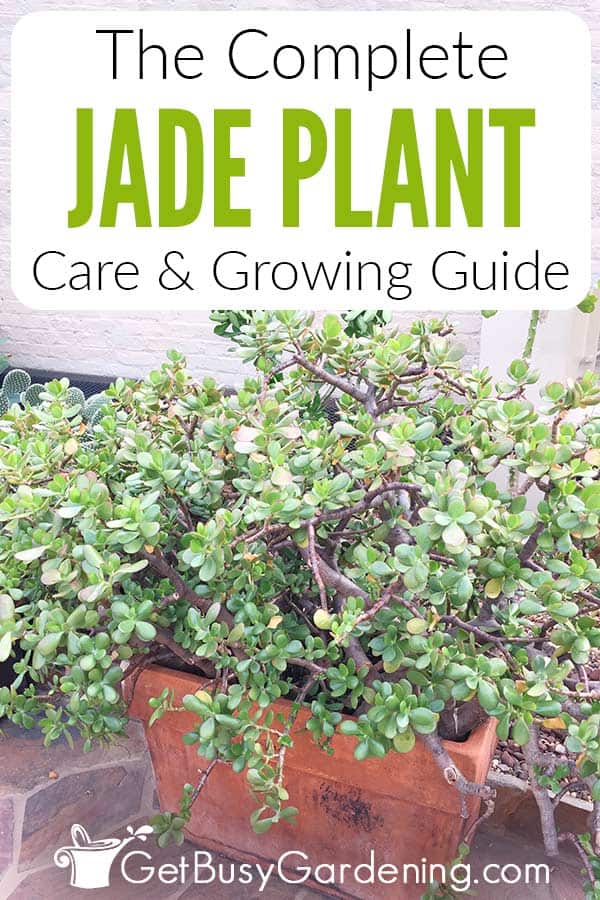
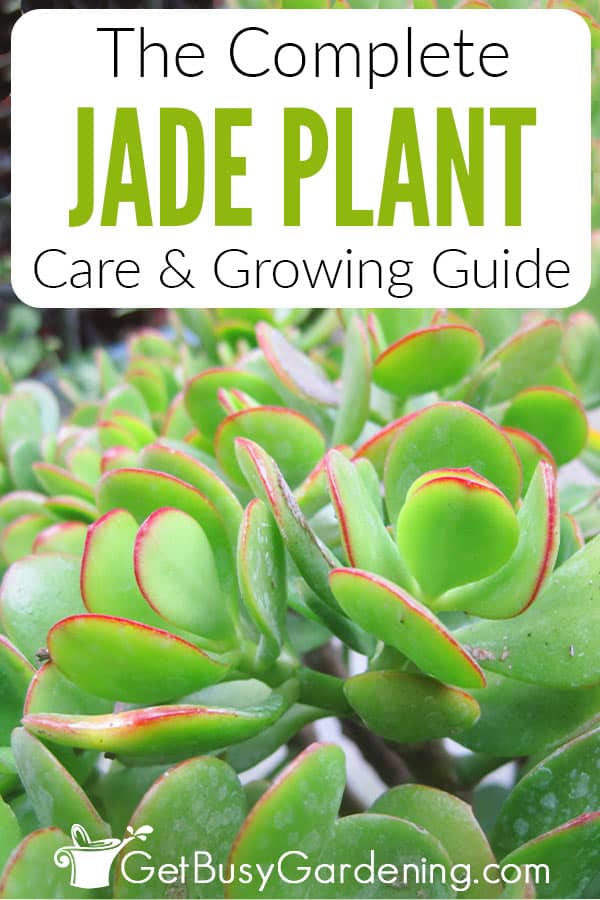
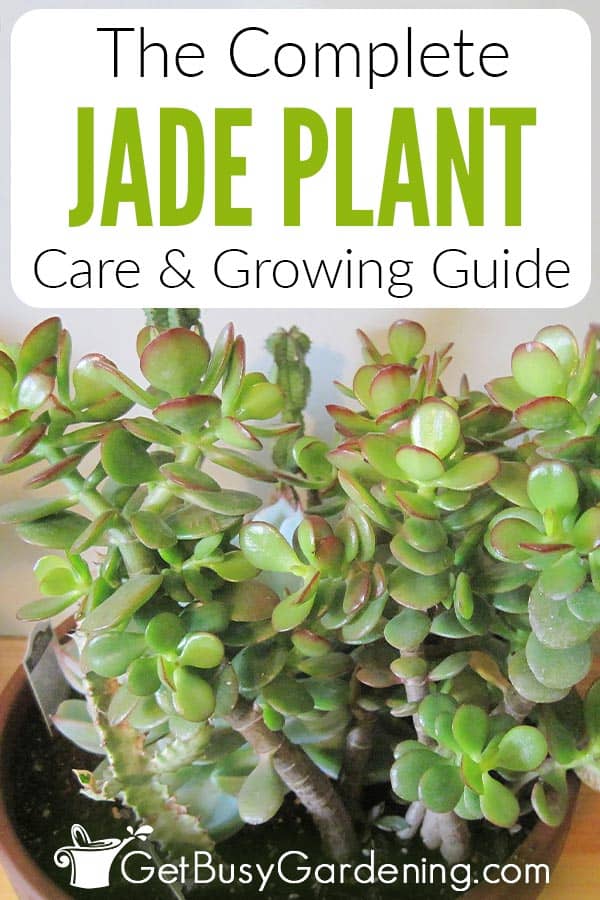
Jade plants are easier to care for than most people think, even for beginners. They grow very well either indoors or outside, and can live for many, many years.
In this complete jade plant care guide, I will show you all you need to know for the best success. We’ll cover everything, from water, light, and soil, to pest control, fertilizer, troubleshooting common problems, and much more.
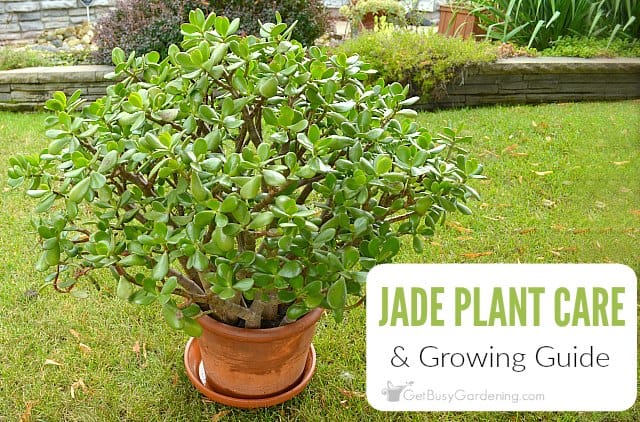

I have been growing jade plants, both indoors and outside, for a few decades. In fact, I still have the very first one I ever bought waaaay back in 2001, and it’s one of the oldest plants I own.
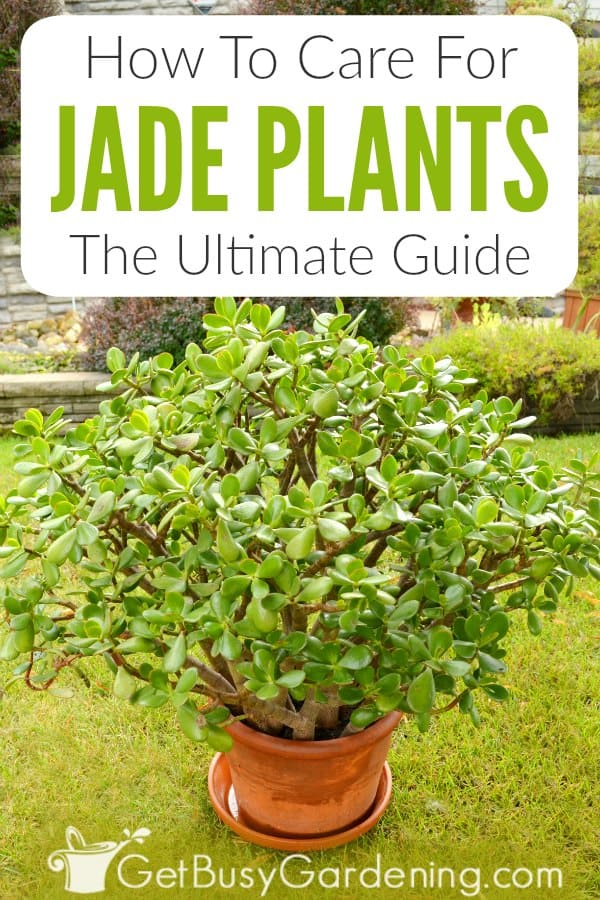
When I got it, it was a tiny thing in a 4″ pot, and now it’s about 3′ tall and wide (it’s the one in the photo above). Since then, I’ve added several others to my collection (you’ll see some of them in the pictures below). Every one of them is thriving, and I love them all.
Needless to say, I was very excited to write this guide to share my wealth of knowledge and expert hands-on experience with all of you.
Quick Jade Plant Care Overview
| Scientific name: | Crassula |
| Classification: | Succulent plant |
| Common names: | Jade plant, Money plant |
| Hardiness: | Zones 9-11 |
| Temperature: | 55-85°F |
| Flowers: | White or pink, blooms in winter |
| Light: | Full sun to partial shade |
| Water: | Allow soil to dry between waterings, do not overwater |
| Humidity: | Little to none |
| Fertilizer: | General purpose plant food in spring and summer |
| Soil: | Fast-draining, sandy soil |
| Common pests: | Mealybugs, scale, spider mites |
Information About Jade Plants
Jade plant (Crassula) is a perennial succulent that is native to parts of South Africa and Mozambique. In nature, they can reach heights of 6′ tall or more, and are often used as shrubs in warm climates.
They’re also known by the common name “money plant”. But don’t confuse it with other plants that go by the same common name, because they require very different care…
Different Types Of Jade Plants
There are lots of different types of jade plants, so you can grow a nice variety of them if you’d like to. I have several in my collection, and I adore every one of them. Here are a few of my favorites…
- Crassula ovata – This is the common jade plant variety that everyone knows and loves. It has rounded, flat leaves, and can grow to become a large shrub with a very thick trunk.
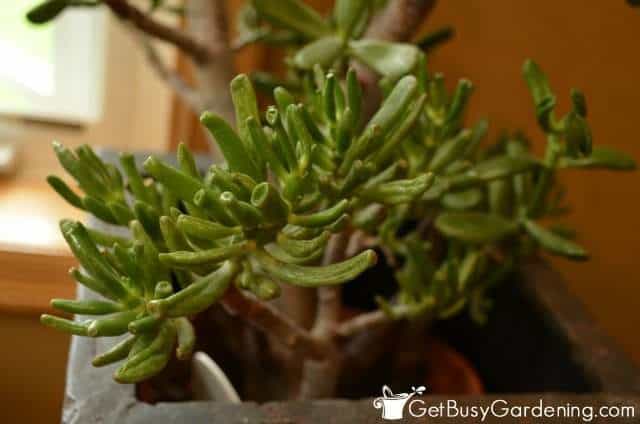
- ‘Gollum’ jade plant – Also called E.T. fingers or baby toes, this variety has really cool tubular shaped leaves that are long, narrow, and rounded.
- Crassula ovata ‘Hobbit’ – Often used interchangeably with the one above as they look very similar, this is commonly called “Shrek Ears” or “Ogre Ears” because the tubular leaves are wider on top as if they are tipped with suction cups.
- Dwarf jades – As the name suggests, dwarf varieties are simply a smaller version of the regular one. They look exactly the same, but have smaller leaves and will only grow to be a few feet tall.
- ‘Jitters’ – A unique variety that has thin, wavy, rippled leaves that are lighter green than the other types.
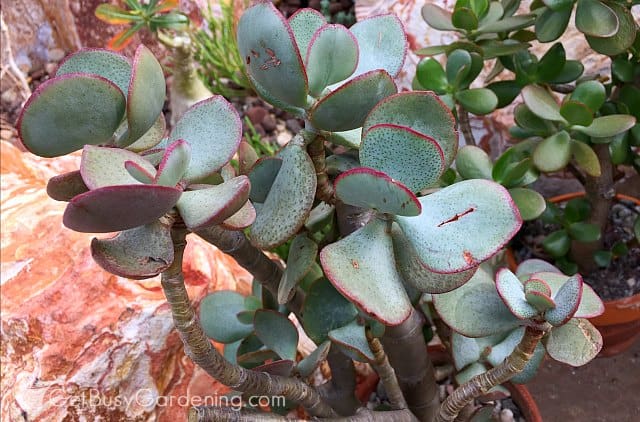
- Crassula arborescens – Also called a “Silver Dollar”, this gorgeous specimen has wide silver/gray leaves with red tips.
Flowers
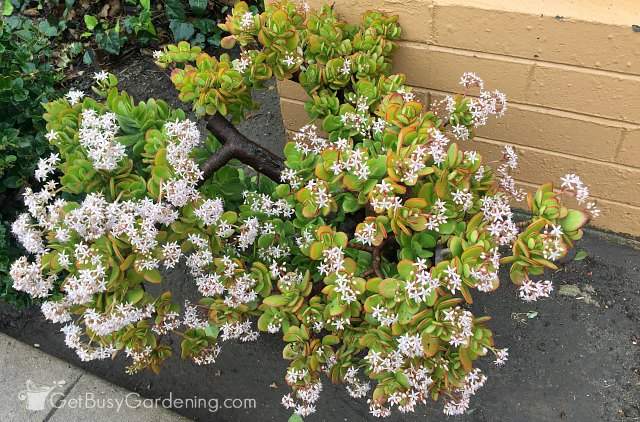
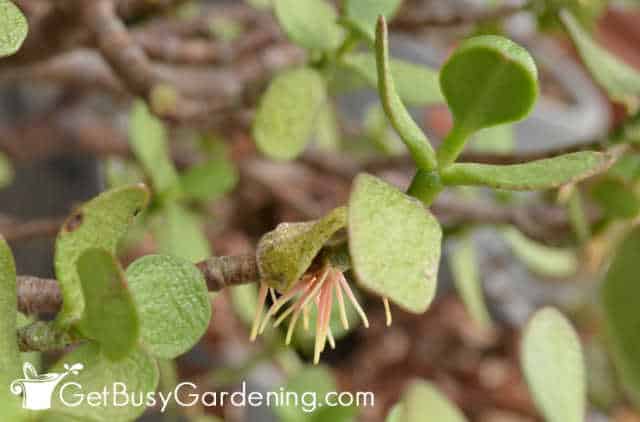
Many people are surprised to learn that, with the proper care, jade plants can flower. In warmer climates where they grow outside year-round, they bloom during the winter. But it’s very uncommon indoors without help.
To get your jade plant to bloom, you need to give it similar conditions to what it experiences when it’s outdoors.
The trick is to give it tons of light during the summer. Then, expose it to cooler (but never freezing) temperatures in the fall, and allow the soil to dry out.
When you bring your jade back inside in the fall, put it in a sunny spot, and keep the soil dry. You should start seeing flower buds in a few weeks.
Crassula Toxicity
According to the ASPCA website, jade plants are toxic to dogs and cats if they ingest them.
My cats have never touched mine, but it’s a good idea to keep them out of reach if your pets like to snack on plants, just in case.
Where To Grow Jade Plants
If you live in a warm enough climate, you can grow your jade plant outside year-round. But they also do very well as indoor houseplants.
Hardiness
Jade plants are hardy down to zone 9. They can handle a bit of cold, and are even tolerant of light frost. But they will eventually die if it stays cold for too long.
If you live in an area with harsh winters, then you’ll either need to bring your plant indoors for the winter, or keep it as a houseplant.
Location
The best location to grow your jade plant is a sunny spot with dry soil. Outdoors, plant it in a spot where the ground is very sandy and fast-draining. Indoors grow your potted jade in a sunny, south-facing window.
You could keep it indoors year-round, or put it outside during the summer to give it a growing boost. Just make sure the pot has holes in the bottom, and bring it back inside before it drops below 60°F in the fall.
Related Post: Debugging and Cleaning Potted Plants Before Bringing Them Indoors
Jade Plant Care & Growing Instructions
For the most part, caring for jade plants is easy. But they do have some pretty specific growing requirements. So, for best success, follow my detailed instructions and tips below.

Watering
The biggest mistake that people make with jade plant care is overwatering, and this is their #1 cause of death. Too much will cause root and stem rot, quickly killing your plant.
You can learn exactly how to properly water your jade plant in this guide, but here are a few quick tips:
- Let the soil dry at least 2-3″ deep before giving your plant more.
- When it’s time, water deeply until it starts running out the bottom holes, and let it drain away completely.
- Give your plant less in the winter, and slightly more during the hot summer months.
- If you struggle with getting it right, get yourself an inexpensive soil moisture gauge to make it easy.
Light Requirements
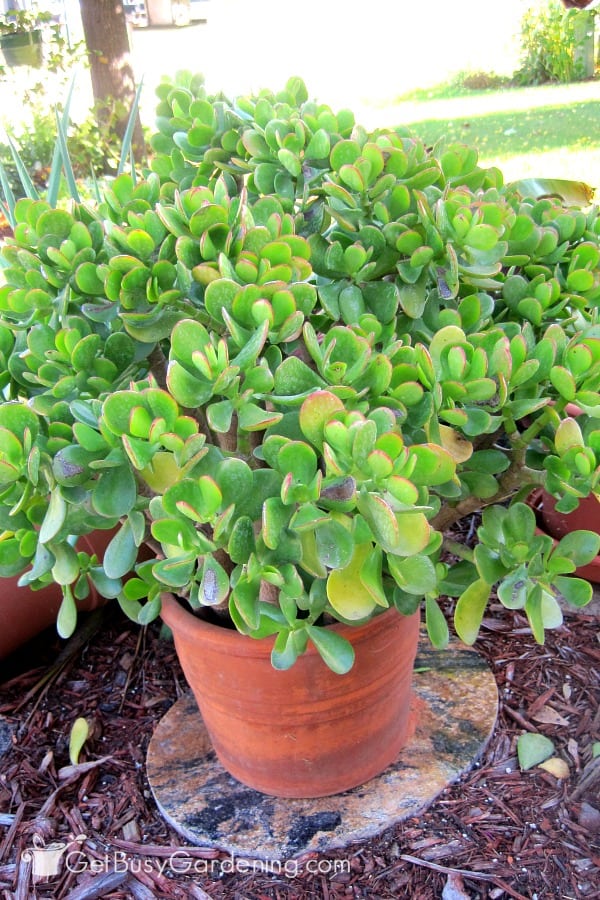
Though they will tolerate partial shade, jade plants grow best in a full sun location. If it’s too dark, especially indoors, the stems and branches will become weak, thin, and leggy.
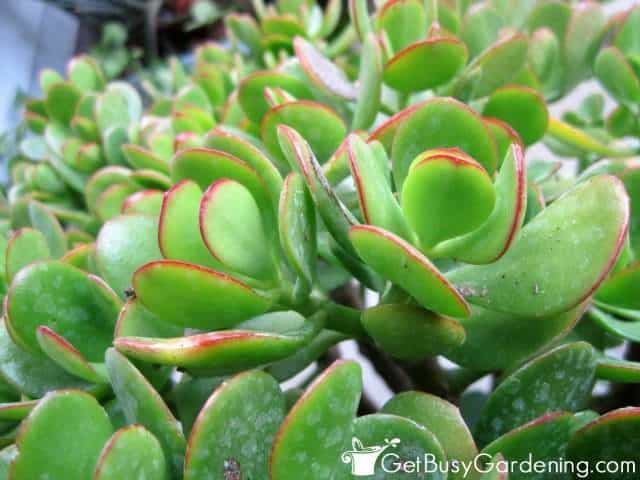
With enough sunlight, the stems and leaves will be thick and compact, and the trunk will turn brown and woody at the base. Also, the leaves or tips of your jade plant will turn red, making them even more beautiful.
Here’s are my tips to figure out the ideal amount light for your plant:
- Indoors – Place your plant in a sunny, south-facing window. If you don’t have enough natural sunlight in your house, then add a grow light to supplement.
- Outside – Grow your jade plant in a full sun to partial shade location. If it gets too much shade, then the leaves will stay green and your plant won’t flower.
Temperature
Jade plants grow their best when the temps are between 55-85°F. They can handle occasional frost, but they’re not very cold hardy.
They’ll also survive brief periods of freezing temperatures, but will start to suffer if it’s cold for too long. So make sure to protect your plant or bring it indoors if it’s going to stay below 45°F outside.
On the flip side, they can handle the heat in the summer. But the leaves can start to shrivel in extremely hot and dry weather. So you should give your jade a little extra water during extended heatwaves.
Best Soil
Using the correct soil for your jade plant is a crucial part of their care. They need a porous and quick-draining mix. General purpose potting soils hold too much moisture, and can cause your plant to rot.
You can buy succulent soil, get a gritty commercial mix, or you can make your own by mixing coarse sand, potting soil, and perlite.
Repotting
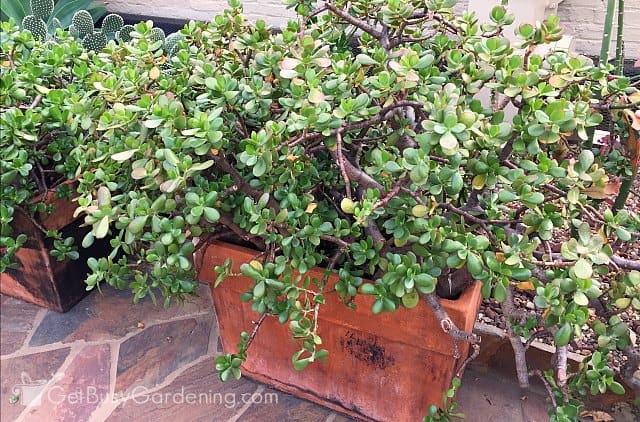
Jade plants have very shallow roots, so they can live in the same pot for many years. In fact, it’s better to keep your plant a little root-bound, rather than repotting it too often.
When the time comes, choose a container that is 1-2 sizes larger than the current one. I recommend using an unglazed clay pot, but plastic or another type will work, as long as it has drainage holes in the bottom.
Fertilizer
You don’t need to worry too much about fertilizing as a part of your regular jade plant care routine. But it will help to encourage faster growth and flowers.
Apply a general purpose liquid monthly during spring and summer, or top-dress with slow-release granules once or twice.
Jades go into a dormant state during the colder months, and you should let them rest. So don’t fertilize during the fall and winter, or the new growth will probably be weak and leggy.
Pest Control Tips
Healthy jade plants don’t usually have problems with pests. But sometimes mealybugs, scale, or spider mites can attack them, especially indoors.
You can spot-treat small infestations by soaking a cotton swab in rubbing alcohol and using that to remove the bugs. For a larger or persistent outbreak, treat your plant with neem oil or a insecticidal soap.
Jades can be sensitive to some types of sprays though. So test any product that you want to use on a couple of leaves first to make sure there’s no damage before you treat the whole plant.
Pruning
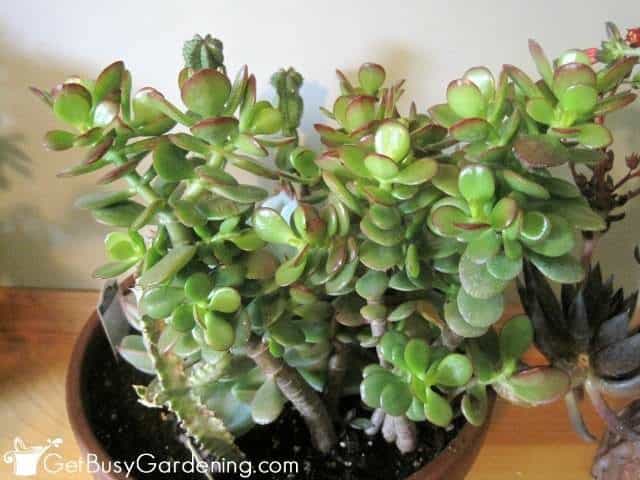
Regular pruning is another important part of jade plant care. It will help to keep the foliage compact, and encourages the stems and the trunk to grow thicker.
Pinch off the new tips as they form in the spring or early summer, and use a sharp pair of precision pruners to trim leggy growth and encourage branching.
Get my full step by step instructions for when and how to your prune jade plant here.
Propagation Tips
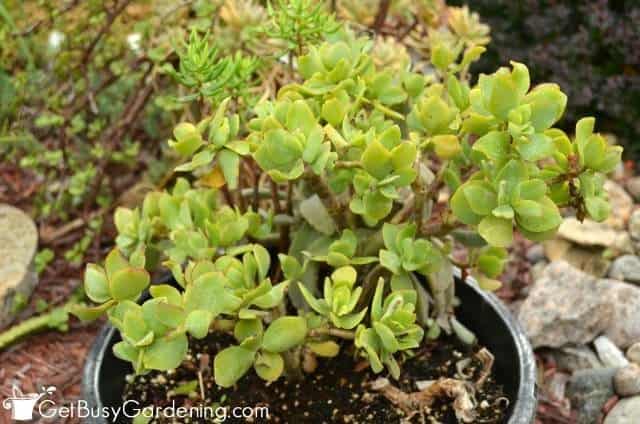
Jade plants are extremely easy to propagate, and you can grow tons of new babies by rooting either stem or leaf cuttings.
Allow the cut area to dry for a few days, then dip it in rooting hormone. Plant it in a slightly moist, well-drained soil mix, and in a few weeks it will form roots.
If you want to learn more about how to do it, then check out my detailed step-by-step jade plant propagation instructions here.
Troubleshooting Common Problems
In this section, I’ll help you troubleshoot some of the most common jade plant care problems you may have, with tips for how to fix them.
Leaves Or Branches Falling Off
When the leaves or branches start dropping off, it’s almost always caused by improper watering (usually too much), but it could be from a bug infestation.
Inspect your plant for signs of bugs, and treat any that you find. Ensure the soil dries completely before giving more, but never to the point where the leaves start shriveling or the plant droops. Use a moisture gauge to get it just right.
Mushy Or Rotting Stem Or Leaves
When the stem, branches, or leaves are brown and mushy, then it means they are rotting because of excessive moisture.
If they’re rotting on the top of your jade plant, then you can just prune off the affected parts. Otherwise, if the main stem is mushy, then you’ll have to take healthy cuttings to start new plants.
Leaves Turning Brown
This could be caused by improper watering or sunburn. If the brown leaves are soft and mushy, then they’re rotting from overwatering. Otherwise if they’re dried up and crispy, then your plant isn’t getting enough moisture
Ensure you’re giving your jade the correct amount of moisture, and harden it off before moving it into the full sun to prevent burning.
Trunk & Stems Turning Brown
It’s normal for the main trunk and branches to turn brown and become woody with age, and it means that you’re doing a great job of caring for your jade plant. However, if smaller stems suddenly turn brown after moving them into the direct sun, it is from sunburn.
In that case, move your jade back to the shade, and slowly acclimate it to the full sun over a period of a few weeks.
Shriveling Or Drooping Branches Or Leaves
When the leaves or branches shrivel, that usually means your jade plant isn’t getting enough moisture.
However, it can also be a sign that the stem has rotted. If the base is not mushy, then water your plant more often. Otherwise, treat it for rot.
Roots Growing On The Stem Or Branches
When roots grow on the stem or branches, they are called “aerial roots”. Though it’s not always a problem, this can be triggered by under watering, and also happens when the main stem is rotting.
Ensure your jade is getting enough moisture, and check the entire stem for signs of rot. If all is good, then you can just prune off the stems with aerial roots if they bother you, or leave them be.
FAQs
Below I will answer some of the most frequently asked questions about growing jades. If you can’t find the answer to your question here, ask it in the comments below.
Is a jade plant indoor or outdoor?
You can grow jade plants either indoors or outdoors, depending on where you live. They aren’t cold hardy though, so you must move them indoors in freezing weather (anywhere less than zone 9).
Do jade plants go dormant?
Though jade plants don’t go fully dormant, they do go into a resting state in the cooler winter months. During this time, growth will slow, and they don’t require as much water.
Does a jade plant like to be root-bound?
Yes, jades like to be root-bound, and can live in the same pot for many years. Their root system isn’t very large, so keeping them in a smaller pot will help prevent overwatering.
Jade plants are easy to care for, and beautiful too. If you follow my detailed tips in this guide, you’ll have no problem keeping yours growing and thriving for decades to come.

If you want to learn all there is to know about maintaining healthy indoor plants, then you need my Houseplant Care eBook. It will show you everything you need to know about how to keep every plant in your home thriving. Download your copy now!
Share your jade plant care tips in the comments section below.

Arlene Collins says
I have a Jade plant that is pushing 25+ years old, just in the last few months I have noticed that there is a fine powdery stuff on the branches, and the leaves will turn black ( at the join onto the stem) then yellow and fall off…I have doused it with mealy bug spray ,soap and nothing is helping. Have even trimmed it down to almost nothing, it is still there…I’m at my wits end with this HELP
Amy Andrychowicz says
Since you say the leaves are turning black and rotting, it sounds like your jade plant may have a fungus rather than mealybugs. Take a very close look at the powdery stuff. If it looks more gray than white, and it’s spread over the leaf, then it’s likely a fungus. The powdery stuff from mealybugs is usually white, and when you look close, you can see the tiny bugs. Plus they cluster around the stems and leaf joints, and don’t usually spread out over the leaf like a fungus does. If it’s a fungus, then that means your jade plants is getting too much humidity. So, the best thing you can so is keep the leaves dry, give it full sun, and make sure there’s plenty of air circulation around the plant so any moisture on leaves can dry out quickly. Also, do not spray anything on the leaves, that will only help the fungus grow faster. You could prune of the worst of it to help get it under control faster. Good luck.
Heather says
What about transplanting jade into a larger pot? Do they tend to be fussy about repotting? I love my jade and don’t want to ruin it by repotting but it’s pretty bound in its current pot and the soil is quite depleted looking.
Amy Andrychowicz says
Nope, jade plants have no problem with being repotted. 🙂
Margo says
Hi there. Was given a jade plant about five years ago but didn’t know what it was or how to care for it properly. Result is a great plant with two main stems but with heavy leggy growth (all healthy) and it has twisted down on itself and growing back upwards. Trouble is I now need to replant into a slightly bigger pot. I do not know whether to prune off the longer twisted stems or leave them be. One twisted stem is now 22inches (56cm ) long and it has a 5inch (12cm) side shoot from it.
I may even damage it when replanting it due to its shape but if I let it keep growing the main stem may not be able to take its weight.
I have thought of ‘staking’ it but everything I can find online says that damages the stem also.
Help needed.
Amy Andrychowicz says
You can go ahead and prune it back as much as you want to. Jades can take heavy pruning. So if it’s growing leggy and hard to manage, then prune off the leggy growth, and it will grow back bushier. If you’re nervous, then just prune back your jade as much as you feel comfortable for now. Then, once it starts to grow back, you can prune it more if you want.
Jackie Atkerson says
Hi Amy,
I have a beautiful jade plant that I have never pruned. I could sure use some help with this as I would not want to damage it. One day I walked in our sunroom and it had tipped over, it is getting so heavy. So I repotted it but I’m still not sure if my pot is big enough for it. It is still a little unbalanced but I have a little wedge underneath the pot to hold one side up. It is surely my favorite plant in the house, please help.
Thank you,
Jackie
Amy Andrychowicz says
Jade plants can take a heavy pruning, so you don’t have much to worry about. If your plant goes outside in the summer, then just be sure to make your cuts at a downward angle so that water can’t pool in the wound. Other than that, you can prune your jade plant back as much as you need to in order to keep the shape and size you want.
Lisa Glancy says
Hello!
I have stumbled upon your excellent page whilst searching to see if my jade would survive outside in Scotland ? I have had it for 15+ years and it is now too big for inside – as it’s a shrub now! Unless I move it soon, it will be too big for the car!
We have a lovely garden in Scotland – and I have seen jade trees outside in the UK , but again it would be too large to bring in for winter ( I was intending to plant directly ie., out of the pot )
However, if the cold winters killed it – the original owner would haunt me !
Any brainy ideas ?? Perhaps take up in the pot, leave outside & keep an eye on it ??
Many thanks! Lisa
Amy Andrychowicz says
Jade plants can handle some cold temperatures, but won’t survive if it gets below 20F. So, if it gets colder in the winter than 20F, your jade probably won’t survive the winter outside in your garden. If the plant has grown too large to move, then there are a few things you could do. You could prune it heavily, so that way it will be smaller and lighter to move. OR, you could take cuttings of a few of the larger branches and propagate them to create new, smaller plants. That way, you still keep your original plant (or at least parts of it), and you won’t be haunted. 😉
Thalia says
I have a 4 year old jade plant that I found growing in a parking lot in Malibu, Calif. It is a terrific memento of that trip. It is now approximately
15inches tall and has no branches. It is tall and straight, with a pair of leaves nearly every one inch–not very beautiful. Is there a way to encourage it to branch out and become more bushy? Thanks for your reply.
Amy Andrychowicz says
Yes, you can prune your jade plant to get it to branch out and grow bushier. Read the “Jade Plant Pruning” section above for more details.
Kathy C says
I have a beautiful Jade that I keep in our sunroom all year long. At this time of year I always struggle as her yellowing, shriveled leaves start falling off. This tells me she needs water but when I touch the soil it feels moist so I tend to wait to water while I continue to watch more leaves fall off. It is a fairly large plant. I wanted to send pictures but I don’t see a way to do that. I’m wondering if the water is just not reaching the bottom of the plant. Measuring from the floor up she is a little over three feet high, and she measures about 4 feet wide and has lots of leaves – most plump and shiny and there is always new growth and this year in particular she has been adding more leaves along the stem.. We repotted her last year. The pot is 14” in diameter and 10” high.
I’m not much of a gardener but I have done well with this plant and want to be sure it continues to thrive. When we purchased her she was flowering (which has never happened again) and we were told that these plants don’t flower until they are about 25 years old and we have had her for about 15 years.
Amy Andrychowicz says
My jade plant does the same thing about this time of the year. Several months of dry winter indoor air causes the leaves to turn brown and drop off. I don’t get too worried about it myself. It grows back beautifully as soon as I move it back outside in the spring. As for the watering, you can stick your finger an inch into the soil to check to see how wet it is (A soil moisture gauge also comes in handy for this). Once the soil is completely dry, water it again until the water starts coming out of the bottom drainage holes. That way you know it’s getting a deep watering. I’m not sure where you heard about the flowering, but jade plants don’t need to be a certain age to flower. Flowering is trigger by light, watering, and temperature, and jades can flower every year in the right conditions. See the section above called “Jade Plant Flowers” for more details.
Amy says
I have had a jade plant a few times throughout my life. The first one lived great with hardly any care at all and routine watering. The last jade I had the leaves all dropped off then some of its large branches as I believe I must have watered it too much or maybe there wasn’t enough light or both. The jade I have currently was out of a succulent garden I purchased 2 years ago. When winter came I kept in the pool house for the winter. Last fall I separated it from the succulent garden into its own pot and brought it in the house for the winter in front of a window that gets a lot of early day light. I’ve noticed a white/grey fuzz mould like film started to cover the tops of the leaves about 2 months ago. It wipes off. I have not read anything in your or anyone else’s posts about this film on the leaves. this also happened to my last large jade plant before and during it dropping it’s leaves. Could this be a sign of root rot? I’ve been trying not to over water it but didn’t realise it prefers pretty dry soil. The pot its in does not have drainage holes either. What do you think? I don’t want to loose another Jade.
Amy Andrychowicz says
Oh no, sorry to hear about your struggles with growing jade plants. Yes, the mildew growing on the leaves could be a sign that it’s getting too much water and/or humidity. However, take a close look at that to make sure it’s not actually mealybugs. Jades do like dry soil, especially during the winter. I water my large jade plant maybe 2-3 times all winter long, and that’t it. I would definitely recommend allowing the soil to dry completely before watering it. I would also recommend repotting it into a container that has drainage holes, especially if you ever put your plant outside. Good luck!
HD says
Is there anyway to promote a leggy Jade to grow more sense? Mine is about 8 years old and was in low light in my last house. I now have a great South facing window. Promote new growth on the stems (fairly thick and woody)?
Amy Andrychowicz says
Yes, you can pinch off the new growth at the very top of the branches to encourage more branching. Otherwise, for a very leggy jade plant, you can prune it back to promote bushy new growth. Jade plants can be pruned back pretty hard. I would wait until spring to prune it.
Jan says
Thanks for all the information you have given, so much I didn’t know, I do have a question though, My jade is huge, probably 4’ x 3’, should I continue to let it grow in its pot or cut in up? Last year it was so heavy the thick trunk split. I pruned as best I could and then braced all over with stakes and ties and actually the thick splint trunk healed back together! It’s outside shielded in the corner patio,my question is should I just let it continue to grow and trim, (I put a huge box of trimmings that I don’t want on the sidewalk with a sign that says free jade tree trimmings, boy the go fast, always an empty box), or should I keep propping it up as it gets bigger, or start cutting it down and start over? Also if I put a nick in its skin will that produce a new sprout? Thanks also
Amy Andrychowicz says
Wow, sounds like you have a very happy jade plant on your hands! Whether you choose to prune it or leave it to continue growing larger is really up to you. If it’s so heavy that it’s falling apart like you describe, then it would be better to prune it back to prevent it from splitting more. They can be pruned back hard. Pruning it will keep your jade more compact, so the branches don’t grow so large and heavy. Simply nicking the skin won’t produce any new growth, but your jade might end up growing roots out of the wound if it’s close to the ground. Otherwise, the wound would just heal over.
Becca says
I was gifted a jade plant that looks like it was several cuttings placed in one pot. I have repotted it twice and it is growing well, but I am concerned that the plants have grown so thickly together that they are competing for sunlight and other respurces. I tried to see if I could pull them apart the last time I repotted them, but they are a pretty solid mass at this point and it would require a lot of cutting. I am afraid cutting them apart may hurt them, so I guess my question is, how likely is it the plants will be damaged by cutting them apart, and is it even worth it? Will their close proximity harm them, or should I just leave them as they are?
Amy Andrychowicz says
Cutting the jade plants apart shouldn’t hurt them. They can be rooted at any point on the stem. So even if each of the stems don’t have roots after you separate them, you can propagate them. (Here’s how to propagate jade cuttings) However, growing multiple jade plants in one pot isn’t a big deal, and they should continue to grow just fine. If they are too crowded, you can transplant them into a larger pot. If they’re growing leggy, then prune them to keep the plants compact.
Sandra Handley says
Hi I live in Connecticut and have been looking for a Jade plant forever, today I found one
In my grocery store, it’s a small one but I was so happy?. I have been reading all about
how to care for this plant for ever, so came home and went onto this site. Thank you for all
your help I hope I can grow this little guy to reach for the sky. I will be visiting your site often. Will let you know how I’m doing. Have a great day.
Amy Andrychowicz says
Wonderful! Congrats on the purchase of your very first jade plant. You’re gonna love it! 🙂
Thaddeus Nalaskowski says
My jade plant had a black fungus on bark to its root ,I cleaned by cutting all black fungus to the good wood ,what can I do
Should I let it air dry or put cutting salve to protect the bare wall all around
Amy Andrychowicz says
Definitely let your jade plant dry out. The fact that fungus is growing on it tells me it’s getting way too much moisture. I would move it to a spot that has better air circulation and where your plant won’t get wet.
Sherry Miller says
Hi Amy, you are the “jade Dr.” I so enjoy all of your helpful posts. I have a jade that is getting big round black spots on a few leaves, only on the top, not the bottom..Its not rot, and everything else looks quite healthy. They are in the north window. A shade tree has grown do much over the summer that the plant only gets A few hours of good sun. Could this be the problem..not enough sunlight? Also, I keep a sprayer full of pure alcohol on hand and all the jades get a good misting about once a month to prevent scale..works great! I just don’t do it in the hot sun as that would burn them!
…
Amy Andrychowicz says
If the black spots on your jade plant aren’t rot, then it could be damage caused by bugs or from a previous sunburn (if you ever put it outside). Jade plants need a lot of light, so definitely move it to a sunnier window or add a grow light. I will just grow leggy in your north facing window.
S Jennings says
This was a really helpful and thorough article, thank you. I am taking over care of my mother’s jade plants after she passed away and this sets everything out very well for a beginner.
Amy Andrychowicz says
Awesome, glad you found my jade plant guide helpful! 🙂 Enjoy your jade plants.
Alyssa says
I have recently sprayed my mini jade bonsai Oliver (yes I name all my plants like a lunatic) with pyrethrin for pests and he has dropped about half go his leaves. Any advice on healing him back up? On the bright side the pests are gone but his leaves almost look like they have a chemical burn. I washed all the leaves off but I think I am too late to save them. Should I put him outside or just in a sunny window? fertilize or let him work through it? Any advice would be greatly appreciated. I would be devastated if I permanently damaged my little guy. 🙁
Amy Andrychowicz says
Oh no, sorry to hear about your jade! Jade plants can be very sensitive to sprays. I would recommend just leaving it alone to recover. Don’t move it, don’t prune it, and definitely do not fertilize it. Once it starts to put on healthy new growth, then you can prune off the old damaged leaves. If the pests ever show up again, definitely test any future sprays you use on a few leaves before spraying the whole plant (I would recommend that for any type of plant). Good luck, I hope Oliver will recover quickly.