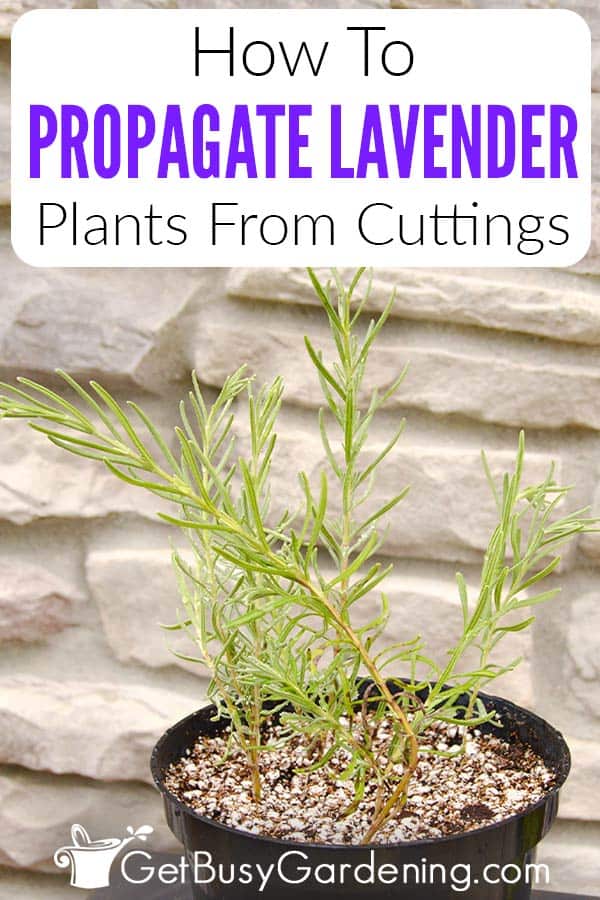
Propagating lavender isn’t difficult, and it’s a fun way to get more plants for your garden. Plus you can share them with your friends and family.
In this post, I’ll show you everything you need to know, including the different methods you could use, when is the best time to do it, and how to take and prepare your cuttings.
Then I’ll give you the detailed step by step instructions for exactly how to propagate lavender in either soil or water, with care and transplanting tips too.
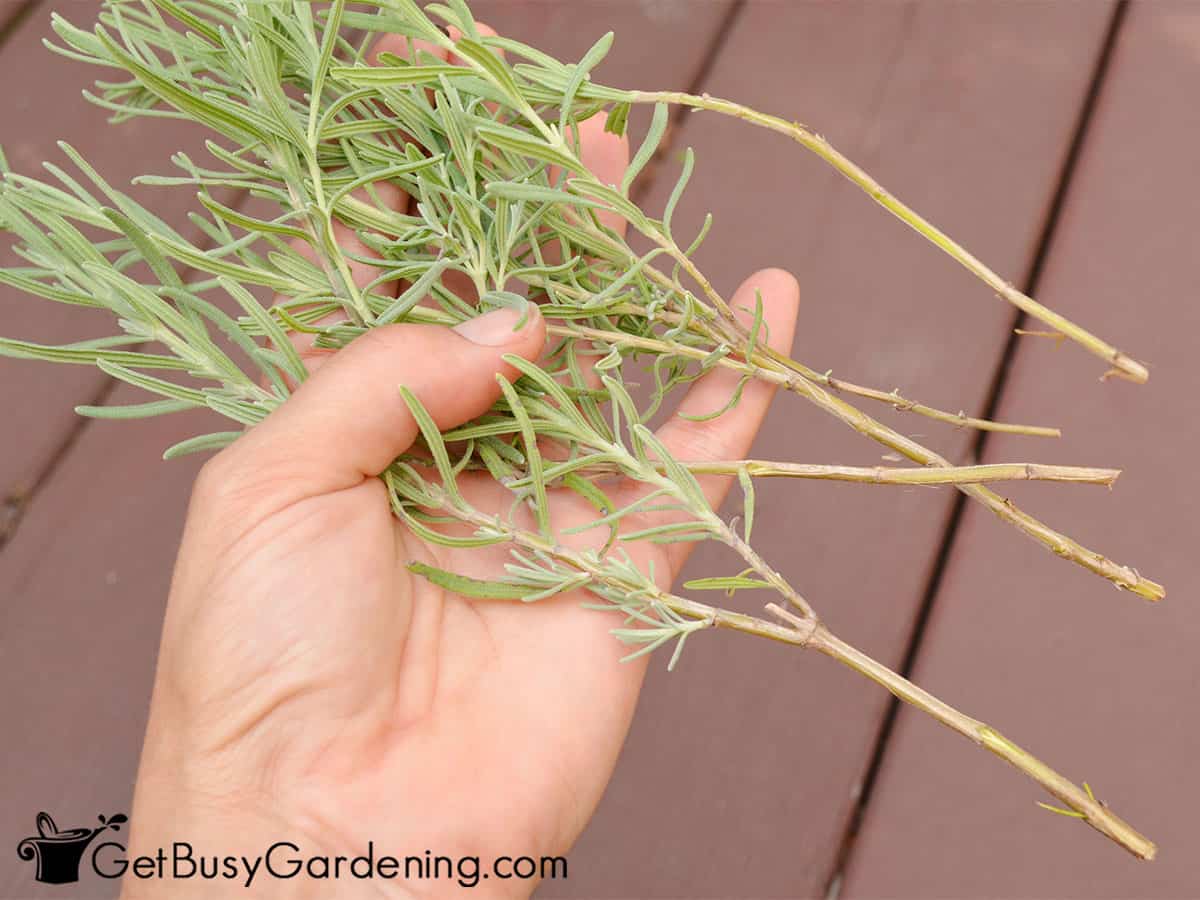

Lavender Propagation Methods
There are two different ways you could propagate your lavender plants: by rooting cuttings, or from seed.
- Rooting cuttings – This is the most popular and fastest method, and the one I will focus on in this guide.
- From seed – You could also try growing your lavender from seeds, though it is a bit more difficult and it will take longer to get sizable plants.
When To Propagate Lavender
The best time to propagate lavender is in the mid to late summer during their active growing season, and when it’s warm and humid outside.
If you take cuttings too late in the summer, or in the fall when the plant is starting to go dormant for the winter, they may not root.
Propagating Lavender From Cuttings
Before you get started, make sure that you gather all of your equipment and prepare the soil or vase of water first.
You should get them going right away so they don’t dry out or shrivel before you have a chance to propagate them. Below I’ll show you the correct way to take and prepare your cuttings.
How To Take Cuttings
For the best success, there are a few things you need to look for before you take cuttings from your lavender plant. Here are some pointers:
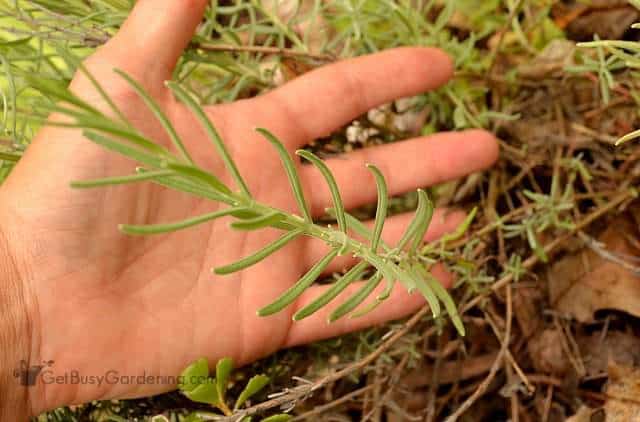
- Look for branches that haven’t flowered yet. Flowering takes a lot of energy, and you want your cuttings to put all of their energy into growing new roots rather than blooming.
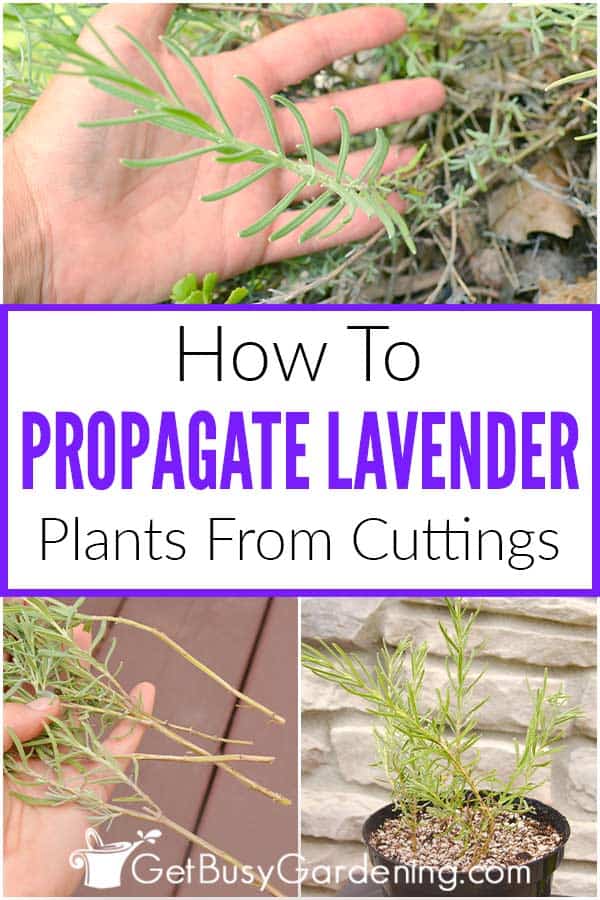
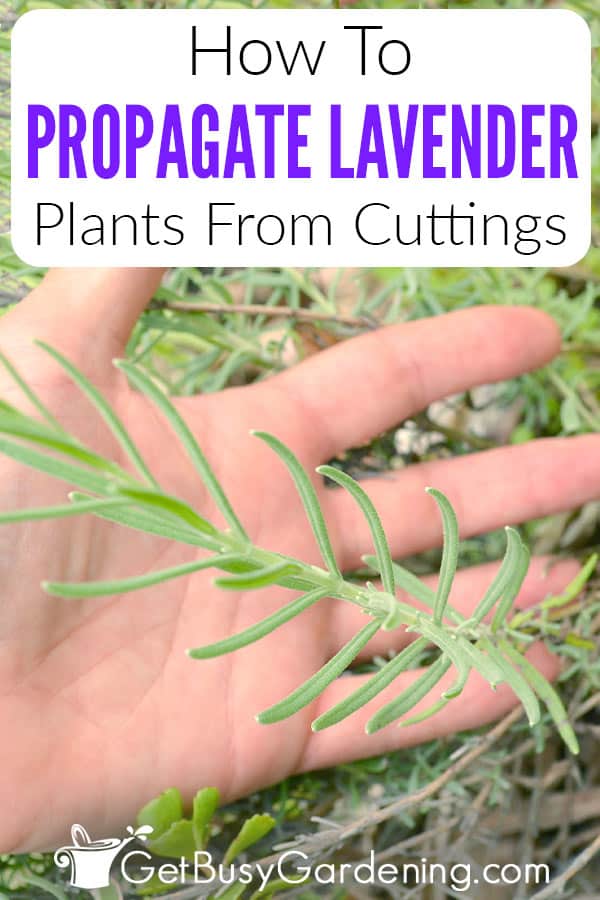
- Use fresh, tender new stems that are above the old hardwood. Softwood cuttings are much easier to root.
- Each stem you remove should be several inches long with 3-5 leaf nodes at the bottom, and plenty of leaves on top.
- Longer stems make it easier to propagate lavender plants because there will be more area to stick into the growing medium, which gives them a better chance of rooting.
Related Post: How To Prune Lavender Plants
Preparing Your Cuttings For Propagation
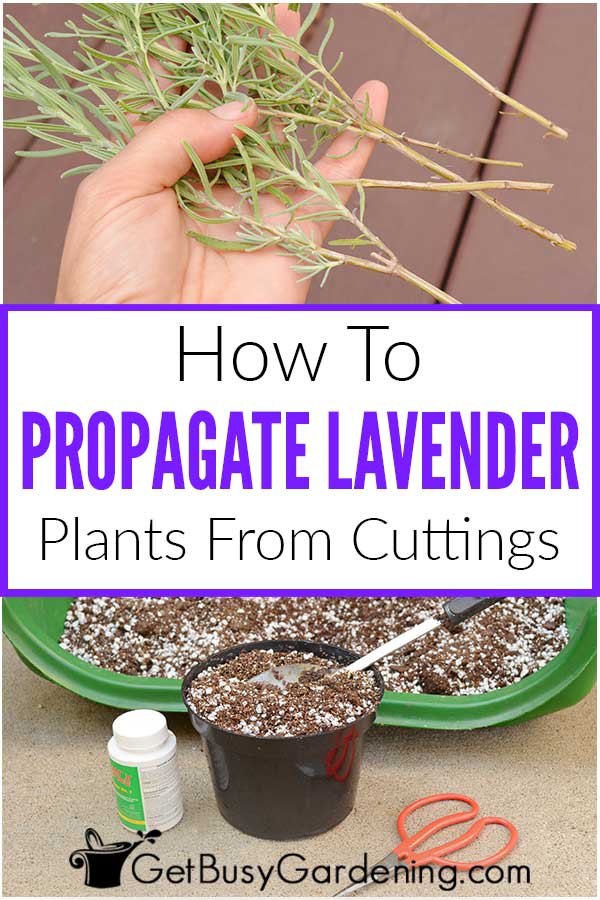
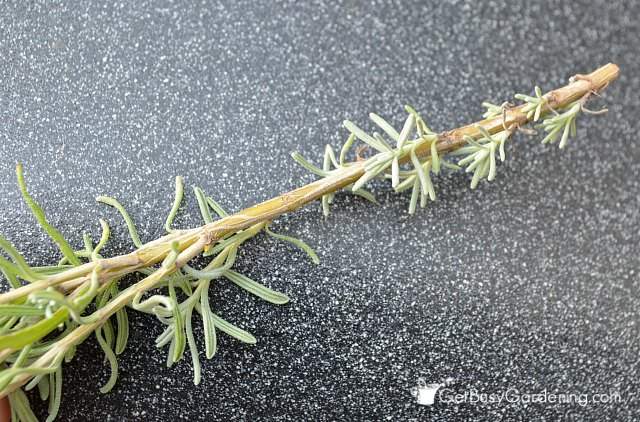
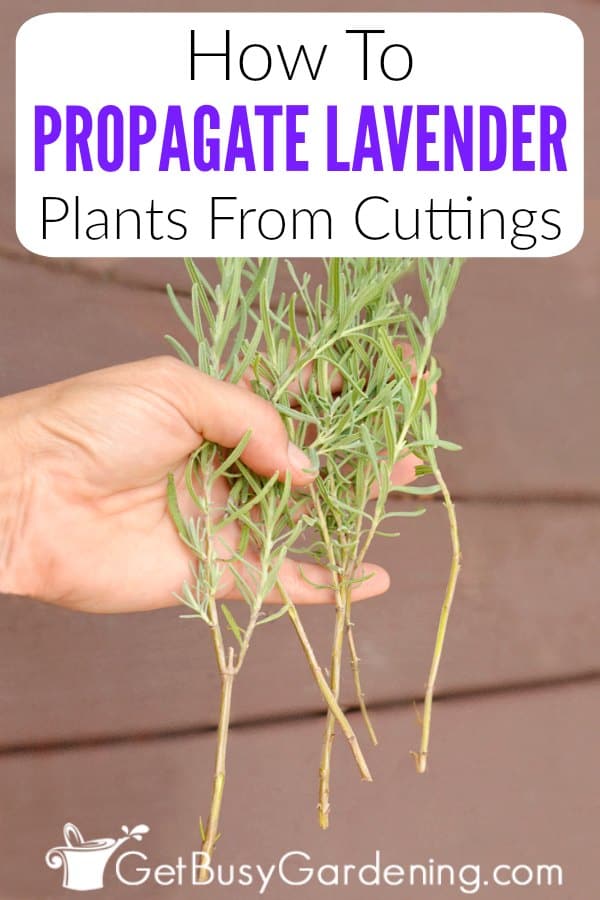
After taking cuttings from your lavender plant, remove the bottom 3-5 sets of leaves from the stem. You can pinch them off with your fingernail, or use a sharp pair of clippers.
Stripping the bottom leaves will create small wounds (or nodes), and that’s where the roots will grow out of.
If any of the stems have already started budding, simply snip off the flower spike to give it a better chance of rooting.
How To Propagate Lavender Step-By-Step
Below I will walk you through how to propagate lavender step by step. I’ll give you the instructions for how to do it in soil first, then I’ll list the steps for rooting them in water. They are a bit different for each, but neither method is complicated.
Steps For Propagating Lavender In Soil
Gather your supplies before you get started to speed up the process. Don’t worry, you won’t need a bunch of expensive equipment – and you probably already have some of this stuff on hand.
Supplies Needed:
- Prepared lavender cuttings
- A pot and a plastic bag
- OR a propagation chamber
- Propagation soil
- Hand trowel
- Heat mat (optional)
- Moisture gauge (optional)
- Grow light (optional)
See my detailed list of the best plant propagation tools & supplies here.
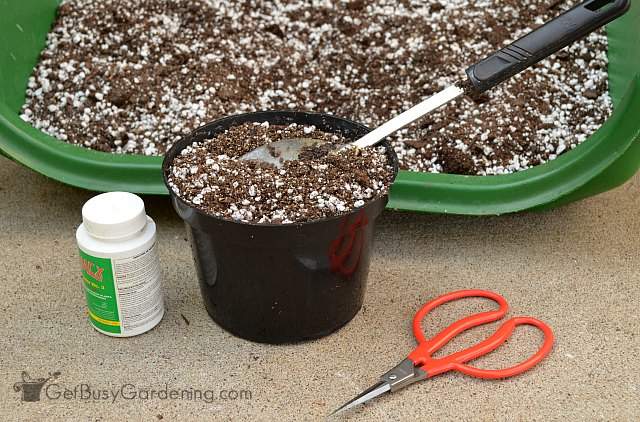
Step 1: Prepare the soil – Use a good quality well-draining mix, like seed starting soil, or make your own by combining half regular potting soil with half perlite. Moisten it lightly before filling your container.
Step 2: Fill the container – Use your hand trowel to fill the pot, leaving about 1 inch of headspace below the rim. Or add 3-4” of the medium into the bottom of your propagation chamber.
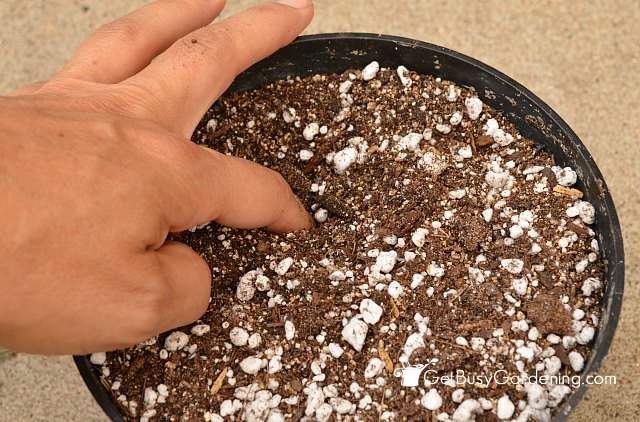
Step 3: Make a hole – Before sticking your cutting into the soil, poke a 2-3″ deep hole with your finger. That way you won’t accidentally break the delicate stems when you plant them.
Related Post: How To Harvest Lavender Fresh From The Garden
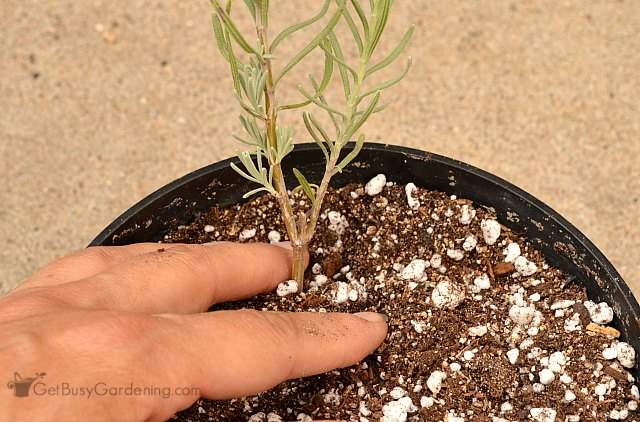
Step 4: Plant the stem – Stick the leafless part of the stem into the hole that you made. Then gently press the soil around it so the cutting stands up on its own, and the medium comes in good contact with the stem.
Step 5: Add the rest of the cuttings – You can put several into one large pot or your propagation chamber. But space them apart far enough so they don’t touch each other. This will ensure adequate airflow, and help to avoid mold or rot.
Related Post: How To Collect Lavender Seeds From Your Garden
Step 6: Cover the container – If you’re using a propagation box, then simply put the lid on it. Otherwise, tent a plastic bag over the entire pot to help provide extra humidity. Make sure the plastic is not touching any of the leaves.
Step 7: Put it in a warm spot – Outdoors, place the container in a warm location where your lavender cuttings will be protected from direct sunlight, wind, and heavy rain during propagation. Indoors you should use a grow light if it’s dark, and a heat mat if it’s cold.
Step 8: Monitor soil moisture: Keep the soil evenly moist, but not wet or soggy. Check daily to make sure that it never dries out completely. Use a moisture gauge if you struggle with this.
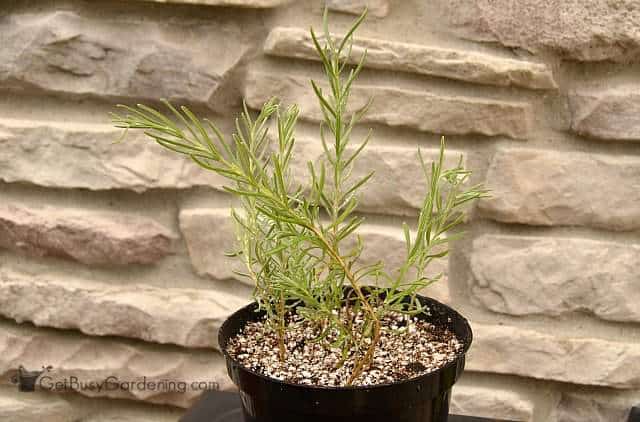
Step 9: Watch for roots: You’ll know your lavender cuttings have started rooting when you see new leaves growing on the top. They also won’t move when you gently tug on them.
Related Post: How To Dry Lavender From Your Garden
Steps For Propagating Lavender In Water
Propagating lavender in water is another option, BUT there is a downside. The roots tend to be weaker, which means the cuttings can suffer from severe transplant shock. So they may have a lower survival rate with this method.
Supplies Needed:
- Prepared lavender cuttings
- Vase
- Tepid water
- Decorative rock (optional)
- Grow light (optional)
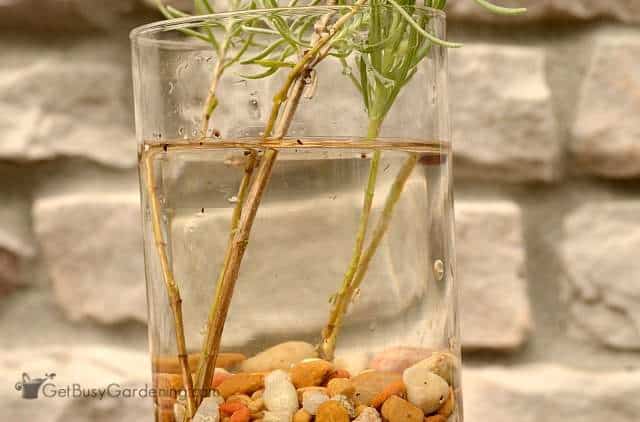
Step 1: Put decorative rock in bottom of vase (optional) – I like to put an inch or so of decorative rock into the bottom of my vase. That will make it more sturdy, and looks nice too. It’s totally optional though, and won’t help the cuttings root any faster.
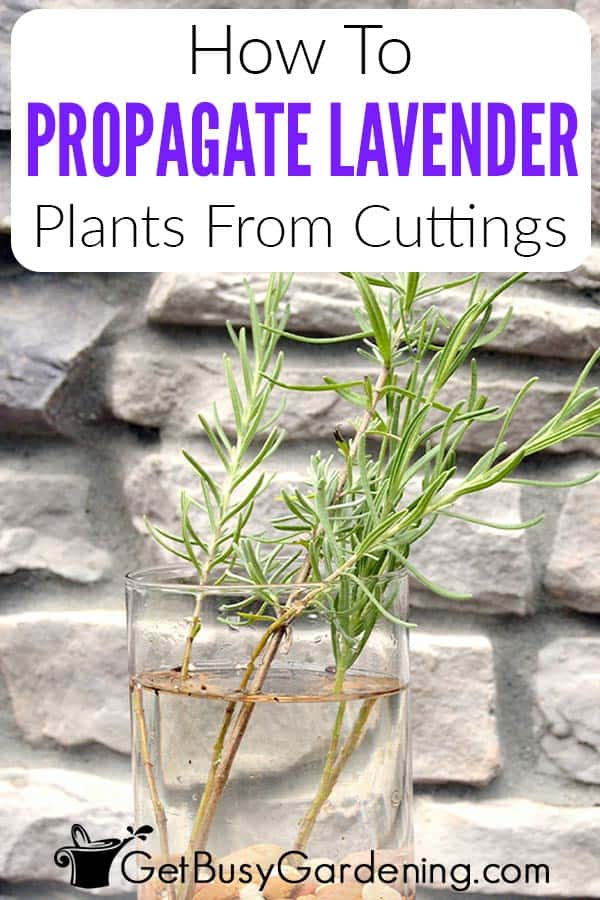
Step 2: Fill the vase – Pour room temperature (tepid) water into the vase until it’s about 1/2 – 3/4 full. I prefer to use filtered, distilled, or rainwater, but you can use tap water if that’s your only option.
Step 3: Add the cuttings – Put your lavender stems into the vase just like you would with fresh flowers. Make sure none of the leaves are touching the water though, or they may rot or mold.
Step 4: Place in a warm, bright location – Keep the vase somewhere that is warm and receives plenty of indirect sunlight. If you don’t have a sunny spot, then add a grow light.
Step 5: Monitor the water – Check the water level regularly to make sure it stays clear and doesn’t evaporate. Refresh it if it drops below the roots or appears murky, to prevent your cuttings from drying out or rotting.
How Long Do Lavender Cuttings Take To Root?
It can take anywhere from 3-6 weeks for roots to develop on your lavender cuttings. The warmer and more humid it is, the faster they will root.
They may start forming a little faster in water than in soil, depending on the humidity and heat levels. Wait until there are several thick roots that are at least 3-4 inches long before you attempt to pot them up.
Why Won’t My Lavender Propagate?
Lavender cuttings won’t root if it’s too cold or wet for them, and it can be more difficult to propagate them in water than it is in soil.
For the best and quickest results, keep the air humid and warm, and make sure the soil is never saturated or soggy.
Tips For Transplanting Rooted Lavender Cuttings
Once the roots are established, it’s time to transplant your lavender starts into their own pots. If you propagated them in soil, you can leave them in the container until they’re ready to go into the garden.
Remove the plastic cover, and move them into the sun. You should also allow the soil to dry out a bit between waterings.
Once they’re ready to go into the ground, I recommend planting them on a shady day, or in the early evening after the intense heat of the sun has passed. Learn more in my comprehensive lavender plant care guide.
Propagating lavender is pretty darn easy, and it’s rewarding too. Once you get the hang of it, you’ll have tons of babies to share with friends and family, or to fill your garden beds.

Do you want to learn how to multiply all of your plants? Then my Plant Propagation eBook is for you! It will show all you need to know to get as many new plants as you want from your existing ones. Grab your copy today!
Share your lavender propagation tips in the comments section below!

Elena Castagnetti says
Hi – i got all the necessary info fm my cousin in London UK where she is overwhelmed with Lavender! So i bought a couple plants – i live in Italy and summers are pretty hot. Planted them straight into the ground, clayish soil so mixed it with some sand. As ORDERED by my cousin, planted where the roots can go DEEP, and never over water. They grew a wonder! The first year just pruned them back… our plant supplier (we almost live in the countryside) gave me about 10 small potted lavenders at the end of the season for free: they were tall but no flowers, looked just like dried up twigs. Well, planted them anyway near my dogs hoping the WOULD grow a ton for a sort of hedge. Watered them rarely, and rain etc was enough, and no snow or freeze over that year.
The beginning of the growing season surprised me with green twigs, leaves and YES! They grew beautifully!!!! Have never pruned them, but will this year reading your info. And have usually harvested to late when flowers were almost dry. So will do as you said. And will try propagating too….
Till now – 3 yrs – they have simply grown taller and bushier every year providing me with ALL the flowers i could possibly want for biggish pot pourris for wardrobes etc, ; plenty longstemmed for decoration, and plenty to give away!
I truly think they propagated themselves dropping their seeds and just naturally growing… Want to propagate myself this year so I can then plant them where wanted…
The hedge is GORGEOUS, did all by itself! Our soil n position seems to be perfect so am aiming at making more clumps for the large garden : now I know not to plant too close…they have become almost 60-70cm diam, bushes fm sickly little sticks!!!!
Your description of HOW TO, is the BEST and most COMPREHENSIVE and SIMPLE I have read so far!!! Thanks SO SO much !!!!!❤️❤️❤️❤️❤️❤️
Amy Andrychowicz says
Fantastic, I’m so glad to hear your lavender is growing so well for you! Good luck propagating it. And thank you so much for your nice comment about my tutorial. It’s great to hear that you found it so easy to follow and useful. Thanks for taking the time to say so. 🙂
Sharon Diemer says
My daughter gave me a lavender tree. After the first bloom I cut it back like it said to and it grew just fine. I just don’t know what to do with it over winter. Can I plant it in my garden next spring and is it hardy. I live in S.W. Minnesota. Thanks for any help you can give me.
Amy Andrychowicz says
It depends on the variety of lavender you’re growing. Some are hardier than others. It’s best to look up the exact variety you have to know for sure.
cheyl says
I have tried for years to grow Lavender in three different states I said this is the last time I read an artical from a ladie in Texas who grows it. She said to plant it where the roots get heat you can put rocks around it or place plants near your drive ways the heat from the dconcrete will help and I am proud to say my two plants have doubled in size and are doing wonderful in Morning sun on the south side of the house next to the drive way good luck.
Amy Andrychowicz says
Wonderful! Thanks for sharing your tips and experience. 🙂
Michelle Willems says
I don’t think that I’ve ever lost a lavender plant that I’ve bought. Definitely not too much water and well draining soil. I had a plant that grew happily with no attention at all!
I’ve just come across a Bella Pink lavender which is supposed to have red flowers, and also some cuttings from a double headed lavender. I’ve taken all of the advice here, and have some cuttings from the red and also the double headed variety, and have some in a pot covered with cling wrap, and some in a small amount of water, so here’s hoping that I can get some more plants from those cuttings.
I live in Australia.
Thanks and cheers ??
Amy Andrychowicz says
How fun! Good luck with your lavender cuttings, I hope they will grow new roots fast and thrive for you!
Rob says
What time of year should I try propagating my lavender? I am in New Jersey, zone 6a. Thank you!
Amy Andrychowicz says
You can propagate lavender plant cuttings anytime during the summer.
Paula says
When you put the lavender cuttings into vases, you don’t use rooting hormone, correct?
Amy Andrychowicz says
Correct.
Mary Craig says
I’ve had the best luck with lavender when I plant it under a huge old maple tree. It has a southern exposure so it does get some all day sun, but it’s protected by the shade of tree limbs also. There’s a 20′ circle garden of shade plants around the big tree. I’ve noticed that the lavender plants closer to the outer edge of the garden don’t do as well. The color isn’t as saturated, & they sprawl out rather than growing into a nice compact, more vertices shape. I keep reading that lavender requires full sun but, from my experience, a mix of sun and shade works best, in my southeastern Michigan, region 5-6 area. After reading your article, I’m anxious to try propagating some lavender plants! Thank you for all your helpful tips.
Amy Andrychowicz says
Interesting! Thanks for sharing your experience. Have fun experimenting with propagating your lavender plants, it’s so much fun!
Heather says
Are lilacs propagated similarly? My neighbor has this gorgeous one that is deep blue when it flowers that I haven’t seen anywhere else since I was a kid.
Amy Andrychowicz says
Yes. Lilacs are trickier, but they can be propagated using the first method of rooting the cuttings in dirt. I would recommend using a propagation chamber, or putting a baggie around the cuttings to keep the air very humid. Bottom heat will also help.
Mary jo says
Last year I bought a lavender plant. Some issyes came in my life & I pretty much left the plant in its original container on the patio. I watered it but, it didn’t do well at all. Then in the Fall I cut it way down because it was all dried up. I was hoping new shoots would come to life this Spring. They didn’t. To get some new blooms can I take the rootball & plant it in my garden? Or is the plant dead beyond repare?
Amy Andrychowicz says
If there isn’t any new growth on the plant, then I think it might be dead. It sure wouldn’t hurt to try planting it to see if it pops back… but that might just end up being a waste of time. Sorry! 🙁
Virginia Cauley says
Do established lavender plants transplant well? Stalks are drying out where planted now.
Thank you
Virginia Cauley
Amy Andrychowicz says
Yes, lavender usually transplants just fine. Sounds like it’s going through transplant shock. Make sure it’s getting enough water in it’s new spot to help with the transition, you may need to baby it for a few weeks. Also, you can trim off the dead branches to help it look healthier.
jane miles says
I’ve propagated lavender a few times with success and will be doing it again after reading this article. I’ve also got rosemary cuttings soaking in water and its got little roots coming!
Amy Andrychowicz says
Awesome, great job! Propagating lavender (and other plants) is addicting!! 🙂
Carina says
I think I killed my lavender plant. I watered it last week and then the leaves looked and felt like they were drying out so I watered it again but it’s just getting worse. Now almost the entire plant looks dark brown and dried out with a bit of green left but the soil is moist. Can I save the last green stems and propagate them in water?
Amy Andrychowicz says
Uh oh, that doesn’t sound good. Yes, it sure wouldn’t hurt to try saving the last few pieces of green stems on your lavender plant to see if you can still propagate them… but if they are really small, it might not work.
Carina says
I tried to propagate the last remaining green stems but sadly it didn’t work out. I’ve tried many times to grow lavender from seeds and then this last time I bought a lavender plant, I don’t know what I’m doing wrong. It’s so frustrating because I really love lavender but my plants never survive ? I live in Arizona and I’m wondering if the constant sun is the issue.
Amy Andrychowicz says
Shoot! Sorry to hear that propagating the last of them didn’t work. Lavender is a drought tolerant plant and, as far as I know, it can be grown in AZ. Maybe you’re planting it at the wrong time of year? Since your summers are so hot, you definitely want to plant it during the cooler fall months rather than in the spring or summer. When you buy your next lavender plant, I would talk to someone at the garden center to see if they have any specific tips for growing lavender in your climate.
Hollie says
That’s
My issue it gets so hot in summermonths
I’mnot sure were to put them? I have a sreen enclosed porch.do I put in morning sun? When not so hot??
Amy Andrychowicz says
Yes, since you live in a hot climate, I would recommend a spot that gets morning/evening sun rather than a hot south facing location during the summer months.
vagmeli says
je vais essayer ,afin d’avoir de la lavande dans ma nouvelle maison,
Merci pour les conseils,espèrons que je vais réussir
Amy Andrychowicz says
You’re welcome, and good luck!
Aurora Hernandez says
I will appreciate advise to how to propagate my rosemary and which months to do that
as well as other plants That is my passion to see new creatures propagated by my hand.
Thank you very much. My admiration for the people that knows all this things.
Aurora Hernandez.
Amy Andrychowicz says
Propagating rosemary would be similar to propagating lavender. I don’t have a post about that yet though. 🙂 Here’s my detailed guide about plant propagation to get you started with others.
Tish says
The process with rosemary IS quite similar, but with rosemary I suggest before using it with rooting powder, that you scrape a few small areas of its thin bark around the cutting and soaking it for about 5 minutes after in H2O and then dip immediately into powder and plant..keeping it out of direct light and moist. Best of luck, this process generally works well for me (At times I skip the powder part.
MJ says
I use the same method as Trish, except I don’t like to use rooting hormone on food plants. Instead I will use compost tea, or even a diluted black tea from the mornings tea bags, to soak the cuttings in. I also water my plants w/ this mixture once they get roots. Adding some Kelp, Fish meal and bone meal gets the plants established quickly, very, very healthy, and with a deep root base. (again a very dilute, mild mixture) I keep my Rosemary in pots so far. I may establish a few plants outside next yr. and see if I can get them to over winter w/ my Thyme & Greek Oregano They just might do it!.
Amy Andrychowicz says
Awesome, thanks for you added propagation tips, and also for sharing your experience with rooting cuttings. Plants really do love compost tea, kelp and fish emulsion. It’s amazing. 🙂
Sandy Bush says
We have ours planted in rocks in the west side of the house for years. It loves it & self seeds.
Amy Andrychowicz says
Awesome! I don’t think mine has ever seeded itself, at least not that I have noticed. But I have collected lavender seeds before, and that’s pretty easy! 🙂
J.V.S. says
I read ,but haven’t had time to try, lavender seeds should be spread on a plate, moistened, then refrigerated for 30 days. They need winter temps to germinate. Then pot them, cover with plastic until roots start.
Amy Andrychowicz says
Yes, they need to be cold stratified in order to germinate.
Naomi S. says
I absolutely love lavendar–the little purple flowers and the delicious smell. I want so much to be able to grow it. But I can’t, seemingly. Every lavendar plant I’ve purchased has died. I’ve tried placing it in the sun and in partial sun. Keeping it moist or letting it dry out between waterings. It always dies. I have many plants–garden and house plants, and I have good success, but not with the lavendar. It is so frustrating because I am so fond of the plant. Do you have any tips that might help me to succeed with this plant?
Amy Andrychowicz says
Oh no, sorry to hear that you’ve struggled so much with it. Give this post a read… How To Care For Lavender Plants. It will answer all of your questions, and tell you everything you need to know to be successful.
Louise Nelson says
Hi Naomi, I love lavenders too. I also had a difficult time having successful plants. At a natural gardeners nursery I found 3 different varieties of lavender. One was English lavender and I don’t remember the names of the other 2 but one of them was marked as best for our area ( central Texas). Well the others had larger blooms , so I bought all three, and sure enough the only one I had success with is the one they said was best for our neck of the woods. My 3″ pot is now a 3’X3′ plant. It’s 3 years old and I get plants from cutting usually successfully in the early spring. I also don’t plant it immediately, I tried it in different locations to see where it seemed to be happiest. Then put it in a 1″ larger pot and kept it in the most favored location, after it showed healthy growth I planted it in a hole larger than the pot with sand in the bottom for drainage. Good luck with your next attempt. Louise
Ada Ardito says
I had horrid results with lavender also until a couple of years ago. I grew tired of looking at the sick plants in my garden. Just yanked them out and stuck them in another bed…clay soil…full sun…. and totally neglected them in the heat of the Arizona desert. To my surprise they flourished 🙂 Now I am here to learn how to propagate more!!
Amy Andrychowicz says
Awesome! 🙂
Hollie says
Im with ya… a lady told me to use packing peanuts and don’t over water.. this is the fourth time with lavender plant in pots! So far I havent killed it! Ive got them on the south side of my home. So far they are doing well! I almost hold my breath when I do anything to them!! ?