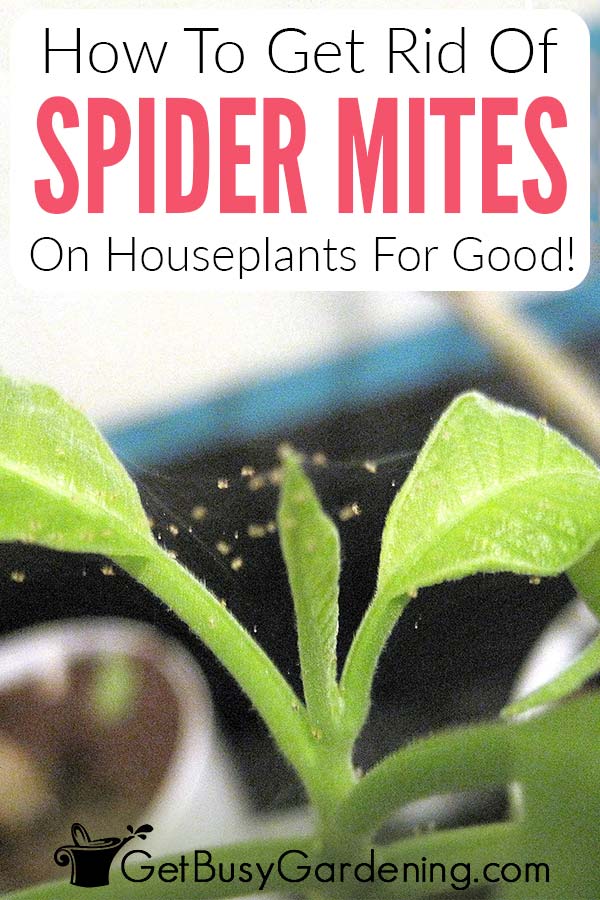
There is nothing more frustrating than finding a spider mite infestation on one of your beloved indoor plants. They are one of the most destructive pests, so it’s very important to get rid of them as quickly as possible.
The good news is that they’re pretty easy to control using natural treatment methods, and you’ll be able to eradicate them quickly.
In this detailed guide, I’ll show you all you need to know about getting rid of spider mites on your plants for good, and how to prevent them from ever coming back.

What Are Spider Mites?
Spider mites are tiny bugs that attack many different types of plants, and they can be a major problem indoors. Though they are arachnids, just like ticks and spiders, they only feed on plant cells.
Since they’re so small, you probably won’t notice them until their population explodes. By then, there can be hundreds of spider mites in a single colony, and they cause significant damage in a very short time.
These annoying pests thrive in warm, dry conditions. So our homes are the perfect breeding grounds, especially during the winter.
How To Identify Them
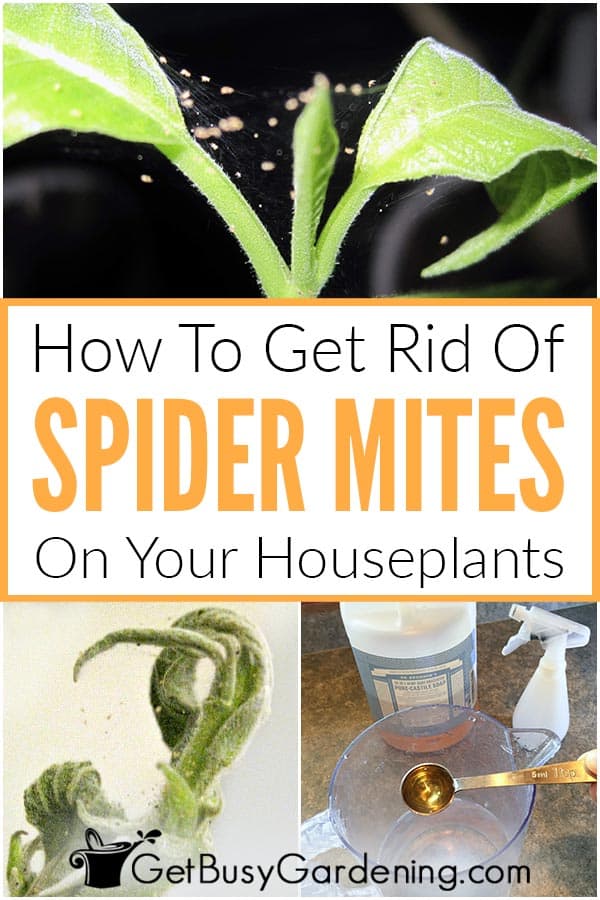
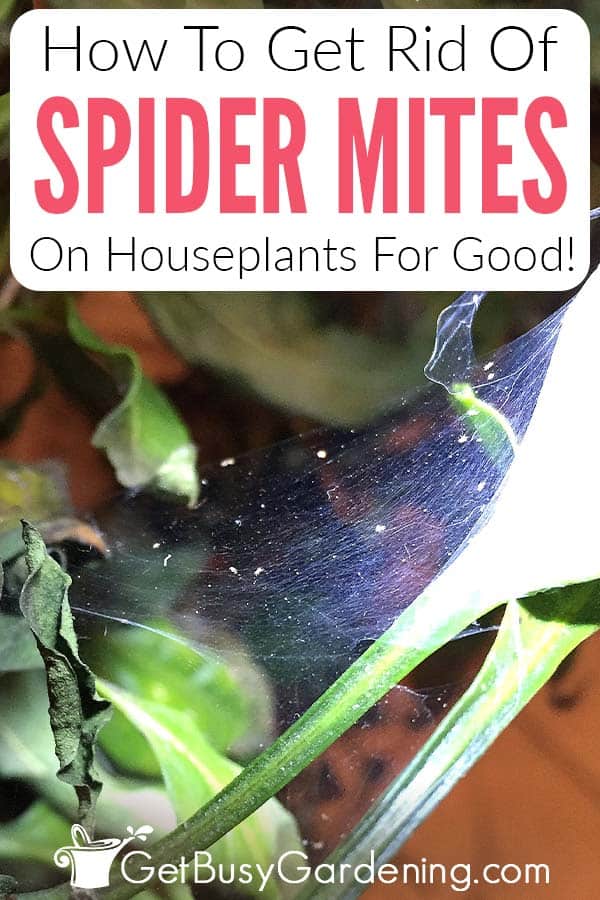
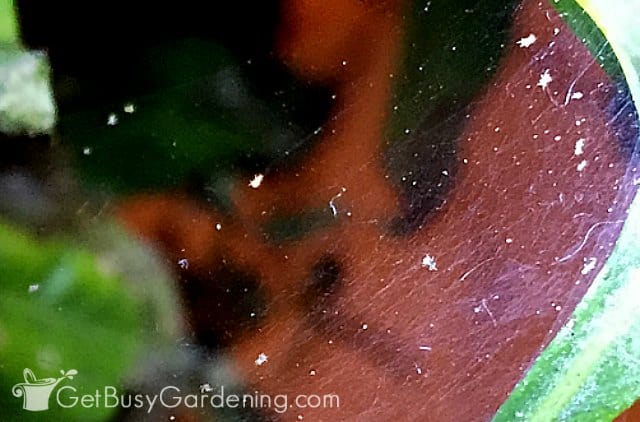
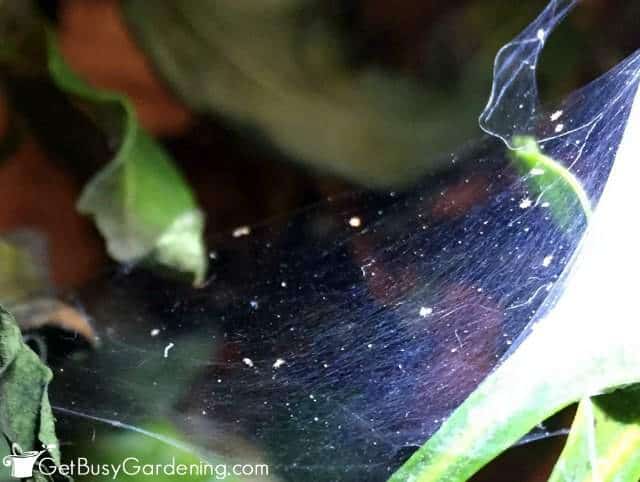
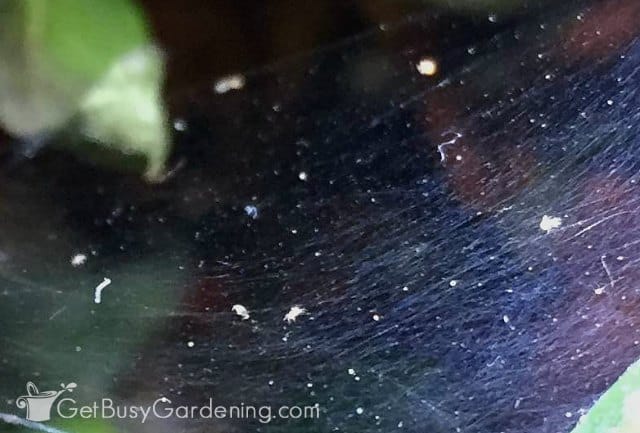
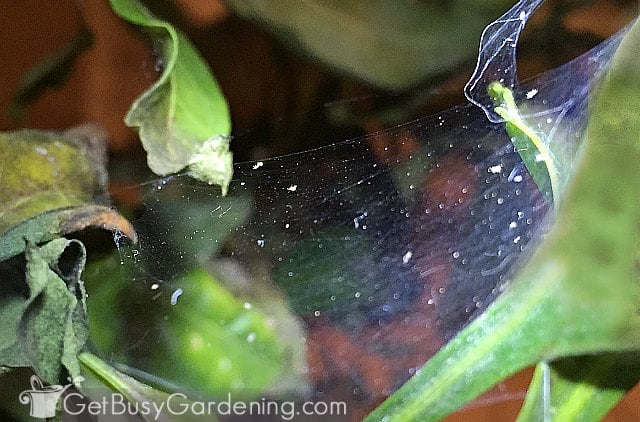
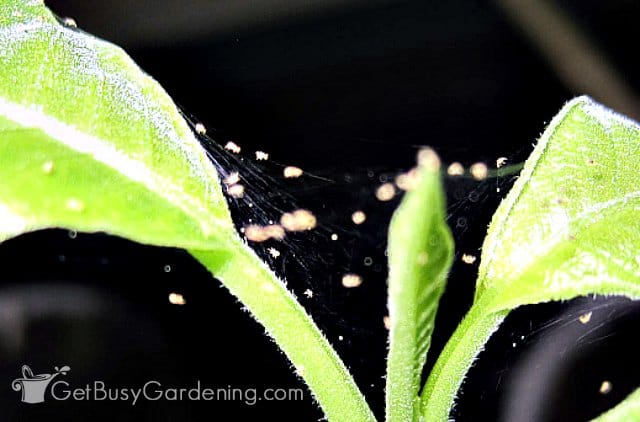
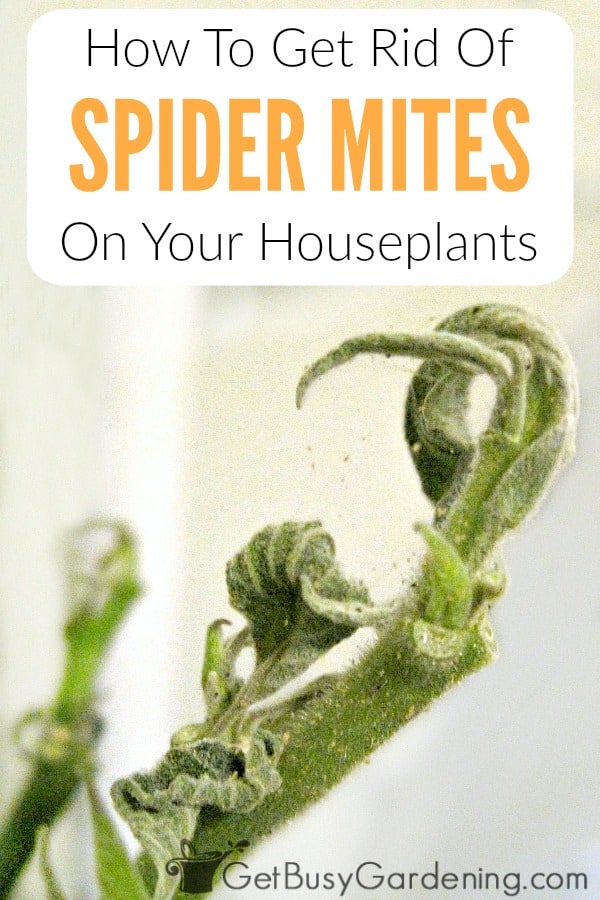
Spider mites are easy to identify, and finding their webbing on a plant is a dead giveaway. Take a closer look at the webs and you’ll see these tiny creatures crawling around on them, yuck!
Oftentimes these mites look like tiny white spiders, but they can also be tan, red, or black.
They are sneaky little suckers, and tend to start their webs on the underside of leaves. So that’s why you probably won’t notice them right away.
Rather than seeing bugs, you’ll probably spot the webs on your houseplant first. Or the leaves may just look dull and dusty, or appear dried out as if you forgot to water.
Related Post: How To Identify Common Types Of Houseplant Bugs
Their Life Cycle
At a high level, there are 4 stages to the spider mite life cycle: egg, larva, nymph, and adult. They mature very quickly, and can become full grown about a week after they hatch.
It only takes a few more weeks for an adult female to lay hundreds of eggs, and for them to start hatching.
So spider mites can multiply exponentially over a very short period of time. And, in the right conditions, their population can double every couple of weeks. Eek!
Where Do Spider Mites Come From?
The tricky part about spider mites is that they can come from anywhere, and you’ll probably never know exactly how they got on your indoor plants. But, here are a few common sources:
- Unknowingly buying an infested plant
- Repotting plants with unsterile potting soil
- Moving your houseplants outside for the summer
- Bringing flowers and vegetables inside from your garden
- Through open doors or window screens
Related Post: Where Do Houseplant Pests Come From?
Spider Mite Damage On Houseplants
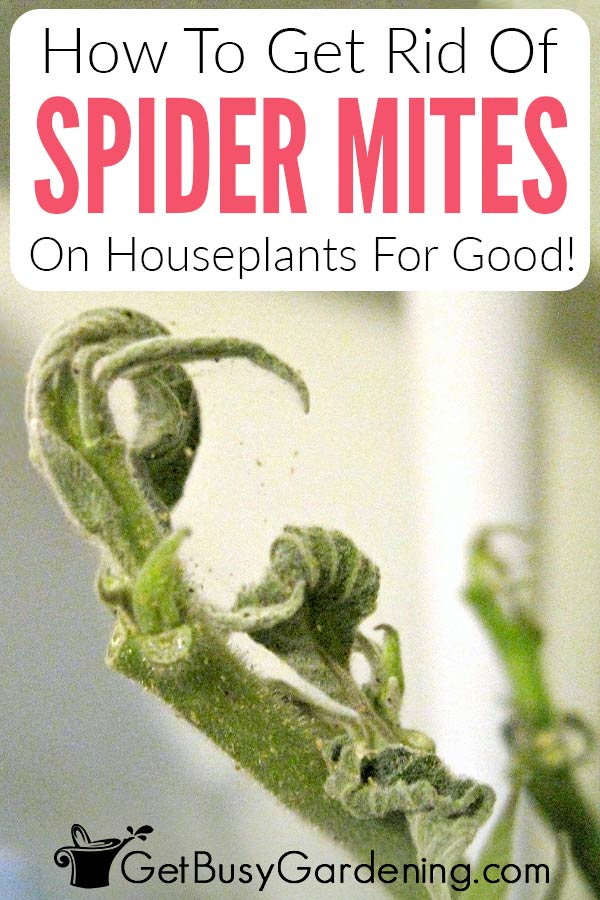
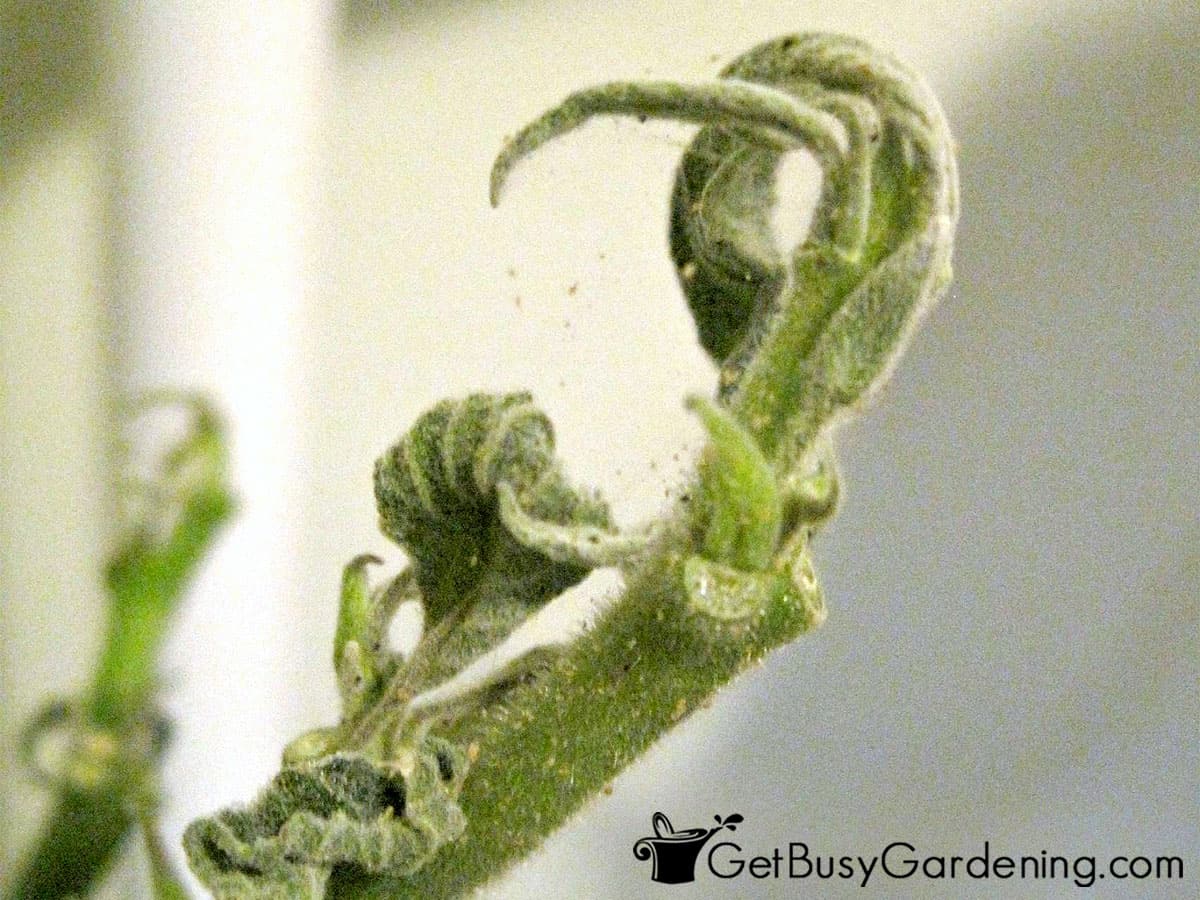
Spider mites cause damage to plants by sucking the sap out of the leaves, making them look discolored, speckled, curled, or dried up. The infested leaves will shrivel, die, and eventually drop off.
They are one of the most destructive pests, and they can heavily damage or even kill a houseplant in a very short period of time.
So it’s very important to take immediate action to get rid of spider mites as soon as you discover them.
How To Get Rid Of Spider Mites On Houseplants
Once you discover an infestation, it’s crucial to act fast to get rid of it before it spreads to the rest of your plants.
The first thing you should do is contain the problem immediately. So quarantine the infested houseplant and inspect all of the surrounding ones for spider mites. Then you should clean the plant.
To do that, I bring mine to the sink or bathtub and wash the leaves with either insecticidal soap or a mild liquid one mixed with water. Be sure to wash the undersides of the leaves too, and rinse the plant well afterward.
Spider Mite Treatment Methods
I highly recommend using only natural and organic treatment methods to get rid of the spider mites on your plants, like the ones I have listed below. Otherwise these pests can develop a resistance to chemical pesticides in a short time.
Also keep in mind that sprays, even organic ones, can damage sensitive leaves. So you should always test them on a few leaves before treating the whole plant.
Related Post: Natural Pest Control For Houseplants
Insecticide Soap
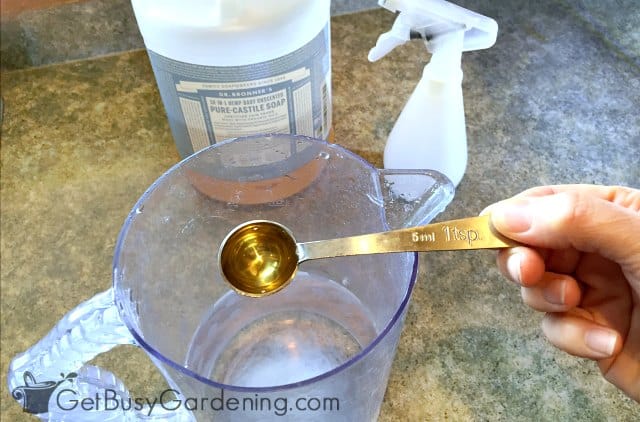
You can buy an organic insecticidal soap, or mix up a batch of my homemade spider mite spray. Here’s my recipe:
- 1 teaspoon of mild liquid soap
- 1 liter tepid water
Mix the ingredients in a spray bottle and then use it to wash the leaves. Either of these options work very well to kill the bugs on contact, but they don’t have any type of residual effect.
Neem Oil
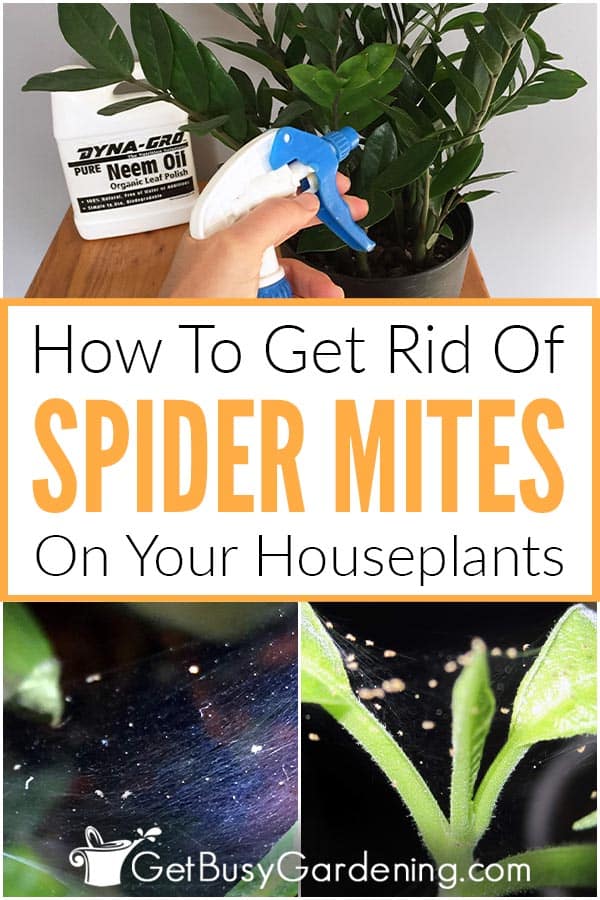
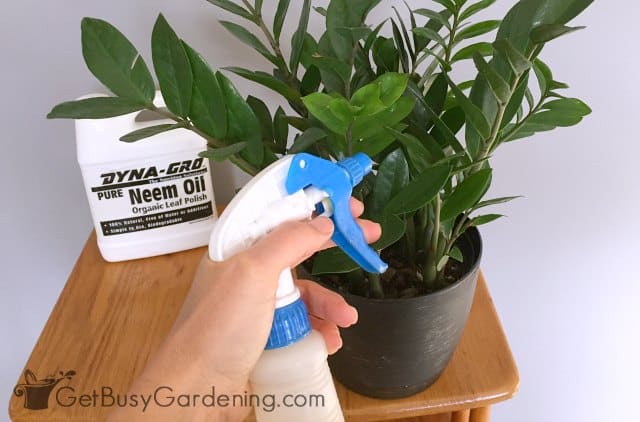
Neem oil is a natural pesticide, and it’s very effective to control spider mite infestations long term. It has a residual effect, so it also works to prevent them from coming back.
I like to buy it in a concentrate and make my own spray so I have complete control of the ingredients. Here’s my simple recipe:
- 1 ½ teaspoons of pure neem oil concentrate
- 1 teaspoon of mild liquid soap
- 1 liter of tepid water
While neem oil does kill spider mites, it can take some time to completely get rid of all of the future generations. So you have to be persistent, and treat your plant every few weeks until all signs of the bugs are gone.
Related Post: How To Use Neem Oil On Plants
Misting & Humidity
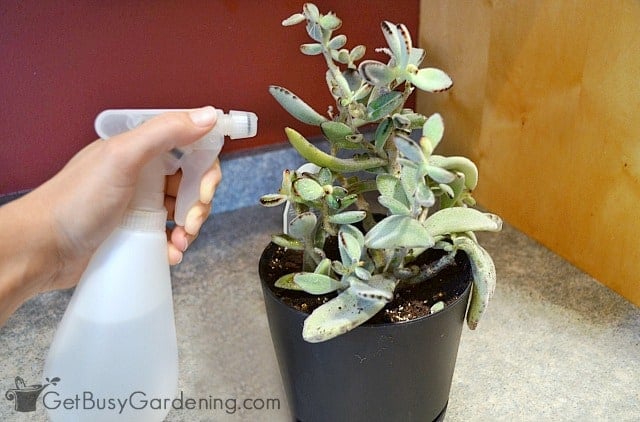
Since spider mites thrive in dry conditions, keeping the air around your indoor plants humid is one of the best prevention methods. There are a few easy ways to do this:
- Mist the leaves regularly
- Keep a container of water next to the plant
- Place the pot on a pebble tray filled with water
- Run a humidifier in the room or near your houseplants
- Place your plants next to the kitchen sink or in a sunny bathroom
If it’s really dry in your house, then I recommend getting an inexpensive indoor humidity monitor so you can monitor it.
Pruning
In addition to washing and spraying your houseplant, you can trim off infested leaves and throw them into the garbage to get rid of even more of the spider mites and eggs.
Never cut all of the leaves off though, just remove the most heavily damaged ones. Then bring the trash outside to get the bugs out of your house.
How To Prevent Spider Mites From Ever Coming Back
Though spider mites can be very persistent, especially on the houseplants they love the best, it’s pretty easy to prevent them from coming back. Here are some tips:
- Keep your plants healthy – When they’re healthy, they aren’t as susceptible to major infestations as sick ones are. Learn how to properly care for your indoor plants here.
- Maintain adequate soil moisture – Well-hydrated plants are less likely to become infested. Here’s my guide for how to water houseplants the right way.
- Increase the humidity – Spider mites thrive best in a dry environment. So mist them or run a humidifier nearby.
- Clean the leaves – You can use neem oil as a leaf polish, or wash the leaves with insecticidal soap to prevent an outbreak.
- Debug them before bringing them inside – If you move any of them outdoors for the summer, be sure to debug all of your plants before bringing them back indoors.
- Check your houseplants – Regularly inspect the leaves for any signs of pests so you can catch them before they get out of control. I do this every time I water.
Though dealing with recurring infestations can be extremely frustrating, it’s not difficult to eliminate spider mites from your indoor plants. The keys are to treat them immediately, be persistent in your fight, and strive to maintain healthy houseplants.
If you’re sick of battling bugs, then my Houseplant Pest Control eBook is for you. This eBook is jam-packed with information about how to get rid of bugs on indoor plants using organic methods. It shows you how to identify common pests so you can quickly and easily get rid of them, and prevent recurring infestations. Download your copy today!
More About Houseplant Pest Control
- How To Get Rid Of Houseplant Bugs Naturally
- How To Get Rid Of Gnats In Houseplant Soil
- How To Get Rid Of Thrips On Indoor Plants
- How To Get Rid Of Scale Insects On Houseplants
- How To Get Rid Of Whiteflies On Indoor Plants
- How To Get Rid Of Aphids On Houseplants
- How To Get Rid Of Mealybugs On Your Houseplants
Share your tips for getting rid of spider mites on houseplants in the comments below.

Maria Montrond says
Hi I have an indoor plant infested with spider web.i don’t have neem oil, is there any other oil to substitute for neem?
Amy Andrychowicz says
Oh bummer, sorry to hear that you plant is infested with spider mites. Simply keeping the humidity high is usually enough to get rid of them. But, you could also try horticultural oil, or regularly washing the laves with insecticidal soap as alternatives to neem oil.
Kathy Stanford says
Hi, I don’t have any Neem oil but do have powdered sulfur. I just sprayed a solution of 1/2 t. sulfur and 1t. castile soap in 1 L of water on my plant. Have you ever done this? Or has anyone else? It’s an Elephant Ear and I’ve moved it away from my other plants. I really don’t want them on my orchids!
Amy Andrychowicz says
No, I have never tried using powdered sulfur, and I’ve never heard of using it for killing spider mites either. So I can’t speak to it. Good luck, I hope it works for you! 🙂
Sky says
Do we leave the unscented Castile soap, neem oil & tepid water mixture spray on the plant? Are we supposed to pour it on the soil too?
Amy Andrychowicz says
Yes, you can leave the neem oil/soap solution on the plant. You don’t need to pour it into the soil unless you see bugs in there. Spider mites live and bred on the leaves, so you only need to worry about spraying the foliage to get rid of them.
Kimia says
Hi..my okra and bean plants are totally infested with spider mite..i am spraying with a soap solution every day but not much result..I’ll try ur tips and hope for the best
Amy Andrychowicz says
Oh no, sorry to hear your plants have spider mites! You could also try the neem oil solution I mentioned above to see if that takes care of them. Good luck!
Stephanie Sorensen says
I have maybe a weird question. I noticed at my church one of the indoor plants has spider mites. I have read your website and there are a lot of great tips i am going to try to get rid of them on this plant. However, i have not had an issue with spider mites on my plants yet in my own home. Should i worry about bringing spider mites home on my clothes and infecting my plants if I’m helping this plant at my church? I would hate to try and help this other plant only to bring the mites home and start a whole new problem. Thank you!
Amy Andrychowicz says
I’m sure it’s possible for spider mites to get on your clothes and transfer to your plants at home, but probably not very likely. I would definitely recommend washing your hands, and any of the tools you use with soap and water after handling the infested plant. You could start by simply spraying the plant with soapy water or neem oil (as described above) to help get the infestation under control. That way you won’t have to touch the plant until after many of the spider mites are dead.
Adrienne says
I dont know the name of the plant I saw mite webs on but it has the most gorgeous colored leaves and grows fairly fast. I started it from a 4 inch pot and now it’s a foot tall with several new shoots. I have a corn plant that I thought had something on it and to my surprise I found a pincher bug down in the center of the corn leaf. it freaked me out when I saw this big bug so I sprayed it with insecticide just a tiny bit and pulled out the bug. Was he eating mites? I have a few strange spots on my corn plant as well. My corn plant is large and so far healthy it sits next to a large fern that sat next to the fern plant at one time sat next to the pretty leaf plant. I moved the pretty leaf plant several weeks ago and just yesterday saw the webs. My question is do I need to spray my fern as well? My corn and fern are large so this is quite an undertaking that I’ll need help with so please lmk I love my plants. Thank You so much.
Amy Andrychowicz says
I would just keep a close eye on the other plants to watch for signs of spider mites. Check the plants daily, and if you don’t see any mites after a few weeks, then they should be fine. Just be sure to keep the infested plant away from your other plants during treatment. Good luck!
Jan says
HI Amy I have a avocado plant that’s about three 4 ft tall and it has a lot of spider mites on the new and old leaves. My avocado plant has neen in the house from a seedling so we recently put it outside and give it a good hose down but these pests multiplied, our help will be greatly appreciated.
Amy Andrychowicz says
Sorry to hear your avocado is infested with spider mites. Sounds like you’ve taken the proper first steps. The key to getting rid of spider mites is being persistent. Continue treating the plant using the methods above until all they’re all gone. It can take some time, so be patient.
Jayson M says
My plants are in a high humid aquarium that I am using as a green house but I still ended up with what i think are spider mites They are Small little white things crawling on tank and on the plant and there is webbing on one of the 3 plants.
Are these actually spider mites because as the article says high humidity is supposed to prevent them?
Amy Andrychowicz says
It doesn’t sound like spider mites to me. I’ve never seen them crawling on anything but their webbing and the plant leaves. If they are large enough that you can easily see them with your naked eye, then they aren’t spider mites. Perhaps a different type of spider? Do you see any damage to the leaves of your plants?
Rachel says
Hello! I’ve been wiping my plant down with need oil spray everyday. I get the sense this may be overkill but also don’t want to risk bugs coming back from a suspected spider mite problem. What’s the best frequency?
Amy Andrychowicz says
Yes, every day is a bit of overkill. It definitely takes a few treatments before the spider mites are gone for good, but you don’t need to spray the plant with neem oil daily. I usually use my neem oil spray on an infested plant about once a week at first. Then I spread it out to once a month or so. If there are no more signs of spider mites after a few months, then I stop spraying the plant and just keep a very close eye on it to make sure the bugs don’t return.
Debbie Schermaier says
I teach aeroponic gardening at a school and found our tower has spider mites. All of the plants are either herbs or vegetables. Is it safe to use the neem and soap on the plants and then still eat them?
Amy Andrychowicz says
I would definitely recommend reading the label on the product that you have before using it on your herbs and vegetables. I personally don’t use neem oil my herbs and vegetables, but many product labels say it’s safe. Many times, spider mites are easily controlled by just increasing the humidity level around the plants. So, you could try misting the plants regularly, or wiping the leaves with a damp cloth. Or even try putting a humidifier near your garden tower. Good luck!
Billy Dorsheimer says
What are some pros and cons of misting indoor plants.I currently DO NOT mist them and was wondering if it was extremely detrimental to the plants and what benefits am I missing out on by not misting them. Any feedback would help tremendously.
Amy Andrychowicz says
Tropical plants like humid air, and some plants will suffer if the air gets too dry. The reason I mention misting plants in this article is because spider mites thrive in dry air, so misting the plant will help to keep them away. So, the benefits of misting are extra humidity for the plants, and preventing spider mites. The cons to misting are that it can cause fungus to grow on the leaves if they stay too wet. Also, some types of plants don’t like to have water on their leaves so it could cause spots. If your plants are healthy, and spider mites are not an issue, then there’s really no reason to start misting your plants. Most common houseplants grow just fine without any misting.
Amber says
Hi Amy! I just moved to Minneapolis a year ago! I am new to houseplants and keeping them alive. I just bought a corn plant from Home Depot about a month ago and I think it is infested with spider mites! It keeps getting brown spots on the leaves. I have dr. Bronners soap and neem oil and will start treating asap. Is there a nursery in the area you highly recommend? Thank you!
Amy Andrychowicz says
Oh no, sorry to hear that your corn plant is infested with spider mites! Yuck! Hope you can get rid of them soon!! I stopped buying plants from big box stores because they always seemed to have bugs. 🙁 Bachman’s is one of my favorite nurseries, and they’re located all around the metro area. There are also lots of local ones that are great too, depending on the area you live.
Alyssa says
I actually have the exact same problem with my Ti plant that I got from Home Depot. Both my infected plants were from there. Not getting anymore plants there. I’ve treated for the past 3 weeks with permethrin insecticide, insecticidal soap and even the insecticide granules and they are coming back. Luckily its just down to the one plant. I like the neem oil idea and am going to get some.
Gord says
None of this helped other than on a VERY temporary basis, and they just keep coming back. Any other suggestions?
Amy Andrychowicz says
Spider mites are tough. You have to be persistent, and treat the plant more than once. Only treating your plant once won’t get rid of them. The eggs are tiny and you can’t see them, so they will just keep hatching and re-infesting the plant. Have you tried the neem oil yet? It takes time to work, but has a longer lasting effect.
Lyndsay says
Once I spray the solution can I wipe the leaves or do I let it sit on the leaves?
Amy Andrychowicz says
Either way works just fine.
Rochelle says
My houseplant is outside until I can repot it with clean potting soil and I will use an inch of sand as suggested however my problem is spider mites in our bathroom where I had the plant. I have been using a ” natural ” spray and I haven’t seen a live mite in a day. I would really like to clean the area up, lots of dead mites on walls, window, and tub but I am hesitant. Will more mites hatch?
Amy Andrychowicz says
The sand on top of the soil won’t do anything for controlling spider mites, that’s only for fungus gnats. I’m not sure what you mean when you say there are dead mites all over the walls and windows…etc. Spider mites are microscopic, so you can barely see them with the naked eye. I think you have may be talking about fungus gnats, or maybe you have some other type of pest problem?
Kelli Calzada says
I have two hydrangea plants that I got from a local nursery last May. Right away I noticed the webbing and started treating for spider mites. I’ve tried spraying with a garden hose in the daytime every 2 days, I’ve tried commercial spider mite insecticide and many other tricks. These plants have somehow made it thus far. I brought them indoors for the winter and noticed the mites are still there although the plants had finally started growing healthy looking leaves and no longer looked on the brink of death. I mixed a solution of rubbing alcohol, mild dish soap and neem oil and have been spraying the plant focusing on underside and stems. I’m spraying every 3 days and keeping the plants well watered. The leaves immediately looked worse and are falling off, browning and the new leaf buds are damaged. Are the mites doing this or is the spray? How do I get rid of the mites at this point if I’ve tried everything? These plants are especially important as these were purchased after the passing of my mother in law as this was what she was named after. I really want to help them survive. Thank you.
Amy Andrychowicz says
Oh no, sorry to hear your plants are infested with spider mites! Did you need to bring them indoors rather than planting them in your garden because they aren’t hardy to your area? I have a few zone 5 plants (I’m in z4) that I overwinter in my unheated garage, which is much, much easier than trying to keep them alive as indoor plants! You might want to consider letting your hydrangeas go dormant as they would naturally. I’m not a hydrangea expert, but I believe they need a cool, dormant period in order to bloom and thrive. Plus if you allow them to go dormant, the leaves will drop off, and it will be much easier to get rid of the spider mites.