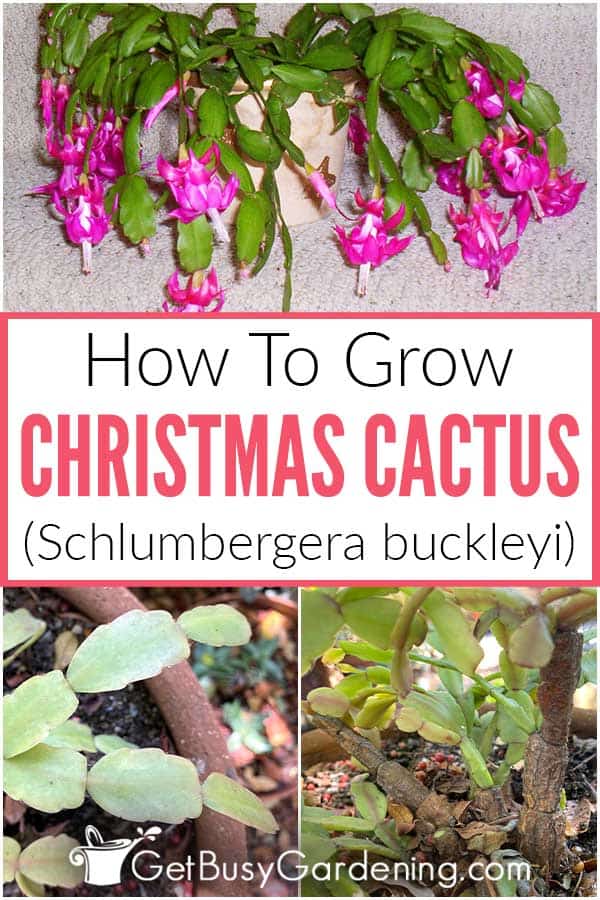
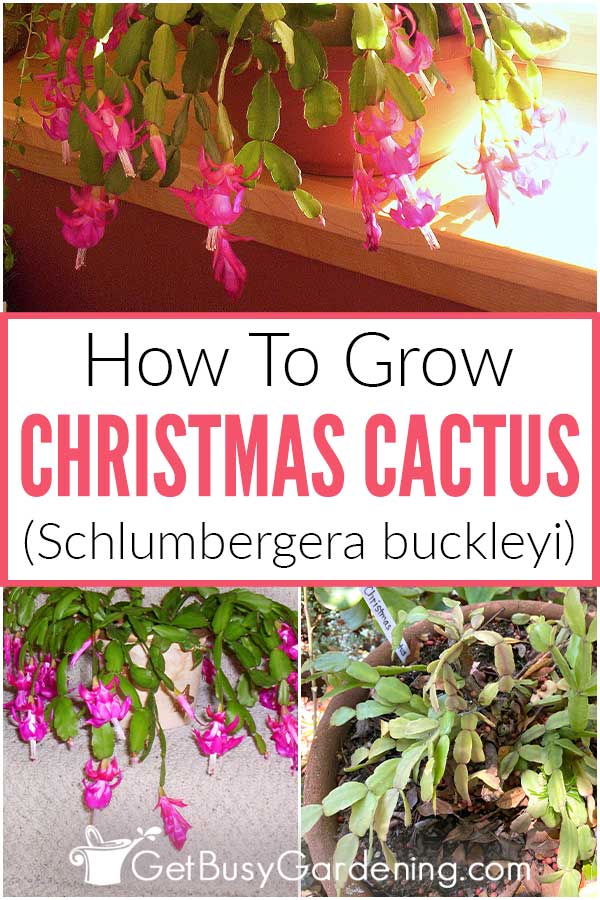
Christmas cactus plants may look difficult to care for, but they are actually pretty easy to grow, and they can thrive for decades.
With the right light, soil, and moisture conditions, you can enjoy your plant year-round, and get plenty of beautiful bold blooms every December.
In this complete guide on Christmas cactus care, I will give you all of my best tips from my years of experience growing this fantastic plant.
I’ll also share my expert advice on pruning, repotting, fertilizing, and propagating, along with managing common pests and diseases, and more. Learn how to care for a Christmas cactus the right way for years of festive flowers.
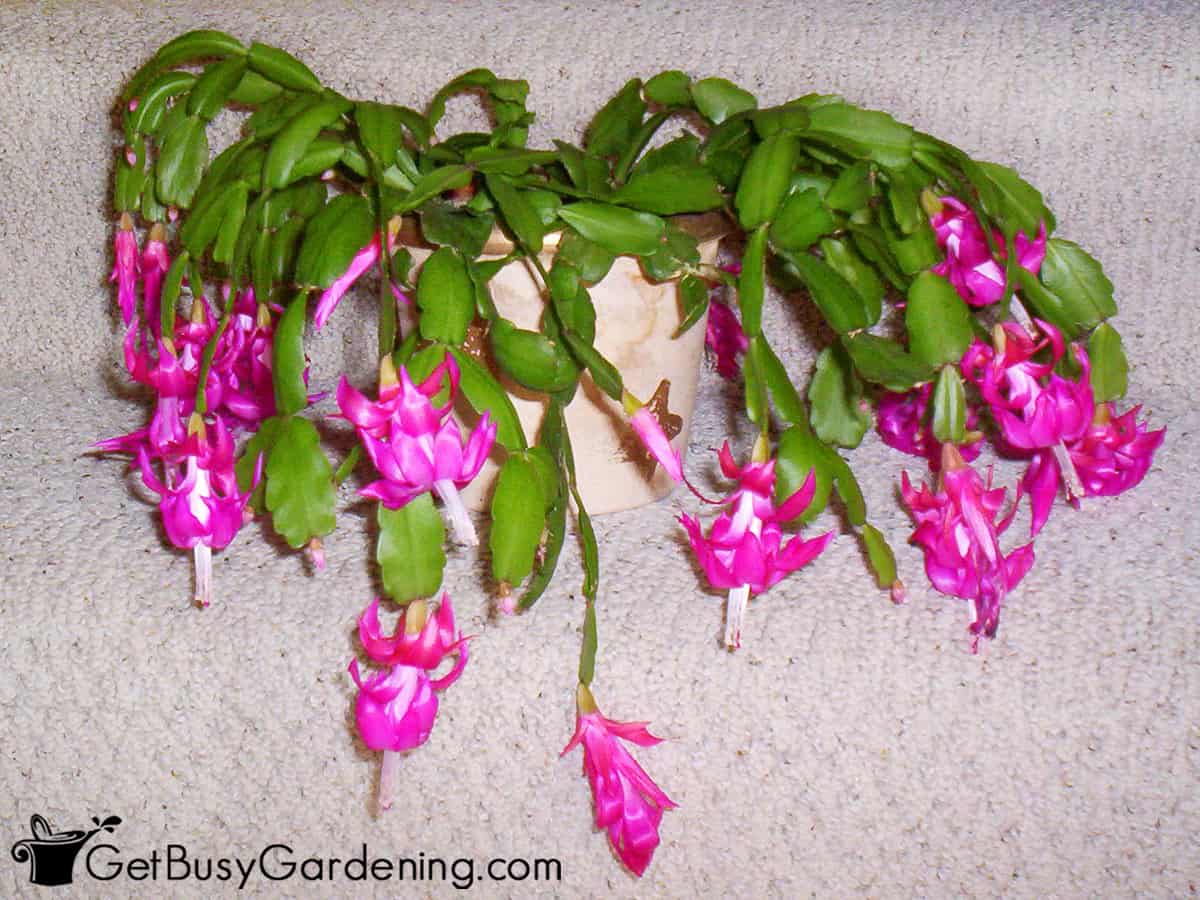

The iconic December-blooming Christmas cactus has become a staple during the holiday season. Not only are they fun to grow, they’re easy to rebloom again year after year.
I was lucky enough to inherit one from a friend over a decade ago, and was pleasantly surprised at how low maintenance they are.
Since then, I’ve been able to enjoy the bright flowers year after year, which is always a welcome sight in the dead of winter here in MN.
Christmas Cactus Quick Care Overview
| Scientific name: | Schlumbergera buckleyi |
| Classification: | Succulent plant |
| Common names: | Christmas cactus, December cactus |
| Hardiness: | Zones 9-11 |
| Temperature: | 65-75°F |
| Flowers: | Pink, white, red, and coral, blooms early-mid winter |
| Light: | Partial shade |
| Water: | Consistently moist, do not overwater |
| Humidity: | High |
| Fertilizer: | Flowering plant food in spring and summer |
| Soil: | Fast-draining, sandy soil |
| Common pests: | Mealybugs, scale, fungus gnats |
What Is A Christmas Cactus?
Despite its name, Christmas cactus (Schlumbergera buckleyi) is a succulent that’s known for its beautiful winter blooms.
These forgiving plants are epiphytes that are native to Brazil, and are just one type of a holiday cactus.
Epiphytes take in nutrients and water through their leaves in addition to their roots. So they and can live in soil, but they’re normally found on tree branches, rocks, or logs in their natural habitat.
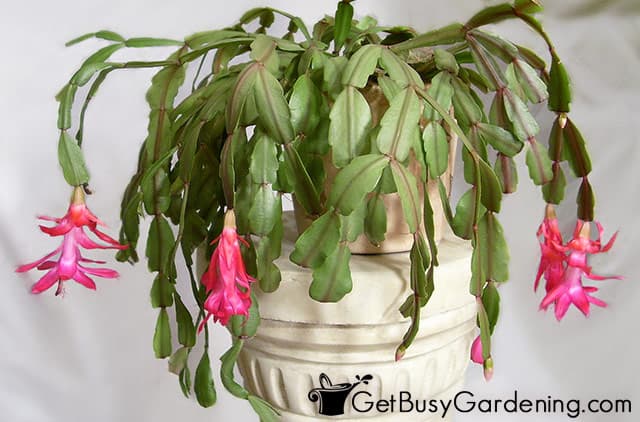
Xmas cacti feature pendulant branches that grow from woody stems, and can reach up to 24” tall.
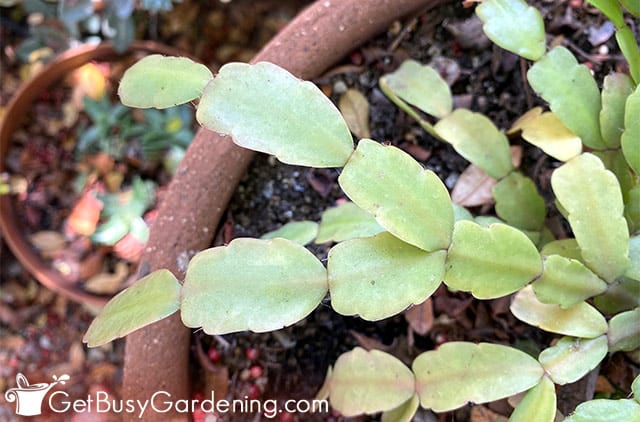
The branches are made up of segmented, evergreen leaf pads with smooth and rounded scalloped edges that look like teardrops.
If the leaf pads on yours are spiky instead of smooth, then you have a Thanksgiving cactus, and you can learn how to care for it here.
Flowers & Bloom Time
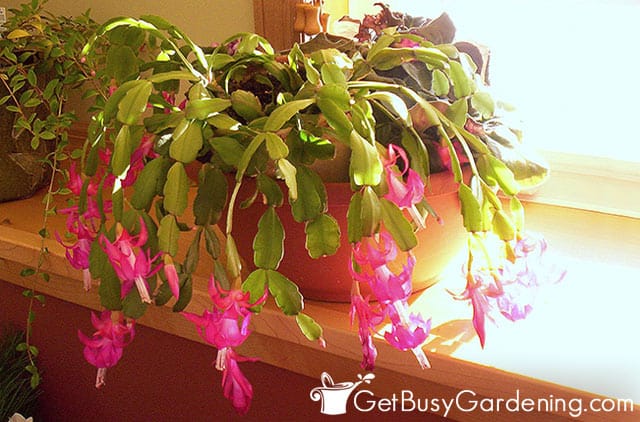
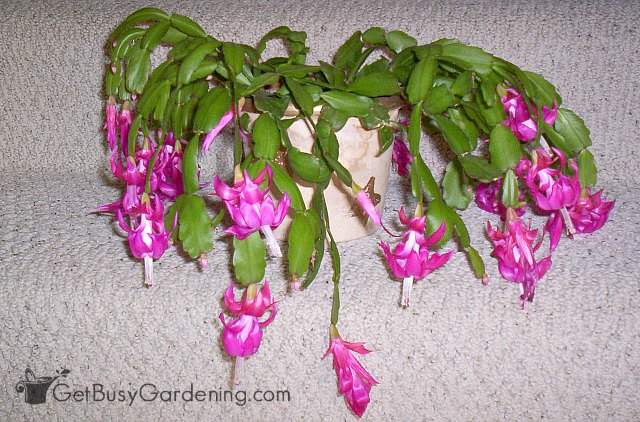
With the right care, a Christmas cactus will blossom in early to mid-winter, earning them the common name December cactus.
The blooms have long pretty petals that fan out from tubular flowers, and hang straight down from the end of the branches.
They come in a limited range of colors including pink, white, red, and coral.
Related Post: How To Care For A Holiday Cactus Plus Growing Tips
How To Grow A Christmas Cactus
We’ll get into all the tips for Christmas cactus care soon, but first you’ll need to know the best conditions for growing one. In the perfect spot, they can live for decades.
Related Post: The Ultimate Guide To Growing Plants Indoors
Hardiness
If you live in zones 9-11, then your Christmas cactus is a perennial that can grow outside all year long. They are not hardy to cold temperatures, and should be protected from frost.
For everyone else, they need to be kept as houseplants over winter. Bring them indoors before the temps drop below 50°F outside.
Where To Grow Schlumbergera buckleyi
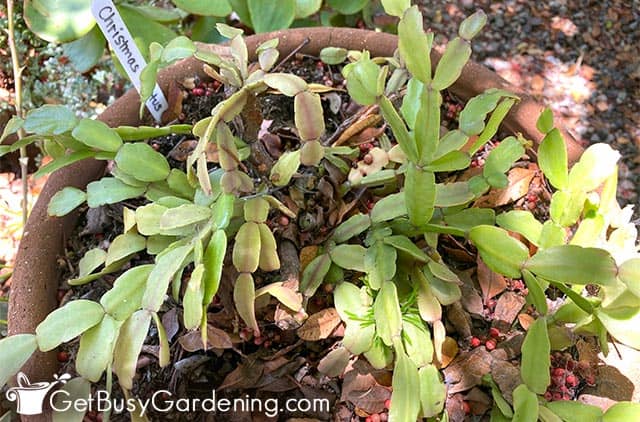
Schlumbergera buckleyi natively grows under the canopy of trees. So in your home garden, place them in a shady area.
Indoors, choose a room that gets plenty of bright daytime light, but not direct sun.
They look great in hanging pots because the branches arch over the edges, but any container you like will work. They can also be mounted on a board, rock, or log instead.
Christmas Cactus Plant Care Instructions
Now that you’ve chosen the perfect spot, we can dive into the details Christmas cactus plant care. When you give your December cactus the proper year-round love, you’ll get to enjoy the beautiful blooms every winter.
Sunlight
Ideally, an Xmas cactus should get around 8 hours of bright light per day. A sunny room that gets natural indirect light is perfect.
If you’re moving it outside for the warmer months, choose a spot that is mostly shaded, or gets dappled sunlight. Too much sun can cause the leaves to burn, redden, or shrivel.
In the fall, they’ll need an average of 14 hours of complete darkness every night to form flowers. If their usual spot gets any light, even from artificial sources, move them to a closet or dark room overnight.
Water
Schlumbergera buckleyi need an average amount of moisture, and don’t like to dry out completely. But they can develop root rot when they’re overwatered.
In soil, keep the surface evenly moist, but avoid puddling. Give your plant water when you notice the top inch has dried out, and allow the excess to completely drain from the pot.
If they’re outdoors in warmer weather, they may need more frequent drinks. A soil moisture gauge can really help if you’re struggling to give them the right amount.
During bud formation, reduce the frequency, and let them dry out a bit more than usual. Then resume regular watering when they begin to flower. Learn more about how to properly water your Christmas cactus.
Humidity
Natively, epiphytes like these love humidity. Providing humidity is important for successful Christmas cactus care, especially when they are kept in the house.
If yours is indoors, it’s important to add moisture to the air in order to avoid shriveling leaves or bud drop.
They will benefit from a humidifier, regular misting, or being set on a pebble tray filled with water (never let them soak in it though).
Mist lightly, and don’t let pools of water sit on the leaves for too long, or they could start to rot.
Temperature
A December cactus can be sensitive to extreme temperatures. Too high of heat can cause dropping leaves and flower buds, prevent flowering, or cause wilting.
If it gets below freezing, it can kill them altogether. When temperatures drop below 50°F at night, it’s time to bring them indoors.
For hot weather outdoors, mist them regularly, and increase watering to ensure they don’t dry out.
They need consistent temperatures of 50-60°F at night while the buds are forming, then between 60-70°F when they are in bloom.
Fertilizer
Fertilizing your Schlumbergera buckleyi is a great way to encourage more growth and flowers. They’ll benefit from a diluted natural, liquid fertilizer from spring through early fall.
Compost tea, a general indoor plant food, or one made for flowering plants are all great choices.
You can apply it two times monthly through mid-fall, or up until the flowers to begin forming. Then stop fertilizing completely until spring when you start to see new growth again.
Soil
Since they naturally grow on logs or rocks, Christmas cacti don’t technically need soil. But most people plant them in pots rather than mounting them.
For containers you can use an all purpose potting mix with good results. But a fertile, porous mixture that’s slightly acidic is their ideal medium.
Purchase a cactus mix, or make your own by amending a general purpose one with sand, perlite, and/or pine bark.
Repotting
If your Christmas cactus isn’t growing very well, or if it’s not flowering as prolifically as it used to, then it may be time to repot it.
But they actually prefer to be root-bound, and generally bloom better when they are. So, for best results, only repot your plant if it has completely outgrown the container.
The best time to do it is in the late winter or early spring after it has finished blooming, but before the new growth appears.
Only move it to a container that’s around an inch or two bigger than the current one. Position it at the same depth as it was in the old pot, and make sure all of the roots are covered by soil. Water it and then place it in a shady spot for a couple of days to let it recover.
Related Post: How To Repot Succulent Plants
Pruning
Though they don’t require regular pruning, late spring or summer is the best time to do it. They’re tolerant of a hard-pruning during this time.
Pruning encourages branching and more flowers. Two new segments will come from the cut joints, and blooms will form at the ends of each.
Use sharp, clean precision snips to clip between the leaf segments. Or, you can gently twist them off by hand. Be sure to keep the trimmings so you can propagate them.
How To Deal With Common Pests & Disease
In all of my years of growing Christmas cactus, I’ve never experienced any pest problems. But they can attract mealy bugs or spider mites on occasion.
A natural insecticidal spray, or a homemade one of 1 teaspoon of mild soap mixed with 1 liter of water, is usually enough to get rid of them. Neem oil is a great option for recurring infestations.
Root or stem rot from overwatering is also a common problem. If you notice soft or mushy stems, you’ll need to take healthy cuttings and root them to save your plant.
Dormancy & Reblooming
If you want those beautiful flowers every winter, dormancy is a very important part of Christmas cactus care.
To trigger dormancy and bud formation, you’ll need to provide a specific environment from late fall to early winter. Don’t worry, it’s easy! You can find my step by step instructions for reblooming your Christmas cactus here. But below are the basic steps.
Simply make sure that nighttime temperatures stay around 60°F or slightly lower, and keep them away from heater vents. Reduce watering too, but don’t let them dry out completely.
For 3-6 weeks, keep them in complete darkness for 13-16 hours every night, and provide 6-8 hours of indirect, bright light during the day.
Once the flower buds have formed, give them a good drink of water, and keep them in a cool location no warmer than 70°F. Avoid drafty areas, and don’t move them at this point, or they may drop their flowers.
Related Post: What To Do With Christmas Cactus After Blooming
Christmas Cactus Propagation Tips
Propagating a Christmas cactus is so easy, and they make a wonderful gifts around the holiday season.
It’s best to do this in the spring or summer, especially after pruning when you have clippings available.
To root them, take healthy cuttings that are 3-5 segments long, and dust the ends with rooting hormone.
Bury the bottom leaf segment halfway down in moist, well-draining soil. Keep them somewhere warm, bright, and humid until you start to see new leaves form on top. Get my full instructions for how to propagate Christmas cacti here.
Troubleshooting Common Christmas Cacti Problems
Schlumbergera buckleyi are usually pretty easy to care for, but you may run into problems over the years. Here you’ll find my best tips for handling some of the more common issues.
Limp Or Droopy Leaves
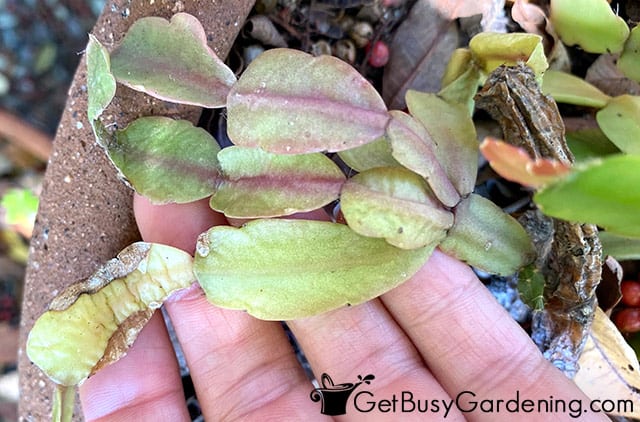
Either over or under watering can cause limp or droopy leaves. If the soil is completely dried out, give it some water, and check on it more frequently.
If the leaves are also mushy or soft, root or stem rot may be the culprit. Make sure the pot isn’t standing in water, there’s no puddling around the stems, and there’s no excess moisture sitting on the leaves after misting.
Flower Buds Dropping
When the flower buds drop off, it’s usually from either too high of heat, drying out, or too much sun. During the flowering part of their life cycle, they need temps below 70°F.
If temperature is not the issue, ensure they’re getting between 13-16 hours of complete darkness a night.
Also make sure the soil is not completely dry. It should be kept evenly moist, but never bone dry, wet, or soggy.
Christmas Cactus Not Blooming
If your Christmas cactus isn’t blooming it’s likely an issue of too much sun or heat, or a recent repotting.
Keep them in a cool place with only indirect sun during the day, and a dark place every night during late fall and early winter.
If you’ve recently repotted, it could take a year for flower buds to form again. Newly rooted baby plants can take even longer.
Leaves & Segments Dropping
Temperature extremes, or root and stem rot from overwatering can cause the leaf segments to drop off.
Double check that your December cactus is not exposed to very high heat or freezing temperatures. Then make sure you’re not watering to the point that the roots are saturated.
If the stems are mushy and soft, it’s time to take cuttings and propagate what you can to save your plant.
Christmas cactus blooming in spring
It’s not uncommon for a Christmas cactus to bloom a second time in the spring.
However, if yours is skipping its winter flowers altogether, it’s likely that they didn’t get that period of dormancy they needed at the right time to trigger bud formation.
In late fall, reduce the amount of water you give it, without letting it completely dry out. Then keep it in a very dark place at night where it stays between 50-60°F.
FAQs About Growing Christmas Cactus
You’ll find answers to the most commonly asked questions about growing a Christmas cactus here. If you don’t see yours, please add it to the comments section below.
Is Christmas cactus really a cactus?
No, a Christmas cactus is not technically a cactus. It is a succulent plant native to the tropical rainforests of Brazil.
How many times a year does a Christmas cactus bloom?
A Christmas cactus can bloom up to two times per year if they’re given the proper care and dormancy conditions. It’s normal for them to bloom in December, and sometimes they will flower again in the spring.
Why did my Christmas cactus drop its flower buds?
Your Christmas cactus might have dropped its flower buds because it received too much light, dried out, or was exposed to temperatures higher than 70°F during bud formation.
Does a Christmas cactus need sun?
A Christmas cactus does not need direct sun, but does need about 8 hours of indirect, bright light in order to form flowers. Full sun can burn or fade the leaves, and cause them to wilt.
When should you put a Christmas cactus in the dark?
The best time to put a Christmas cactus in the dark is mid-fall, or sometime in September through early November. The timing is important to encourage flowering in late December.
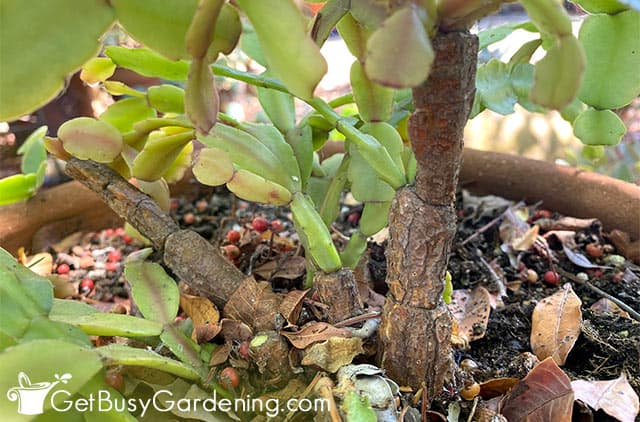
Why does my Christmas cactus have brown woody stems?
It’s normal for a mature Christmas cactus to have brown woody stems as they age and mature. This is a natural part of their growth, and nothing to be concerned about.
When you follow these Christmas cactus plant care tips, you’ll be able to enjoy them for decades to come, and fill your home with colorful holiday blooms annually.

If you want to learn all there is to know about maintaining healthy indoor plants, then you need my Houseplant Care eBook. It will show you everything you need to know about how to keep every plant in your home thriving. Download your copy now!
More Holiday Plant Care Guides
- How To Care For An Easter Cactus Plant (Schlumbergera gaertneri)
- How To Care For Poinsettia Plants
- How To Care For An Amaryllis Plant
- How To Care For Cyclamen Plants
More Epiphyte Plant Care Guides
- How To Grow Rabbit’s Foot Fern (Davallia fejeensis)
- How To Care For An Orchid Cactus Plant (Epiphyllum)
- How To Care For Staghorn Fern (Platycerium bifurcatum)
Share your Christmas cactus care tips in the comments section below.

Leave a Reply