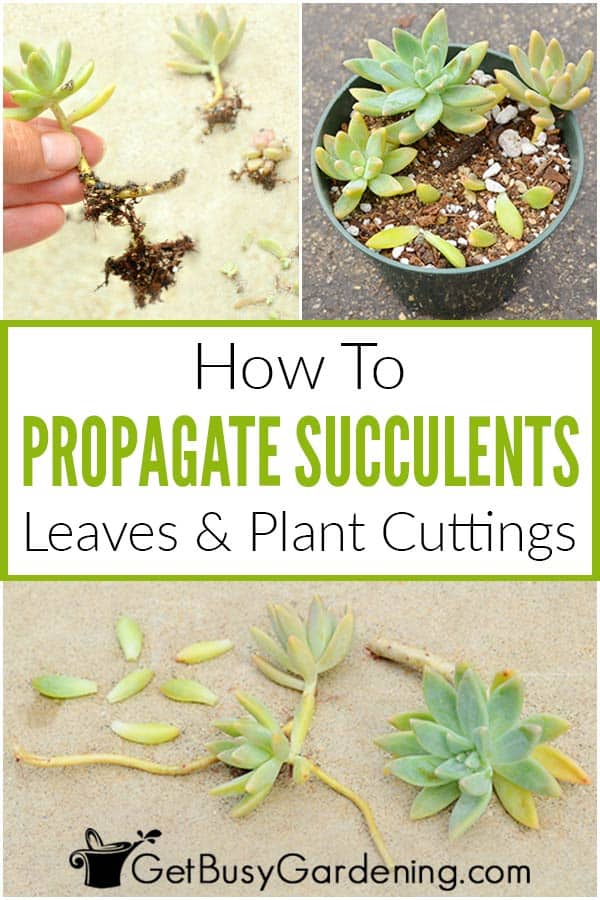
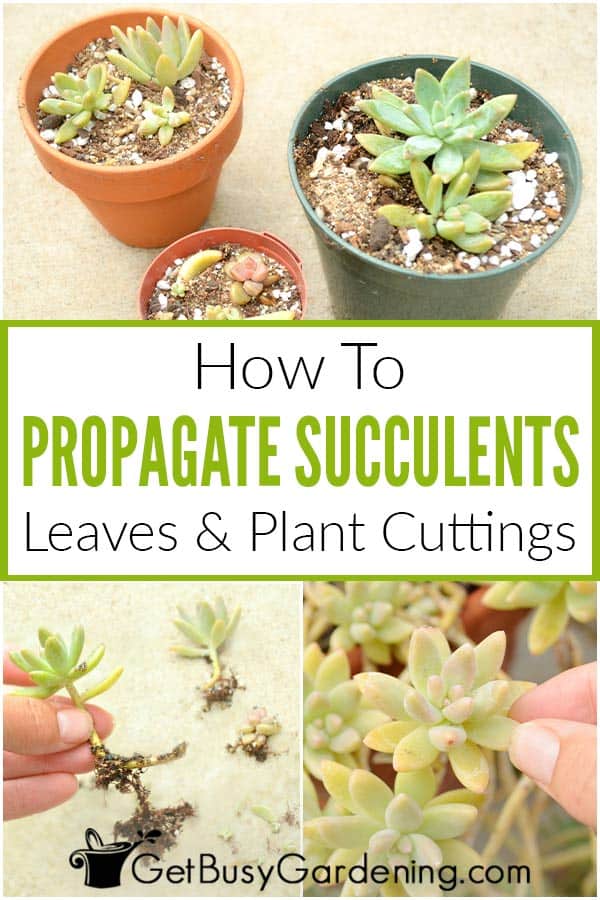
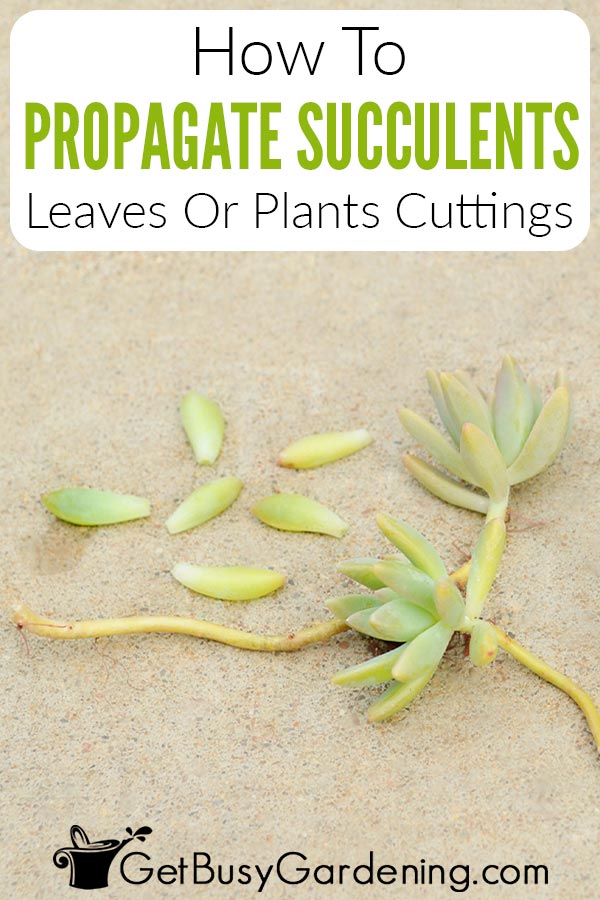
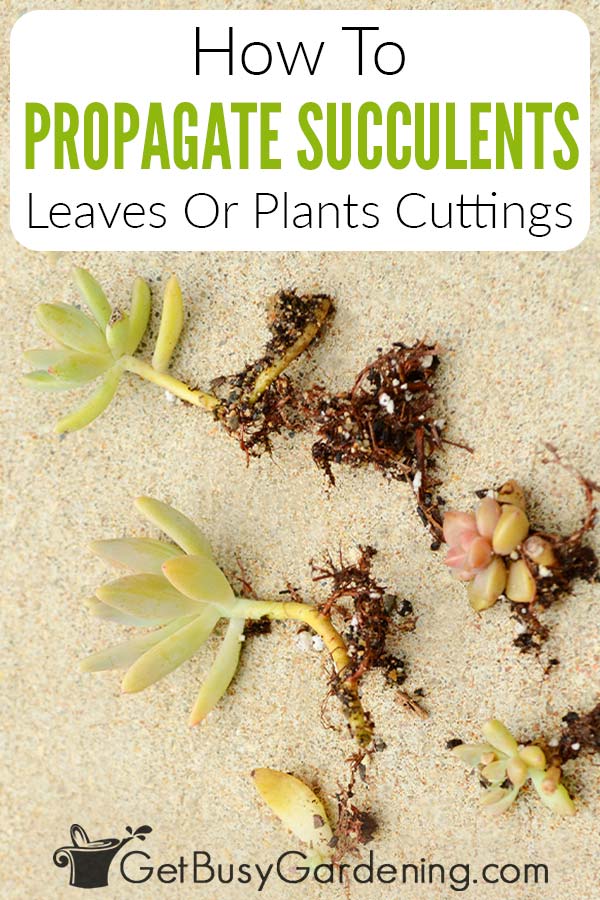
Propagating succulents is a great way to share your favorites with friends or expand your own collection, and they’re perfect for beginners to start with.
Though there are a few different methods you can use, rooting stem or leaf cuttings is by far the most popular and fun way to do it.
Below I’ll tell you all you need to know about how to propagate your succulents, and the best time to do it. I’ll walk you through everything step by step, from taking and preparing your cuttings, all the way through potting them up.

Succulent Propagation Methods
There are three basic ways that you can propagate succulents: 1. rooting cuttings, 2. by division, or 3. from seeds. The exact method to use depends on the type of plant that you have.
For example, you can easily root stems or leaves from jade plants, graptopetalum, or Christmas cactus. But for some species, like aloe vera, haworthia, or echeveria, it’s much easier to divide them.
Starting from seeds is also a fun experiment, and possible for most varieties. But it’s the slowest method and will take much longer to get sizable plants. In this guide, I will focus on how to propagate succulents from stem cuttings or leaves.
When To Propagate Succulents
The best time to propagate succulents is during the spring and summer months. Warm weather will make them root much faster.
In fact, it’s so easy that sometimes pieces will break off and start growing in the ground without any help from you. But, if you provide the right environment for them, you can do it during the winter too.
Propagating Succulents From Cuttings
There are two different types of cuttings you can use to propagate your succulents: either from the stem or individual leaves.
So be sure to keep your clippings when you’re pruning them, or if any of the branches are broken. Here are the pros and cons for each method:
- Stem cuttings – This is where you cut off an entire stem or branch and root it. It’s the easiest method, and will give you larger plants faster.
- Leaf cuttings – Many times you can use the individual leaves, but it’s usually more difficult. It also takes much longer to get mature plants, and it will not work for some varieties.
How To Take Cuttings
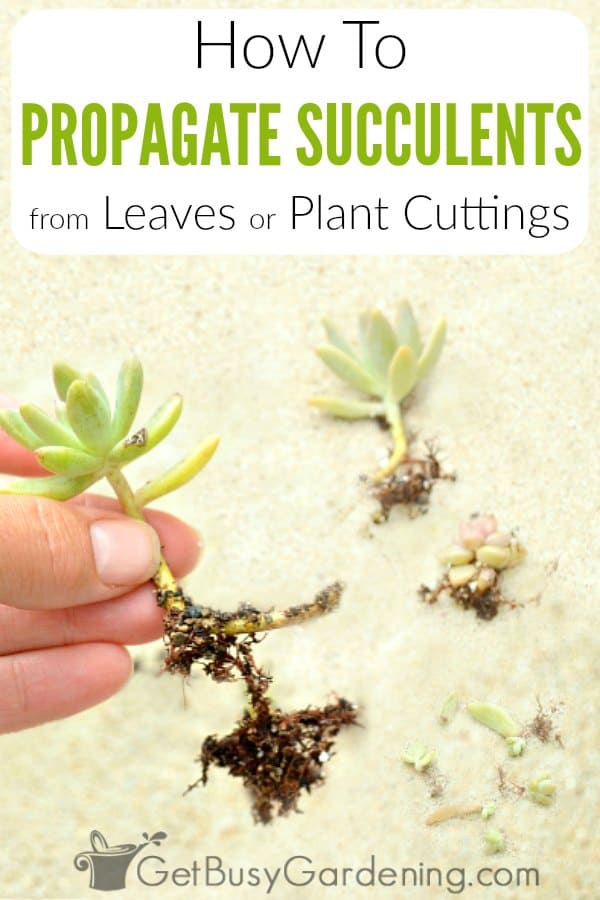
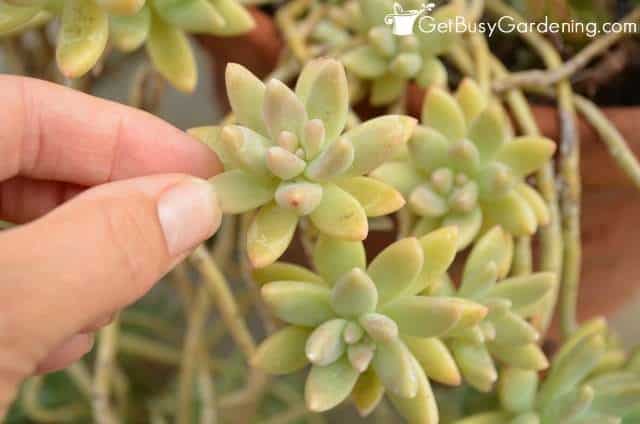
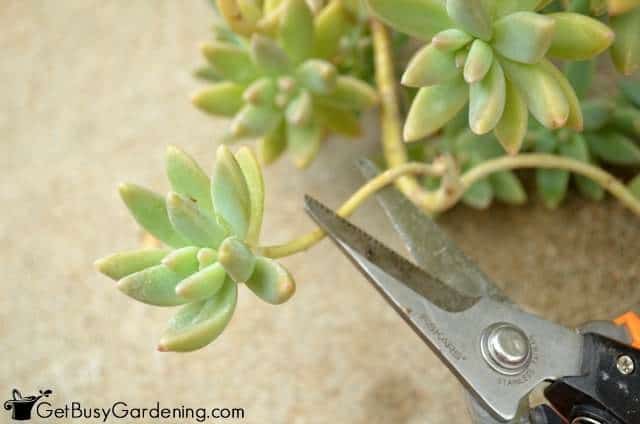
You can take succulent cuttings from anywhere along the stem, but it will be easier to propagate them if they’re at least 2-3 inches long.
Many times you can simply break off a section, and that will root just fine. But I recommend using a sharp and sterile pair of precision clippers or bonsai shears to remove them so they will get off to a healthy start.
Related Post: Succulent Plant Care & Ultimate Growing Guide
Properly Preparing Your Cuttings
After taking stem cuttings from your succulents, there are a few things you should do to prepare them for propagation.
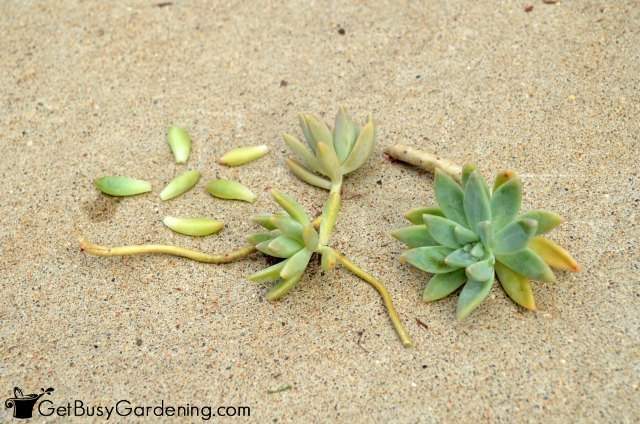
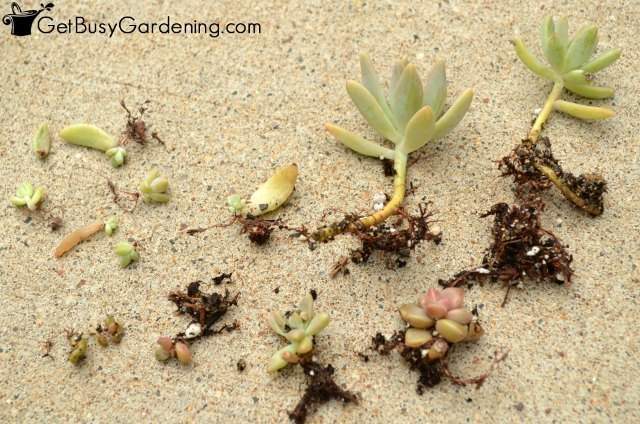
If it’s covered by leaves, remove the lowest ones to expose a few inches of the stem. New roots will form from the leaf nodes, so you’ll definitely need to expose at least a couple of them. Don’t remove all of the leaves though.
It’s also important to allow the wound to cure (dry out and callus over) for a few days to help prevent rotting. The thicker the stem, the longer you should let it cure.
Tips For Propagating Succulent Leaves
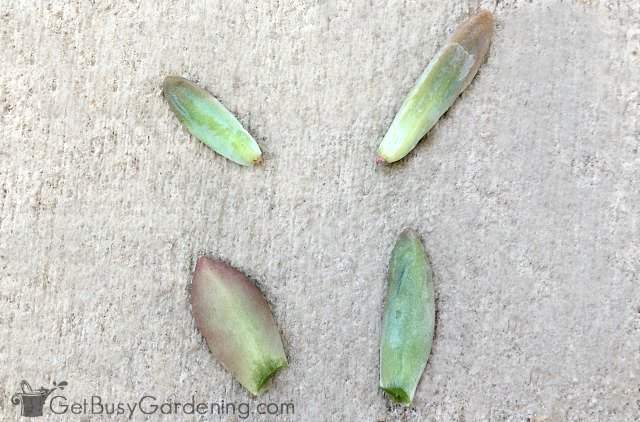
To be successful with propagating your succulents from leaves, it’s important to remove each one correctly. You must break the entire leaf off cleanly, or it will not root.
To do that, hold onto the tip, and gently wiggle or twist it until it comes off. If they break in half in the process, or any part is left on the plant, discard that one and try again.
The leaves will shrivel pretty quickly after you remove them, especially if they’re small. So don’t wait too long to start them, or it might not work.
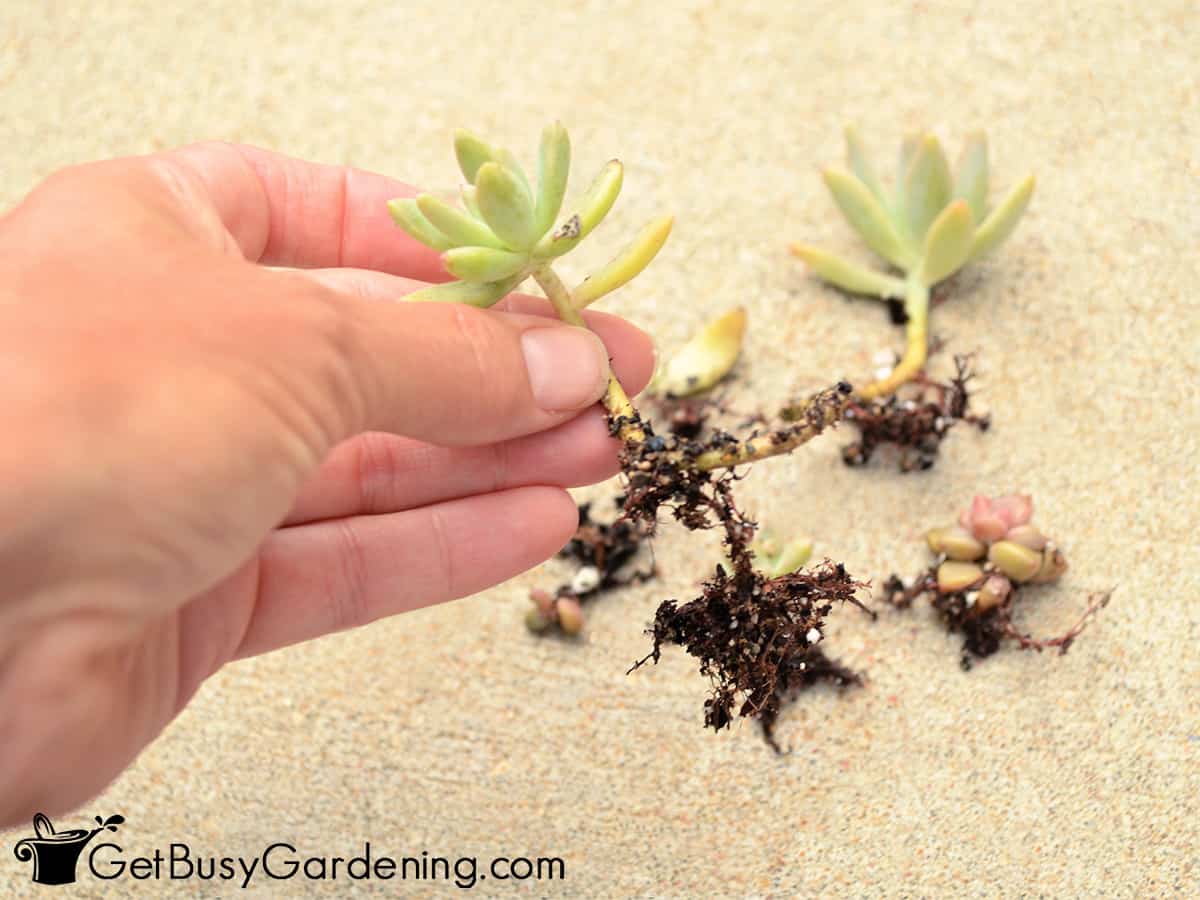
Once they have roots, a tiny plant will form at the base of the leaf. Then eventually the propagated leaf will shrivel up and die as the new baby succulent gets larger. So don’t freak out when that happens, it’s completely normal.
Related Post: How To Plant Succulents Indoors Or Outside
How To Propagate Succulents Step By Step
The best way to propagate succulent cuttings is to plant them in soil. This will give you the best success, and produce stronger, healthier roots. Follow these step by step instructions:
Supplies Needed:
- Prepared stem cuttings or leaves
- Fast-draining soil medium
- Hand trowel
- Rooting hormone
- Clean pot
- Precision pruners or Bonsai shears
See my detailed list of the best plant propagation supplies here.
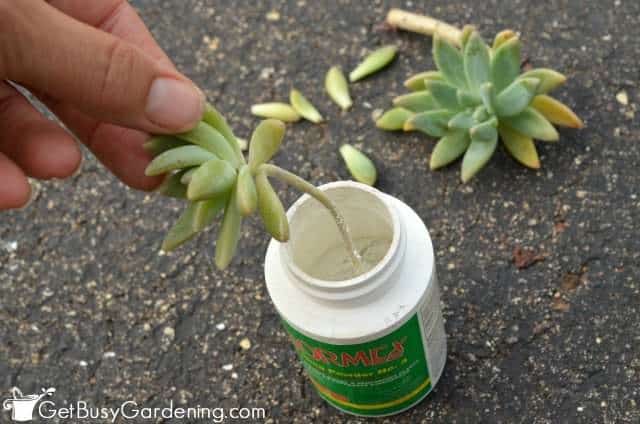
Step 1: Apply rooting hormone – You can use rooting rooting hormone on succulents to speed up the process. Simply dust the stem or base of the leaf with it. This will help them develop roots much faster, and they’ll be stronger too. But you don’t have to use it if you don’t want to.
Step 2: Fill a container with medium – Fill a small pot with the potting mixture. For best results, I recommend using a very fast draining medium. General potting soil is too heavy, and can cause the cuttings to rot.
Related Post: How To Make Your Own Succulent Soil (With Recipe!)
Step 3: Plant the cuttings – For longer cuttings, make a hole in the medium with a pencil or your finger, and gently place the stem into it so the rooting hormone won’t rub off.
Then lightly pack the medium around the base of the stem so it stays in place, and to ensure the soil comes into good contact with it.
For individual leaves, you can simply lay them on top, or cover them with a very thin layer. Don’t bury them very deep though, just cover the bottom quarter of the leaf, or so.
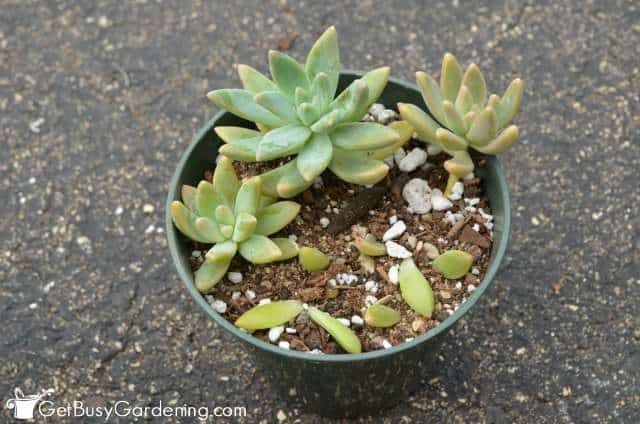
Step 4: Place somewhere warm and bright – Put the pot in a warm spot with bright, indirect light. Outdoors, make sure they are protected from full sun and heavy rain.
Keep the soil dry, but the air around them slightly humid – if it’s too wet they will rot. For leaves, the medium should be damp, or you can lightly mist them daily.
Step 5: Check for roots – The roots should start forming in a few weeks. You’ll know your succulent cuttings are propagated when you see new leaves growing on the top, and it doesn’t move when you lightly tug on it.
For individual leaves, once the roots are about a 1/2″ long, you can bury them with a thin layer of medium if you want to, but don’t cover any part of the tiny baby plant.
Related Post: How To Water A Succulent Plant
How Long Does It Take To Root Succulents?
It takes anywhere from 2-6 weeks to propagate succulents, but the exact timing depends on the environment and the variety that you have. They will root faster if the air is humid than they will in totally dry conditions.
If you laid individual leaves on top of the medium, then you will be able to watch them as they sprout. A new baby plant will start forming at the base of the leaf shortly after the roots form, but sometimes it can happen before.
Related Post: How To Make An Indoor Succulent Garden
Why Aren’t My Succulent Cuttings Rooting?
If your succulent cuttings are not propagating, then there are a few things to check. They won’t root if it’s too wet, the air is extremely dry and hot, or if it’s too cold. Individual leaves won’t root if you broke them off the wrong way – the entire leaf must be intact for it to work.
For the best chance of success, put them in a bright, warm, and slightly humid location that’s out of direct sunlight, and keep the medium on the dry side. To speed things up, set the pot on a heat mat and use a grow light.
Potting Up Your Rooted Succulent Cuttings
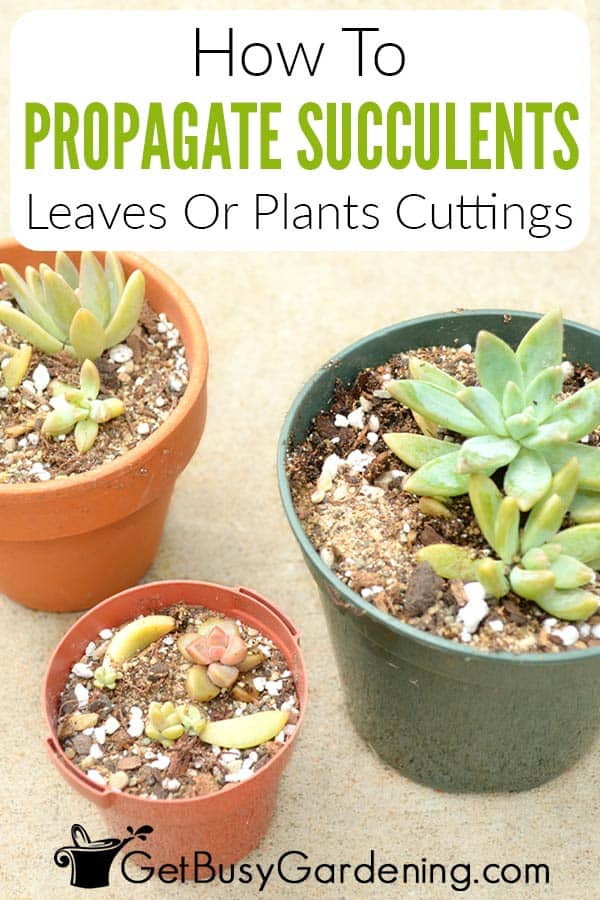
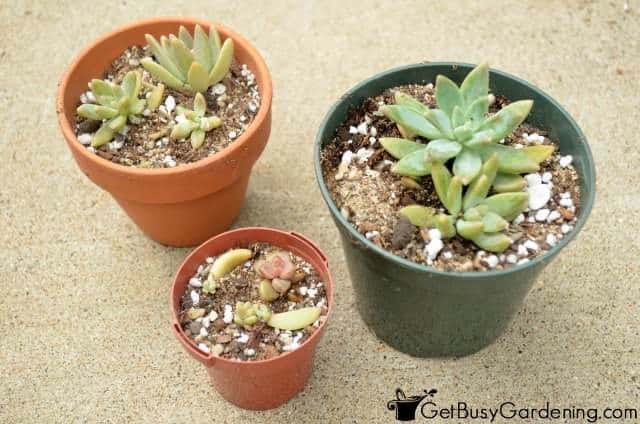
Once they have thick and healthy roots, you can pot up your newly propagated succulent cuttings. But this is optional. If the container they’re in is large enough, you can just leave them be until they outgrow it.
When the time comes, choose a new pot that’s only one or two sizes larger, and make sure it has drainage holes in the bottom. Fill it with a quick draining mix, or a use gritty one, then plant your new babies at the same depth they were in the old container.
Related Post: How To Repot Succulent Plants
FAQs
The best way to propagate succulents is by rooting stem cuttings. You can also use individual leaves as well, but it will take much longer to get a decent sized plant.
You could certainly try propagating your succulents in water. However, this method can be risky because they can quickly rot. If you want to try it, make sure to suspend the cutting above the waterline rather than submerging it.
Propagating succulents is easy, and it’s a great way to multiply your favorites and share them with friends and family. Once you get the hang of it, you’ll have plenty of new babies to go around.

Do you want to learn how to multiply all of your plants? Then my Plant Propagation eBook is for you! It will show all you need to know to get as many new plants as you want from your existing ones. Grab your copy today!
Share your tips for propagating succulents in the comments section below!

Amy Sue Bergmann says
I am new to succulent planting; i live in Iowa and I am wondering if these can be left to winter-over outside?
Amy Andrychowicz says
The type of succulents that are shown in my photos are not hardy and would need to be brought indoors as houseplants for the winter.
Nancy says
I live in Southern California. I bought a 2 foot Plumaria and planted it in a huge plastic pot outside. It has grown 5’ tall with many leaves and bloomed in one spot beautifully. After reading all your wonderful information, I am now not sure what to do with it for the winter season. We have been dealing with a severe drought situation here but, I don’t want it to get overwatered if and when it does rain. Should I just cover the soil with a tarp or mulch or something for the winter?
Amy Andrychowicz says
Plumeria plants grow very well in So Cal, and I’ve seen them growing right in the ground in people’s yards in both LA and San Diego. So cool! As long as the pots you’re growing your plants in have drainage holes, you shouldn’t have to worry about them if it rains during the winter. Unless you’re expecting to get torrential rainfall for several days in a row, then they’ll be fine without any extra protection from the rain. If you do get rain, then just keep an eye on the soil and make sure it’s not soggy. If it starts to get soggy and can’t dry out, then you may want to move it to a protected location where it can dry out for a few days. Check out my plumeria plant care guide for more details about how to care for them.
Mike Clapham says
Hi, how do I attach a photo to show you which succulent I’m referring to please? The succulent in question says the genus is Echeveria, a variagated yellow. Many thanks
Amy Andrychowicz says
You can’t post a photo here, but you can post one on my Facebook page, or tag me on Twitter or Instagram.
Peyton Kidd says
One of my succulents has dropped almost all of its leaves. The only explanation I can come up with is overwatering, although I’m not sure. The leaves seem firm and healthy. Are they suitable for propagation? How do I know when they’re “dried out?” Sorry, I’m the ultimate newbie at this hahah.
Amy Andrychowicz says
Do you know what type of succulent plant it is? I have one that drops the leaves in the fall after I bring it inside. Also, if everything looks healthy on the plant, maybe it was disturbed somehow (e.g.: by an animal or heavy rainfall)? Some succulent plants are very delicate, and the leaves will easily break off when it’s disturbed. You would know if the leaves were dried out. They would be brown and crispy, and look very obviously like dead leaves. If the leaves on yours are firm and have a clean break, then yes, you could definitely try propagating them.
Taylor says
I work in weddings and our event last night used succulents in her bouquets. Since she didn’t want any of them at the end of the night I now have 15 new blooms. However the entire root of the plant has been carefully cut off. I put each Bloom in a pot of soil last night. Should I take them out to dry out and then try again or do you think this will work? Thanks!
Amy Andrychowicz says
That sounds beautiful, I love the idea of using succulents in wedding bouquets! I bet that looked amazing! How nice of her to give them to you, great score. I’m assuming that when you’re saying “blooms” you mean a small succulent plant rather than a flower from the plant. If so, I would recommend that you remove a few of the bottom leaves to make a little stem that you can stick in the dirt to make it easier for the plant to root. You can keep the leaves, and root those too! Yes, you can allow the stem to dry out a bit before trying to root them. A day or two would be plenty of time for small plants like I’m picturing you have.
Ghostie says
I’m very new to this and was given a succulent from a friend. It’s a cutting and has no roots but I thought I still had to water it. No wonder the soil is still damp. Is this harmful to the plant? Should I re-pot it?
Amy Andrychowicz says
If it doesn’t have any roots, then you can just move it to a pot where the dirt is dryer. No problem.
Chelsea says
At first cuttings shouldn’t be watered too much, usually a week to give it a chance to callous over, so it doesnt rot. I recently cut a head off a plant and put it in soil. I pulled it up a week later and its starting to develop some roots from where old leaves used to be. It will eventually get roots and you can water regularly. Less is more for succulents. U can tell if they get raisin like they need water.
Lisa says
Hello! I have a question, when you cut the piece you want to propagate off, does the rest of the stem (that is on the original plant) die? Or will it continue to grow?
Amy Andrychowicz says
It should continue to grow, and the new growth will sprout out below where the cut was made. The succulent plant will grow bushier after you prune off the cuttings. 🙂
Rebecca says
I love the color of that ghost plant! Does it stay that green or does it tern gray like the pictures of other ghost plants? do you sell cuttings? I really love the form of ghost plants but not the typical grayish color i see in pics so i havnt bought one. Id love one just like that though
Amy Andrychowicz says
There are lots of different varieties of ghost plants, some are green and some are gray… and everything in between. No, I don’t sell cuttings, sorry. Thanks for asking though. 🙂
Sandra says
What succulent is that?
Amy Andrychowicz says
It’s a type of ghost plant succulent.
Barbara Price says
Thanks for the info on rooting succulents. The following idea is for rooting woody-stem plants like roses. I was excited to get a cutting from a heritage rose bush originally planted by my great great grandmother in the mid-1800s. I had read about a propagation technique that used a large clay pot & a small one as a water reservoir. Thus began an experiment I named The Texas Two-Pot method.
You put the small water reservoir pot in the middle & fill the large pot with good potting soil. Strip off some leaves & thorns, put the cuttings in the dirt, & keep the reservoir full.
Amy Andrychowicz says
You’re welcome. Thanks for sharing The Texas Two-Pot method, sounds awesome!
Mary Mack says
do both the pots have holes in the bottom?
Lynne says
I am trying to propagate some succulent leaves and I wondered, what do you do when a baby plant grows on the leaf but no roots? How can you get the baby to root? Or is it a no hope situation?
Amy Andrychowicz says
You can root the baby just like you would a cutting if it has a stem. Otherwise, if there’s no stem, you can root it like you would if it was just one leaf. Try dipping the bottom in rooting hormone, pressing it down into the dirt a bit, and follow the instructions I’ve written above. It should work just fine. 🙂
Kerry says
So you cut the baby stem and leaves from the mother leaf if it hasn’t grown roots, then plant it in soil?
Amy Andrychowicz says
Sorry, but I don’t understand your question.
Kerry says
Sorry! Must have been half asleep when I wrote the question!
Robin says
Great tips- I am always trying to get those little leaves that break off my succulents to root!
Amy Andrychowicz says
Awesome! Propagating succulents from leaf cuttings is so much fun isn’t it!? 🙂
Victoria @DazzleWhileFrazzled says
Succulents are my favorite! They are easy to propagate, even without knowing what I’m doing! 😉
Amy Andrychowicz says
Succulents are my favorites too!
Chelsea says
When cAn you remove the big propagating leaf from the chick? I have a purple echeveria baby that was about half an inch attached to a large but rather lifeless leaf, I cut it off w scissors …
Amy Andrychowicz says
Yes, wait until the main leaf dies back, and then you can remove it from the baby succulents. Sometimes they’re easy to pinch out, or you can use clippers and cut them out just like you did.
ivy joyce tapales says
do you have names and photos of succulent plants? will you post them here and notify me pls? thanks so much.
Amy Andrychowicz says
The plant used in this post is a ghost plant succulent. You can find more info and see photos of other types of succulents in my succulent plant care guide.
angel says
Thanks for the succulent propagation tips! I learned a thing or two.
Amy Andrychowicz says
You’re welcome!