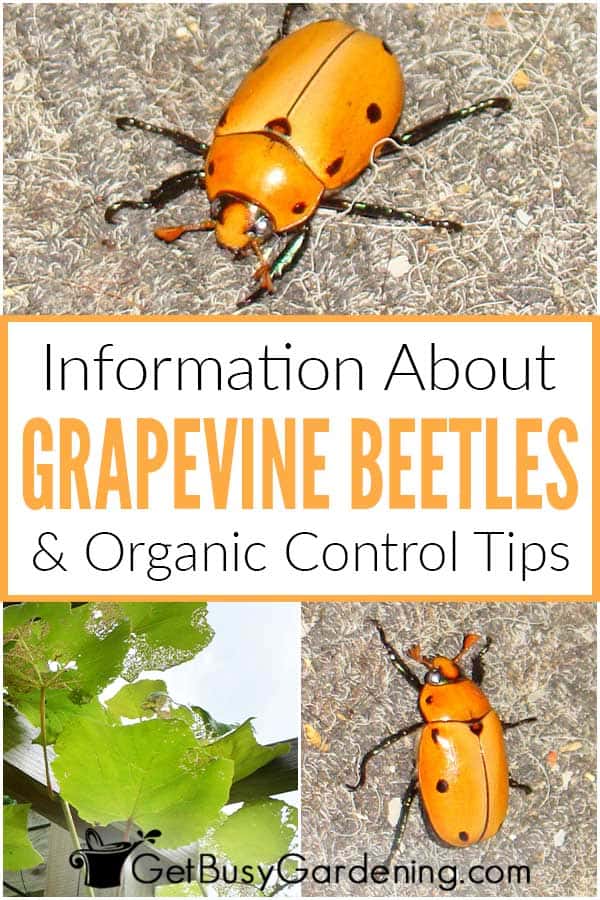
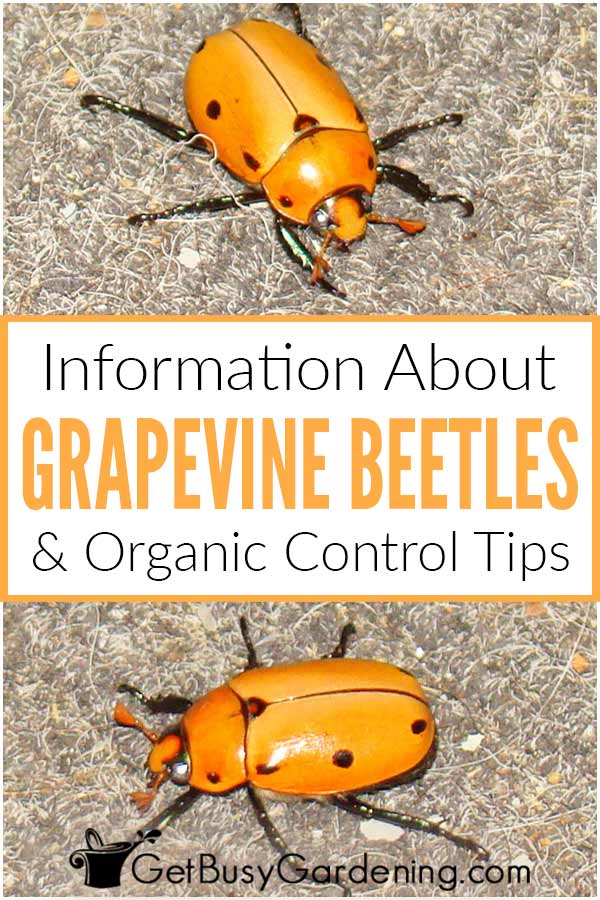
Grapevine beetles are large orange or tan bugs that like to feed on grapevines and fruit trees. Though they are big and scary looking, they aren’t usually a major garden pest.
In this guide you’ll learn all you need to know about them. I’ll go through everything from what they eat, their life cycle, where they come from, the damage they cause, and whether you should worry about getting rid of them or not.
Plus you’ll find lots of easy and non-toxic ways to prevent grapevine beetles from eating your plants, if they ever do become a pest in your garden.
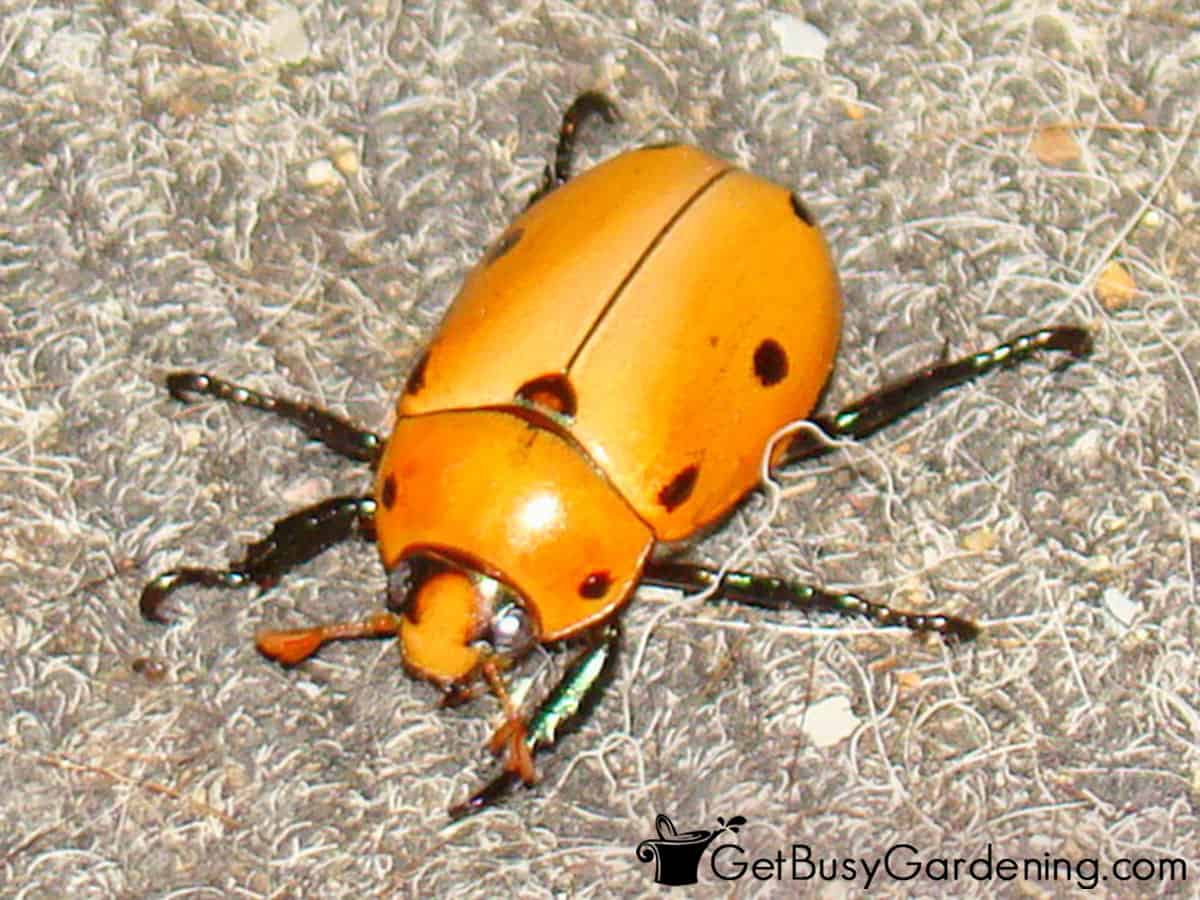

What Is A Grapevine Beetle?
The grapevine beetle (Pelidnota punctata), is a type of scarab that is found in eastern and central parts of North America.
They are related to the Junebug, and sometimes called a ‘spotted June beetle’. Like their more common relative, they’re nocturnal and attracted to bright light.
What Do They Look Like?
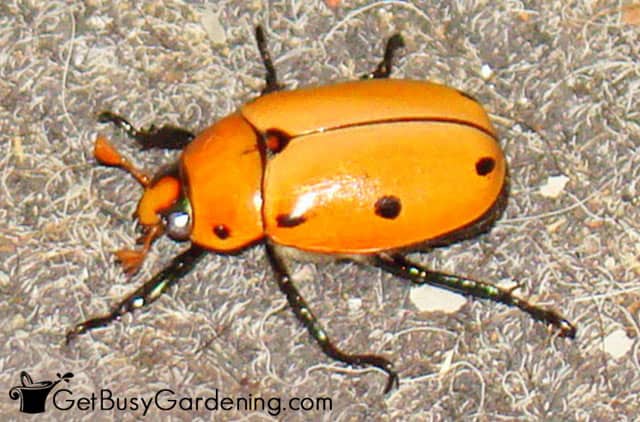
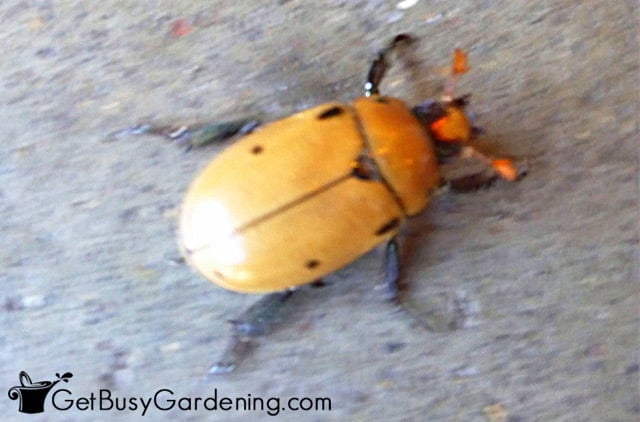
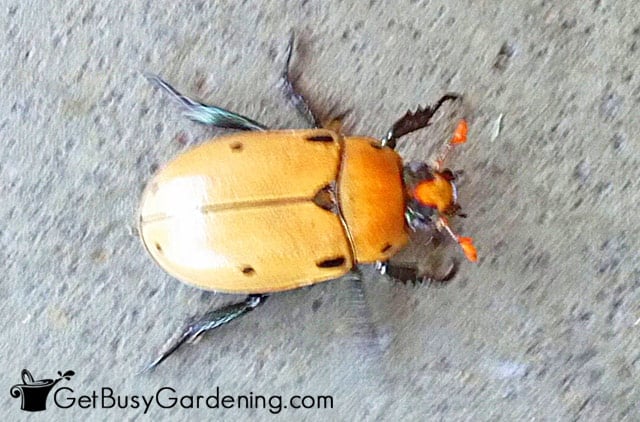
First off, they’re hard to miss because they are HUGE. They’re easily two-three times larger than a Junebug, and actually kind of scary looking the first time you see one. YIKES!
If their size isn’t enough to make a positive ID, then look for other distinguishing characteristics. The colors range from bright orange to light tan, and they usually have black spots on their back (though some may not have spots).
They fly around at night, and are just as clumsy as their more popular relative. If you ask me, they look like they’ve been drinking when they fly.
But don’t let this fool you, they can still move pretty darn fast. Their size and clumsy way of travel makes them easy to spot when they’re buzzing around.
Grapevine Beetle Life Cycle
There are four stages to the grapevine beetle life cycle: adult, egg, larva, and pupa. The adults lay their eggs in the soil, and the larvae hatch a few weeks later.
The larvae are large white grub worms that burrow deep into the ground, where they overwinter until spring. As the soil warms up, they slowly make their way back to the surface, where they feed on rotting wood.
Once they’re mature enough, the grubs pupate near the surface of the soil, and they emerge as adult beetles sometime in July. There’s only one generation per year.
What Do They Eat?
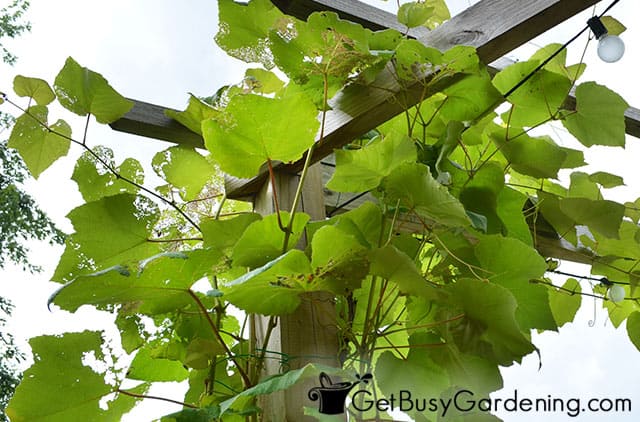
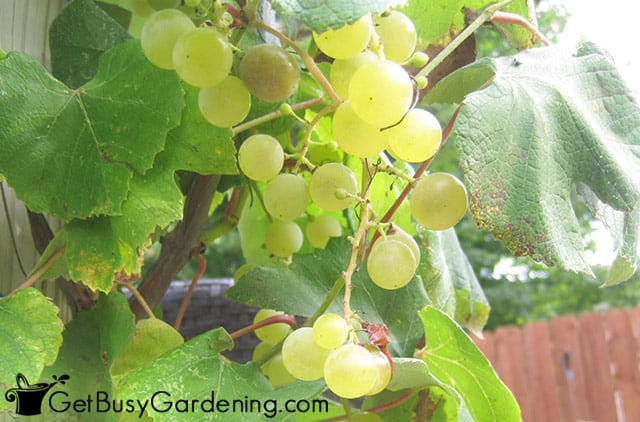
As their name suggests, these beetles like to eat the leaves and fruits on both wild and cultivated grapevines. They can feed on other types of fruits too (like apples and raspberries), but it’s pretty uncommon.
The larvae eat rotting organic material, so they are actually considered beneficial. Thankfully, the larvae do not feed on plants. Only the adults do that.
Damage To Plants
They can damage plants by eating holes in the leaves or fruits. They will skeletonize the leaves, and can also destroy the fruit.
However it’s very rare for them to cause major damage to the plant. This is because they aren’t usually found in large numbers.
What’s Eating My Grapevine Leaves?
Just because you find damage on your plants doesn’t mean you have grapevine beetles. The more likely culprit is Japanese beetles.
Those pesky bugs absolutely love my grapevines, and feast on them every summer. They ARE major garden pests, and like to congregate in large numbers. But they’re much smaller and iridescent green and brown. Read all about how to identify and control Japanese beetles here.
Are Grapevine Beetles Harmful?
Luckily they are not harmful to humans or pets, and they don’t sting or bite. They are also rarely harmful to plants.
Even though the adult beetles primarily feed on grapevines, they aren’t considered major pests in vineyards. So it’s highly unlikely they would cause major problems in your home garden.
A major infestation certainly could cause damage, but it’s pretty uncommon. So don’t worry if you see one or two of them flying around your neighborhood.
How To Get Rid Of Grapevine Beetles Naturally
In the unlikely event that you do have an infestation, there are a few different things you can do to control them. But if you only see a couple of them, I encourage you to just leave them be.
There is no reason to ever use synthetic pesticides (plus I’m guessing you don’t want to spray chemicals on your grapes anyway). So please use the organic control methods below to target only the pest insect.
Related Post: How To Control Garden Pests Naturally
Hand Picking
Since they are so big, it’s easy to hand pick them from the plant and drop them into a bucket of soapy water. I find that Dr. Bronner’s liquid soap works very fast to kill bugs.
But, since they are nocturnal, it may be hard to find them. So I recommend going out in the late evening or early morning to hand pick them when they are still out, but not as active.
Diatomaceous Earth
If hand picking them is just too much to bear (and I don’t blame you for that!), then you can try a more hands-off approach. Diatomaceous earth (DE) is an all-natural product made from crushed up hard-shelled organisms.
Sprinkle it directly on the grapevine beetles. It will get under their shell and cut up their soft bodies, eventually killing them.
Insecticidal Soap Spray
An organic insecticidal soap spray can work to shock them so they’re easier to pick from the plant. You can mix your own using 1 teaspoon of mild liquid soap to 1 liter of water.
You have to spray it directly on the bugs though, or it won’t have any effect. Also, it probably won’t kill them right away, so use it to stun them before hand-picking.
Beneficial Nematodes
Another organic method you can try is beneficial nematodes. These are tiny predatory parasites that live in the soil and feed on the larvae (grub worms).
For best results, apply them in the fall or spring when the grubs are close to the soil surface. Read all about how to apply beneficial nematodes here.
Milky Spores
Harmless to beneficial bugs, milky spore is a naturally occurring bacteria that infects the grubs when they eat it, and eventually kills them.
The downfall is that it can take 2-3 years for this method to be effective. But once active, milky spores last in the soil for several years.
Related Post: Natural Garden Pest Control Remedies And Recipes
How To Prevent Grapevine Beetles
Rather than treating for them, you could try preventing grapevine beetles from munching on your vines in the first place. Here are a few preventive methods you can try…
Cover Your Vines
Since grapes don’t need to be pollinated by bees, you can cover your plants during grapevine beetle season (mid-summer through fall). This works great for keeping all types of pests away.
Use a lightweight garden fabric or tulle to cover or loosely wrap the vines. Get the exact steps for how to protect your grapevines here.
Keep Your Garden Clean
The adult females tend to lay their eggs on pieces of rotting wood. So, if you have any dead wood sitting around your garden or property, clean it up.
That will help to prevent the adult beetles from laying their eggs close to your grapevines, and hopefully they’ll go elsewhere.
FAQs
No, grapevine beetles are not poisonous. They do not emit or contain any type of toxins, so you have nothing to worry about there.
No, grapevine beetles do not bite or sting humans or pets. They just eat plants and fruit.
No, grapevine beetles are not dangerous. Though the adults do feed on foliage and fruit, they rarely cause major damage or kill the plant.
Their life cycle, from egg through adult, is two years. But the adults only live for one season. They lay their eggs in the fall and the larvae overwinter underground.
You probably don’t need to do anything to get rid of them. They are not a major pest or much of a threat to home gardens. So if you only see one or two, then just leave them alone.
More Garden Pest Control Posts
- How To Control Flea Beetles In The Organic Garden
- How To Get Rid Of Cabbage Worms Organically
- How to Control Squash Bugs Organically
- How To Get Rid Of Slugs In The Garden Naturally
Share your grapevine beetle stories or experiences in the comments below.
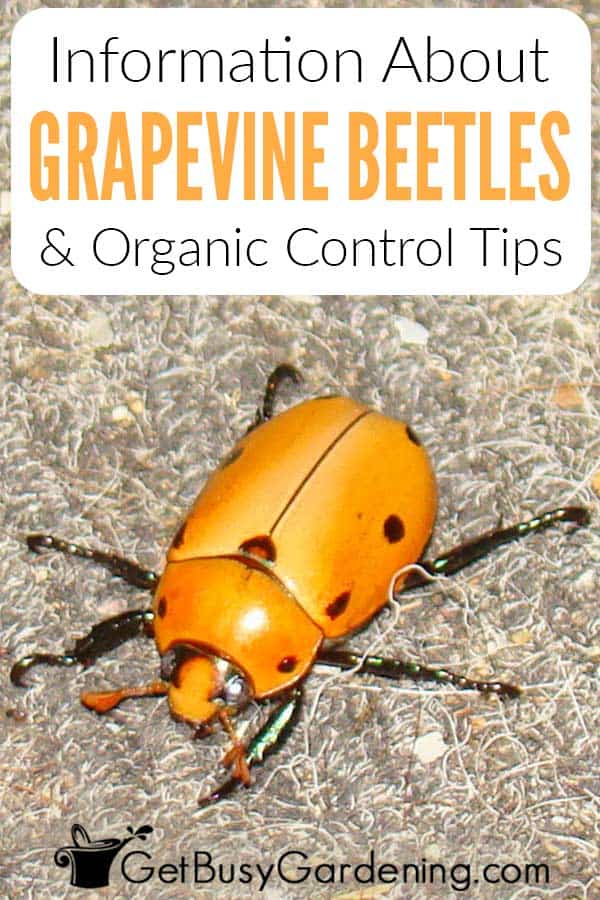
Photo Credit: Public Domain Pictures

John Lindsay Morash says
Hello never experienced that grape Beatle what month during the summer or fall do they stop
Amy Andrychowicz says
Grapevine beetles will stop once it gets cold in the fall, usually around the first hard freeze.
patricia grove says
Saw my first grapevine beetle today resting on my front screen door. Yep kinda scary so I looked it up. I think it must be lost because I don’t have a garden, grapevines or anything yummy this bug may want. Strange that it moved closer when I told it to rest up and move on. 6 hours later, still there. I appreciate the information here about it not being harmful.
Amy Andrychowicz says
There may be wild grapevines nearby that you don’t know about, or maybe the beetle was just passing through.
Tina LeC says
Came home at dusk to see a golden beetle on our screen door. I photod it using the Google app and photo matches and your article came up. You learn something every day. Will leave alone and watch for any others on my old old concord grape vine. Thanks for your info.
Amy Andrychowicz says
You’re welcome, glad to hear I could help you identify the grapevine beetle and know what to do. 🙂
Lj says
I have one strolling through my Mpls chard garden. It has a cute furry belly!
Amy Andrychowicz says
Cool. I never noticed that grapevine beetles have a furry belly. I’ve never gotten that close to see it, LOL!
Connie Rose says
I have been out picking green beans this morning before all heat breaks loose and was hear some large bee type sounds. I persisted in accomplishing my goal when the buzzes became louder, over my back and then the sound of hitting metal. With 20′ of greenbean wonders to pick and something dive bombing me, I stood up and saw numbers of possible large bees or hornets flying haphazardly to and fro, up an down, into the camper side and back. The hazey morning sky had cleared and the morning sun made things a bit blurry but at fear of being stung and not accomplishing my task I focused…..what? Crazy flying beetles? BIG ones at that! Breaktime! I looked up Japanese beetles and the did not match but a beetle chart showed me the culprit. This same spotted June Beetle. I have never witnessed these before! The corn is right beside my beans and they are hanging around there. On my way to the house a couple emerged from the grass. We are in Bristol, Indiana and garden organically and mulch with duck compost that sat over the winter. It is great but this year as we covered our veggies and flower beds I noticed a good number of grubs. I squished alot but am sure I missed some. This all led me to your sight. Thank you for the great information and the comments from readers, some of whom are from my home town of Findlay, Ohio…go Buckeyes! Time to study up on spotted June beetle prevention.
Amy Andrychowicz says
You’re welcome, glad you found this article helpful. Unless the grapevine beetles are causing damage to your plants, you don’t have to worry about them. If however they are wreaking havoc, they’re easy to hand pick and drop into a bucket of soapy water.
Nancy Taylor says
I saw one of these on the sidewalk outside the grocery store. Being afraid someone would step on it , i picked it up and set it on the grass. I thought it was beautiful, took a photo, and found this article. Glad to k ow what it is. It didn’t hurt me at all. I live in Northwestern Pennsylvania.
Amy Andrychowicz says
Good for you for saving the grapevine beetle! 🙂
Trent Anderson says
Staying up late tonight with my fan on and my screenless window open(the fan covers 95% of the open window), when I hear Thwapclickclick. The little guy hit my already semi broken wobbly blades fan so hard he broke it more! He unfortunately died and I feel bad, but he must have come from the rotten stump out front of my house in the middle of town(uptsate ny, about 75 miles below sacandaga)
Amy Andrychowicz says
Holy smokes, that must have been a big shock for you!! I bet it was really loud when that huge grapevine beetle came through the fan. Yikes! Too bad it didn’t survive.
Laura lee Bushong says
I was pulling weeds in my green beans and the thing attached itself to my wrist. I was freaking out .I managed to shake it off and came in and looked it up it was a grape vine beetle . I watched it for a minute and then it flew off it was huge
Amy Andrychowicz says
Eek!! I would have freaked out too! Good thing grapevine beetles don’t bite or anything. I’m so glad that you were able to ID it, and to hear that you let it go along it’s merry way. 🙂
Barbara says
Just found a dead one on my porch in central New York. No grapevines nearby. I have lots of potted plants and a garden full of perennials. I will look for them now that I know what they are and what they do.
Amy Andrychowicz says
Weird, I wonder why it died. It might have just been passing through, or maybe there are wild grapevines growing near your neighborhood.
Dennis says
My neighbor has grapevines but I never saw one before this year. Now I’ve seen a number of them. One landed on my bare arm a couple nights ago. When I tried to pull him off he dug in with sharp claws. After I got him off with some pain, he got hold of my finger. I had to shake my hand really hard to get rid of him.
Amy Andrychowicz says
Eek!! That sounds horrifying!
Worried Mother of 2 says
Checking in from Westchester County, NY. We don’t have a garden, in NY. But I just saw my 1st one of these BIG Beetles when I walked in tonight. I didn’t know what it was, but I have a 1 year old, & 5 year old, & it freaked me out. So I killed it (luckily my husband & kids were sleeping, & it didn’t wake them up). But like 1 of the other readers said, I’m happy to know that it wouldn’t have bitten, or eaten any of my kids or family. Thanks for the info!!
Amy Andrychowicz says
Wow, you are brave to have killed it! I would have woken my husband up so fast, he wouldn’t have known what was going on, LOL!
JonRoss Noble says
I Found my first grapevine beetle today laying between a flower bud and leaf of my Dinnerplate Hibiscus. I instantly jumped back from the size of what I first thought was a mutant Japanese beetle, because it threw it’s hind legs up exactly like those evil little trolls. Besides for wanting to make sure I could identify it later, I made sure to capture it so it wouldn’t cause any damage.
I am in Indiana so I had a hard time identifying based on searching sites specific to insects/beetles typically found in indiana or northern states. When I finally did a Google search with a simple description of the beetle and found an image that matched, the site stated it was a ‘small beetle’ (I would have used the word huge) and referred to West coast states and Mexico as its general reach. Even though I know lots of bugs have wings and the inability to read state ‘welcome’ signs, we are a little more then a few states away from the west coast.
Even with proof from picture, I was a bit reluctant to think it was a grapevine beetle until I saw this page. So, much thanks! We also had a fairly mild winter this year (and last year, actually). Spring started warm and humid with summer following suit. I guess coupled with my hibiscus garden, it would be worth the travel for a near Maui experience for a vacationing beetle. Lol I learned something new today and hopefully the next one I encounter won’t freak me out so bad.
Amy Andrychowicz says
LOL, I love your story. I completely freaked out the first time I found one too, and immediately ran to my computer to look it up. They are HUGE, and we never see bugs that big up here in MN. I can’t believe that someone described them as a small beetle. I’d hate to see the bugs they consider huge, YIKES! Glad you were able to find my site, and learn more about the grapevine beetle. 🙂
Barbara Wheeler says
I used neem oil on my grapevine and its been amazing it takes care of the bugs for the most part and its safe to use
Amy Andrychowicz says
Good to know it works for your grapevines, thanks.