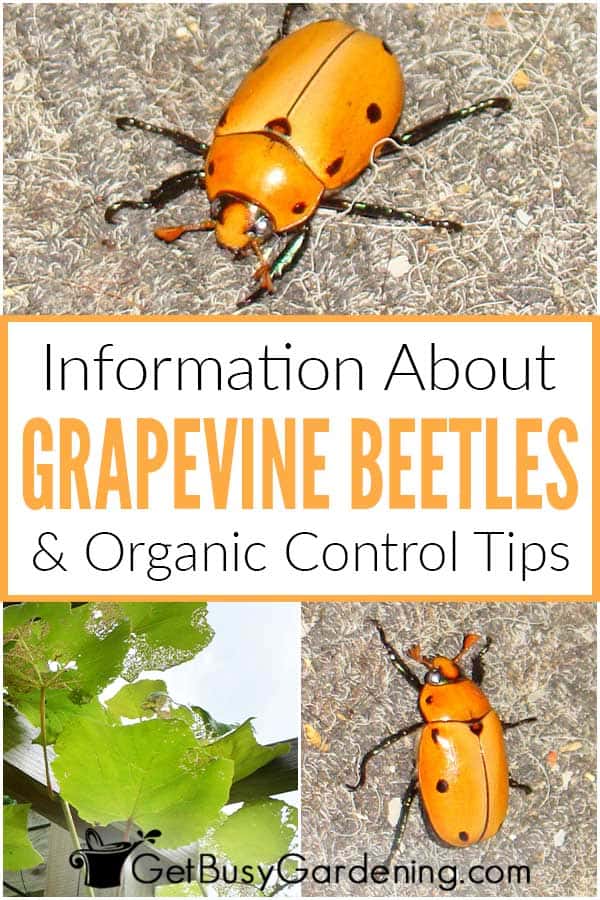
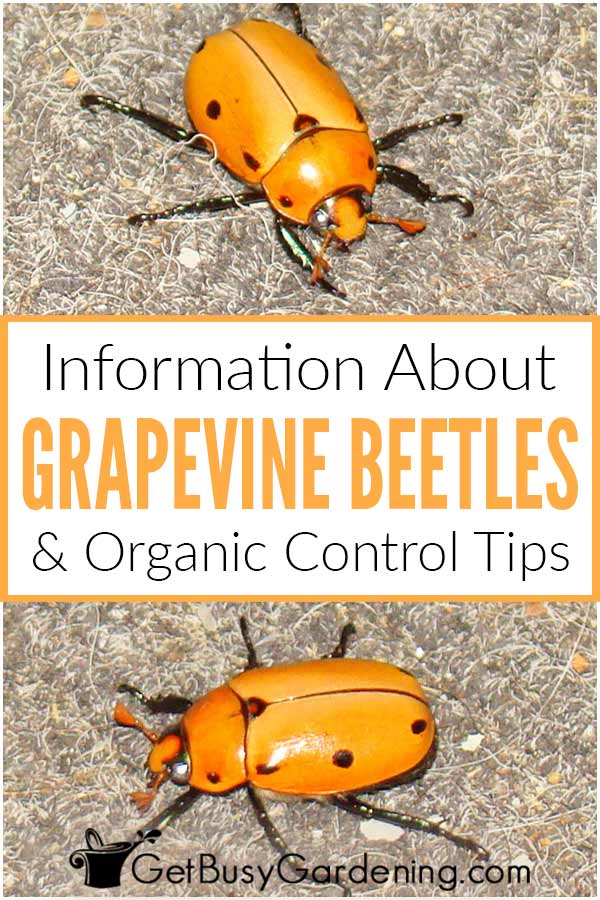
Grapevine beetles are large orange or tan bugs that like to feed on grapevines and fruit trees. Though they are big and scary looking, they aren’t usually a major garden pest.
In this guide you’ll learn all you need to know about them. I’ll go through everything from what they eat, their life cycle, where they come from, the damage they cause, and whether you should worry about getting rid of them or not.
Plus you’ll find lots of easy and non-toxic ways to prevent grapevine beetles from eating your plants, if they ever do become a pest in your garden.

What Is A Grapevine Beetle?
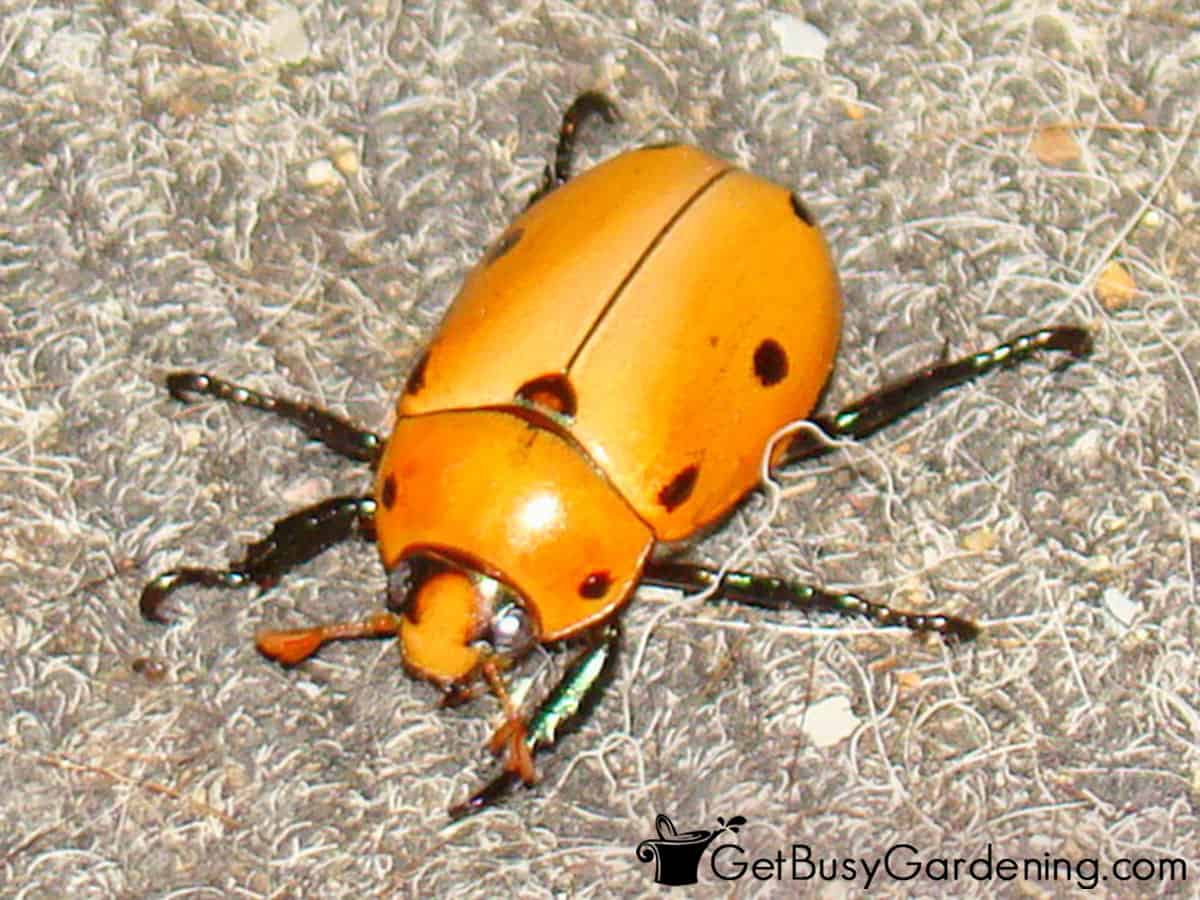
The grapevine beetle (Pelidnota punctata), is a type of scarab that is found in eastern and central parts of North America.
They are related to the Junebug, and sometimes called a ‘spotted June beetle’. Like their more common relative, they’re nocturnal and attracted to bright light.
What Do They Look Like?
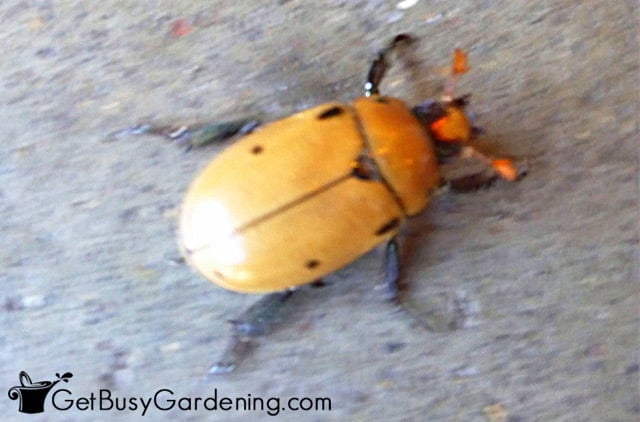
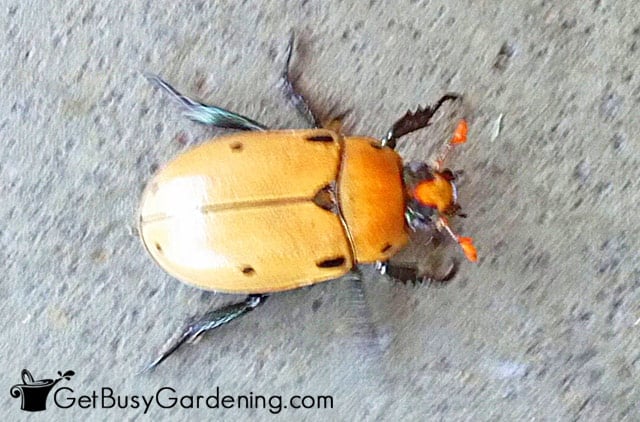
First off, they’re hard to miss because they are HUGE. They’re easily two-three times larger than a Junebug, and actually kind of scary looking the first time you see one. YIKES!
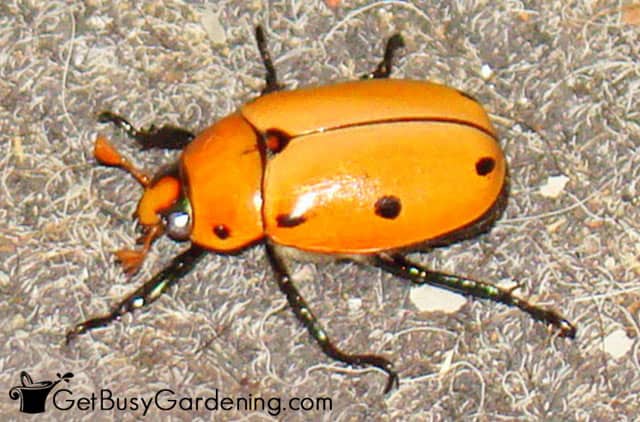
If their size isn’t enough to make a positive ID, then look for other distinguishing characteristics. The colors range from bright orange to light tan, and they usually have black spots on their back (though some may not have spots).
They fly around at night, and are just as clumsy as their more popular relative. If you ask me, they look like they’ve been drinking when they fly.
But don’t let this fool you, they can still move pretty darn fast. Their size and clumsy way of travel makes them easy to spot when they’re buzzing around.
Grapevine Beetle Life Cycle
There are four stages to the grapevine beetle life cycle: adult, egg, larva, and pupa. The adults lay their eggs in the soil, and the larvae hatch a few weeks later.
The larvae are large white grub worms that burrow deep into the ground, where they overwinter until spring. As the soil warms up, they slowly make their way back to the surface, where they feed on rotting wood.
Once they’re mature enough, the grubs pupate near the surface of the soil, and they emerge as adult beetles sometime in July. There’s only one generation per year.
What Do They Eat?
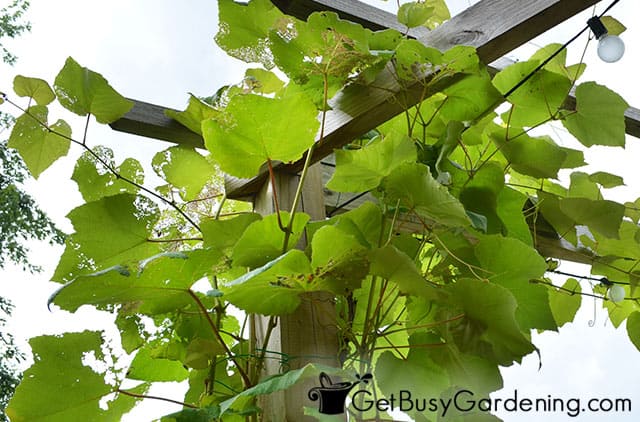
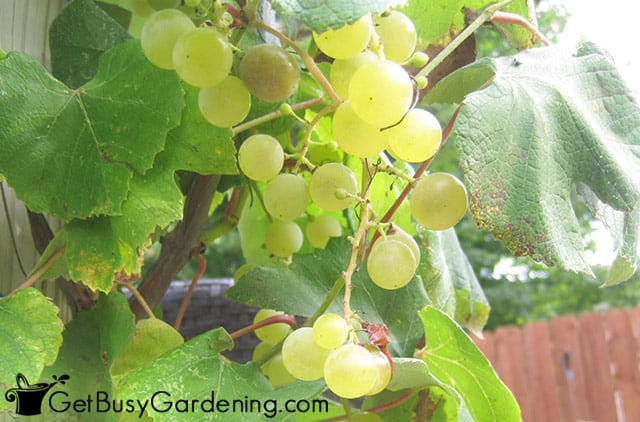
As their name suggests, these beetles like to eat the leaves and fruits on both wild and cultivated grapevines. They can feed on other types of fruits too (like apples and raspberries), but it’s pretty uncommon.
The larvae eat rotting organic material, so they are actually considered beneficial. Thankfully, the larvae do not feed on plants. Only the adults do that.
Damage To Plants
They can damage plants by eating holes in the leaves or fruits. They will skeletonize the leaves, and can also destroy the fruit.
However it’s very rare for them to cause major damage to the plant. This is because they aren’t usually found in large numbers.
What’s Eating My Grapevine Leaves?
Just because you find damage on your plants doesn’t mean you have grapevine beetles. The more likely culprit is Japanese beetles.
Those pesky bugs absolutely love my grapevines, and feast on them every summer. They ARE major garden pests, and like to congregate in large numbers. But they’re much smaller and iridescent green and brown. Read all about how to identify and control Japanese beetles here.
Are Grapevine Beetles Harmful?
Luckily they are not harmful to humans or pets, and they don’t sting or bite. They are also rarely harmful to plants.
Even though the adult beetles primarily feed on grapevines, they aren’t considered major pests in vineyards. So it’s highly unlikely they would cause major problems in your home garden.
A major infestation certainly could cause damage, but it’s pretty uncommon. So don’t worry if you see one or two of them flying around your neighborhood.
How To Get Rid Of Grapevine Beetles Naturally
In the unlikely event that you do have an infestation, there are a few different things you can do to control them. But if you only see a couple of them, I encourage you to just leave them be.
There is no reason to ever use synthetic pesticides (plus I’m guessing you don’t want to spray chemicals on your grapes anyway). So please use the organic control methods below to target only the pest insect.
Related Post: How To Control Garden Pests Naturally
Hand Picking
Since they are so big, it’s easy to hand pick them from the plant and drop them into a bucket of soapy water. I find that Dr. Bronner’s liquid soap works very fast to kill bugs.
But, since they are nocturnal, it may be hard to find them. So I recommend going out in the late evening or early morning to hand pick them when they are still out, but not as active.
Diatomaceous Earth
If hand picking them is just too much to bear (and I don’t blame you for that!), then you can try a more hands-off approach. Diatomaceous earth (DE) is an all-natural product made from crushed up hard-shelled organisms.
Sprinkle it directly on the grapevine beetles. It will get under their shell and cut up their soft bodies, eventually killing them.
Insecticidal Soap Spray
An organic insecticidal soap spray can work to shock them so they’re easier to pick from the plant. You can mix your own using 1 teaspoon of mild liquid soap to 1 liter of water.
You have to spray it directly on the bugs though, or it won’t have any effect. Also, it probably won’t kill them right away, so use it to stun them before hand-picking.
Beneficial Nematodes
Another organic method you can try is beneficial nematodes. These are tiny predatory parasites that live in the soil and feed on the larvae (grub worms).
For best results, apply them in the fall or spring when the grubs are close to the soil surface. Read all about how to apply beneficial nematodes here.
Milky Spores
Harmless to beneficial bugs, milky spore is a naturally occurring bacteria that infects the grubs when they eat it, and eventually kills them.
The downfall is that it can take 2-3 years for this method to be effective. But once active, milky spores last in the soil for several years.
Related Post: Natural Garden Pest Control Remedies And Recipes
How To Prevent Grapevine Beetles
Rather than treating for them, you could try preventing grapevine beetles from munching on your vines in the first place. Here are a few preventive methods you can try…
Cover Your Vines
Since grapes don’t need to be pollinated by bees, you can cover your plants during grapevine beetle season (mid-summer through fall). This works great for keeping all types of pests away.
Use a lightweight garden fabric or tulle to cover or loosely wrap the vines. Get the exact steps for how to protect your grapevines here.
Keep Your Garden Clean
The adult females tend to lay their eggs on pieces of rotting wood. So, if you have any dead wood sitting around your garden or property, clean it up.
That will help to prevent the adult beetles from laying their eggs close to your grapevines, and hopefully they’ll go elsewhere.
FAQs
No, grapevine beetles are not poisonous. They do not emit or contain any type of toxins, so you have nothing to worry about there.
No, grapevine beetles do not bite or sting humans or pets. They just eat plants and fruit.
No, grapevine beetles are not dangerous. Though the adults do feed on foliage and fruit, they rarely cause major damage or kill the plant.
Their life cycle, from egg through adult, is two years. But the adults only live for one season. They lay their eggs in the fall and the larvae overwinter underground.
You probably don’t need to do anything to get rid of them. They are not a major pest or much of a threat to home gardens. So if you only see one or two, then just leave them alone.
More Garden Pest Control Posts
- How To Control Flea Beetles In The Organic Garden
- How To Get Rid Of Cabbage Worms Organically
- How to Control Squash Bugs Organically
- How To Get Rid Of Slugs In The Garden Naturally
Share your grapevine beetle stories or experiences in the comments below.
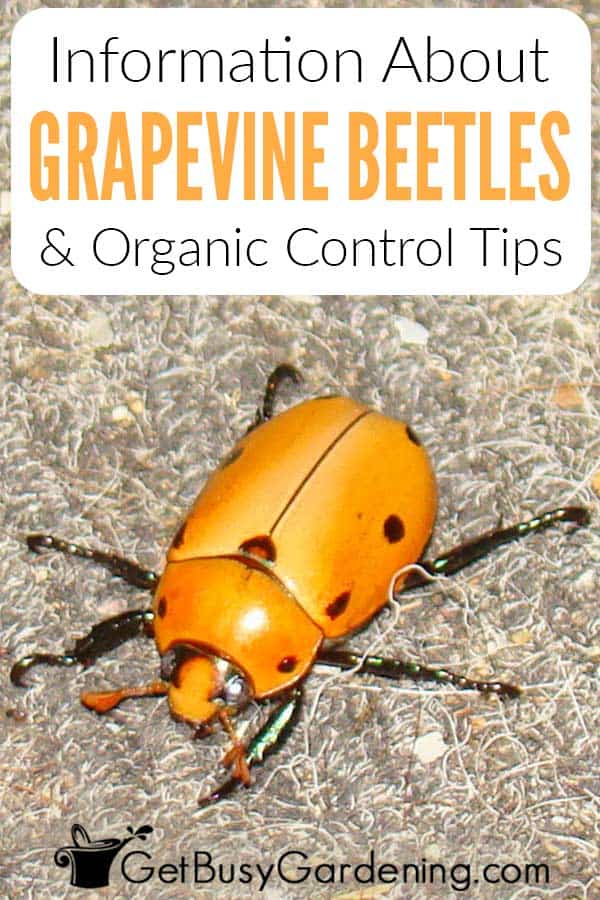
Photo Credit: Public Domain Pictures

Carrie says
Central PA checking in – I had also never seen one of these. He was hanging on my screen door. No grapevines terribly close. He may have been passing through, I only saw him the one time.
By the way, my beetle is the only reason I stumbled across your site, so there’s that! 🙂
Amy Andrychowicz says
Cool, thanks for checking in! Yeah! Glad you found my site. 🙂
Claude Cox says
Barrie, Ontario. My wife has a grapevine, as of a couple of years ago. Today I saw my first Grapevine beetle, on a grapevine leaf. It had pulled it around itself for the night. We let it be. Big!
Amy Andrychowicz says
Cool! I didn’t know they would wrap themselves in a leaf.
Brian says
One of these beasts just flew *through*** our window air conditioner (heard a “THWAP” sound as it passed through the fan. Holy crap! My wife and I got a good scare. Managed to trap him in an empty pint glass after he flew around the room for a couple minutes, smashed into a wall 3 or 4 times and crash landed right onto my pillow! Took him outside, and released him back into nature (in my next door neighbors yard). Hopefully he stays away from my garden! I’ve never seen this crazy bug in Massachusetts before.
Amy Andrychowicz says
Yikes!! LOL
roadkillyumy2 says
Michigander here I’m 69 and this is the first time seeing one, do they bite if u handle them ,tks for all ur info
Amy Andrychowicz says
Haha, isn’t it funny how that happens. No, grapevine beetles do not bite.
Vivian Sturz says
I just found two of them in my backyard today. I live in New Jersey. One was dead and one was alive (although he has now joined his brother in beetle heaven). I’ve never seen them before either. I have wild grapevines that I can’t seem to get rid of so it’s too bad these beetles don’t kill them. Now that I know they fly fast at night, I am never going outside at night again. My dog will have to learn to use wee-wee pads!
Amy Andrychowicz says
Hahaha, I didn’t mean to freak you out! I’ve only ever seen two in my life flying around at night (and we have 3 grapevines). They’re not as prevalent as June bugs, those things are nasty!
Barb says
I have used the mix of canola oil water garlic powder and dawn dish soap but they are still there on the grape vine ugh what to do now hate picking those nasty critters off the vine
Barb says
I have Japanese Beetles and have only seen 3 grapevine beetles
Amy Andrychowicz says
Have you ever tried Neem oil? It’s an organic pesticide and helps to deter pests too. Here’s a post I wrote about it… Neem Oil as Organic Pest Control
Barb says
No I haven’t but will be looking for it tomorrow after those nasty Japanese beetles came at me as I was using my canola oil mixture and some got in my shirt and they bit me. I need to figure out why I have them when no one around me is having as issue from what I can find they re in the ground and I need to buy something like a grub or worm ( cant remember what they called them it was a strange word ) and get rid of them any ideals?
Amy Andrychowicz says
It sounds to me like you’re talking about beneficial nematodes. Here’s a detailed post about them… Using Beneficial Nematodes To Control Garden Pests
Unfortunately, I don’t think you’ll be able to get rid of Japanese beetles all together. They do lay their eggs in the soil, and grub worms are their larva. They fly, so they can easily travel from yard to yard, and that’s why it’s hard to get rid of them. Here are a few posts that will help you control them…
How To Control Japanese Beetles Organically
How To Use Japanese Beetle Traps
Barbara Wheeler says
Neem oil works great for Japanese beetles I used it last year and it killed them and also havent seen them this year yet thank goodness
Tami says
I have a book that talks about bugs. I looked this particular bug up when I saw it last year on my tomato plants. This year the are on my corn. I don’t see any signs of damage. I am not aware of any grapevines in the area, but I mulch heavy. So I wonder if that’s what attracts them. Also, mine are more reddish than yellowish. And I’m from Toledo, Oh.
Amy Andrychowicz says
Cool. Glad to hear they aren’t causing any damage!
Carrie Easley says
I have one on my front door. It’s obviously lost as I live in Central Texas. I had to look it up too. I don’t even have any grapevines.
Amy Andrychowicz says
Haha! There must be grapevines around the area, maybe one of your neighbors has one.
Barb says
so these huge things are ok to have on my vines? Granted I only saw 1 today but did not get to check the rest of the vine that is about 6 feet tall and about 10 to 20 feet long.
Amy Andrychowicz says
I wouldn’t worry about it unless you see several buzzing around and you see damage to your plants. Japanese beetles are the ones that do the most damage to our grapevines, and we protect ours from them (and pick the buggers off and drown them). If the grapevine beetles become a pest, then it’s time to take action.
Mark S says
NYC checking in. Right in the middle of Manhattan. Grapevine guys feeding on an old stump that was buried when my garden was renovated. Garden is just potted, flowering plants right now so based on what I am reading my initial fears are unwarranted.
Trying to teach Dexter (the cat) pest control but he is too well fed to take much interest. Thanks for the conversation
Mark
Amy Andrychowicz says
Yes, glad you found this post! Someone must be growing grapes nearby. Haha, too bad your cat doesn’t want to help with pest control. Mine wouldn’t either.
Brenda Visser says
I just saw one of these today in my garden for the first time ever- Eastern Ontario, Canada- near upstate NY.
Amy Andrychowicz says
There must be grapevines close by. Hopefully it’s only one and won’t do any damage in your garden. I’ve only seen 2 in my life. They are cool bugs, but not cool if they become pests.
Amy
Cindy says
Well just happen to see one myself, First time to see it. Huge couldn’t, miss em. I Live in Southern Ontario near Niagara Falls.. We do have Japanese Beetles, which we notices the sparrows are taking good care of them. Not to sure what the birds think when they see the size of this bug. ?
Cindy
Amy Andrychowicz says
Haha! It would have to be a very large bird in order to be able to eat a grapevine beetle.
Annie Wright says
I just found one of these Beatles on my front porch and I live in Troy Grove IL. It scared the heck out of me my older son who is a bug lover looked it up for me. I am thankful to know it will not eat me. My son is now going to keep it and feed it grapes lol. I am talking him into letting it go home to its family. Thank u for all your work and research I would be freaking out if it was not for all your hard work. As for the other Asian beatles they are killing my morning glories and sun flowers is there anyway to stop them. I have used seven dust and sprayed them with dawn dish soap nothing has helped. Can u help
Amy Andrychowicz says
Yes, the Japanese beetles are out in full force right now, and munching away on my plants too. Yuck! Here are some ideas for controlling them…
How To Control Japanese Beetles Organically
How To Use Japanese Beetle Traps
Anonymous says
I was digging out the stump of an old crabapple tree that we cut down a few years ago. The stump was out of the way, so no hurry to do anything with it. It is pretty soft and rotted now, and we came across dozens of larvae and almost ready to fly adults! I have never seen these beetles before in southeast Wisconsin, and came across your blog. We have one grapevine and am happy to hear that they shouldn’t be a big worry to the vine! 🙂
Amy Andrychowicz says
Glad that I could help put your mind at ease. Just keep an eye on your grapevines to make sure the beetles don’t start feeding on them. But sounds like you don’t have to worry.
Anonymous says
Sitting on my neighbor's porch last night in Findlay, Ohio, we encountered one of these beetles. We've had a couple of stag beetles show up recently as well, but the Grapevine Beetle is new. I've lived in Findlay for 44 years and I've never seen one before. Grapevine Beetles are actually very beautiful, and it's good to know they aren't much of a danger to my vegetable garden. Our area recently had a tornado and multitudes of trees were destroyed or damaged. Knowing this beetle eats rotting wood, I expect to see more of them, for there’s plenty of food fo them now! I learned something new, and that’s fun for me.
Amy Andrychowicz says
Awesome, glad I could help you learn something new! 🙂 Yep, I'm with you, I've never seen one before this summer either. Sorry to hear you lost so many trees. Do you have grapevines in your area? Grapevine beetles are beautiful to look at, but I don't want them flying around me.
Garden Salad says
I live in Columbus, OH and I just saw one of these. First sighting for me as well–maybe they are moving north with the complete farce of a non-winter that we had? We have a wild grapevine, and I’m going to start watching to see if it gets eaten…I wouldn’t mind a little natural grapevine control–save me the trouble of biweekly pruning 😉
Amy Andrychowicz says
Japanese beetles do a way better job of chowing down on grapevine leaves around here! LOL
Jeffery says
Ahh, beetle time. I don't care much for the buggers, I used to get freaked out by them from a slight phobia, but I've since gotten over it. The grapevine beetles are kind of beautiful themselves, aren't they?
Amy Andrychowicz says
LOL, yes, grapevine beetles are kind of pretty (as long as they never decimate my plants). 🙂
T hardy says
I have found about ten of these little blighters so far in just two weeks. Each time I’ve seen them they were mating. I didn’t know what they were until just now so I’ve been killing them. Thank god it’s mating season as they didn’t hear me coming to kill them.
Amy Andrychowicz says
You’ve found ten grapevine beetles? Wow, that is the most I’ve heard anyone see at one time. Yikes!
Julie says
It's that time of year huh? I just found a Japanese beetle on my broccoli today. I didn't know you have grapes. What kind do you have? I was thinking of planting some next spring. Can they take any shade?
Amy Andrychowicz says
Yes, we have two grapevines. The variety we have is Edelweiss. Ours are in a part shade area, and doing great. We get tons of grapes every year.
Faith says
Is there any spray you can get to keep them off roses?
Amy Andrychowicz says
Grapevine beetles don’t usually attack roses, are you sure you’re not talking about Japanese beetles? If you have seen grapevine beetles on your roses, then I would just monitor them to see if they are doing any damage. If so, then handpicking them will take care of the problem. You shouldn’t need to use any type of spray on your roses to get rid of the grapevine beetles.