

Mother of thousand plants are unique and easy to care for. In this post, I’m going to tell you all you need to know about how to grow them, so they will thrive in your home or garden.
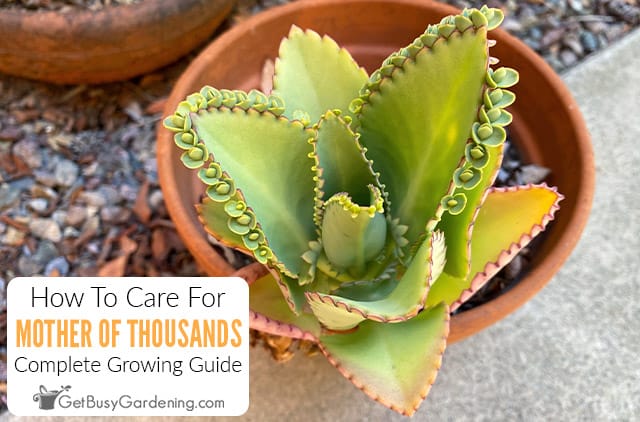

If you’re looking for a cool new addition to your indoor plant collection or garden, then you should try growing mother of thousands.
Their care is simple, and anyone can learn how to create the ideal environment for them, even beginners.
This detailed growing guide will teach you exactly how to care for a mother of thousands plant.
Learn about the sun, water, and soil requirements, plus how to prune, propagate, and so much more.
Mother Of Thousands Quick Care Overview
| Scientific name: | Kalanchoe daigremontiana, Bryophyllum daigremontianum |
| Classification: | Kalanchoe species |
| Common names: | Mother of thousands, Devil’s backbone, Alligator plant, Mexican hat plant |
| Hardiness: | Zones 9-11 |
| Temperature: | 60-95°F |
| Flowers: | Pink-orange, blooms late fall-winter |
| Light: | Full sun to partial shade |
| Water: | Allow soil to dry between waterings, do not overwater |
| Humidity: | Little to none |
| Fertilizer: | General purpose plant food in spring and summer |
| Soil: | Fast-draining, sandy soil |
| Common pests: | Aphids, mealybugs, scale |
Information About Mother Of Thousands
Mother of thousands, or Kalanchoe daigremontiana, is a succulent native to Madagascar.
It also goes by the names Bryophyllum daigremontianum, devil’s backbone, alligator plant, and Mexican hat plant.
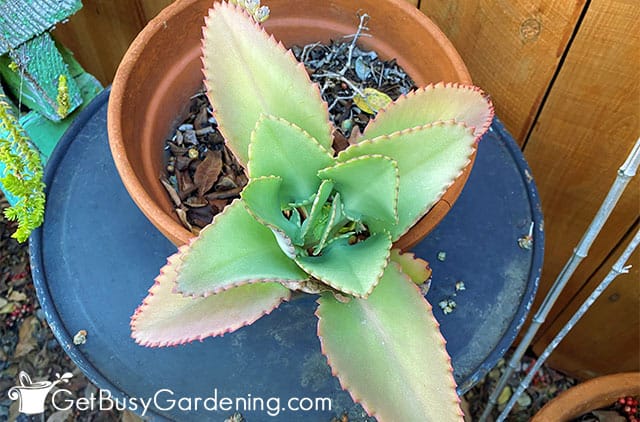
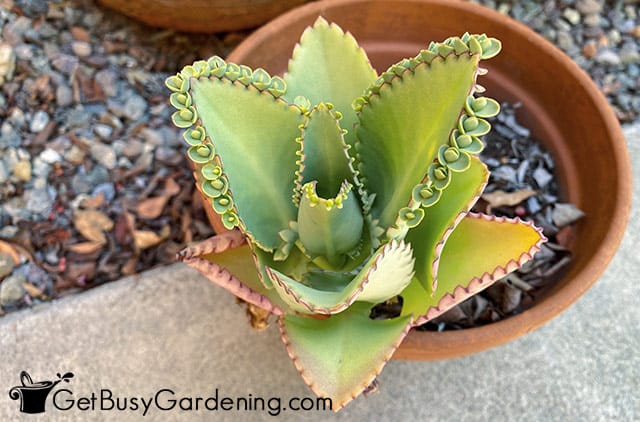
It’s a drought tolerant plant that can reach heights of 3’ tall. It grows V-shaped, blue-green leaves that arch outward from a single stem, and reach lengths up to 6”.
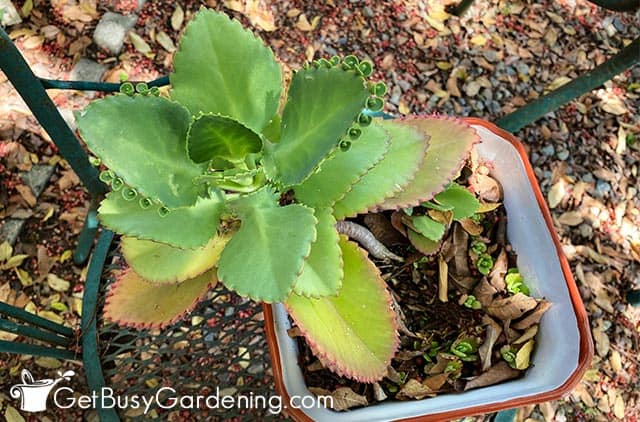
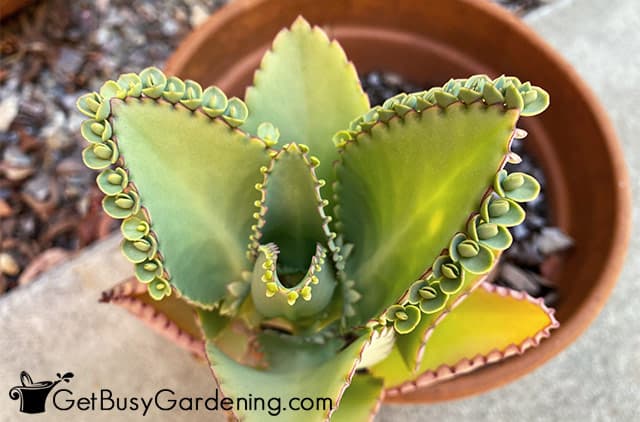
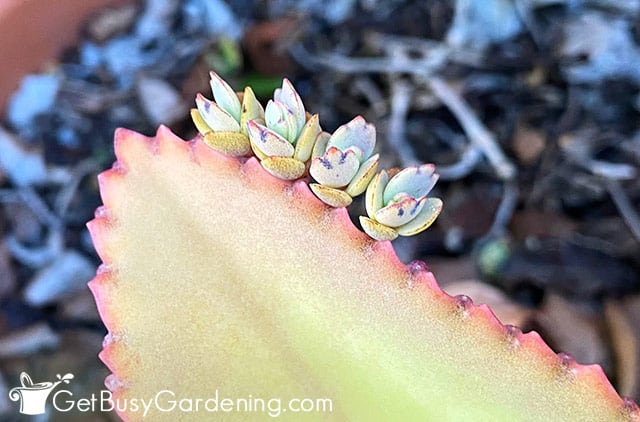
Its name comes from its ability to produce tons of tiny babies, or pups, along the leaf edges. It’s often confused with the mother of millions which shares that same ability, but they’re actually different plants.
Flowers
Though rare indoors, with the proper care mother of thousands can produce flowers in late fall or early winter.
The tubular pink-orange blooms grow on tall flower stalks that form on top of the main stem.
Mother Of Thousands Plant Toxicity
All parts of the Bryophyllum daigremontianum are considered toxic to pets or people if ingested.
It’s a good idea to keep it out of reach of dogs, cats, and young children, just in case. Check out the ASPCA website for more information.
How To Grow Kalanchoe daigremontiana
Before we discuss the best way to care for mother of thousands, first we should chat about where to grow it. Choosing the right location is an important first step.
Hardiness
Kalanchoe daigremontiana is not a cold hardy plant. They can live outside year round only in zones 9-11, where the temperatures are mild in the winter.
In colder climates it’s best to overwinter them indoors, or move them to a protected spot before it gets too cold in the fall.
Where To Grow Mother Of Thousands
The best location to grow mother of thousands indoors is somewhere that receives plenty of bright, indirect light.
Outdoors they can tolerate full sun. But in very hot weather, they’ll do better with partial shade in the afternoon.
They prefer well-draining, loose soil and will do well in containers that have drainage holes.
They’re often planted alone because of the self-propagating tendencies. When left to their own devices, they can quickly overwhelm other plants.
Mother Of Thousands Care & Growing Instructions
Now that you know where to plant your mother of thousands, let’s talk about how to grow and care for it. These tips will help you keep them healthy for many years.
Light
Provide at least 6 hours of bright, indirect light every day. Direct morning or evening sunlight is perfect.
Give them shade during the afternoon hours, especially outdoors, to avoid scorching or sunburn.
If you struggle to get enough light indoors, supplement with a grow light.
Water
Kalanchoe daigremontiana is drought-tolerant, but can suffer if they dry out completely on a regular basis.
Allow the top 2” of soil to dry, then water deeply until it comes out of the bottom drainage holes.
Sitting water or soggy soil can both lead to root rot, so always drain away any excess. If you struggle with this, I recommend using an inexpensive moisture gauge.
Temperature
Though they can handle some cold, the ideal temperature range is between 65-95°F, which is easy to attain indoors.
They like it warm and can tolerate higher heat, especially in the shade. If you put yours outside for the summer, be sure to move it indoors before it gets below 50°F to prevent damage.
Fertilizer
Mother of thousands don’t need frequent fertilizer as part of their care, but occasional feedings can help boost growth. Be wary of overdoing it, which can cause more harm than good.
Feed yours once per season in the spring and summer with a liquid fertilizer diluted to half strength. Do not feed them in the fall or winter.
Organic options like compost tea, or a balanced liquid fertilizer will work great. If you prefer, you can apply granules once or twice per season.
Soil
You’ll need to use a well-draining soil mixture in order to have the best success. Otherwise, If it holds too much moisture, it will cause root rot.
You can use a commercial mix, or try making your own. Simply combine a quality potting soil with coarse sand, and perlite or pumice to improve drainage.
Repotting
You won’t need to worry about repotting Kalanchoe daigremontiana very often. They have a shallow root system, and like to be pot-bound.
You’ll see signs like roots coming from the drainage holes as an indicator that it has outgrown its current pot. Transfer it into a container just one size up in the spring.
Pruning
It is not necessary to prune mother of thousands regularly, which is part of what makes their care so hands-off.
The only reason to do it is to remove dead leaves and flowers, or to rejuvenate leggy or sparse growth.
You can trim away brown or dry foliage at any time. To encourage them to branch out, cut or pinch off the top of the plant just above a large leaf in the spring.
Pest Control Tips
Pests are not often a concern, especially indoors. But occasionally aphids, mealybugs, or scale can attack.
You can target visible insects with a cotton swab dipped in rubbing alcohol. Otherwise treat the leaves with insecticidal soap or a neem oil solution.
I make my own spray by combining 1 teaspoon of gentle liquid soap with 1 liter of water.
Mother Of Thousands Propagation Tips
Propagating a mother of thousands couldn’t be easier! You can take stem cuttings, but the babies are very good at rooting themselves as they fall off naturally.
To root them yourself, gently brush the plantlets that form on the edge of the leaves. The ones that are ready will drop off with the slightest touch.
Dip the ends in rooting hormone, lay them on top of lightly damp soil, and keep them somewhere bright. Once they’ve taken root, pot them up in well-draining soil.
Troubleshooting Common Care Problems
Mother of thousands are pretty low-maintenance, but sometimes you can run into problems with their care. Use these tips to help get it back into healthy shape.
Plant Not Growing
The most common causes for very slow or stalled growth is too much water or incorrect light.
Only water when the top few inches of the soil have dried out. Never saturate it to the point of making it soggy or wet, and always drain off any excess.
Also be sure to provide 6 or more hours of bright, indirect light a day. Supplement with a grow light if needed, but keep it out of direct afternoon sun, especially during the summer.
Shriveling Leaves
If you notice shriveling or limp leaves, it can be caused by inconsistent watering, incorrect lighting, or heat.
Keep the soil from becoming overly wet or too dry, and give it lots of bright light. Protect it from extreme heat, like afternoon sun or winter heater vents.
Growing Tall / Leggy
Sparse, tall, or leggy growth on Kalanchoe daigremontiana usually comes from too little light.
Increase the amount it receives, and trim off the top of the plant in the spring to encourage it to get bushier.
Leaves Turning Brown
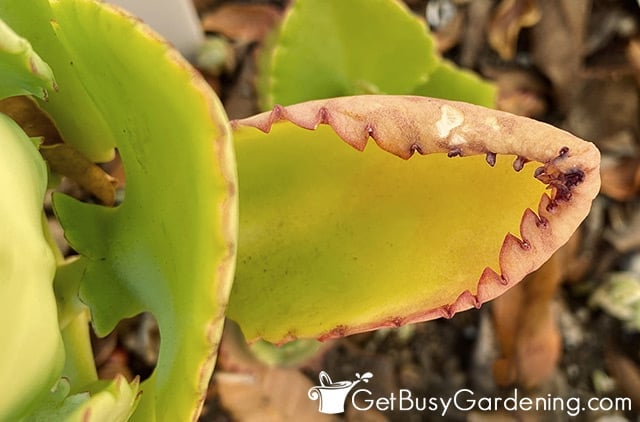
Browning leaves can be caused by improper watering, or or it could be from sunburn.
Too much water can lead to root rot, which will eventually cause mushy brown leaves. Not enough, and your Kalanchoe daigremontiana will dry out, leading to brittle brown tips or spots.
Direct sun exposure, especially in the afternoon or during hot weather, can burn the foliage as well. Provide shade during those hours to help avoid that.
FAQs About Mother Of Thousands
Here I’ve answered several of the most common questions about mother of thousands plant care. If yours isn’t listed, please ask it in the comments section below.
Can I touch mother of thousands?
Yes, you can touch a mother of thousands plant. Though it looks like the edges are sharp, they don’t have any spike. And, while it’s considered a toxic plant, the danger comes ingesting it, not from touching.
Does mother of thousands grow fast?
Mother of thousands grow fairly fast, reaching its full size in about 2-5 years, depending on the environment and quality of care it receives.
How big does a mother of thousands plant get?
A mother of thousands plant can get pretty big. It typically reaches heights of 3’, with leaves reaching out about 6” from the stem.
Is the mother of thousands plant invasive?
The mother of thousands plant can be invasive in warm climates because of its ability to readily self-propagate, though the babies are easy to pull out. However this is not typically a problem in cold regions or for indoor plants.
Is mother of thousands poisonous?
All parts of the mother of thousands plant are poisonous to cats, dogs, and people if ingested. You can get more information on the ASPCA website.
Now that you know just how simple it is to care for mother of thousands, you’ll be able to keep yours healthy and happily growing for many years to come.

If you want to learn all there is to know about maintaining healthy indoor plants, then you need my Houseplant Care eBook. It will show you everything you need to know about how to keep every plant in your home thriving. Download your copy now!
More Houseplant Care Guides
- How To Care For String Of Bananas Plant (Curio radicans)
- How To Care For Cat Palm (Chamaedorea cataractarum)
- How To Care For A Philodendron Birkin Plant
- How To Care For Fiddle Leaf Fig Plant (Ficus lyrata)
- How To Care For Firestick Plant (Euphorbia tirucalli ‘Sticks Of Fire’)
- How To Care For Pencil Cactus (Euphorbia tirucalli)
Share your mother of thousands plant care tips in the comments section below.

Kellie Knight says
What do I do once my mother of thousands bloom’s at the top with flowers?
Amy Andrychowicz says
Once your mother of millions flowers fade and die, you can simply prune off the bloom spike all the way down to the bottom.