

Mother of millions plants are easy to care for and fun to grow. In this post, I’ll show you all you need to know to keep your Kalanchoe delagoensis thriving for years to come.


The mother of millions plant is a beautiful addition to any collection, and adds character to your home or garden.
With its fast-growing nature, you can enjoy the unique foliage and flowers both indoors and outside.
In this guide you’ll learn everything you need to know about mother of millions plant care.
From basics like water, light, and fertilizer, to how to prune and propagate them, you’ll soon feel like a pro.
Mother Of Millions Quick Care Overview
| Scientific name: | Kalanchoe delagoensis |
| Classification: | Kalanchoe species |
| Common names: | Mother of millions, chandelier plant |
| Hardiness: | Zones 9-11 |
| Temperature: | 60-95°F |
| Flowers: | Salmon, hot pink, orange, blooms late winter-spring |
| Light: | Full sun to partial shade |
| Water: | Allow soil to dry between waterings, do not overwater |
| Humidity: | Little to none |
| Fertilizer: | General purpose plant food in spring and summer |
| Soil: | Fast-draining, sandy soil |
| Common pests: | Mealybugs, scale, whiteflies |
What Is A Mother Of Millions Plant?
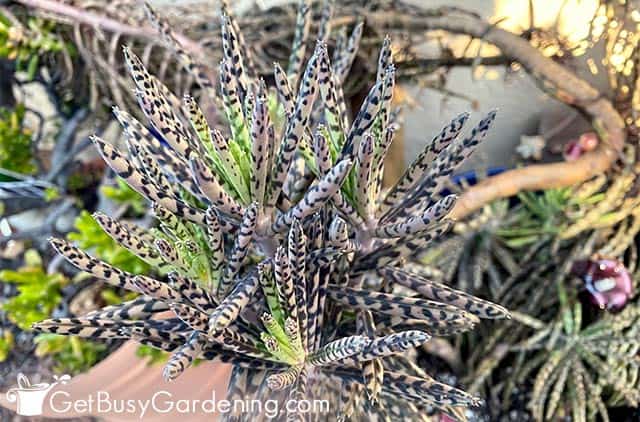
Mother of millions, or Kalanchoe delagoensis, also called the chandelier plant, is a succulent native to Madagascar.
This drought tolerant plant can grow up to 6’ tall and has tubular leaves that can reach between 2-5”.
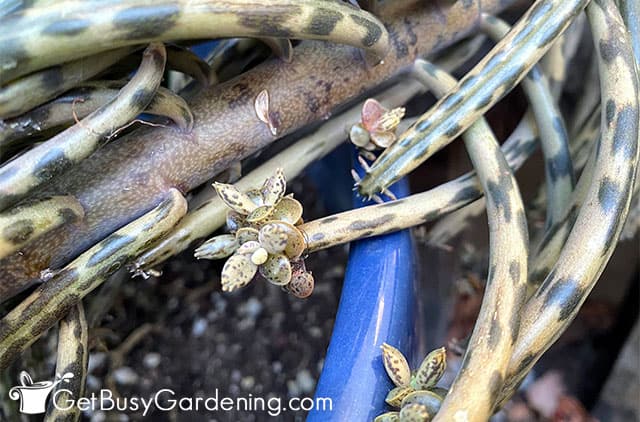
The common nickname comes from its unique ability to produce small plantlets, or pups, on the end of the leaves. Left untended, these babies will fall off and root to create a huge number of new plants.
Different Mother Of Millions Varieties
People often use the names “mother of millions” and “mother of thousands” interchangeably when referring to this plant.
While they do have very similar growth habits and care requirements, there is only one true mother of millions, and it is Kalanchoe delagoensis.
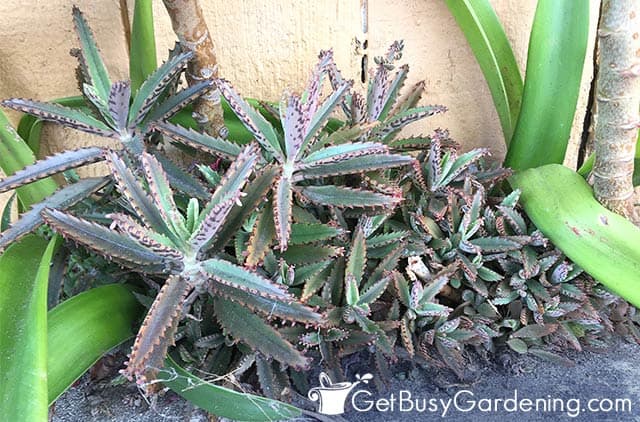
The latter, Kalanchoe daigremontiana, is a different species with wider v-shaped leaves and green foliage. You can learn all about that one in this article.
Flowers
The nickname “chandelier plant” comes from the way the trumpet-shaped flowers grow in a circular cluster on top of tall stalks at the end of the stems.
The fragrance-free blooms appear anywhere from late winter to early summer outdoors, but are very rare indoors. Their color can range from pale salmon, to hot pink, or bright orange.

Toxicity
According to the ASPCA website mother of millions is a toxic plant for pets when ingested. It’s best to keep it away from your dogs or cats if you have one.
How To Grow Kalanchoe delagoensis
Before we get into how to care for the mother of millions, first we should talk about where to grow them. Choosing a good location is the first step to long lasting health.
Hardiness
Mother of millions is not a cold hardy plant. In zones 9-11 it’s a perennial that can grow happily outside, but in other areas it’s better overwintered or kept exclusively indoors.
It can enjoy summer weather when temps stay above 50°F at night, but when they drop below that it’s time to move it inside.
Where To Grow Mother Of Millions
The ideal spot for a Kalanchoe delagoensis is somewhere very bright. They love the sun, but can burn in the intense afternoon rays, especially during summer.
Partial shade is ideal outdoors, while indoors they do best with diffused bright light.
They prefer a well-draining garden location, and also grow very well in containers. Choose one with drainage holes to help prevent root rot.
Mother Of Millions Plant Care & Growing Instructions
Now that you have the perfect place in mind, let’s talk about mother of millions care. These tips will ensure you know exactly how to keep yours thriving.
Light
It’s important that your mother of millions receives 4-6 hours of bright light a day to keep the marbling pattern. With too little they can become leggy and pale.
Outdoors in the summer, place them in a bright partial shade location that’s protected from the hot afternoon sun.
In the winter, they’re less likely to burn, and prefer direct sun. Indoors, use a grow light to supplement if you don’t have a sunny window for them.
Water
Kalanchoe delagoensis doesn’t like wet feet. Wait until the soil is dry several inches down before giving it a drink, and always drain any excess from the pot.
It’s important to avoid overwatering, which can lead to drooping leaves or shedding pups, and eventually root rot. A water moisture gauge is a great tool to help you get it just right.
Temperature
The ideal temperature range for a mother of millions plant is between 60-95°F.
They will stop growing when it falls below 50°F, and can suffer damage, or even die if exposed to cooler temps for extended periods of time.
Always bring them indoors when temperatures begin to drop in the fall. During extreme heat waves, you may need to water them more frequently.

Fertilizer
Fertilizing mother of millions is not a necessary part of their routine care, but monthly feedings during the spring and summer can stimulate growth.
Choose an organic houseplant or cactus fertilizer for best results. I recommend avoiding any chemical based options, as those can do more harm than good.
Soil
Kalanchoe delagoensis are not picky about soil, and are natively found growing in poor or infertile places. But ideally, they’ll do best in a loose, sandy, well-draining mix.
You can use a commercial mix, or make your own with equal parts potting soil and perlite, and a few handfuls of coarse sand.
Repotting
Due to the fast-growth of mother of millions, they may need repotting every few years. Check the bottom for roots coming out of the drainage holes to know when it’s time.
It’s best to tackle it in the spring or summer, or after it’s finished flowering for the year.
Use a container that’s 1-2” bigger and has holes in the bottom, then plant it at the same depth as it was in the original pot.

Pruning
Pruning is a great way to keep the growth rate under control, and encourage denser leaves. You can prune in the spring or summer.
Use sharp, sterile snips to cut back the top, just above a large leaf. That should prompt it to begin branching out lower along the main stem.
It’s also a good idea to deadhead or trim off any spent flowers after they’ve faded as well.
Pest Control Tips
When cared for properly, healthy mother of millions plants rarely have issues with insect pests. But occasionally mealybugs, scale, or whiteflies can attack.
The best way to combat bugs is by using a natural solution like neem oil or an insecticidal soap. You can even mix your own by combining 1 teaspoon of mild liquid soap with 1 liter of water.
To speed things up and kill any obvious bugs you see on contact, clean them off using a cotton swab dipped in rubbing alcohol.
Mother Of Millions Propagation Tips
Kalanchoe delagoensis is notoriously simple to propagate, hence the common name. When left to its own devices, the tiny plantlets will fall off and root themselves.
If you don’t want to wait for them to drop on their own, simply grasp a baby and gently bend or twist it off.
Allow it to callous over for a day, then dip it in rooting hormone, and set it on top of moistened, well-draining soil.
They can also be multiplied by rooting stem cuttings, which will give you a large plant much faster than cultivating the tiny pups.
Troubleshooting Mother Of Millions Care Problems
Mother of millions are very easy to care for. But over time you may run into one of these common issues. Use the tips below to help get yours thriving and healthy again.
Leaves Turning Brown
Brown leaves can be caused by either sunburn, or prolonged drought. Keep them out of direct sun during the hottest part of the day, and don’t let the soil remain bone dry for extended periods of time.
Leaves Curing Or Shriveling
Curled or shriveling leaves could be the result of a few different issues. Too much sun or lack of water can cause dry curling leaves, while too much water can cause them to wrinkle and wilt.
Keep them somewhere bright, but out of direct afternoon sun, and water when the soil is dry a few inches down, but avoid making it soggy to prevent issues of rot.
Plant Falling Over
Your mother of millions may be falling over from excess water, or because it’s top-heavy. They can get very tall, and may need to be repotted into a larger, sturdier container every few years.
But limp, wilting, and drooping plants are suffering from too much moisture, which will eventually cause them to rot and fall over at the base.
Growing Tall & Leggy
Long stems between sparse leaves is a sign of too little light. Move it somewhere brighter or add a grow light indoors, and prune the top to encourage more compact, fuller growth.
No Babies / Pups
If your plant is healthy but not producing babies it could be a lack of light or nutrients, or it’s too cold. But it could just be the time of the year.
Mother of millions plants don’t produce babies until late winter or early spring. If timing isn’t the problem, then move it to a full sun location or add a grow light indoors.
Also, make sure it gets plenty of warmth (above 65°F), and try fertilizing it with a general purpose solution monthly.
FAQs About Mother Of Millions
Here I’ve answered some of the most commonly asked questions about Kalanchoe delagoensis care. If yours isn’t listed, please ask it in the comments section below.
How big does mother of millions grow?
Mother of millions can grow quite large with the proper care, up to 6’. But indoors or in containers, they more commonly only reach heights around 3’.
Is mother of millions plant invasive?
Mother of millions plants are considered invasive in some parts of the world because of their ability to self-propagate by shedding the pups.
Does mother of millions like humidity?
No, mother of millions plants don’t like high humidity, and thrive in dry and hot environments.
Now that you understand the needs of Kalanchoe delagoensis, you can enjoy this low-maintenance plant in your home or garden. These mother of millions care tips will help you keep them thriving for many years.

If you want to learn all there is to know about maintaining healthy indoor plants, then you need my Houseplant Care eBook. It will show you everything you need to know about how to keep every plant in your home thriving. Download your copy now!
More Houseplant Care Guides
- How To Grow & Care For Echeveria Plants
- How To Care For String Of Pearls Plant
- How To Care For String Of Bananas Plant (Curio radicans)
- How To Care For Fishbone Cactus (Selenicereus anthonyanus)
Share your mother of millions plant care tips in the comments section below.


Emma Haider says
My mother of millions is grown indoors, it is about a metre and a half tall and has 4 stems coming from the main stem that are all well established and producing lots of babies.
The issue is, at the bottom of the plant, the leaves are turning dark and droopy.
Please help me, what do I do?
Amy Andrychowicz says
They do tend to lose their lower leaves as they age, so it might just be normal life cycle. But make sure it’s getting the right amount of water – the soil should dry out between waterings and never be saturated – but also not totally bone dry. It’s best to give it a deep drink, and then let the soil dry 1″ deep before watering again.
Jesse says
If I top my MoM plant, can I root and replant the top?
Amy Andrychowicz says
Yes, you can root any part of the stem on your mother of millions plant.
Carolyn says
My plant is growing but not producing babies. It is in house in front is picture window
Amy Andrychowicz says
Mother of millions plants usually won’t produce babies until spring, so you might just need to be patient. Otherwise, it’s either not getting enough sunlight (they need a sunny south-facing window at minimum) or it’s too cold for them.
Esmée says
My original Mother plant has grown so tall (2 years old) and recently shed all of its lower leaves and now fallen over in well over half way up the stalk. There are aerial roots just a bit higher where the plant has fallen. My instinct is to cut the stem and re-pot allowing the aerial roots to become the main root system; however I can’t find any advice on doing this to the plant on the internet and don’t want to harm the plant.
Any suggestions? 🙂
Amy Andrychowicz says
Yes, you can cut the stem on your mother of millions right below those aerial roots and plant it, just as you thought. The main stem might even grow more leaves again after you top the plant. They tend to grow very leggy when they’re not getting enough light, so move it to a sunny window or add a grow light to prevent that from happening in the future.
Nancy says
My plant grows new sprouts on the stems and the have air roots … How do i remove them an how do i plant them????
Amy Andrychowicz says
Yes, those tiny new sprouts on the stems are little babies, and that’s how “mother of millions” got its common name. 🙂 Once the babies have their own roots, simply pluck them off the put them into soil. Or you can just let them drop off and root themselves. They’re pretty prolific.
Cheryl says
I don’t understand my mother of millions, it has grown tall, full, a beautiful plant but no PUPS.
Amy Andrychowicz says
Mother of millions plants normally produce pups sometime in the late winter through late spring, depending on where you live. If your has never produced pups, then it’s probably not getting enough light, which is especially a problem when you grow them indoors. I would try giving it more light by moving it to a sunny window, or adding a grow light indoors. If it’s outside, then move it to a sunnier location. If you’ve never fertilized it, then try giving it a shot of a balanced natural fertilizer. Another factor that could be causing the problem is the temperature. They won’t set pups if it’s too cold, so think about how cool it gets in the area where you keep it during the winter.