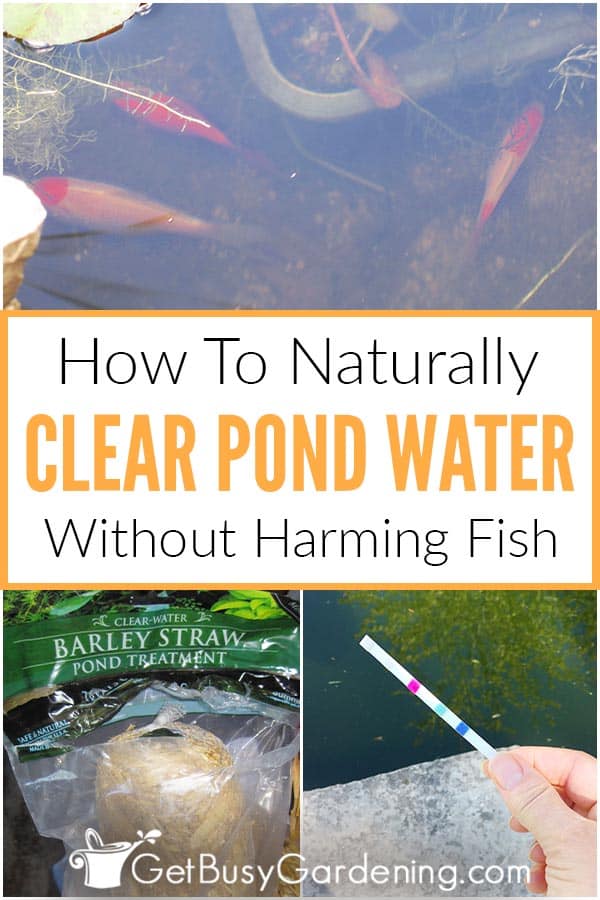
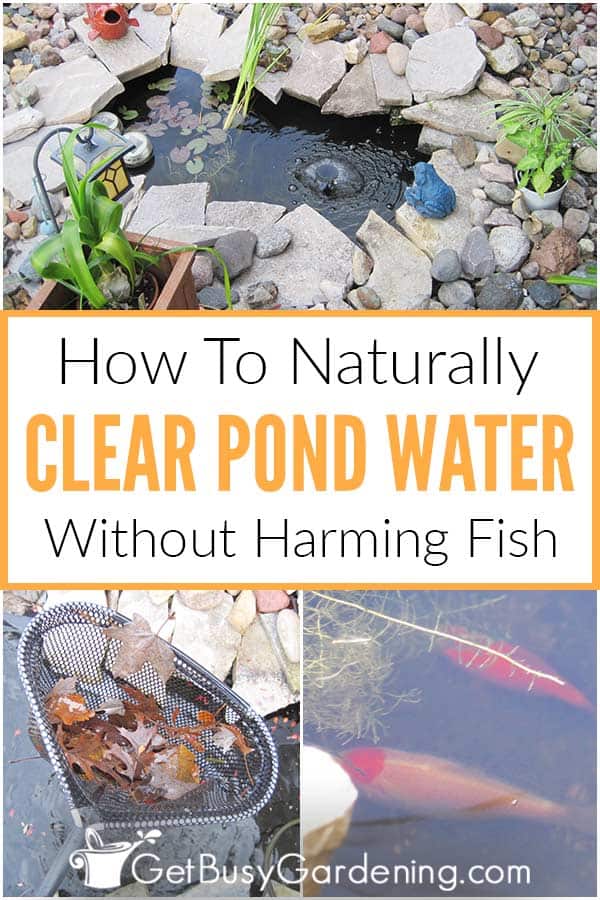
Keeping pond water clear the natural way is easy, and you don’t have to use any harsh chemicals either.
In this post I will show you step by step exactly how to get rid of that gross algae buildup and clear the water quickly, without harming your fish or plants.
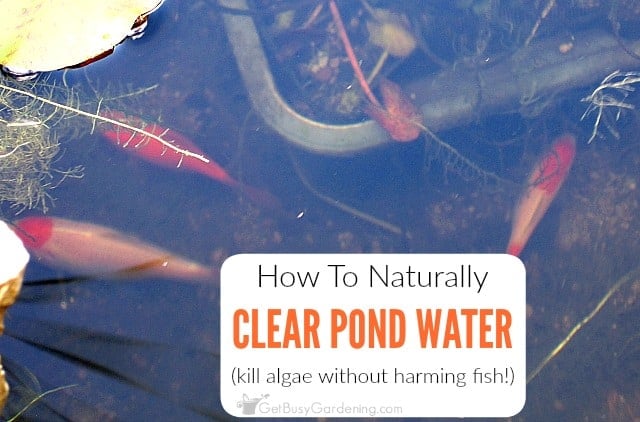

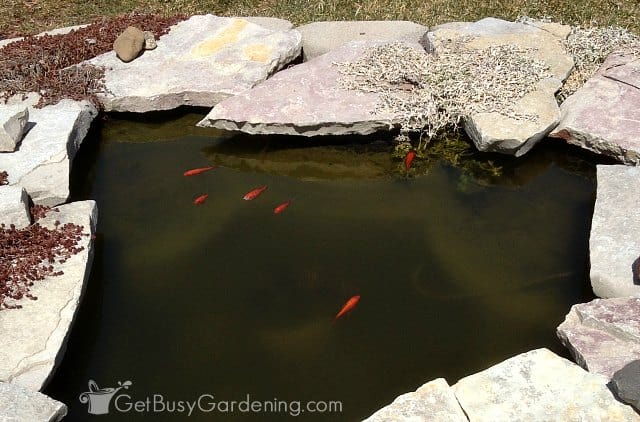
Several years ago, my small backyard garden pond became completely overgrown with mossy, weedy algae. It was green, cloudy, and disgusting – plus I could no longer see my fish or plants.
I was pretty nervous when I first discovered the problem, and worried that I would have to use expensive chemicals to treat it. Or, even worse, that those chemicals might kill my fish and plants.
It’s normal for ponds to have a greenish or brownish tint to them. However, it’s not healthy when the water becomes mossy, or so green that you can’t see through it.
Well, as it turns out, clearing out the algae naturally, and keeping your pond water crystal clear is easy. Whew!
What Clears Pond Water Naturally?
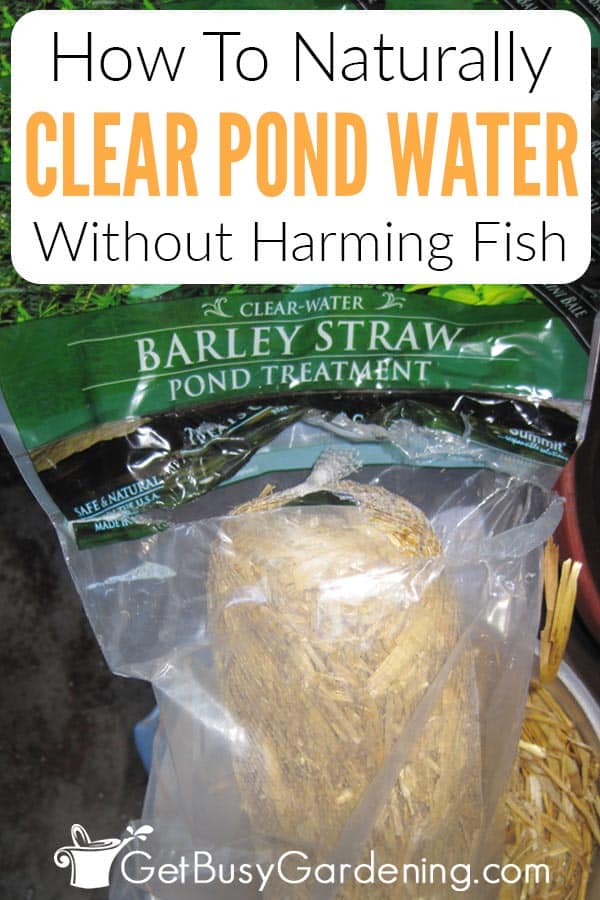
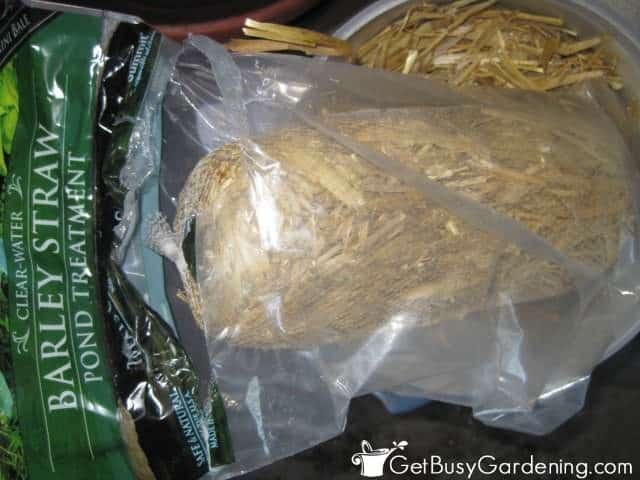
It sounds strange, but the answer is barley straw. Not only is it completely natural, but it won’t harm your fish or plants, and it’s inexpensive to buy too.
How it works is that, as barley straw decomposes, it releases something similar to hydrogen peroxide. This non-toxic by-product will choke out and kill pond algae, leaving the water crystal clear.
Below I will show you how to use it step by step. However, if your water is brown, thick and mucky, or it smells bad, then first you need to learn how to properly clean your pond here.
How To Clear Your Pond Water Step By Step
If you want to start seeing clear water in your pond as fast as possible, then follow my steps below. You only need a few supplies.
Supplies Needed:
- Toilet brush (or similar)
- Barley straw bundle (instead you could buy it in liquid form, or use the pellets)*
- Twine string (optional)
- Hydrogen peroxide (optional)
* The amount of barley straw you’ll need depends on the size of your pond. The package on the product that you buy should tell you exactly how to figure it out.
Instructions
Step 1: Remove the algae – To speed up your efforts, start by manually removing as much of the algae from your pond as you can. Don’t worry this sounds harder than it is.
An inexpensive toilet brush works great for this task, and you can use it to scrub the insides of your pond walls too.
Ideally, you would buy one to use specifically for this purpose. I mean, what would be more disgusting – using an old toilet brush in your pond, or using your pond brush in your toilet?
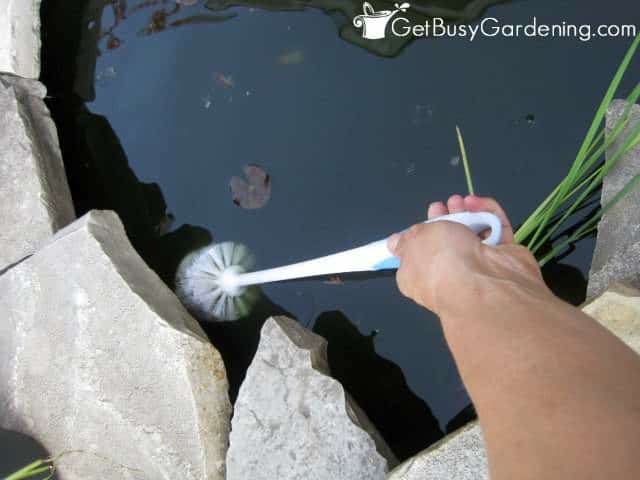
Step 2: Make a barley straw bundle (optional) – The barley straw that I use comes in bundles that are too large for my 90 gallon garden pond.
So I made smaller ones out of the mesh packaging that they came in, which I reuse year after year. I simply used some twine string to tie the mesh closed and secure the bundle.
Related Post: How To Winterize A Garden Pond Step-By-Step
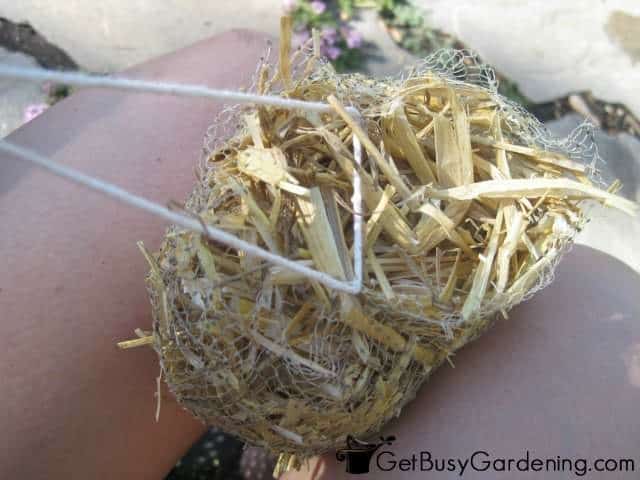
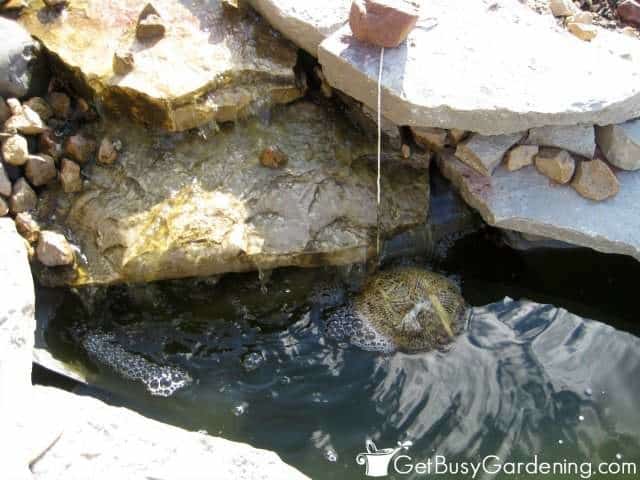
Step 3: Add the barley straw to the water – It’s best to put your barley straw near a fountain or waterfall where the water will flow through it.
This will help to circulate the water and clear it much faster. I used a long piece of the twine to hang the bundle from my waterfall.
The bundle will float at first, which isn’t always pretty. But once the straw starts to break down, it will sink so it’s no longer visible on top of the water.
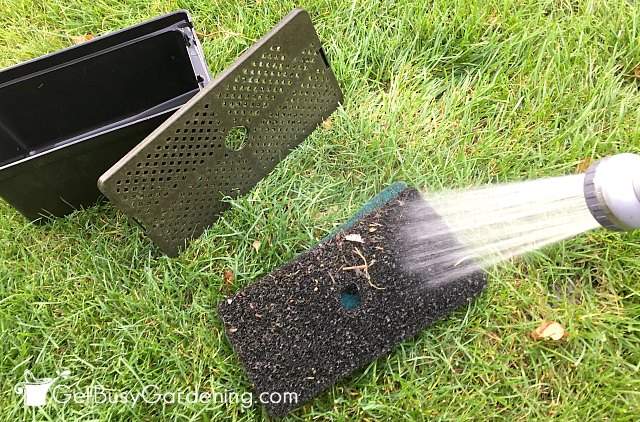
Step 4: Rinse the filter – To jumpstart the process, you should make sure your filter is clear so it can run smoothly and efficiently. I take mine out and rinse it off with the hose.
But you could use some of the water from your pond if you don’t want to risk killing the good algae that’s living in your filter.
If your pump didn’t come with a filter, I highly recommend that you get a universal pump filter box. It will make keeping your pond water clear sooooo much easier.
Step 5: Use hydrogen peroxide (H2O2): It takes a few weeks for the barley straw to work. So, to clear your pond water faster, use hydrogen peroxide (and no, it won’t kill your fish). Pour it right next to the fountain or waterfall to disperse it.
NOTE: I don’t know if there’s a special formula of H2O2 per gallon of water, so I recommend doing some research for your specific pond size. Mine holds 90 gallons of water, and I added a 1/2 cup of H2O2.
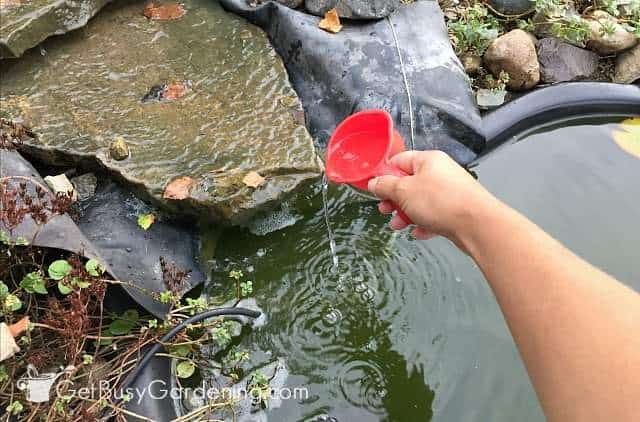
Step 6: Rinse the filter daily – I recommend rinsing your filter daily, which will help to remove the algae and speed up the process.
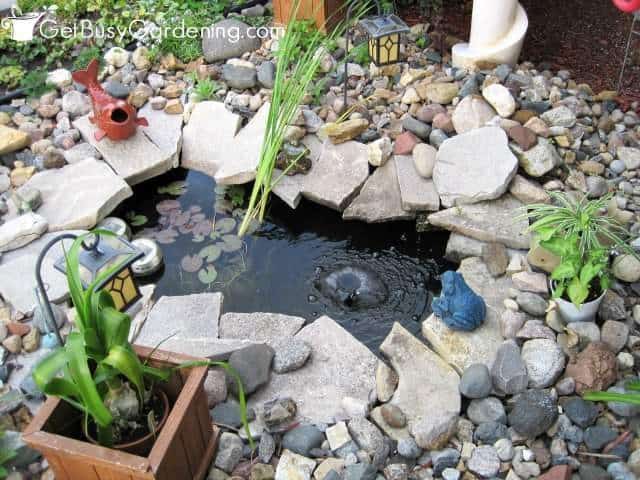
You should start seeing results within a week or so. In no time, the water in my pond was crystal clear, and it stayed that way all summer.
How To Keep Your Pond Water Clear
Once your pond water is clear, you can easily keep it that way for the long-term. Here are my tips for the best success:
- Use barley straw regularly – Put fresh barley straw in your pond every spring. One small bundle lasts me all summer.
- Keep the filter clear – You should get into the habit of rinsing your pond filter every couple of weeks, and probably more during the hot summer months when algae grows the fastest.
- Clear out the debris – Removing any debris that falls into the water is very important to ensure that it stays clear. My skimmer net makes this task super easy.
- Test the water regularly – You can get an inexpensive test kit, and that will help you maintain the perfect balance in your pond so you can prevent algae growth.
FAQs
Pond water turns green because of algae. It’s normal for it to have a greenish tint, but if it’s soupy or has mossy growth in it, then you should work to clear it ASAP.
Pond water turns brown when plant debris, like fallen leaves, and fish waste build up for too long. It’s normal for the color to be brownish, but it should not be mucky or stinky.
Not all types of algae are bad for your pond. But string algae can take over a small pond very quickly. If you don’t get rid of it, it could eventually starve your fish and plants of their oxygen and nutrients.
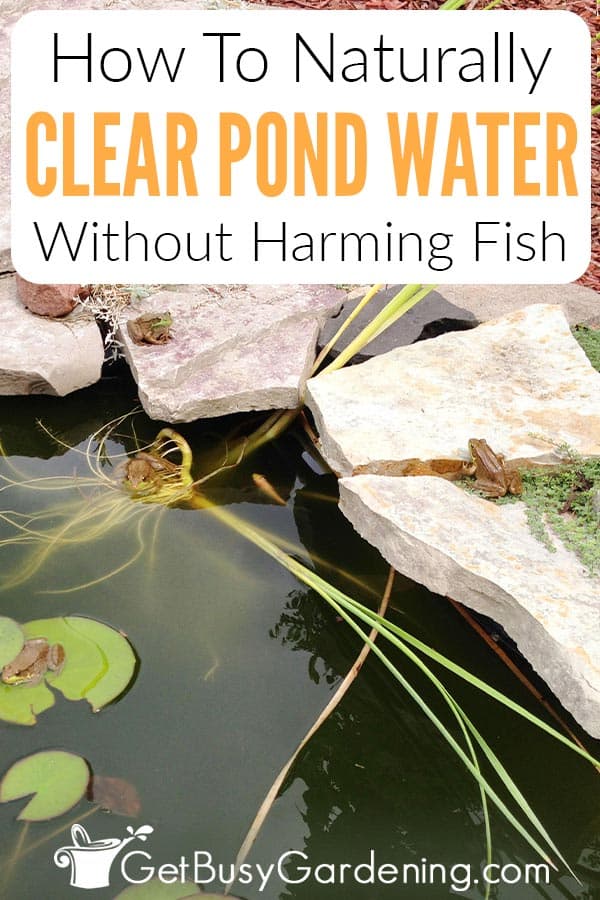
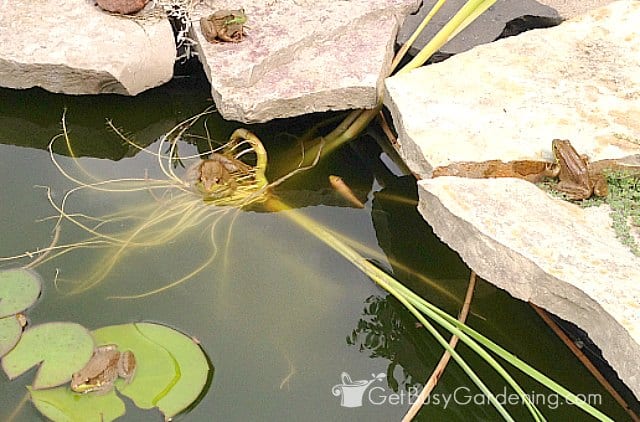
I love my little garden pond again now that the water is crystal clear, and keeping it algae-free isn’t that difficult when you know how. It’s nice to be able to watch my fish swimming around. Plus it constantly has frogs and salamanders in it too – a wonderful sign of a healthy pond.
Share your tips for keeping pond water clear in the comments below.

Shirley Sauls says
Hi Amy, I have really enjoyed reading your site and all the comments. I would like to ask if you have heard any thing about helping clear your pond with building a waterfall that runs down like a small little rock stream going to the pond.i was told that is the natural way to keep your pond clean. My pond has algae terrible ! I can’t see my fish unless the are swimming at the top. Makes me so sad.? I am going to try the barley straw and peroxide also. Please let me know if you have heard of the small rock stream for cleaning a pond. Thank you so much !
Shirley
Amy Andrychowicz says
I haven’t heard of that. I have a waterfall next to my pond. The water is pumped from the bottom of the pond to the top of the waterfall. It trickles down the rocks of the waterfall, and cycles back into the pond. It definitely doesn’t stop the algae growth just by doing that though. Putting a filter on the pump definitely helps, but it’s the barley straw that kills the algae.
Chris says
Test your pond water if you haven’t already. Mine was green and stayed green even after trying to add algaecide and bacterial boosters and barley straw ($300 worth of products) over the course of 6 weeks. Finally tested the water and found that the KH/GH was low and ph was high. Added about $6 worth of baking soda to raise the KH/GH and regulate PH. The water cleared up in a week!
Bobbie says
I just had a pond built. No fish yet. but it gets hot and humid here in south Texas. Should I start caring for algae now? I Can get barley straw at my gardenc enter. I’ve been told to wait at least a month before introducing fish.
Amy Andrychowicz says
How fun, congrats on your new pond!! Yes, you can definitely put the barley straw in there now to get a jump on any algae growth. You could check at your local garden center, most of them around here (I’m in MN) do carry barley straw. I’m not sure why you have to wait a month to introduce fish. You should only need to wait 24 hours for the chlorine to evaporate, that’s what I do. But I have goldfish in mine, so maybe koi or other types of fish are different, if you’re getting something besides goldfish.
Theodore c Young says
Barley is good in controlling string algae. As to the pea algae or algae that turns rocks green I have not found a solution for that.
carole says
What strenth Peroxide is used 10%, 20% 30%…?
Amy Andrychowicz says
I use 3% for my small garden pond, but read through the other comments here because others have chimed in with their experiences too.
wendy says
The Barley Bags did not keep my pond clean, they ended up getting algae on them also, and turned green… any other suggestions for natural way?
Amy Andrychowicz says
Are you certain you used barley straw, other types of straw will not work? If so, did you use enough barley straw for the size of your pond? I have included a few other suggestions for natural ways to clear your pond under the “Natural Pond Algae Treatment Use Tips” section above.
Julia says
My pond holds about 500 gallons. It has an upper tank which overflows down a series of waterfalls. It started getting very green and murky so I built a small campfire, added a large log to the fire and let it burn until it was a large chunk of charcoal. Then I put out the fire and let it coool down completely. I tossed it into the upper tank. When I checked it the next day the water was crystal clear and I never saw any green murkiness in my pond again. Fish and plants all beautifully healthy.
Amy Andrychowicz says
Wow, that’s awesome! Thanks for sharing the tip, I knew that charcoal helped to keep water clean, but I had no idea you could make your own, LOL! I might just have to give that a try next summer.
Shelia B Glenn says
We just finished our pond. It’s to cold here to run the waterfall. Putting a barley in will that still work? We have put a screen over to keep leaves out.
Amy Andrychowicz says
I would wait until spring to add the barley straw.
Franz CRIEGO says
I have a unique problem. I have planted plants in the bottom of my 6ft pond. THe water turns over every 1.5 to 2 hours and I use a UV clarifier with a bead filter. The koi have shredded my plants and I am unable to produce “clear” water due to the debri left behind. HOW or what do I do to “clear” my water?
Amy Andrychowicz says
If the plants are still in there, and the koi are constantly shredding them, I don’t think you’ll ever be able to clear it. I would remove the plants, and then use a filter that will pull the debris out of the water, and keep cleaning it. Also, use a net to fish out as much of the debris as you can to help speed it up.
Liberty says
Can you use this in stock ponds? i have a pond that is cover with green stuff. we don’t have livestock using it.
Amy Andrychowicz says
I don’t see why not, since it’s non-toxic. But, I’ve never read anything about it, so you might want to do a bit of research about that first.
Leslie says
I am planning on putting in a small pond on my patio garden. I really like the idea of using a natural algae remedy. I wonder, do I need to wait until there’s algae in the pond to use the barley straw, or could I put the barley straw in the pond from the beginning to keep the pond clean? Does it work as the algae is forming (I’m assuming, since I live in a hot climate, that there will be algae very quickly?) I’ve been living in rentals for 10 years and I’m excited to have my own space to make a garden. Thank you for your advice.
Amy Andrychowicz says
You can put the barley straw in from the beginning, it won’t hurt anything. Have fun with your new garden, how exciting!!
John Winlow says
We have emptied our small pond of sludge etc, cleaned it out wire brushed the blanket weed off the sides, put largish pebbles on the bottom and installed a small pump. I made a simple filter out of a plastic swingbin, using aquatic grade fine foam and an old fine weave cotton cloth folded up to catch the tiny particles.
This is working great for us. No more murky water, just filtered re-cycled pond water..
I put the pebbles in so that every now and then I can use a water hose to stir up the junk on the bottom and let the pump filter it out.
Hope this helps.
Sarah Kaser says
How often do you treat your pond with peroxide?
Amy Andrychowicz says
I only use the peroxide as needed before the barley straw starts to decompose and work it’s magic. I probably use it about once a week or so.
Buggins says
The wife and I spent FIVE hours clearing out our small fishpond. There was four inches of sediment on the bottom (which stank!). Took out the irises, took out the lily pads..
We cleaned it all out, put pebbles on the bottom, filled it up and re-introduced the five goldfish.
First three days lovely and clear, and now beginning to get a very slight haze in the water..
We don’t over feed the fish, we only have two plants in there
My guess is it’s a combination of rainborne/windborne dust plus fish poo.
I am going to try rigging up two solar powered pumps to draw the water through a home made filter and re-cycle clean water back in.
Or I might fill the darn thing in!
Amy Andrychowicz says
Yes, all of that muck is caused by fish waste, and also bugs, leaves and other debris that falls into the pond daily. It’s a good idea to get into the habit of skimming the debris off the top of your pond regularly. This is especially important in the fall as the leaves are dropping. Adding a filter will help a ton, along with the barley straw treatments I’ve described above. Good luck!
Tina Novotny says
Hi,
Would the following be a good one that includes everything?
https://www.amazon.com/dp/B0068MW50M
Thanks,
Tina
Amy Andrychowicz says
That one would work great for a small pond, and comes with a fountain attachment rather than a waterfall. But, if you have a waterfall, you can still use it, you just have put a tube attachment on there instead of the fountain attachment.
Tina Novotny says
Hi Amy,
What kind of waterfall pump do you recommend for a small pond and where can I find one? I don’t want to buy an expensive one.
Thanks,
Tina
Amy Andrychowicz says
It depends on the size of your pond, and the height of your waterfall (if you have one). This is the pump I have in my small pond (which is about 120 gallons). The waterfall is about 3-4 feet from the bottom of the pond, so this one is more than adequate, and works great for me! It pumps 330 gallons per hour, and works great for waterfalls under 7 feet tall.
Buggins says
We have tried any amount of barley straw in our smallish pond and found it absolutely useless!
Maybe there’s a special kind of barley straw and you need to know the codes/passwords/special handshakes to obtain a supply, but the stuff we bought from our garden centre changed nothinh.
The toilet brush tip is a good one though. I have recently used an industrial style wire brush with remarkable results..
Most of the blanket weed has now gone, but unfortunately the goldfish have developed rust spots..
Amy Andrychowicz says
I’m not sure what kind you bought, but this is the type that I buy… barley straw. Keep in mind that it takes a while to start working, so you won’t see any results right away. The barley straw won’t work until it starts to break down, and could take a month or so to start working.
john h chadwick says
for blanket problemes go for clover leaf u k tried it and no prob, all clear brill, the water will turn white, with no harm to fish, but after that clean pond,
Marcela says
Hi Amy, We are building a natural pond and need some advise. We live in South America 2.800 meters over sea level rains a lot but the sun is strong too year round? Can you please suggest plants to buy and any other tip will be welcome.
Best regards
Amy Andrychowicz says
I grow water lilies in my pond. They are very cold hardy, and they flower every year. I’m not sure what you comparable growing zone would be in, so it’s tough to recommend plants that will grow well for you. But some common pond plants are water lilies, cattails, papyrus, water irises, taro, water hyacinth, canna lilies and umbrella plant. There are lots of water plants to choose from though, some are hardy and some are tropical (not cold hardy). Also, check your local garden center to see what they recommend.
Dave says
Thanks!
Dave says
Hi Amy,
Great thread. I have a 250 gallon pond. My questions is: can one put too much barley in the water? I’m noticing most commercially packed barley bails are for 500-1000 gallons. Do I need to reduce the size or can I put a barley pack designed for a 1000 gallon pond into my 250 gallon pond? Thanks in advance!
Amy Andrychowicz says
I reduced the size of the straw bales for my small backyard garden pond (as you can see in the photos above). I don’t think you can add too much barley straw… but I thought it would be wasteful (and ugly) to use the huge straw bale in my tiny pond. Breaking it apart means I get more uses out of one bale.