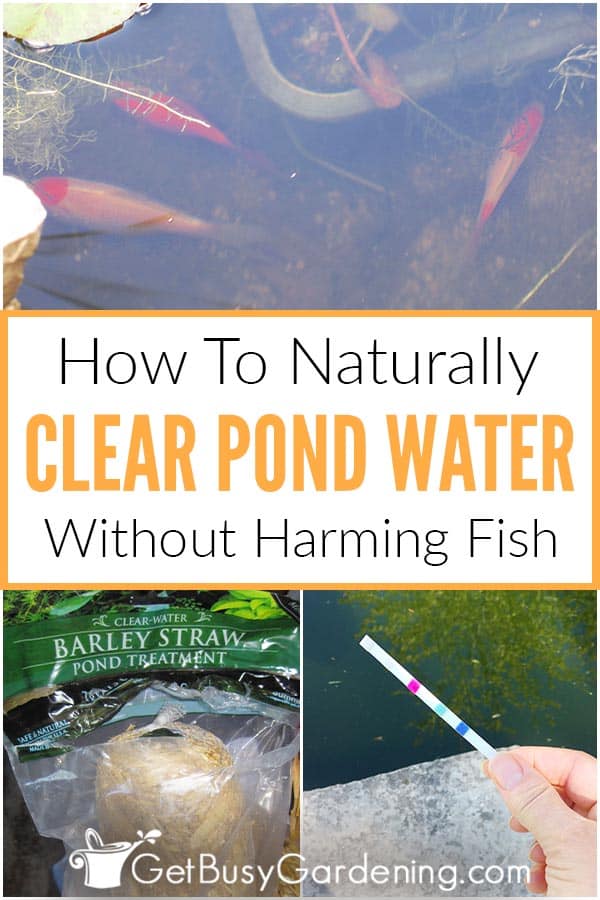
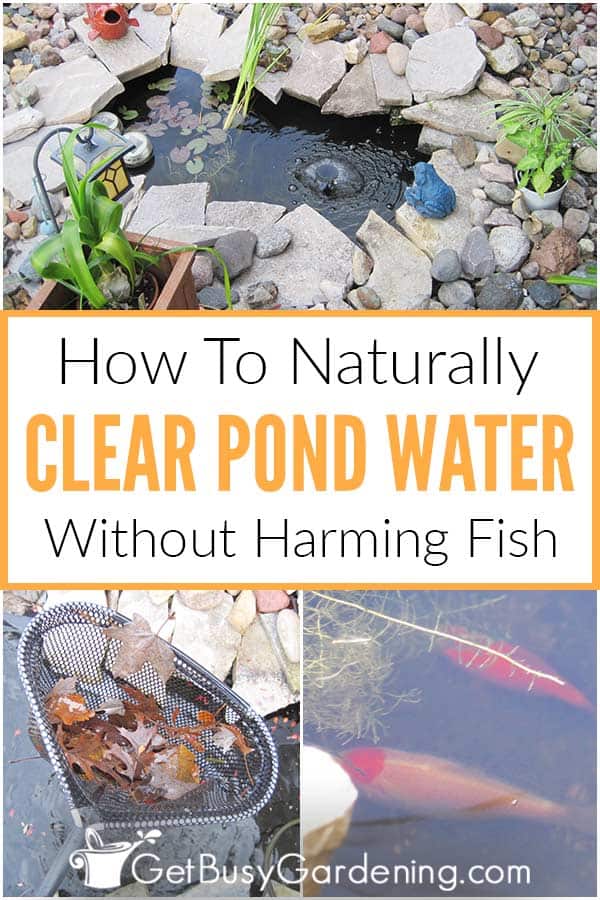
Keeping pond water clear the natural way is easy, and you don’t have to use any harsh chemicals either.
In this post I will show you step by step exactly how to get rid of that gross algae buildup and clear the water quickly, without harming your fish or plants.
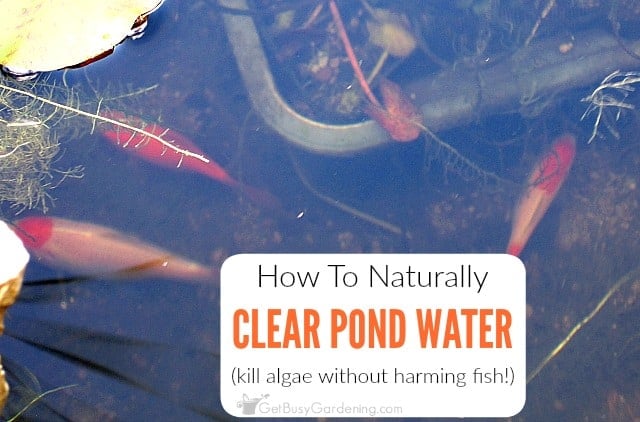

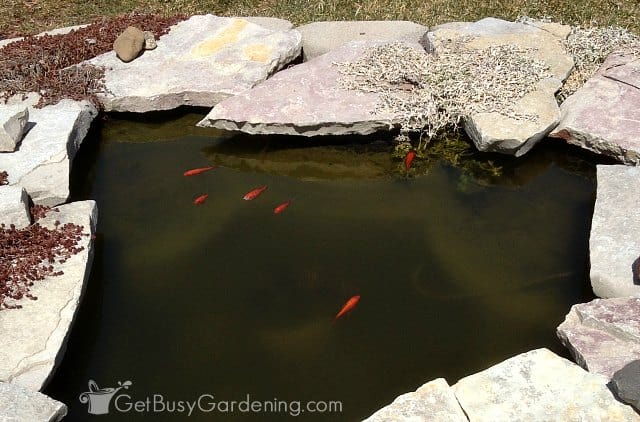
Several years ago, my small backyard garden pond became completely overgrown with mossy, weedy algae. It was green, cloudy, and disgusting – plus I could no longer see my fish or plants.
I was pretty nervous when I first discovered the problem, and worried that I would have to use expensive chemicals to treat it. Or, even worse, that those chemicals might kill my fish and plants.
It’s normal for ponds to have a greenish or brownish tint to them. However, it’s not healthy when the water becomes mossy, or so green that you can’t see through it.
Well, as it turns out, clearing out the algae naturally, and keeping your pond water crystal clear is easy. Whew!
What Clears Pond Water Naturally?
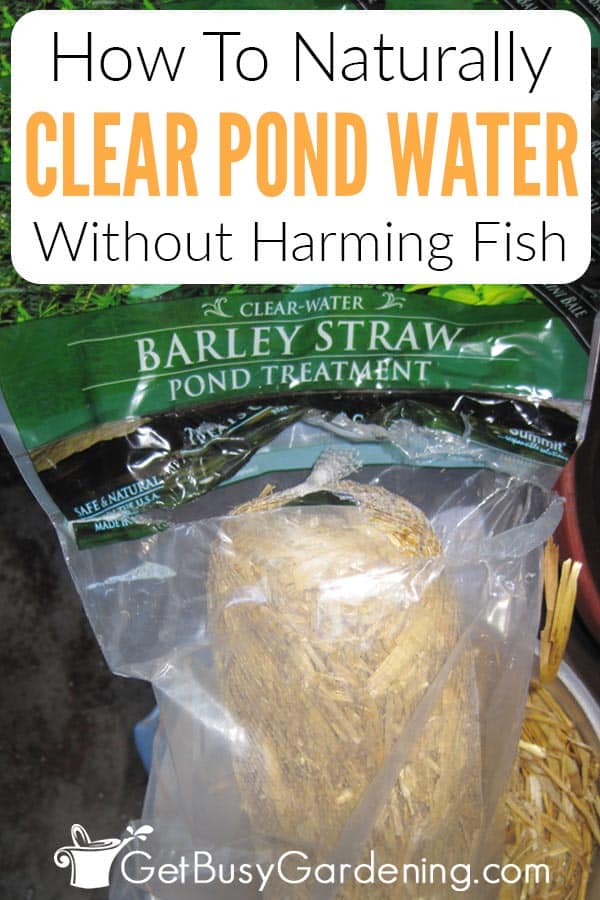
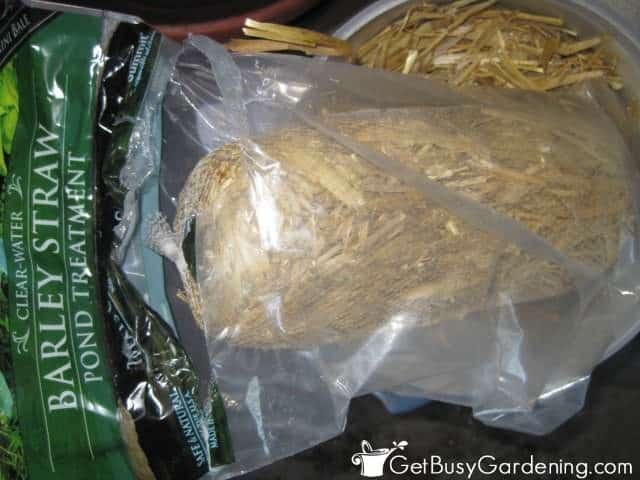
It sounds strange, but the answer is barley straw. Not only is it completely natural, but it won’t harm your fish or plants, and it’s inexpensive to buy too.
How it works is that, as barley straw decomposes, it releases something similar to hydrogen peroxide. This non-toxic by-product will choke out and kill pond algae, leaving the water crystal clear.
Below I will show you how to use it step by step. However, if your water is brown, thick and mucky, or it smells bad, then first you need to learn how to properly clean your pond here.
How To Clear Your Pond Water Step By Step
If you want to start seeing clear water in your pond as fast as possible, then follow my steps below. You only need a few supplies.
Supplies Needed:
- Toilet brush (or similar)
- Barley straw bundle (instead you could buy it in liquid form, or use the pellets)*
- Twine string (optional)
- Hydrogen peroxide (optional)
* The amount of barley straw you’ll need depends on the size of your pond. The package on the product that you buy should tell you exactly how to figure it out.
Instructions
Step 1: Remove the algae – To speed up your efforts, start by manually removing as much of the algae from your pond as you can. Don’t worry this sounds harder than it is.
An inexpensive toilet brush works great for this task, and you can use it to scrub the insides of your pond walls too.
Ideally, you would buy one to use specifically for this purpose. I mean, what would be more disgusting – using an old toilet brush in your pond, or using your pond brush in your toilet?
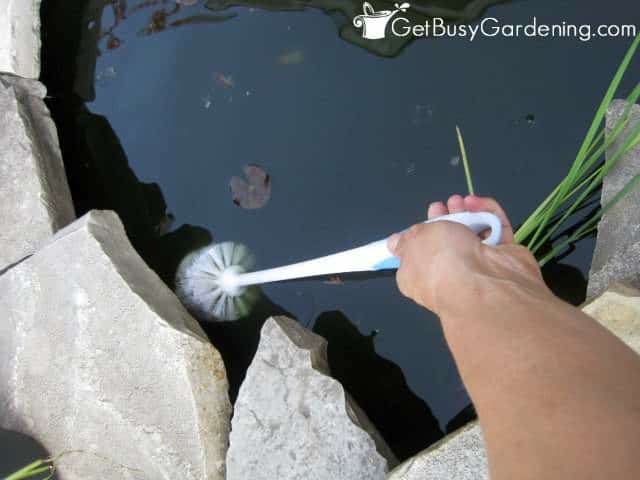
Step 2: Make a barley straw bundle (optional) – The barley straw that I use comes in bundles that are too large for my 90 gallon garden pond.
So I made smaller ones out of the mesh packaging that they came in, which I reuse year after year. I simply used some twine string to tie the mesh closed and secure the bundle.
Related Post: How To Winterize A Garden Pond Step-By-Step
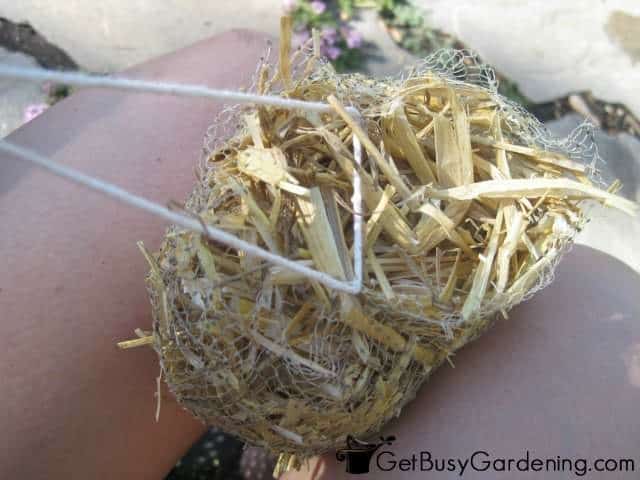
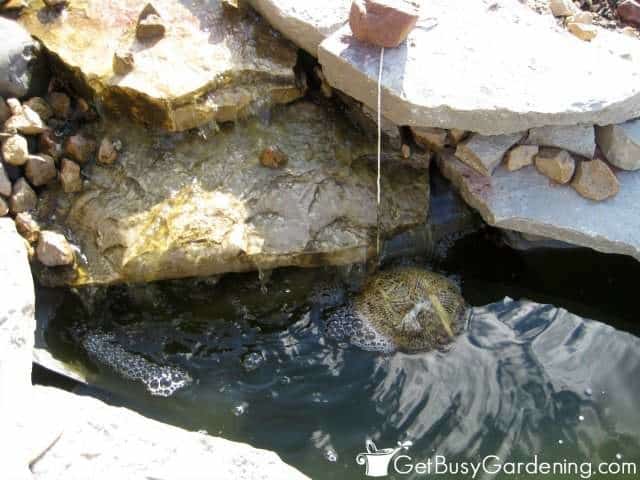
Step 3: Add the barley straw to the water – It’s best to put your barley straw near a fountain or waterfall where the water will flow through it.
This will help to circulate the water and clear it much faster. I used a long piece of the twine to hang the bundle from my waterfall.
The bundle will float at first, which isn’t always pretty. But once the straw starts to break down, it will sink so it’s no longer visible on top of the water.
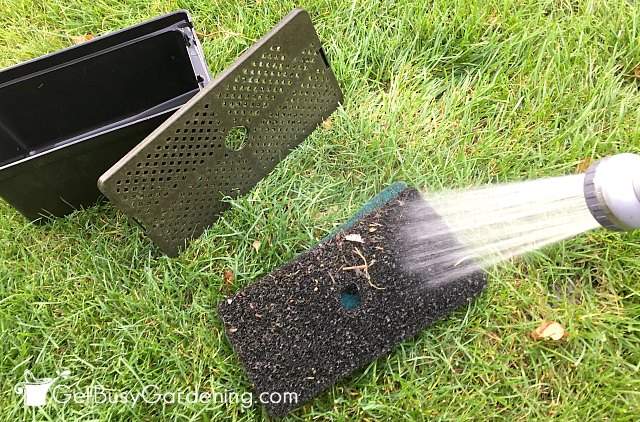
Step 4: Rinse the filter – To jumpstart the process, you should make sure your filter is clear so it can run smoothly and efficiently. I take mine out and rinse it off with the hose.
But you could use some of the water from your pond if you don’t want to risk killing the good algae that’s living in your filter.
If your pump didn’t come with a filter, I highly recommend that you get a universal pump filter box. It will make keeping your pond water clear sooooo much easier.
Step 5: Use hydrogen peroxide (H2O2): It takes a few weeks for the barley straw to work. So, to clear your pond water faster, use hydrogen peroxide (and no, it won’t kill your fish). Pour it right next to the fountain or waterfall to disperse it.
NOTE: I don’t know if there’s a special formula of H2O2 per gallon of water, so I recommend doing some research for your specific pond size. Mine holds 90 gallons of water, and I added a 1/2 cup of H2O2.
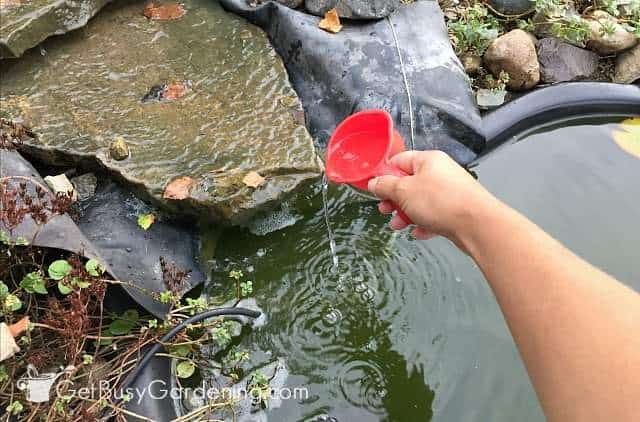
Step 6: Rinse the filter daily – I recommend rinsing your filter daily, which will help to remove the algae and speed up the process.
You should start seeing results within a week or so. In no time, the water in my pond was crystal clear, and it stayed that way all summer.
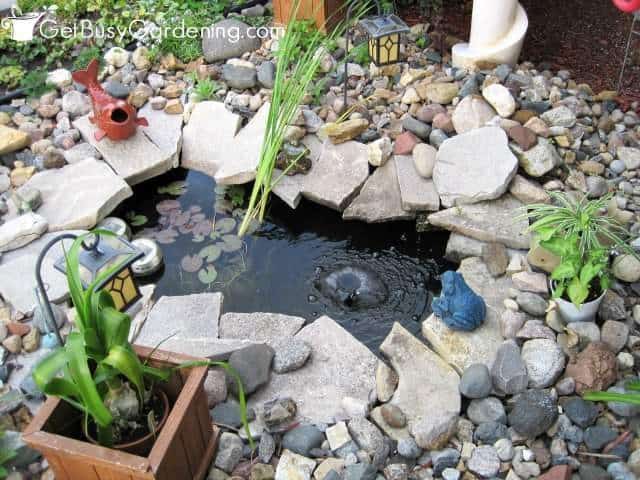
How To Keep Your Pond Water Clear
Once your pond water is clear, you can easily keep it that way for the long-term. Here are my tips for the best success:
- Use barley straw regularly – Put fresh barley straw in your pond every spring. One small bundle lasts me all summer.
- Keep the filter clear – You should get into the habit of rinsing your pond filter every couple of weeks, and probably more during the hot summer months when algae grows the fastest.
- Clear out the debris – Removing any debris that falls into the water is very important to ensure that it stays clear. My skimmer net makes this task super easy.
- Test the water regularly – You can get an inexpensive test kit, and that will help you maintain the perfect balance in your pond so you can prevent algae growth.
FAQs
Pond water turns green because of algae. It’s normal for it to have a greenish tint, but if it’s soupy or has mossy growth in it, then you should work to clear it ASAP.
Pond water turns brown when plant debris, like fallen leaves, and fish waste build up for too long. It’s normal for the color to be brownish, but it should not be mucky or stinky.
Not all types of algae are bad for your pond. But string algae can take over a small pond very quickly. If you don’t get rid of it, it could eventually starve your fish and plants of their oxygen and nutrients.
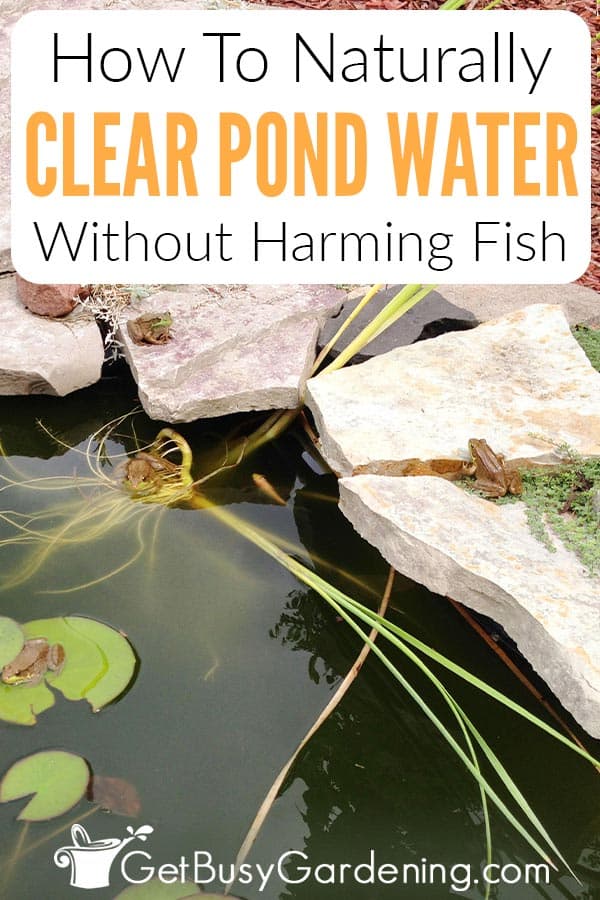
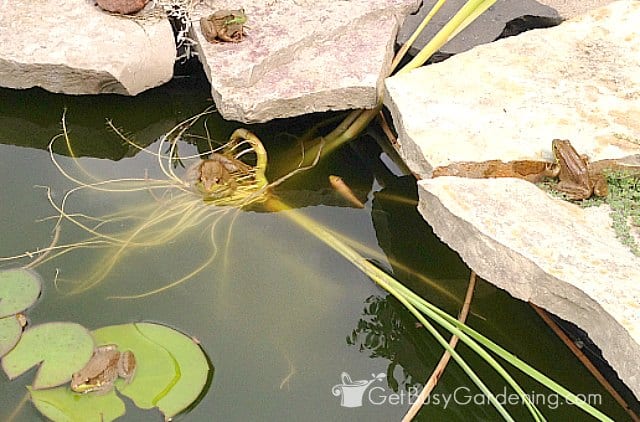
I love my little garden pond again now that the water is crystal clear, and keeping it algae-free isn’t that difficult when you know how. It’s nice to be able to watch my fish swimming around. Plus it constantly has frogs and salamanders in it too – a wonderful sign of a healthy pond.
Share your tips for keeping pond water clear in the comments below.

Patt says
I use Barley straw as well. I do like it. I use it in 3 ponds. But I put one in, in the spring, then another one in the middle of the summer. But I do recomment it. I make sacks for the straw and put the straw in it.
Amy Andrychowicz says
Awesome, thanks for sharing your experience with using barley straw to get rid of pond algae. Glad to hear it works well for you too! 🙂
Diane says
My new pond was starting to get murky. I used the barley straw; in just 2 days the water was clear right to the bottom. I don’t know why some ponds don’t respond well to the barley but mine was a few day clear method.
The bale has just now absorbed enough water to sink and I’ll watch to see if there are any changes.
I have a 500 gallon tank, 4 ft deep, built above ground, 3-tiered fountain, nine Koi and 30 algae eating snails.
My Koi are happy and fun to watch as they “frolic” throughout the pond. I have many “hide-y” holes for them to swim around and through.
I’m most pleased with the pond and it requires little work other than cleaning the pump every couple of weeks.
I am going to use a tank water heater regulated just to keep the water from freezing and possibly keep my waterfall in use year round.
I hear that many people remove the pumps for the winter.
Amy Andrychowicz says
Awesome, so happy to hear that barley straw worked so fast to clear your pond! Woohoo! It gets very cold here in MN, so I have to use a pond heater to keep mine from freezing over, and I must turn off the waterfall. I don’t remove my pump though, since the heater keeps my pond from freezing to the bottom. Here’s a post I wrote all about how to winterize a pond.
Brenda says
Hi, I have a very large pond with a 4 Ft waterfall. I don’t remove my pump in the winter and I don’t have a heater either, I just run two bubblers in the pond it’s self, so my fish have two air holes for oxygen and pond gases to escape. I have only had it for one winter and all but’s two fish did well, but they were from a pet store. I shut the waterfall off in the winter and only run the bubblers in the lower pond.
Joanne Lebo says
My husband and I have a quarter acre pond with a stream running through it. We tried to keep it clean manually, but we couldn’t keep up with it because of separate health issues. Our pond has about 100 koi and several types of frogs that live in it. I am sure there are other sweet critters as well. Our issue is that the pond has a lot of overgrowth and it smells so horrible I could almost gag. Where would I get a free test kit to see what problem needs addressed exactly? I have ordered a few hundred dollars worth of different pond cleaning stuff and it will be delivered this weekend. We just don’t know which way to turn at this point. All the things I’ve ordered claim to be safe for pond life.
Amy Andrychowicz says
Oh bummer, so sorry to hear you’ve been struggling with stinky and mucky pond water! I’m not sure where you could a free test kit, but they’re not very expensive to buy. Here’s the one I have… pond test kit.
June says
You need oxygen in your water. We had the problem of stinky water. Added a windmill, attached to it was a hose and a air pump. Put a weight on the hose with the air pump and sunk it in the deepest part of the pond. The windmill catches the wind and turns the blades on the fan, that pumps air down through the hose in the bottom of the pond and releases oxygen. You see the air bubbles on the top of the water. We also added a floating electric fountain. This aerates the surface water. Purchased pond muck cleaner. It also helps if you can get rain water to flow into the pond. We have a 4 foot ditch that surrounds the pond and put a pipe that connects the ditch to the pond. When it rains heavily the ditch water flows into the pond. All of this has helped tremendously. No more stinky pond. We have stocked it and it is beautiful.
Arch.Tung says
More than likely the smell is from the sulfur created by anaerobic bacteria. You have a big pond and probably many dead vegetation blocking the flow of your pond thus reducing the oxygen. Anaerobic bacteria helps reduce the nitrate level in your pond taking place of your dead plants. I use to create an anaerobic filtration system for my reef tank to keep the nitrate level low. They require low oxygen level to thrive and remove nitrates and cause the smell due to stagnated water. Clean all dead and decayed debris and add a large pump to aerate the pond.
Art D says
Another tip for filtration, apparently activated charcoal is this:
Make a fire using Hardwoods. Once all of the wood have become Red Hot Cherry Coal feed your fire water, as much as it takes to subdue the coal.
Now the charcoal has become activated. Break into whatever size pieces you need and thoroughly rinse.
Note, it will smell like a campfire when rinsing but that will quickly pass. I’ve done this myself and find it’s a lot cheaper than buying already activated charcoal at the store. I haven’t yet tested it for drinking water, but that’s on the do.
Amy Andrychowicz says
Great, thanks for sharing your method of clearing pond water! I like the charcoal idea.
Arch.Tung says
In addition, you can reactivate the charcoal with heat and reuse it again many times. Charcoal have large surface areas to absorb surfur, phosporus and nitrates thus clears the water. By heating it up around 400 degrees F for about 30-60 minutes essentially cooking the bad stuff out you can rinse and reuse. Sams warehouse have charcoal wood for grilling that you can buy but i would definitely heat in oven first just to make sure all bad chemicals that were used to process the charcoal are gone to keep the fish safe.
Bill says
I have two ponds, the one in the sun is a constant cloudy algae problem, but the one in the shade is always clear as drinking water, without any additives, filtration etc. Pick the location in the shade to rid yourself of all those problems, or shade it or move it if possible.
Amy Andrychowicz says
Great tip for people looking for the best location to build a new pond. Though I agree that a pond in the sun will likely have more problems with algae growth, moving it to the shade won’t necessarily solve that issue. My pond in the front is in full shade, and I still have to fight algae in there.
Melissa Johnson says
I know this is off the subject, but I am planning a pond for my ducks and this is all wonderful advice. Does anyone know if i can put koi fish in the pond with my ducks?
Amy Andrychowicz says
Sure, I don’t see any problem with putting koi in a duck pond.
marylu says
Ducks will eat or kill small koi (fish 4-5 inches in length would be in danger).
Amy Andrychowicz says
Really?? I have ducks in my pond every spring, and they’ve never eaten any of my fish.
James Parson says
I live in southeast Texas and have a 5 acre lake, and I desperately need someone to help. It’s overtaken by underwater growth and I don’t know what to do. If you know of someone in my area that could come & take a look I would be most grateful.
Amy Andrychowicz says
Sorry but I don’t know much about lakes. I would call your local city or state department of agriculture and talk to them about your options. Here in MN the lakes are owned by the state, so that’s where I would start.
D says
Try contacting Texas A&M. They might be able to send someone out, or get you a test kit of some kind.
Robin says
Our pond holds 3600,00 gals of water, how much pine straw would I need for this? I have. 75 large goldfish and Koi, and about that many babies. Yes they seem happy. Lol
Amy Andrychowicz says
The barley straw that I buy says that each bale treats 1000 gallons. You may be able to find larger bales for a larger pond like yours.
Shirley McKinney says
My pond holds approx. 1200 gallons of water. I do not have the green stuff yet this year but the water is dirty looking. What to do?
Amy Andrychowicz says
Here’s a detailed post about how to clean a fish pond that will give you all the info you need.
Dale Burleson says
I live in Thailand and do not have access to Barley straw. I used rice straw and it worked just as good.
Step 1.
Soak a bundle of rice straw for 3 days in water. Drain after 3 days.
Step 2.
Wrap rice straw in netting.
Step 3.
Place straw in flowing water and leave it.
Should start seeing results in about 2 to 4 weeks.
After 3 weeks the alge in my pond started to disappear and pond water is now clear and alge is nearly gone.
Amy Andrychowicz says
Great, thanks for sharing your tips and experience for using rice straw instead of barley straw to clear your pond water!
Keith Tuck says
Another good way of keeping algae down is to have an Ultra Violet lamp in your filter system. I used to have a filter box with built in ultra violet lamp when I had a small pond and the water stayed crystal clear.
Amy Andrychowicz says
Wow, cool. I’ve never heard of a pond filter with an ultra violet lamp. Thanks for the added tip.
Sharin says
Can u put devil vine n ur garden pond? Or will it take to much oxygen out of my water. Don’t want to kill my goldfish or koso fish
Amy Andrychowicz says
Plants actually help to add oxygen to the water, they don’t take oxygen out of the water. I’ve never grown devil vine (I think you’re talking about pothos?) in my pond before, but I don’t see why you couldn’t give it a try. I have water lilies in mine, and overwinter them in there with the fish.
Art D says
Amy, not certain about aquatic plants but I do believe that the root system for plants on land breathe oxygen and exhale carbon dioxide just as we do. it’s just that the top side of the plant does the reverse at a greater rate usually, so overall the plant generates more oxygen than it consumes. If researching this proves that I’m wrong, preemptive apology here. 🙂
Kristy says
Our goldfish got sucked into the filter/ pump area. Any suggests for this?
Amy Andrychowicz says
Oh no! So sorry to hear about your fish! I’m not sure what type of filter or pump you’re using, but I’ve never had that happen to my fish. I would recommend getting a universal filter box if that would work with your pump. That’s what I use, and my fish have never been sucked up.
Cindy says
We use panty hose. WTer filters through but fish and frogs do not. Pool and big name hardware stores with garden centers sell them specifically for the pump and filter. They allow the water to flow through trapping debris and thicker algae.
Gay says
Do you have a problem with raccoons or water snakes invading your pond?
Amy Andrychowicz says
I haven’t had any problems with critters invading my pond. We do have lots of frogs and I’ve also seen salamanders in the pond, but nothing invading it (well, unless you call 15 frogs having a party in there on a hot day an invasion, LOL!). I’m sure that wildlife like raccoons drink from my pond regularly (I’ve seen lots of birds and even squirrels taking a drink), but the raccoons have never done any damage or eaten my fish (that I know of anyway). Knock on wood!
Paulette says
Hi I read that you have frogs in your pond. My pond is also about 90 gallons so my goldfish are relatively small maybe 4”. I’ve always loved the idea of having frogs but afraid they would eat the small fish. How big are your fish? Do you have a problem with frogs eating them? Thanks
Amy Andrychowicz says
I also just have goldfish in my pond, and have never had problems with frogs eating them. Since my pond is outside, I would never be able to keep the frogs out anyway, LOL!
Theodore c Young says
Barley straw only kills the string algae. In order to deter the other types of algae make sure 50% of your pond is covered with plants. Too much sun promotes the growth.
Just sayin
Amy Andrychowicz says
Using pond plants to shade the water from the sun is a great idea, thanks for the tip!