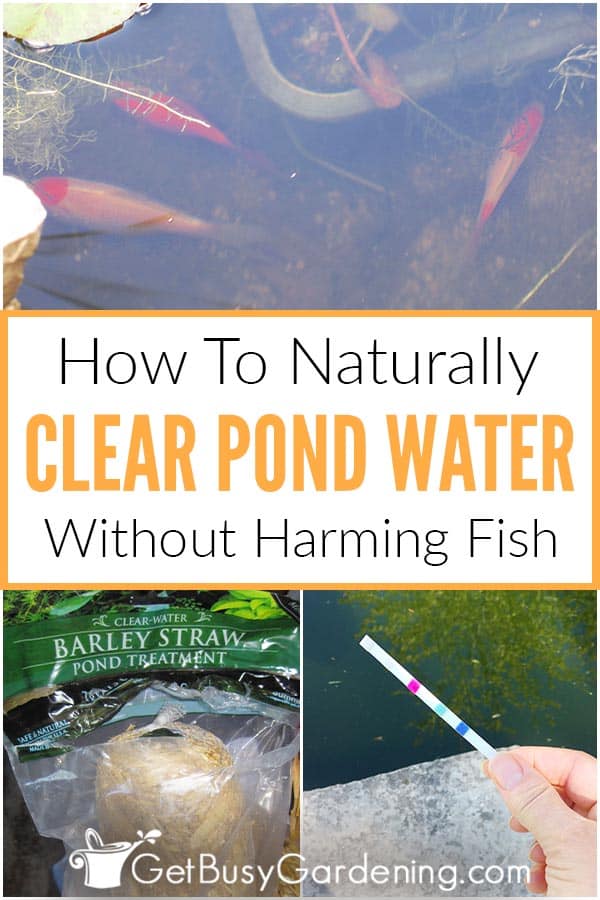
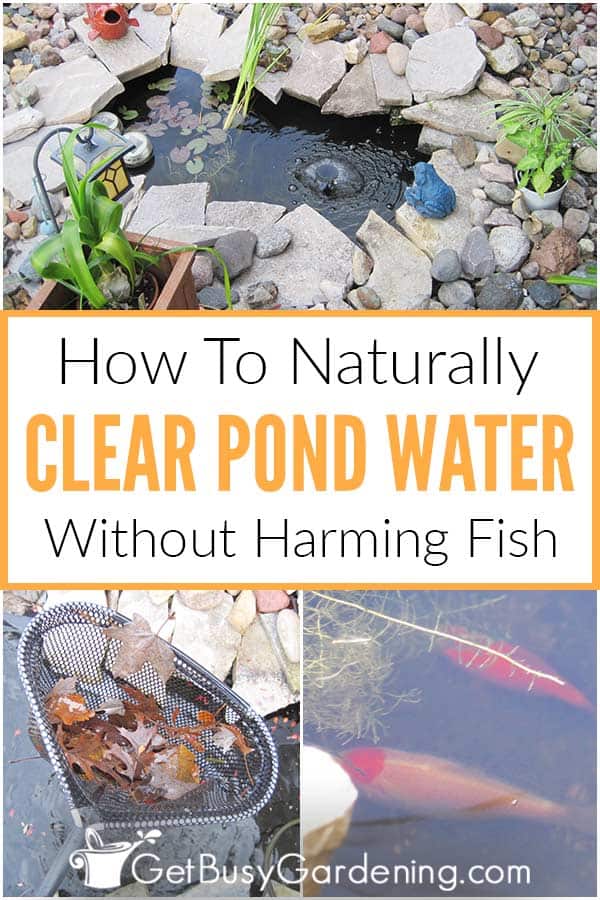
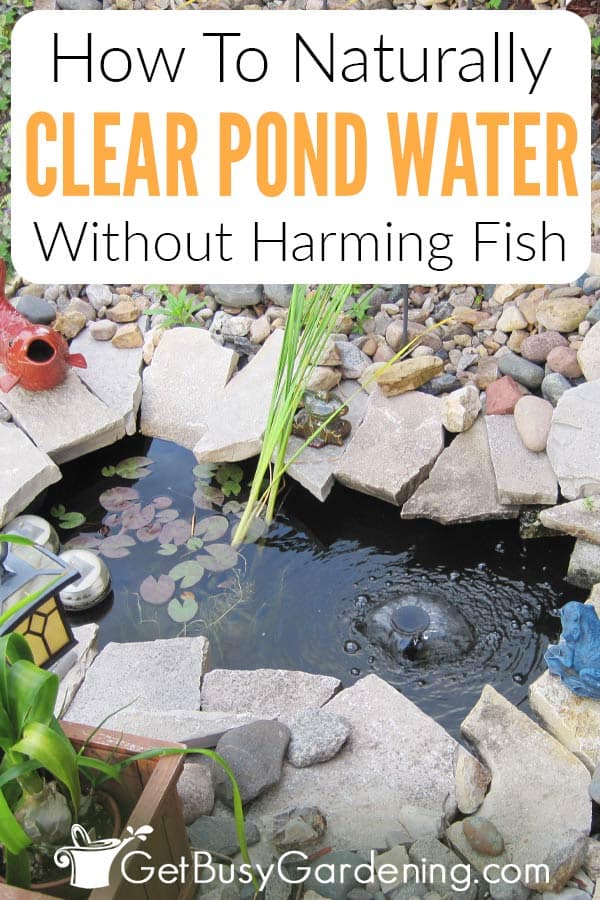
Keeping pond water clear the natural way is easy, and you don’t have to use any harsh chemicals either.
In this post I will show you step by step exactly how to get rid of that gross algae buildup and clear the water quickly, without harming your fish or plants.
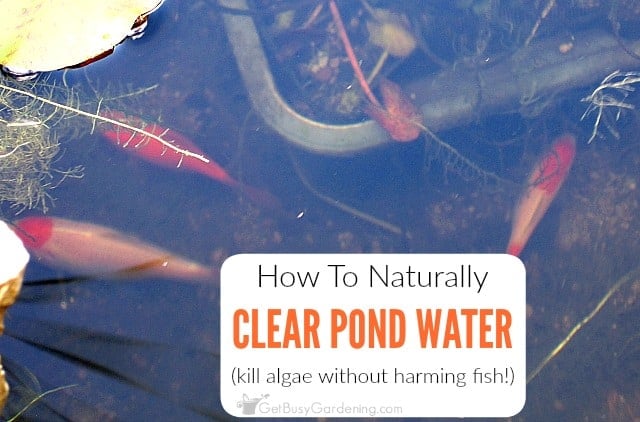

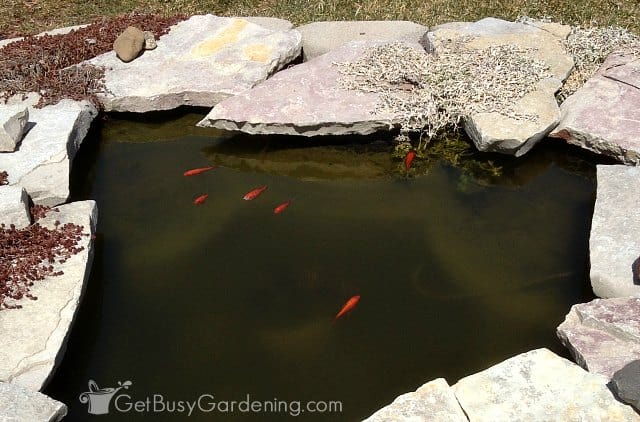
Several years ago, my small backyard garden pond became completely overgrown with mossy, weedy algae. It was green, cloudy, and disgusting – plus I could no longer see my fish or plants.
I was pretty nervous when I first discovered the problem, and worried that I would have to use expensive chemicals to treat it. Or, even worse, that those chemicals might kill my fish and plants.
It’s normal for ponds to have a greenish or brownish tint to them. However, it’s not healthy when the water becomes mossy, or so green that you can’t see through it.
Well, as it turns out, clearing out the algae naturally, and keeping your pond water crystal clear is easy. Whew!
What Clears Pond Water Naturally?
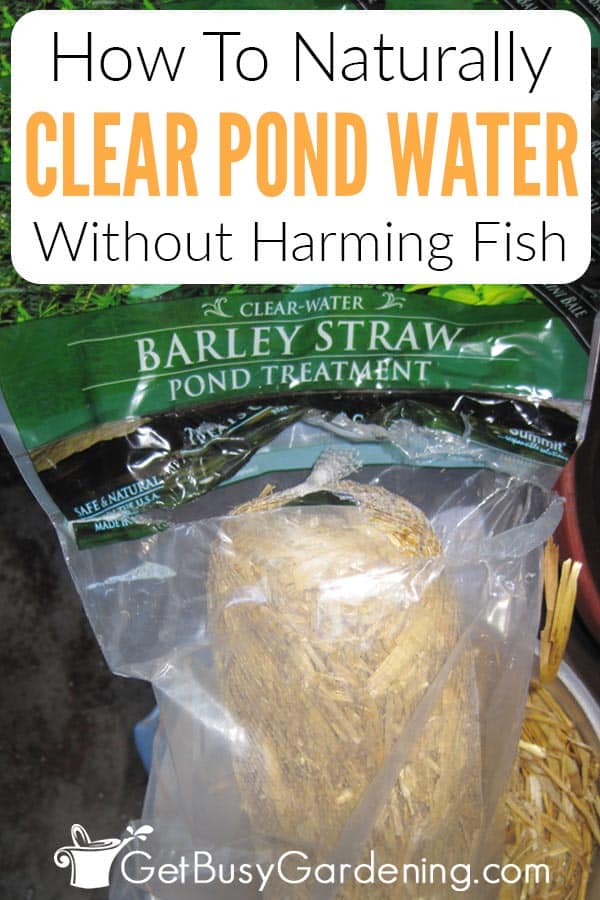
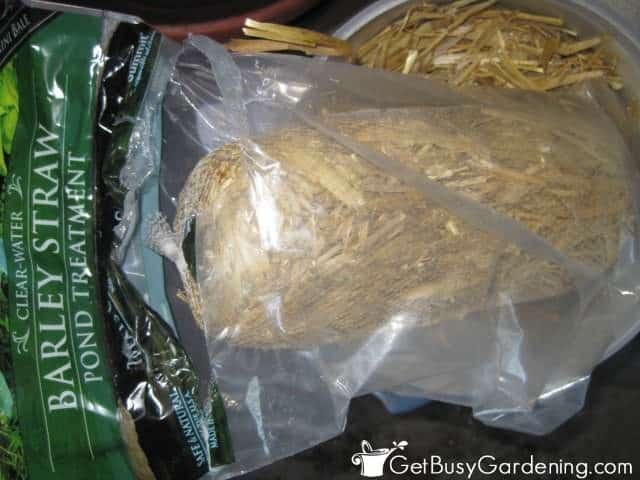
It sounds strange, but the answer is barley straw. Not only is it completely natural, but it won’t harm your fish or plants, and it’s inexpensive to buy too.
How it works is that, as barley straw decomposes, it releases something similar to hydrogen peroxide. This non-toxic by-product will choke out and kill pond algae, leaving the water crystal clear.
Below I will show you how to use it step by step. However, if your water is brown, thick and mucky, or it smells bad, then first you need to learn how to properly clean your pond here.
How To Clear Your Pond Water Step By Step
If you want to start seeing clear water in your pond as fast as possible, then follow my steps below. You only need a few supplies.
Supplies Needed:
- Toilet brush (or similar)
- Barley straw bundle (instead you could buy it in liquid form, or use the pellets)*
- Twine string (optional)
- Hydrogen peroxide (optional)
* The amount of barley straw you’ll need depends on the size of your pond. The package on the product that you buy should tell you exactly how to figure it out.
Instructions
Step 1: Remove the algae – To speed up your efforts, start by manually removing as much of the algae from your pond as you can. Don’t worry this sounds harder than it is.
An inexpensive toilet brush works great for this task, and you can use it to scrub the insides of your pond walls too.
Ideally, you would buy one to use specifically for this purpose. I mean, what would be more disgusting – using an old toilet brush in your pond, or using your pond brush in your toilet?
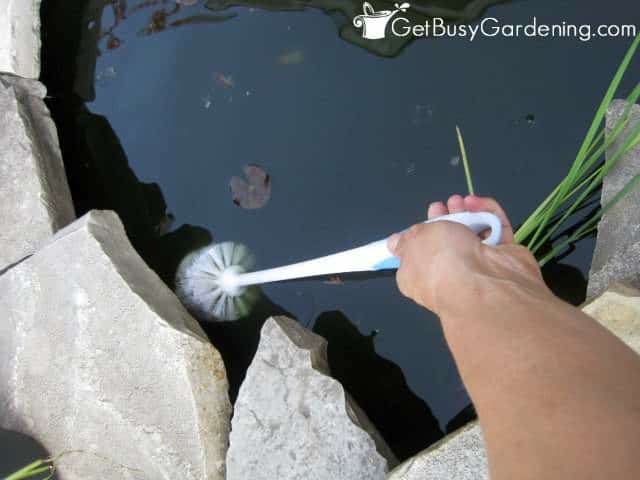
Step 2: Make a barley straw bundle (optional) – The barley straw that I use comes in bundles that are too large for my 90 gallon garden pond.
So I made smaller ones out of the mesh packaging that they came in, which I reuse year after year. I simply used some twine string to tie the mesh closed and secure the bundle.
Related Post: How To Winterize A Garden Pond Step-By-Step
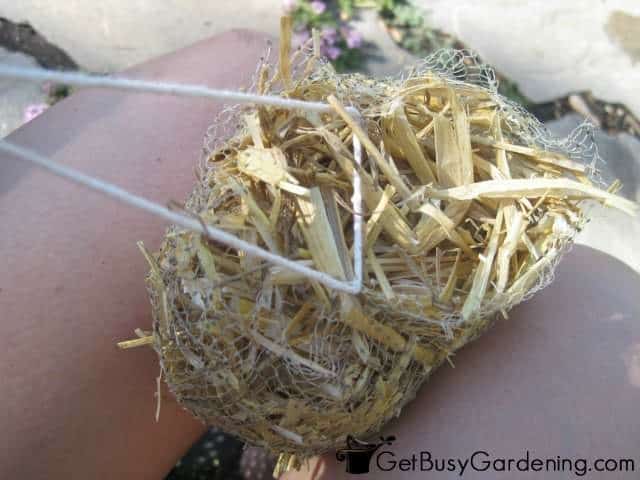
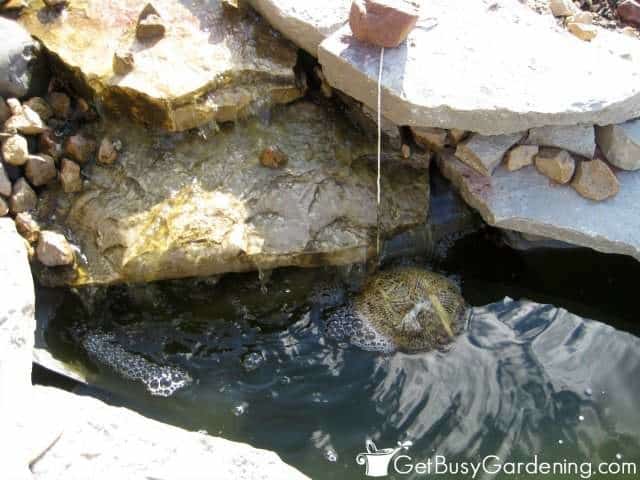
Step 3: Add the barley straw to the water – It’s best to put your barley straw near a fountain or waterfall where the water will flow through it.
This will help to circulate the water and clear it much faster. I used a long piece of the twine to hang the bundle from my waterfall.
The bundle will float at first, which isn’t always pretty. But once the straw starts to break down, it will sink so it’s no longer visible on top of the water.
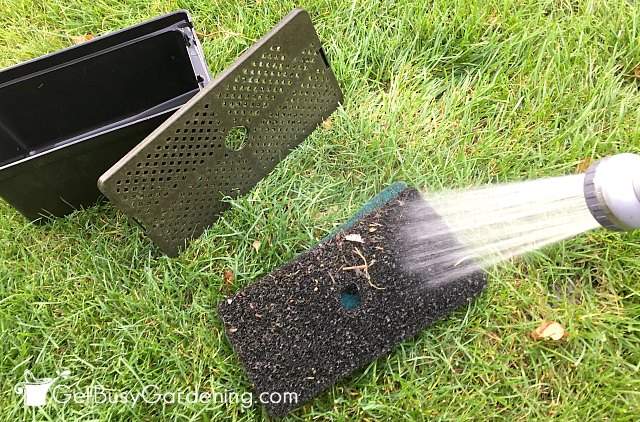
Step 4: Rinse the filter – To jumpstart the process, you should make sure your filter is clear so it can run smoothly and efficiently. I take mine out and rinse it off with the hose.
But you could use some of the water from your pond if you don’t want to risk killing the good algae that’s living in your filter.
If your pump didn’t come with a filter, I highly recommend that you get a universal pump filter box. It will make keeping your pond water clear sooooo much easier.
Step 5: Use hydrogen peroxide (H2O2): It takes a few weeks for the barley straw to work. So, to clear your pond water faster, use hydrogen peroxide (and no, it won’t kill your fish). Pour it right next to the fountain or waterfall to disperse it.
NOTE: I don’t know if there’s a special formula of H2O2 per gallon of water, so I recommend doing some research for your specific pond size. Mine holds 90 gallons of water, and I added a 1/2 cup of H2O2.
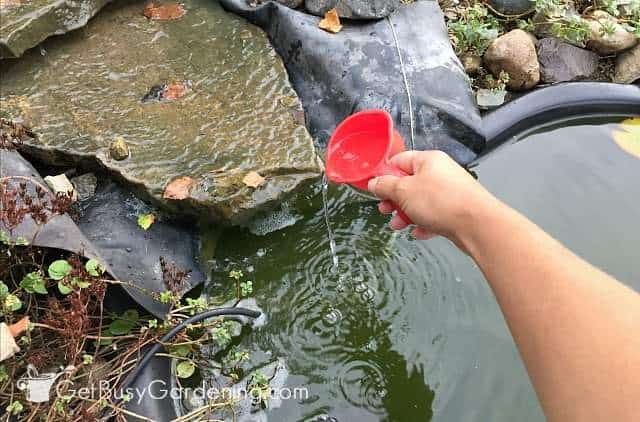
Step 6: Rinse the filter daily – I recommend rinsing your filter daily, which will help to remove the algae and speed up the process.
You should start seeing results within a week or so. In no time, the water in my pond was crystal clear, and it stayed that way all summer.
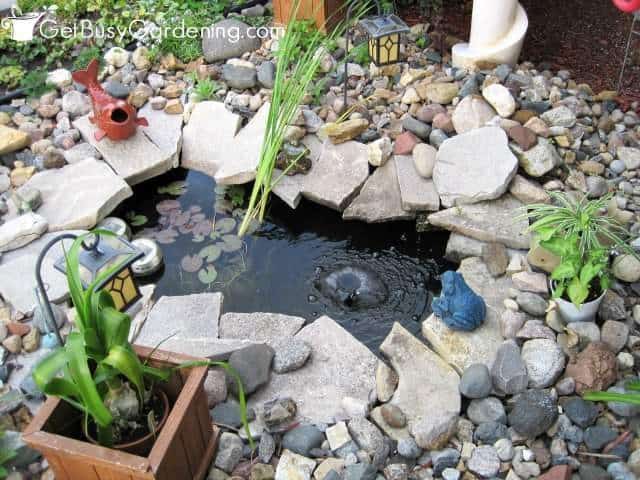
How To Keep Your Pond Water Clear
Once your pond water is clear, you can easily keep it that way for the long-term. Here are my tips for the best success:
- Use barley straw regularly – Put fresh barley straw in your pond every spring. One small bundle lasts me all summer.
- Keep the filter clear – You should get into the habit of rinsing your pond filter every couple of weeks, and probably more during the hot summer months when algae grows the fastest.
- Clear out the debris – Removing any debris that falls into the water is very important to ensure that it stays clear. My skimmer net makes this task super easy.
- Test the water regularly – You can get an inexpensive test kit, and that will help you maintain the perfect balance in your pond so you can prevent algae growth.
FAQs
Pond water turns green because of algae. It’s normal for it to have a greenish tint, but if it’s soupy or has mossy growth in it, then you should work to clear it ASAP.
Pond water turns brown when plant debris, like fallen leaves, and fish waste build up for too long. It’s normal for the color to be brownish, but it should not be mucky or stinky.
Not all types of algae are bad for your pond. But string algae can take over a small pond very quickly. If you don’t get rid of it, it could eventually starve your fish and plants of their oxygen and nutrients.
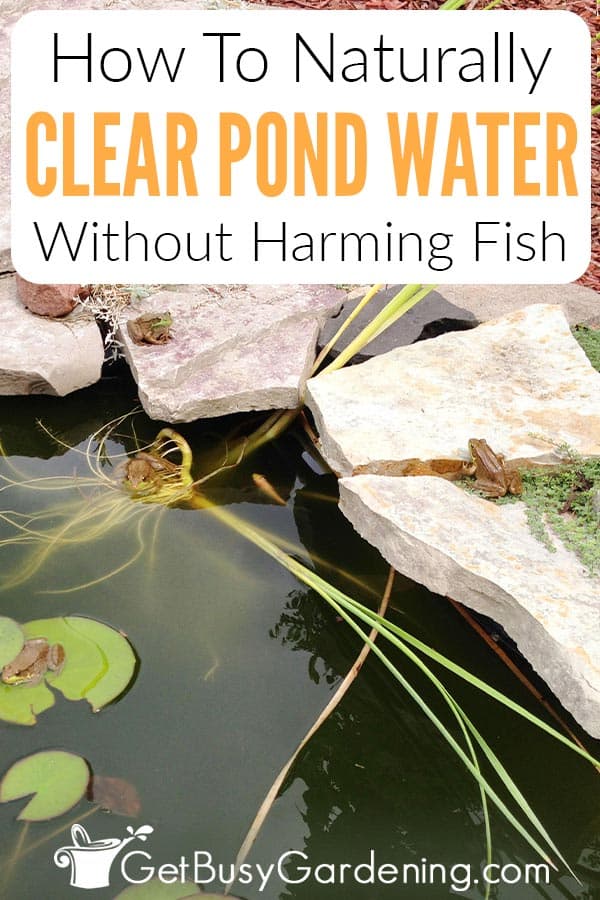
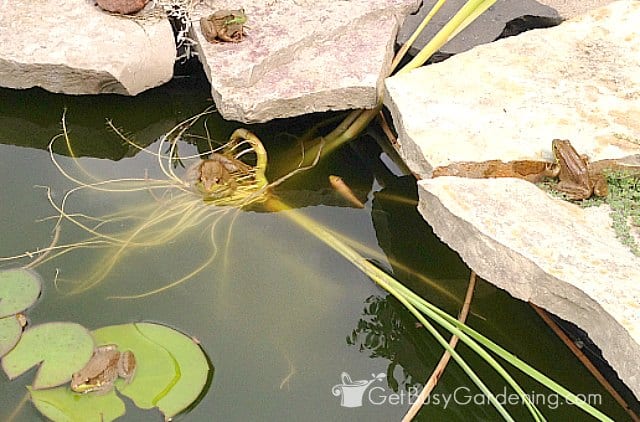
I love my little garden pond again now that the water is crystal clear, and keeping it algae-free isn’t that difficult when you know how. It’s nice to be able to watch my fish swimming around. Plus it constantly has frogs and salamanders in it too – a wonderful sign of a healthy pond.
Share your tips for keeping pond water clear in the comments below.

Sara says
There are fish that eat algea which is great but they cannot tolerate cold weather. You can buy them in most stores that sell fish. Snails eat algea too. There are some very large snails that can be bought for outside ponds. They are difficult to find though.
Amy Andrychowicz says
Thanks Sara. Great tips! I have thought about getting one of those bottom feeder fish that eat algae, but I would feel terrible when it died over the winter. I think it would be really hard to find it in the pond to take it out in the fall. LOL!
Helga says
Hi Amy
I live in Australia on the Sunshine Coast. This area is tropical but has cool winters.
We just put a tyre pond in. I have 4 gold fish at the moment, some water plants and stones at the bottom of the pond. I have a small solar water fountain which only works during the day. This will be made into a waterfall going from one pond to the next- we used two tyres. My goldfish are very happy but I can feel the sides of the pond starting to get a bit slimy. I will definitely try the hydrogen peroxide trick and get some barley straw. What a wonderful idea.
I will save your site onto my desktop.
I will also be looking at buying some fish that eat mosquito larvae which is also a problem here in Summer. If I get some more water plants will they also help to keep the pond healthy?
Kind regards
Amy Andrychowicz says
Sounds wonderful! Goldfish eat mosquito larvae, so you should be fine there. Yes, adding a few plants will also help to keep the pond healthy. I have hardy water lilies growing in mine, they’re beautiful!
Molly Ackert says
We just bought a house on a shortsale..It has two ponds. One in a walled in area(which has an electric filter which clearly has not been turned on in years) and the other is about 50 feet by 40 feet. Also is in sad state. I will immediately get the barley, a skimmer net, H2O2, and some goldfish. There are cat tails growing along the bank in areas. Do we need an aerator? Your article is superb. Thanks so much
Amy Andrychowicz says
I would recommend you test the water in your ponds before you add fish. You might have some work to do to get the water clean enough for them to survive. Here are some test strips that you can use… Pond Test Strips Goldfish are cheap, but it’s not worth the effort of adding them to the ponds if they’ll only die shortly after. 😉 I would start with that, and then go from there. Once you get the water healthy and ready for fish, then you can look into buying an aerator.
Marsha Bailey says
I used charcoal in mine. After it settles it works great.
Amy Andrychowicz says
Cool! Is it a charcoal filter, or do you just drop bits of charcoal in there?
Ryan says
FYI when the barley straw decomposes it actually produces H2O2, so skip the middle man and go straight to the H2O2. For small ponds, the 3% stuff is fine. For larger ponds, it’s cheaper to get the 27% (often sold as chlorine-free pool shock). When H2O2 breaks down, it forms H2O (water) and O2 (Oxygen), so it is safe once it breaks down. The key is to make sure it breaks down! This is more of a factor of how much organics/algae you have as opposed to total volume. If your water is brown, with a lot of leaves and algae, the H2O2 will break down quickly. If your water is mostly clear, start with minimal doses, and repeat every couple days if needed.
Some reading from people way smarter than I!
Amy Andrychowicz says
Thanks for adding your tips!
Kelly & Randy O'Reilly says
Our pond is 12,000 gallons, will the pool shock be safe for our plants and fish?
Chris Pendleton says
Hey Amy great story I have a natural alternative that won’t cost a dime
I live in the Ohio Valley, New Albany, IN five mins across the Ohio River from downtown Louisville, KY. Anyway, the sun is strong here and algae is problem if your pond is not covered with 60% of the top in shade whether you use floating plants or some sort of coverage to prevent the algae blooms. I open and close peoples ponds and keep them clean as a side job. After doing some research I learned you can take simple branches of weeping willow depending on the size of your pond I d say about one branch for every 10 gallons of water. The best way to remove the branch fromthe tree is by making a clean cut with a knife or razor blade and this will not harm the tree it will regroup the branch. By making a clean cut with a sharp object it does not disturb the water vein in the branch like it would if you used shears or scissors. That would pinch and close off the water vein. Place your cut end of the branches into your pond, bird bath, fountain, etc. Around 5-6 days you will notice roots forming from the cut ends and those branches will now start taking in nutrients ffrom the water and starve and deplete the algae from getting them which in turn kills the algae and now you have starts of new willow trees that you can plant in the ground. You can leave the branches in the water for as long as you like. But the best way to keep the algae out long term is to have 60 % of your water feature shaded either by floating plants, a roof, or by using pond dye. Hope your followers try this inexpensive treatment and raise new willow trees from it. Enjoy your day evryone! Chris Pendleton-New Albany, IN facebook.com/stylinstud
Amy Andrychowicz says
Wow, that is so awesome! I love this idea and I’m totally going to give it a try. Thanks so much for sharing Chris!
Diane Smith says
Now all I have to do is search for a willow. I will try it. It makes sense to me. Because of willows’ penchant for growing into plumbing problems, people don’t use them much anymore for landscaping. I grew up having tea parties and other pretend parties under one huge shady willow.
One tip from me: If you have ailing trees, roses and other shrubs, planting willow slips around them usually cures them. It has medicinal properties for plants.
Amy Andrychowicz says
Interesting, thanks for the tip!
Tammy in NY says
Hello I just recently put in a small pond (its just the tub that you buy with the kit – I bought used) I scrubbed it before putting in the ground and doing my landscaping. I do plan on buying the pump to do a waterfall but for now it’s just there. I bought some feeder goldfish, a albino frog and 2 fantail gold fish but unfortunately we cant see them cuz the water is cloudy but way too soon for algea. Would the peroxide work?
Amy Andrychowicz says
You can definitely give it a try, it should help. But it would work best of you put a pump in there (even it it’s just a bubbler) to aerate the water and help to circulate the peroxide.
booboo says
I have just brought barley straw off of the internet for the pond, to eliminate green/algae;
it is already in nets; does it need anything added to it or treating with anything first? Do I just put it in the pond and leave it? Is it harmless to fish and pond life?
Amy Andrychowicz says
You just need to put it in the pond and leave it. It will eventually sink. No, it’s not harmful, it’s completely natural and safe to use.
Simone says
I have a house that came with a pond and had no idea what to do with it. This info is right on time! Thanks!
Amy Andrychowicz says
Perfect! You’re welcome.
Judy says
I have a 250gal pond with Koi in it. I’m constantly having to change the filter. We’d like to do away with the filter entirely and only use an aerator. We want to cut down on the maintenance and use only barley straw and lava rocks. Any suggestions and would this work?
Amy Andrychowicz says
Sounds like a great idea. I would definitely talk to someone at your local nursery (where they sell backyard pond equipment) and get their advice. Sorry, but I don’t have experience doing that. 🙂
Cindy says
I hope to some day get to have a little pond in a backyard somewhere(we’re in a duplex right now). This is good info to know. I’ll also pass it along to my mom whose pond is generally getting a bit of algae in it by the end of summertime. Thanks so much for the tips!
Amy Andrychowicz says
Awesome, thanks! You’re welcome. 🙂
Julie says
We moved last year to a house with a tiny pond with a big algae problem. I have just been removing it manually so I’m happy to give this a try. thanks.
BTW cleaning the pond with a toilet brush is way more gross that cleaning the toilet with the pond brush in my opinion anyway!
Amy Andrychowicz says
Awesome, hope it works well for you.
LOL, I agree! Love it.
Candy says
Using this method, would the water be safe for my dogs to drink?
Amy Andrychowicz says
Well, I don’t have dogs so I’m not sure how “safe” pond water is for them to drink. 😉 But you can feel safe knowing that you’re not putting any yucky chemicals in the water that could be harmful to your dogs if they drink the water.
Victoria J. Maniquis says
I have a 10ft. Height waterfall leading to my koi pond and ends up in a gazebo. I live in a tropical country. I don’t think we have barley straws here. Can you suggest anything else?
Hope you can help. Thanks.
Amy Andrychowicz says
You can buy barley straw online. I’m not sure if you can shop on Amazon from where you live, but here’s the barley straw that I buy… Barley Straw
I also mentioned a few products you could try in the post above, here’s a list of a few things I’ve also used…
Barley Straw liquid extract
Barley Straw Pellets
Hydrogen Peroxide
If you can’t order this stuff online, then I recommend going to your local garden center and ask if they carry any of these products, or if they know where you can find them.
Jay says
When you brush the algae off though it just goes straight into the water, which I doubt is good for the fish? Having this problem myself when cleaning my fountain, all the muck goes straight in. Any ideas?
Amy Andrychowicz says
True, but that’s why you have to rinse the filter on a regular basis. That will help clear out the algae.
Andrea Tobar says
can I Use wheat?
Amy Andrychowicz says
No, it has to be barley straw.