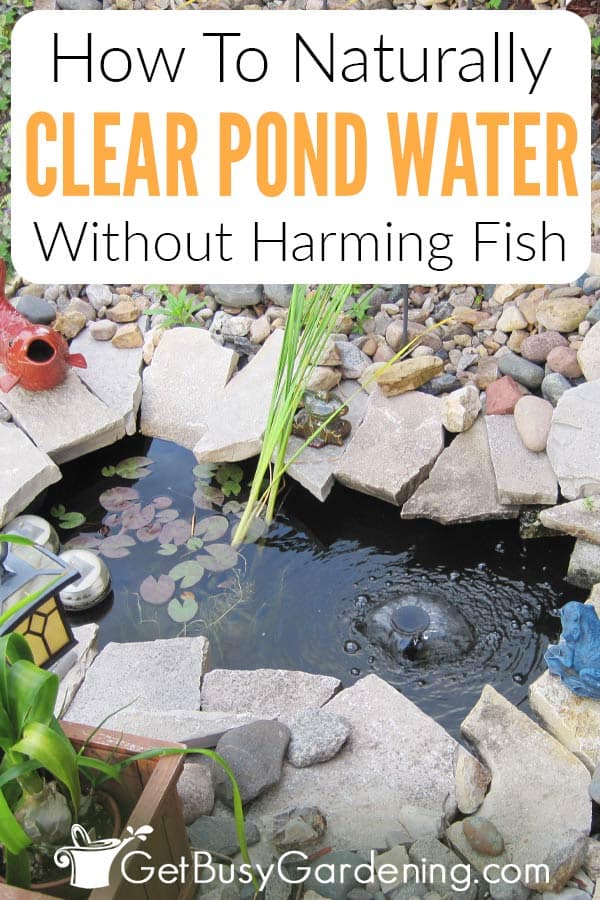
Keeping pond water clear the natural way is easy, and you don’t have to use any harsh chemicals either.
In this post I will show you step by step exactly how to get rid of that gross algae buildup and clear the water quickly, without harming your fish or plants.
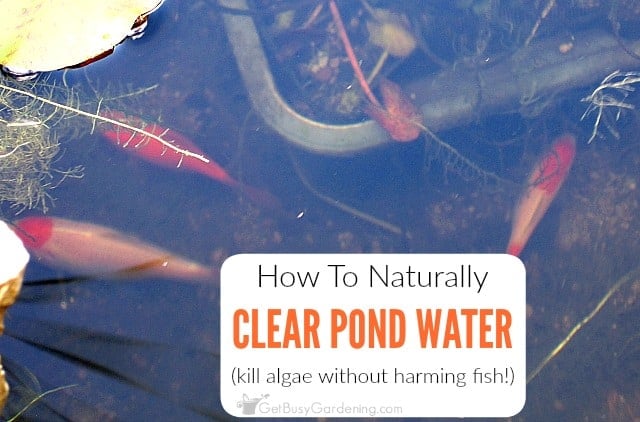

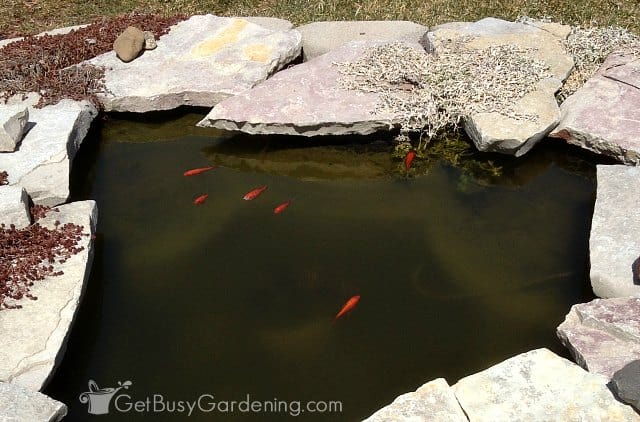
Several years ago, my small backyard garden pond became completely overgrown with mossy, weedy algae. It was green, cloudy, and disgusting – plus I could no longer see my fish or plants.
I was pretty nervous when I first discovered the problem, and worried that I would have to use expensive chemicals to treat it. Or, even worse, that those chemicals might kill my fish and plants.
It’s normal for ponds to have a greenish or brownish tint to them. However, it’s not healthy when the water becomes mossy, or so green that you can’t see through it.
Well, as it turns out, clearing out the algae naturally, and keeping your pond water crystal clear is easy. Whew!
What Clears Pond Water Naturally?
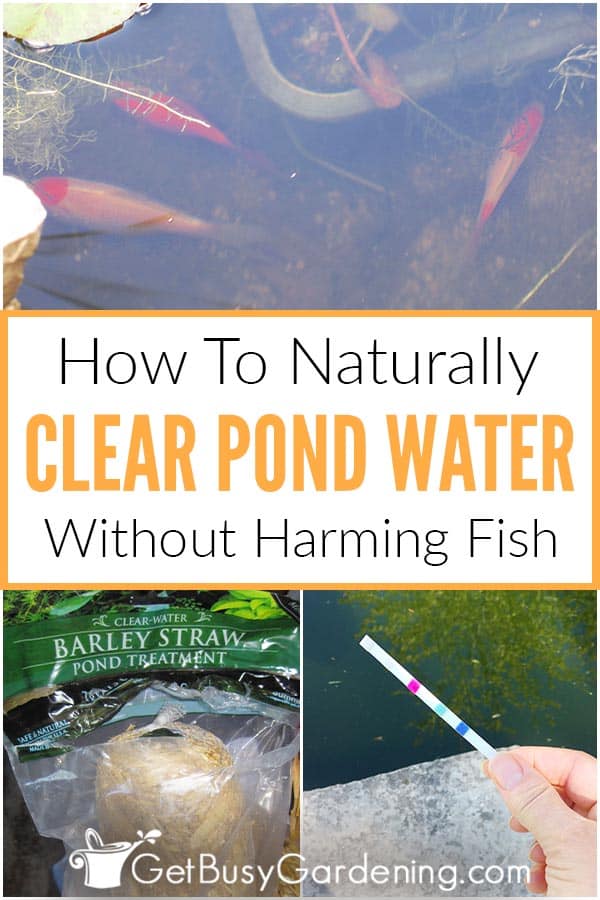
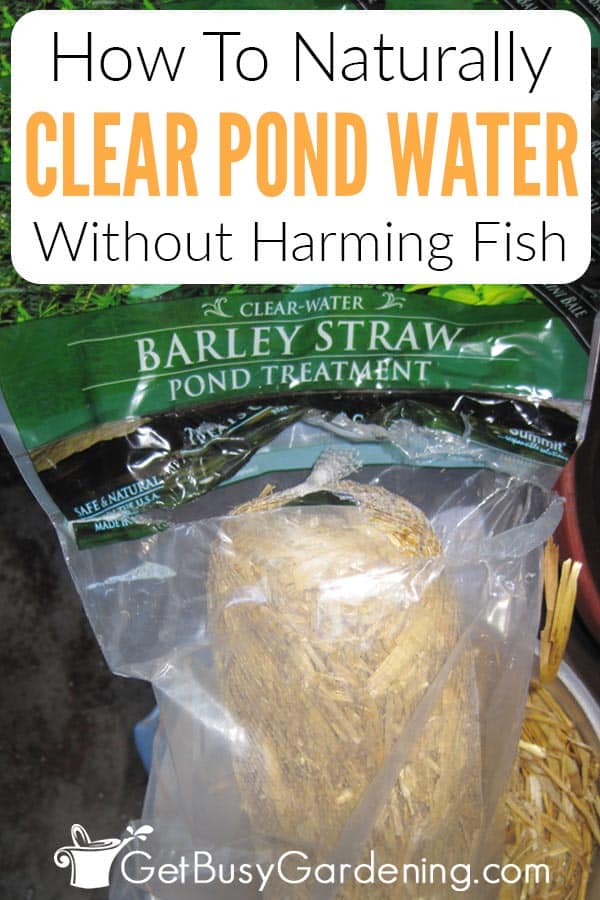
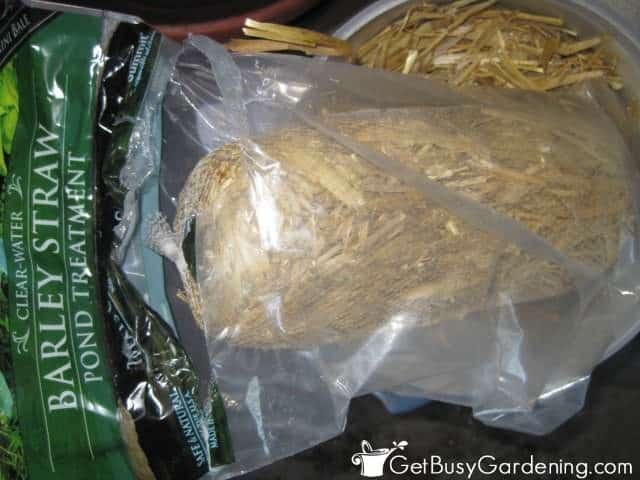
It sounds strange, but the answer is barley straw. Not only is it completely natural, but it won’t harm your fish or plants, and it’s inexpensive to buy too.
How it works is that, as barley straw decomposes, it releases something similar to hydrogen peroxide. This non-toxic by-product will choke out and kill pond algae, leaving the water crystal clear.
Below I will show you how to use it step by step. However, if your water is brown, thick and mucky, or it smells bad, then first you need to learn how to properly clean your pond here.
How To Clear Your Pond Water Step By Step
If you want to start seeing clear water in your pond as fast as possible, then follow my steps below. You only need a few supplies.
Supplies Needed:
- Toilet brush (or similar)
- Barley straw bundle (instead you could buy it in liquid form, or use the pellets)*
- Twine string (optional)
- Hydrogen peroxide (optional)
* The amount of barley straw you’ll need depends on the size of your pond. The package on the product that you buy should tell you exactly how to figure it out.
Instructions
Step 1: Remove the algae – To speed up your efforts, start by manually removing as much of the algae from your pond as you can. Don’t worry this sounds harder than it is.
An inexpensive toilet brush works great for this task, and you can use it to scrub the insides of your pond walls too.
Ideally, you would buy one to use specifically for this purpose. I mean, what would be more disgusting – using an old toilet brush in your pond, or using your pond brush in your toilet?
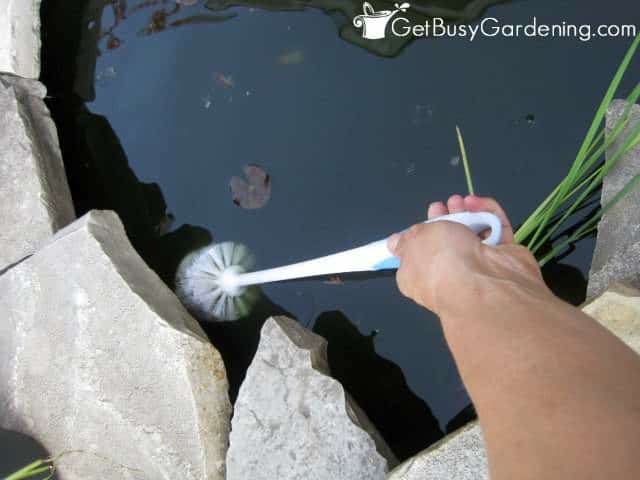
Step 2: Make a barley straw bundle (optional) – The barley straw that I use comes in bundles that are too large for my 90 gallon garden pond.
So I made smaller ones out of the mesh packaging that they came in, which I reuse year after year. I simply used some twine string to tie the mesh closed and secure the bundle.
Related Post: How To Winterize A Garden Pond Step-By-Step
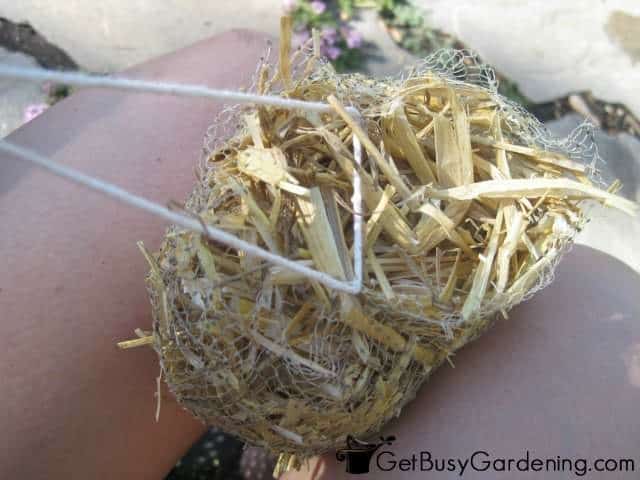
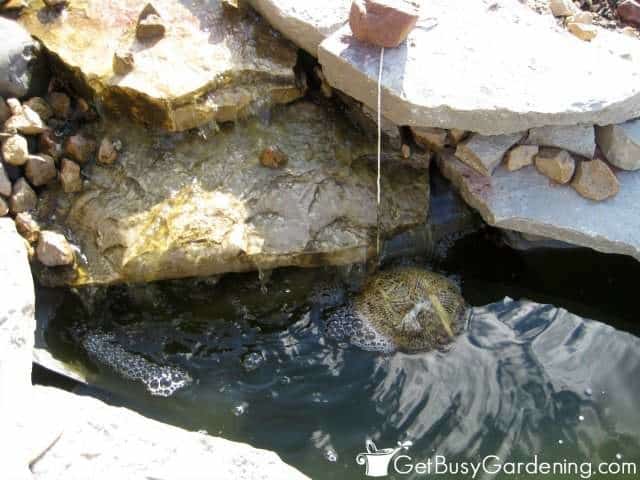
Step 3: Add the barley straw to the water – It’s best to put your barley straw near a fountain or waterfall where the water will flow through it.
This will help to circulate the water and clear it much faster. I used a long piece of the twine to hang the bundle from my waterfall.
The bundle will float at first, which isn’t always pretty. But once the straw starts to break down, it will sink so it’s no longer visible on top of the water.
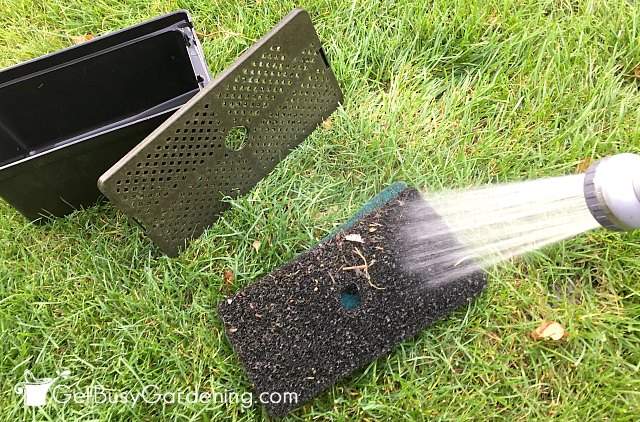
Step 4: Rinse the filter – To jumpstart the process, you should make sure your filter is clear so it can run smoothly and efficiently. I take mine out and rinse it off with the hose.
But you could use some of the water from your pond if you don’t want to risk killing the good algae that’s living in your filter.
If your pump didn’t come with a filter, I highly recommend that you get a universal pump filter box. It will make keeping your pond water clear sooooo much easier.
Step 5: Use hydrogen peroxide (H2O2): It takes a few weeks for the barley straw to work. So, to clear your pond water faster, use hydrogen peroxide (and no, it won’t kill your fish). Pour it right next to the fountain or waterfall to disperse it.
NOTE: I don’t know if there’s a special formula of H2O2 per gallon of water, so I recommend doing some research for your specific pond size. Mine holds 90 gallons of water, and I added a 1/2 cup of H2O2.
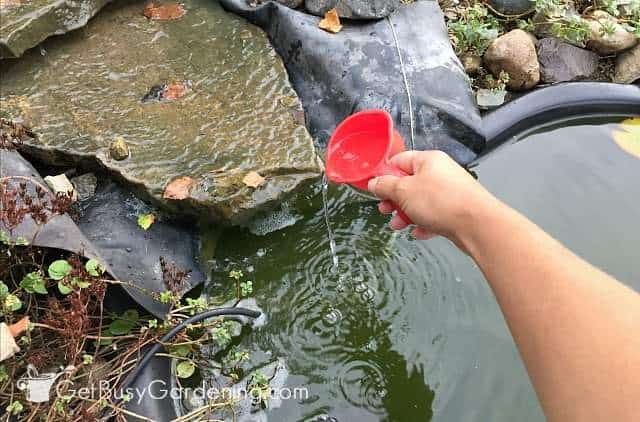
Step 6: Rinse the filter daily – I recommend rinsing your filter daily, which will help to remove the algae and speed up the process.
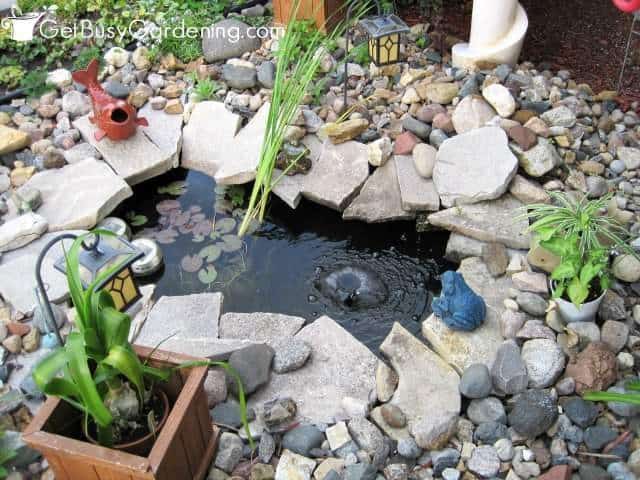
You should start seeing results within a week or so. In no time, the water in my pond was crystal clear, and it stayed that way all summer.
How To Keep Your Pond Water Clear
Once your pond water is clear, you can easily keep it that way for the long-term. Here are my tips for the best success:
- Use barley straw regularly – Put fresh barley straw in your pond every spring. One small bundle lasts me all summer.
- Keep the filter clear – You should get into the habit of rinsing your pond filter every couple of weeks, and probably more during the hot summer months when algae grows the fastest.
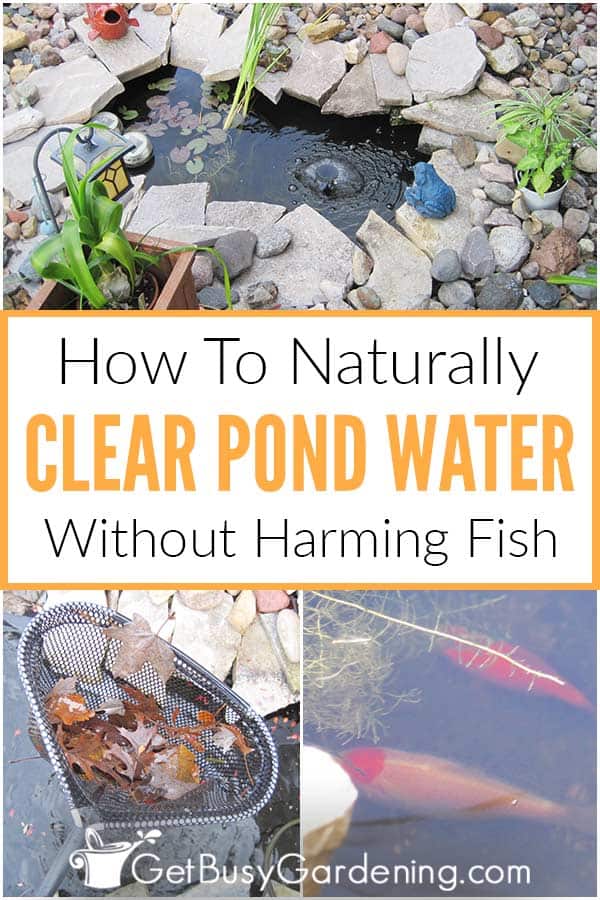
- Clear out the debris – Removing any debris that falls into the water is very important to ensure that it stays clear. My skimmer net makes this task super easy.
- Test the water regularly – You can get an inexpensive test kit, and that will help you maintain the perfect balance in your pond so you can prevent algae growth.
FAQs
Pond water turns green because of algae. It’s normal for it to have a greenish tint, but if it’s soupy or has mossy growth in it, then you should work to clear it ASAP.
Pond water turns brown when plant debris, like fallen leaves, and fish waste build up for too long. It’s normal for the color to be brownish, but it should not be mucky or stinky.
Not all types of algae are bad for your pond. But string algae can take over a small pond very quickly. If you don’t get rid of it, it could eventually starve your fish and plants of their oxygen and nutrients.
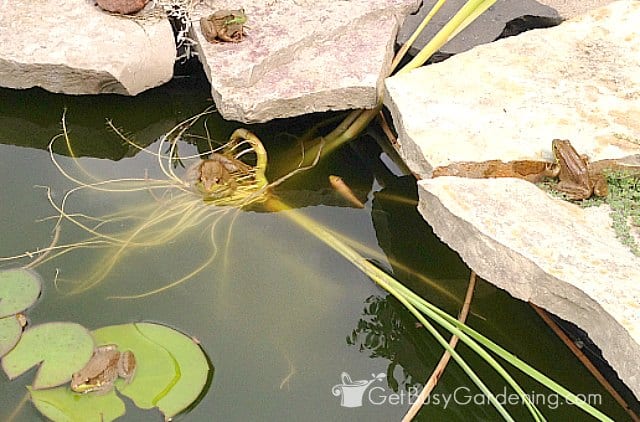
I love my little garden pond again now that the water is crystal clear, and keeping it algae-free isn’t that difficult when you know how. It’s nice to be able to watch my fish swimming around. Plus it constantly has frogs and salamanders in it too – a wonderful sign of a healthy pond.
Share your tips for keeping pond water clear in the comments below.

laurie clark says
hi
we have a pond which has 2000 gallons of water. We r having trouble with the algae it’s like a fine dust floating around n it will just brush of rocks n sticks to plants will hydrogen peroxide help this n do u kn what kind of agae it is
thanks
laurie
Amy Andrychowicz says
Sorry, I don’t know what type of algae it is, but the barley straw/peroxide trick should work the same for any type of pond algae. Make sure to skim the algae regularly while you’re treating the pond, that will get rid of it much faster. Good luck!
Brenda says
I was wondering if hydrogen peroxide will hurt koi or goldfish in my pond?
Thanks
Amy Andrychowicz says
No, it won’t hurt them as long as you stick to the recommended amount. I have goldfish in my ponds.
Dani says
I am thinking of doing a couple of recycled tire ponds in my backyard but I have dogs and I live in MN so breeding bloodsucking mosquitoes is a problem. Do you have any recommendations? I don’t plan to do fish as they wouldn’t survive the MN winter in such a shallow area. Will I need something to keep the water moving? I’d use chlorine but it’s not safe for the dogs. Any suggestions would be great
Amy Andrychowicz says
I am also in MN and I use a stock tank heater to keep the water in my ponds from freezing to the bottom. Mine are in the ground though, so if yours is going to be above ground, the stock tank heater probably won’t keep it from freezing. I recommend buying inexpensive goldfish. They will eat all the mosquito larvae and are cheap enough that if they don’t survive the winter, you can replace them every year (they’re like $.10 or $.25 cents a piece at the pet store). But, the goldfish will hibernate and survive the winter as long as the water doesn’t freeze solid. I’ve had them survive 5+ years in my small garden pond.
Shirley Mc kinney says
I buy most of my gold fish at the bait store for my pond. They seem to be hardier than those sold at the pet stores. You can find some rather pretty ones there also, plus cheaper!
Jen says
Hi Amy! I am excited to try this!! Gonna purchase some barley straw today! I was using chemicals, and wanted to find a natural way of clearing my pond of guck! Thank you for this post!!! Aloha, Jen
Amy Andrychowicz says
Great, glad to hear it! Hope it works as well for you as it has for me.
Deanna Oster says
i was wondering if timothy hay would work the same way. i have many goldfish in my 90 gallon pond. would the peroxide hurt the fish?
Amy Andrychowicz says
Only barley straw works in this way. The peroxide doesn’t harm the fish, I use it in my ponds all the time (I have goldfish too).
Greg Beck says
How often can you add peroxide?
Amy Andrychowicz says
I would say once a week, or once every other week until you start to see the string algae dying back. But, if you have a ton of algae growth in your pond, try to remove as much as you can with a toilet brush (or other brush) before treating your pond with hydrogen peroxide. Otherwise, it can be really hard to clean the pond once the algae starts dying.
Heather says
We have a 4000-5000 gallon natural pond in our yard with several koi and comets. The string algae is always a problem in the spring. We’ve treated with barley extract a couple times but it didn’t seem to having long lasting effects and ended up adding the chemicals to control the out of control algae. We added several water plants which seemed to help some. Now that I’ve read your article, I’ll try the barley bale from my local garden center and the peroxide as well…it’ll be a lot more than a 1/2 cup 🙂 Thanks for the ideas!
Amy Andrychowicz says
Haha, yes you’ll definitely need more than 1/2 a cup for your huge pond! I hope the barley straw will do the trick for you, good luck!
Susan Bundlie says
Our pond is about 20 acres. A few years ago I read an article about making an island out of barley straw and planting things on the top of it to control algae. For a water area this large, that can get to be very expensive. I’ll have to organize all the neighbors who live on the water and see if they will all chip in. Maybe next year.
Amy Andrychowicz says
Wow, that sounds like it would be really cool. Time for a fundraiser. 🙂
charles e caulk says
would not it be safer to dilute the peroxide before dispersing it?
Amy Andrychowicz says
You could dilute the peroxide before adding it to your pond water if you feel more comfortable doing that. But, it’s not necessary.
Camille Hatcher says
Thank you, ever so much for this post! Couldn’t have been more timely . . . we bought our house in May and with it came a large koi pond (guessing about 500-600 gallon). It needs cleaning desperately and until reading your article I had not a clue how to go about it.
Amy Andrychowicz says
Wow, that sounds awesome Camille! I’m glad I can help. Enjoy your new pond!
Amy
Pranshu Goel says
Which brand Hydrogen Peroxide are you using ? and what is the percentage Food Grade or Commercial – 3% or 35%
Amy Andrychowicz says
I just buy the generic brand at Target. It's 3%. I find it in the first aid section.
Josie says
35% will burn skin and kill anything it touches! Use the 3%:)
Peggy says
Even with it being the middle of summer we just got our pond going again about 2 weeks ago with rebuilt sides and stepping stones around side because our small boulders on side of pool kept falling in. Our water garden is in the sun from noon until sundown we are trying to get more plants and fish. only have 3 small orffs and 2 gold fish now. will get more if these do ok for a couple of weeks. Water is starting to get murky and small amount of string algae. The water fall also turning green and black. Would it be beneficial to add barley this late. Our water garden is 2,500 gal water, with filter and water fall feature. Please advise any suggestions appreciated. We live in Southeast Iowa so cool nights are already here.
Amy Andrychowicz says
Yes, I would add barley straw and treat with peroxide now. I leave barley straw in mine year round, refreshing it every spring. It certainly won't hurt to add it this late, and it will start to break down before winter. Next spring, add new barley straw. Hope this helps.Amy
Niki says
I have a pond 1 1/2 metres deep, can I ask why you take out the barley straw and not let it decompose fully in the bottom when it sinks?
Amy Andrychowicz says
My garden pond is really small, so that’s why I always remove the barley straw every spring to add a new bundle. But I guess you could just leave it in a larger pond. Just make sure you use a material that will also decompose when you make your bundle.
Tomm says
Amy;
We are really impressed with your page, and now have new direction to clear the water in our problematic 250 gallon pond. I will relay our progress and success as it happens, along with any new information we come across in hopes to help you or your followers. Thanks, Tomm
Amy Andrychowicz says
Thanks! Hope this method will help you keep your pond clear. I would love to hear about your progress, and how it goes for you. Good luck!
Brenda says
Will hydrogen peroxide hurt the fish?
Amy Andrychowicz says
It might if you pour it directly on them. But, if you use the recommended amount and pour it over your fountain or waterfall to disburse it, it won’t hurt the fish. I’ve been doing this for a few years and have never lost any fish.
Anonymous says
I bought property and had an overgrown pondan area. We got excited my birthday came an my nephew cleaned ut pretty good then added fish. Onjy gad it for three weeks.already see grreen hairy stuff ansludge too.with aiiwe have to do I need some easy steps I have no pump just running water.please help me out.don't think its 500 gallons but Huerta guessing.I sure want to enjoy it.help needed!
Amy Andrychowicz says
I would start by taking a brush and cleaning out some of the algae (like I describe above). Next, I would add hydrogen peroxide (I use 1/2 cup in my 90 gallon pond, so you can do the math for your pond). You said you don’t have a pump, but do have running water so just pour the peroxide over the area where the water is running into the pond. Or you can disperse it around the pond yourself.
RandomGardener says
Thanks for the information! When we have a pond(hopefully soon), it'll be good to know about these things! I never even thought about the problems with a pond!
Amy Andrychowicz says
Funny! I never thought about problems with a pond before I put my first one in. Why would you ever worry about stuff like that? 🙂 I put in the small 90 gallon one as a test one to make sure I could handle it before I went larger (I didn’t really go much larger as it turns out). But a pond sounds much scarier than it is, it’s pretty easy to maintain once you get the right balance. Good luck with your pond project!
Amy Andrychowicz says
Having a pond is pretty easy once you understand the basics of keeping a healthy balance so it won't become a maintenance nightmare.
Alexis says
Hi There,
I just ran into this problem with my fish pond. I noticed that homedepot sells Barley Pond Clarifier, do u think I can use this for our pond? If so, I have goldfish in the pond now. Should I put this chemical in the pond while the fishes are in there? Would it harm the fish? Please advice. Thanks.
Amy Andrychowicz says
The label should say if it’s safe for use in a pond and if it’s safe for fish. If it’s the Barley Straw extract, then it should be natural and safe to use – but make sure to read the label.
Barbra says
I have used the liquid barley and it is safe. Also see for dogs that drink from your pond.
PlantPostings says
Cool! What a great lesson! If I ever get around to building a pond, I'll try to remember this. I love ponds. It will be fun to see more posts about yours!
Phebe Archer says
I livd im Italy and am setting up a bio pool with only plants to clear thd 60 m3 seperate swimming pool. I finally found the algae solution by consulting with a company that has several types of bacteria that feast on algae. The water was an awful green with a muddy bottom. With added barley straw I can now see the bottom clearly. It takes weeks to not use chemicals. And patience.
Amy Andrychowicz says
Awesome! Thanks for sharing your experience with using barley straw to clear your green water. Glad you were able to get it all cleared up. 🙂
Amy Andrychowicz says
We have moss growth on our fountain too and I just poured some H2O2 in there to see if it would work. I don't see why it wouldn't.
ester says
Hello, im curious om the peroxide… my pond is about 390 gal round galvanized stock tank …. how much would i pour in the thanl??? i have about 7 baby gold fish and 5 lg fish . koi. gold fancy tail gold fish ….would it hurt them…. i have one plant in there its a lilly pad lots of green floating algae on the top,i have to skimp off the alea everyday just so i can see my fish….
thanks again..
Amy Andrychowicz says
Humm… I’m not an expert on how much peroxide you should add per gallon of water. I use a 1/2 cup in my 90 gallon pond to help get a head start on killing the algae cause barley straw takes a few weeks to start working. So, you can do the math based on what I’ve used. Make sure to disperse it as evenly as you can throughout the water – don’t just pour it all in one spot. I too have goldfish and plants in my pond, and have never lost any of them because I used peroxide. (I wouldn’t recommend pouring it directly on the fish though.)
Diane Smith says
I never tried peroxide but did add small amt of Chlorox bleach to a 10 ft pond. Killed the goldfish, Killed the mosquito fish. Never again.
I never had a floating device for the barley I tried. Put it into a nylon stocking and never such much improvement. Am ready to find a float and try again.
Any recycle ideas for the float?
Amy Andrychowicz says
Yes, I definitely would NOT recommend using bleach. That will kill the fish for sure, and might also kill the plants in the pond. Sorry for your loss. 🙁 I’m not sure what you’re asking about a “float”, sorry. I tie my barley straw bundle to the fountain in my front pond, and right at the bottom of my waterfall in my backyard garden pond. The barley straw bundle needs to be next to the running water source in order for it to work. The bundle will float on it’s own, and once it starts to break down, it will eventually sink. I can get it out easily buy just pulling it out by the string so it won’t sink to the bottom. The larger the pond, the more barley straw you need (it has instructions on the package).
Gazza says
Hi Amy i am in thailand and my pond is 7,000 litres. It is in direct sunlight for about 4 and a half hours per day. I clean it out and the green comes back after 4 or 5 days. Will the peroxide help this?
Amy Andrychowicz says
Have you tried the barley straw yet? With a pond that size, hydrogen peroxide isn’t a good option because you would need a LOT of it.
Zak says
Hi am in South Africa I use a product called Aquazyme
I really works well for algae control
Hopefully you have a pump and a U V light system set up on the water return
Pete says
Hi, my pond is 400,000 litres. I have a full-sized barley bale float in it. I have a weightlifting weight attached a metre below it so it floats around the middle. It has a long rope to the bank to allow for me adjusting it’s position in the wind. No algae. Works perfectly and sinks level with the surface after a few months. Is replaced annually.
Lydia Harris says
I have a 100 gal pond and bought algae chemical from Walmart and it killed 10 of my big goldfish? n all my live plants so starting from scratch, so how often do I put 1/2c of hydrogen peroxide in my pond from now on to keep it clean along with a sm bundle of barly straw
Amy Andrychowicz says
Oh no, I’m sorry to hear about the loss of your fish and plants! That’s a huge bummer!! Pond chemicals always scare me. Once the barley straw starts to decompose, you won’t need to use the peroxide anymore. It takes a few weeks for the barley straw to start to break down. It will start to sink once it’s breaking down. I add the peroxide to my pond water once or twice before the straw starts breaking down. Here’s a post I wrote about cleaning fish pond water, which may also help you keep the water clean through the summer.
Carol says
I too have a small (maybe 90 gallon ) fish pond and I made a natural waterfall. I use a pump to circulate the water. The water in my pond is Crystal clear and there are also frogs in it. My question is that the rocks of my waterfall are completely covered in a very thick moss, and although it is very natural and beautiful, is the moss taking away the oxygen from the fish as the water runs through it ?
Amy Andrychowicz says
Sounds beautiful! I wouldn’t worry about the moss growing on the waterfall, as long as it’s running into the pond just fine. It’s not going to pull oxygen out of the water or anything like that. The only concern I would have is the potential of the water being diverted off of the waterfall, which could slowly drain the pond. But other than that, I wouldn’t worry.
Alan says
I had the same problem with the floating algae. until i got me a floating skimmer on amazon, i also drained about half the water out and refilled it, i also tinted the water with (pond tint) because my pond is in full sun all day. untill the banana tree’s grow out that is.
Tootsie says
I wonder if this will work in my fountain? I think I might try it. My fountain holds about 10 gallons of water….and it gets just gross after a while. thanks for the tips! I am a new follower!!
donna says
hi would anyone recommend to get rid of green fish pond water have tryed lots of things
but cant get rid of it thanks
Amy Andrychowicz says
The full instructions for how to get rid of green fish pond water are in the blog post above. 🙂
Don says
I suggest iris pseudacorus zip tied on a milk crate and placed at water level. It is aggressive, and you might need 3-6 of these crates depending on size of pond and movement of water. Mine are in a bog filter and upper pond, but I am starting a 650 gallon pond with no flow/pump, with them right in the pond.
erhard c autrata says
Aloha from Hawaii I have 3 bird -bath for my Bees I use copper pennies before 1982 and some copper pieces I had ….It will keep the algae down Besides having some Water-Lilly for the bees to land on to get Water for them …the idea I got from my fishpond !!!!
Chick says
Be careful with copper if you have fish. It is highly toxic to fish.