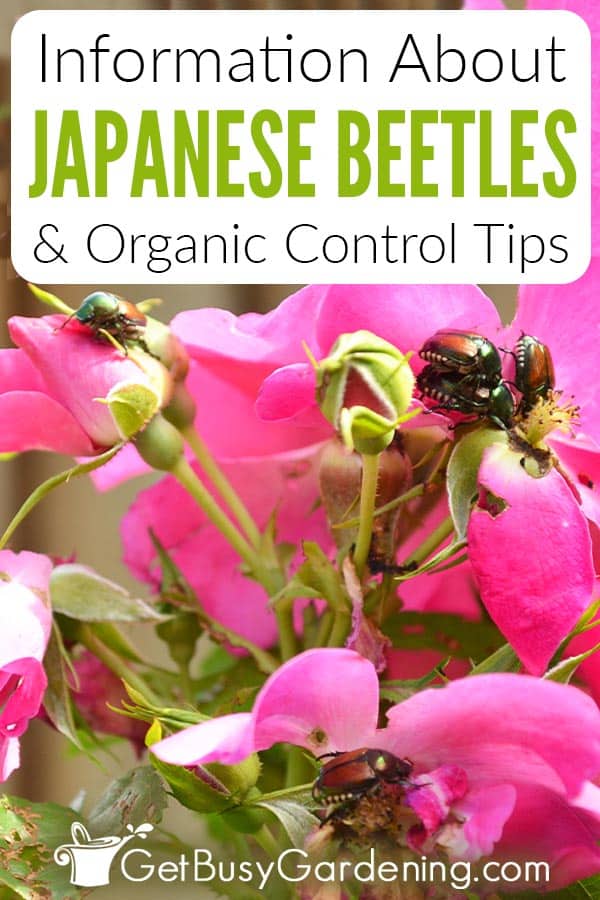
Japanese beetles are extremely destructive pests, and they’ve become a major problem for many gardeners.
If you live in an area where they’re present, you know first hand just how quickly they can devour your flowers and plants. It’s very disheartening!
In this post, I’ll show you tons of organic methods you can use to control Japanese beetles in your yard and garden. You’ll learn everything you need to know about them, including their life cycle, what they eat, the damage they cause, and much more.
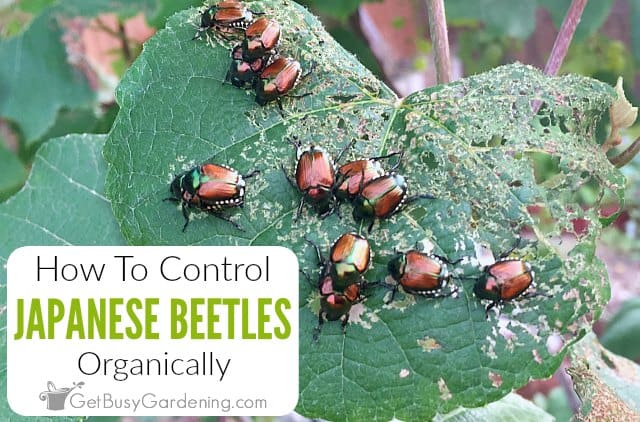

I remember the first time I saw a Japanese beetle in my garden (it was waaay back in 2008-ish). I actually thought it was kinda pretty (I know, crazy right!?!).
But over the course of 2-3 years, the population exploded, and they quickly became a HUGE pest here in Minnesota.
Now I see hundreds of them in my garden every summer. Hundreds! They are completely out of control.
If you don’t have these invasive bugs in your region of the world yet, you’re lucky. Fighting Japanese beetles can be extremely frustrating, and it’s pretty much impossible to get rid of them completely.
But it’s not all gloom and doom. There are tons of methods you can use to control them and prevent major damage to your plants.
What Are Japanese Beetles?
Japanese beetles (JBs) are extremely destructive scarab insects that were introduced into the eastern United States in the early 1900’s.
They are native to Japan (hence the name), where they are not considered a pest. But, they’re an invasive species here in the US.
Over the last century, they have become a widespread problem in many states – especially in the eastern and midwestern US, and areas of southeast Canada. But they are slowly making their way to the western parts of North America, so be prepared.
What Do They Look Like?
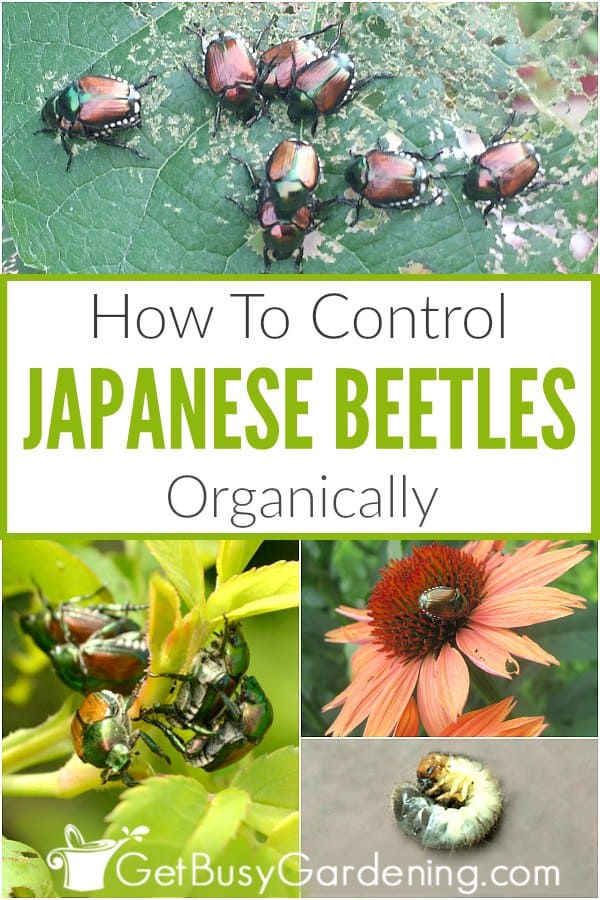
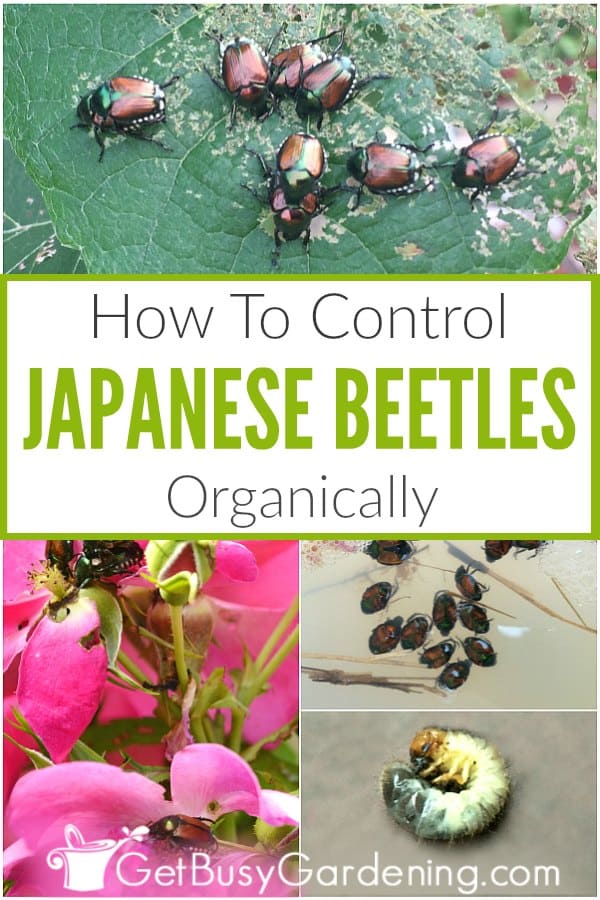
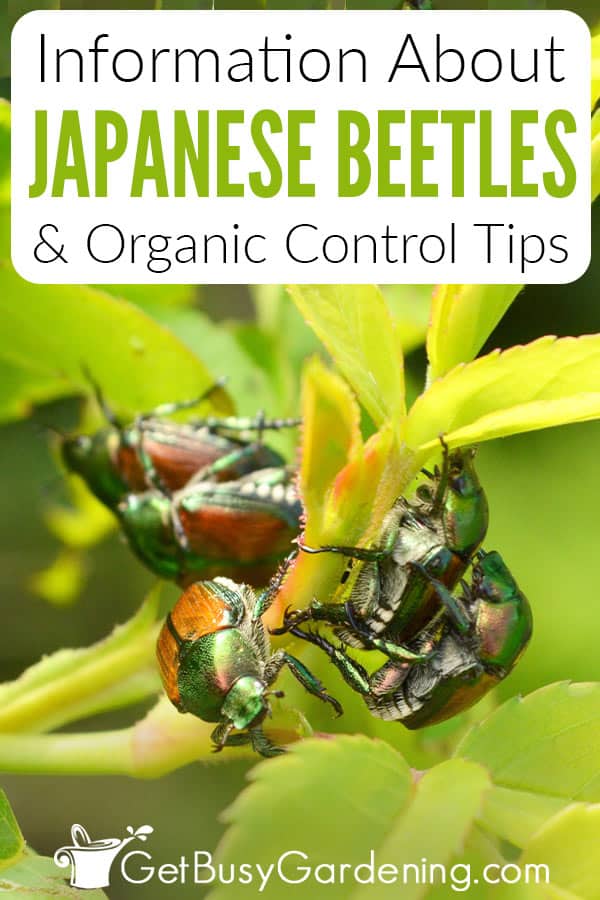
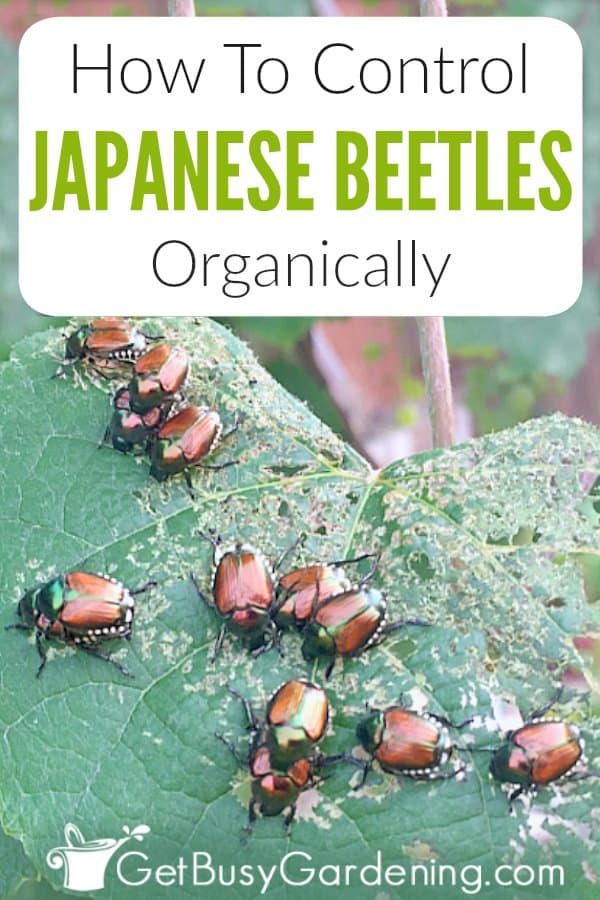
Adult Japanese beetles are oval-shaped iridescent bugs. They have a bronze-colored body and a green head, with fine white hairs on their undersides.
There are five white tufts of hair along both sides of their body, which look like dots from the top, or lines from the side.
The adults are usually about 1/2 inch long, but can be smaller. They can fly, and are very active during the day.
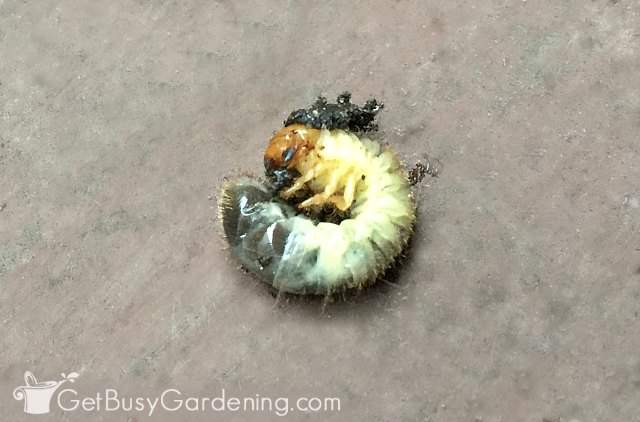
In their larval stage, JBs are C shaped white grub worms that live underground. They are about a 1/2 inch long or so, and have a white/cream colored body with a tan/orange head.
The grubs also have six creepy looking legs on the top of their body, and a green-brown colored tail end.
Life Cycle
There are four stages to the Japanese beetle life cycle: egg, larvae (aka: grubs), pupa, and adult. Interestingly enough, they spend most of their life underground, which is partly what makes them so difficult to control.
The adults only live for about 6-8 weeks, thank goodness. But they can do a LOT of damage in that short amount of time, as many of us know from experience.
Female beetles lay eggs in the soil throughout the summer, where the larvae hatches a couple weeks later. The grubs feed and grow until the soil begins to cool in the fall. Then they go deeper into the ground, where they hibernate for the winter.
In the spring, the grubs slowly make their way back to the surface, where they feed on the roots of grasses and other plants until they’re large enough to pupate.
It takes a few weeks for them to pupate, and then they emerge from the ground as adult Japanese beetles to start feeding on our gardens.
The adults start emerging in late June or early July here in Minnesota. But it could be earlier or later depending on where you live.
At least we have one thing to be thankful for… there is only one generation of JBs per year. Whew!
What Do Japanese Beetles Eat?
Unfortunately, they feed on tons of different types of plants and trees, which is what makes them such a major pest. But they do favor some over others.
This extremely destructive pest does double damage. Not only are the adults a huge problem, but the larvae can be too. Japanese beetle grubs feed on the roots of your lawn and other plants, which can damage or ultimately kill them.
Though they can eat pretty much any type of plant, here’s a list of the ones they love the best in my garden. There may be others on your list, depending on where you live…
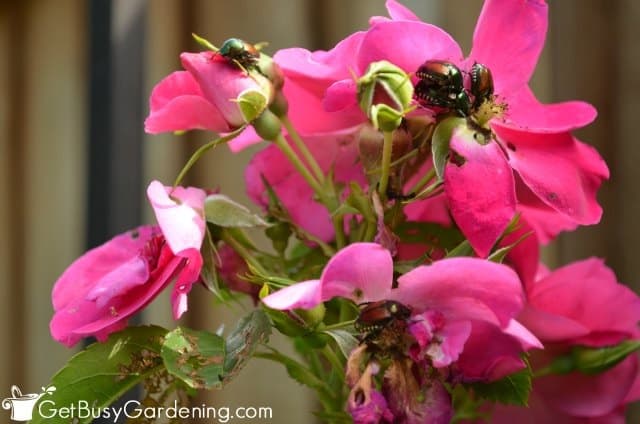
- roses
- hibiscus
- zinnias
- canna lilies
- grapevines
- beans
- linden tree (they also love fruit trees like apple and peach.)
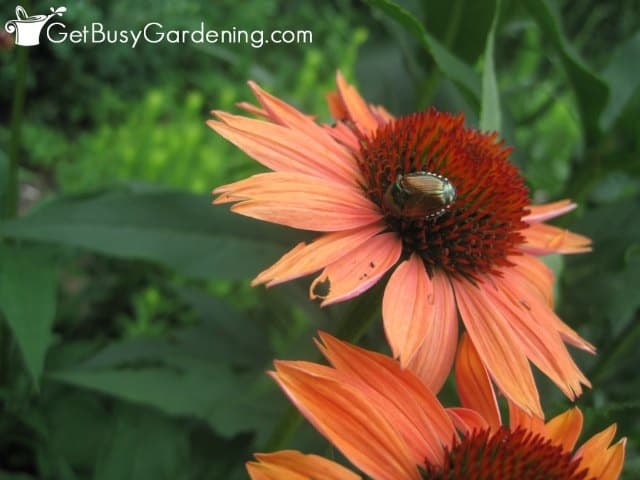
- coneflowers
- basil
- hollyhock
- raspberries
Damage To Plants
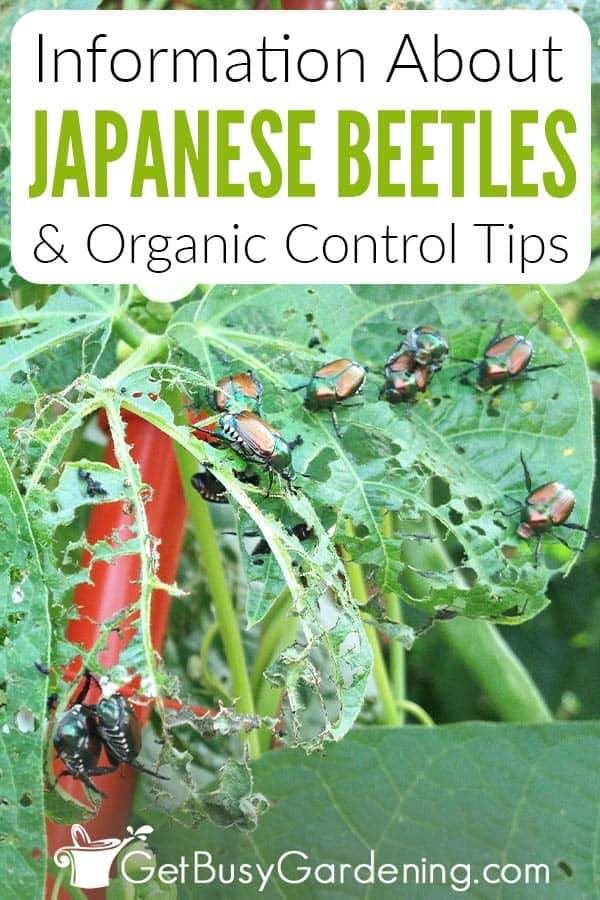
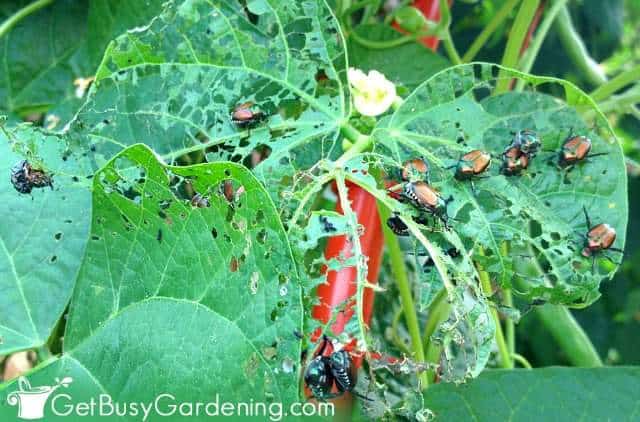
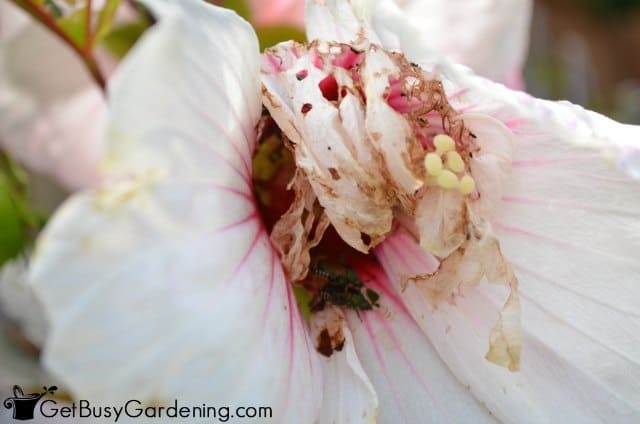
Japanese beetles damage plants by eating holes in the flowers and leaves. They can skeletonize the foliage, and destroy the flowers very quickly. A large population can decimate a small plant in a short time.
The good news is that they mainly feed on leaves and flowers, and they very rarely kill a plant. As ugly as it is, mature plants and trees can usually withstand fairly heavy damage without any long-term effects.
Grub damage isn’t usually as severe or noticeable as what the adults cause. They mostly feed on the roots of grasses, which can cause areas of your lawn to turn brown and die.
However, moles, opossums, skunks, and other animals love eating grub worms, and will dig them up to feast. And that can cause much worse damage to your lawn than the grubs do.
How To Control Japanese Beetles
Unfortunately, getting rid of Japanese beetles completely isn’t a realistic goal. They can fly a very long distance. So, if you live in an area where they’re present, it’s pretty much impossible to eliminate them from your garden.
But you can greatly reduce the amount of damage they cause to your plants. The key to controlling a large outbreak is to get on top of the problem right away. Once they start feeding, they will attract more beetles. So the sooner you get to work, the better.
But before you plan your counter-attack, please try to remember that the adults usually only cause cosmetic damage to plants, and rarely kill them.
So, there is no reason to reach for toxic chemical insecticides, or do any type of broad pesticide sprays or applications to get rid of the JBs in your garden. It’s best to use targeted natural and organic treatment methods instead.
Related Post: How To Control Garden Pests Naturally
Organic Japanese Beetle Treatment Methods
There are several safe and effective ways to control Japanese beetles in your garden organically. Below I’ve listed the ones that I use and recommend. For the best results, you should try all of these methods and see which ones you prefer.
Hand Picking
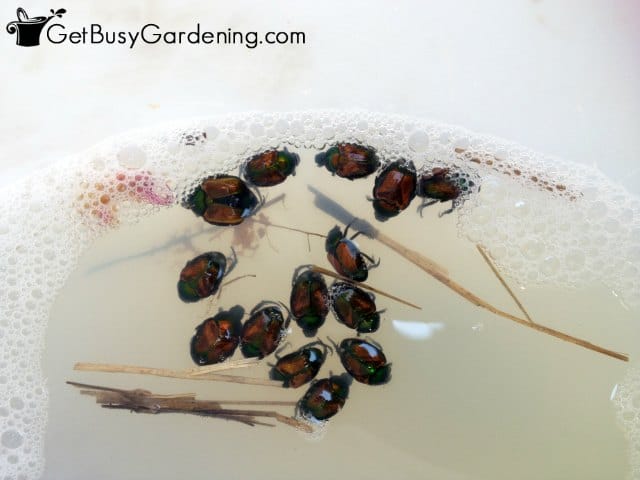
The fastest way to get rid of Japanese beetles is to remove them from the plants. Simply hand pick them off, and drop them into a bucket of soapy water to kill them. Gross, I know! But don’t worry, you’ll get used to it. Here are my tips and tricks to make this as easy as possible:
- The best time to hand pick them is early in the morning, or in the evening. They aren’t as active during these times of the day. I don’t know about you, but I can’t stand doing it during the day when they’re buzzing around and flying at me – EEK!
- Hand picking the Japanese beetles sounds easier than it is because sometimes they hold on tight to the plant and won’t let go.
- The beetles can quickly drop off the plant as soon as you disturb it, so you have to be fast with the bucket. And don’t stand directly under them either… trust me on this one (that’s a story for another day).
- Don’t just use water in your bucket, make sure to put soap in there too. The soap will kill JBs quickly. Otherwise, they can swim for a really, really long time – like days. Seriously, it’s creepy! And disgusting.
- I’ve tried a few different types of soaps in my bucket, but I like Dr. Bronner’s organic liquid soap the best. It kills the beetles faster than other soaps I have used, which means there’s no way any of them will escape my bucket.
- It takes some work, but hand picking them is pretty easy once you get the hang of it. Plus, it’s definitely satisfying to see all those nasty things floating in the bucket at the end of the day.
Diatomaceous Earth
You can try sprinkling Japanese beetles with diatomaceous earth (DE) to kill them. This is an all-natural powder that gets under the beetle’s shells as they move around, which cuts them up and eventually kills them (sounds bad I know, but it’s way better than using chemicals).
DE will be most effective when you apply it directly on the beetles, rather than just spreading it everywhere. You could also try using eggshell powder in a similar way.
Insecticidal Soap
Insecticidal soap is another great way to control Japanese beetles. It will kill some of them on contact, and the rest will be stunned and easier to hand pick.
You can buy a pre-mixed organic one, or make your own by combining one teaspoon of mild liquid soap with one liter of water. They don’t have any type of residual effect though, so you have to spray them directly on the bugs.
Beneficial Nematodes
Beneficial nematodes are a natural way of controlling JB grub worms in the soil. They are tiny organisms that feed on the larva, and kill them before they can emerge as adults.
For best results, apply them in the fall and/or spring when the grubs are closest to the surface of the soil. Learn how to use beneficial nematodes here.
Milky Spores
Harmless to beneficial bugs, milky spore is a naturally occurring bacteria that infects the grubs when they eat it, and eventually kills them.
The downfall is that it can take 2-3 years for this method to be effective. But once active, milky spores last in the soil for several years.
Get more natural garden pest control remedies & recipes here.
Pheromone Traps
Another great option for controlling Japanese beetles without spraying chemical pesticides is using pheromone traps. They are completely non-toxic and harmless to other bugs.
They work by attracting the adults with pheromones and other scents they can’t resist. The beetles fly into the trap, but they can’t get back out. Read more about how to use Japanese beetle traps here.
How To Prevent Japanese Beetles
One of the easiest ways to control JBs is to prevent them from getting out of hand in the first place. Below are a few methods you could try to prevent them from damaging your plants…
Protect Your Plants
Try covering your prized plants and flowers to keep them from being destroyed. This works great for plants that don’t need to be pollinated by bees.
Use row covers, inexpensive tulle fabric, or garden fabric to keep Japanese beetles off your plants. Just be sure to secure it around the bottom, otherwise the beetles will find their way in. I use clothes pins to hold my fabric in place, and secure the bottoms.
Try Repellent Plants
There are a few plants that could work to repel JBs, including tansy, rue, and garlic. So try interplanting them with the ones that the beetles love the best, and see if they help to deter them.
Grow Plants They Won’t Eat
Like I mentioned above, there are plants that they tend to favor over others. So, if you’re tired of fighting to get rid of Japanese beetles in your garden, then try planting stuff they don’t like instead.
Below is a list to get you started. There are probably many more that you can add to this list, depending on where you live.
- arborvitae
- clematis
- lilac
- ash trees
- chrysanthemum
- maple trees
- burning bush
- boxwood
- dogwood
- daylilies
- oak trees
- rhododendron
- iris
- sedums
FAQs
Adult Japanese beetles only live for about 6-8 weeks. But the grubs live underground for the rest of the year (or about 10 months).
Bacillus thuringiensis (BT) works best to kill caterpillars and worms that feed on plants above ground. Though it may work on Japanese beetles too, the methods I have listed above are much more effective.
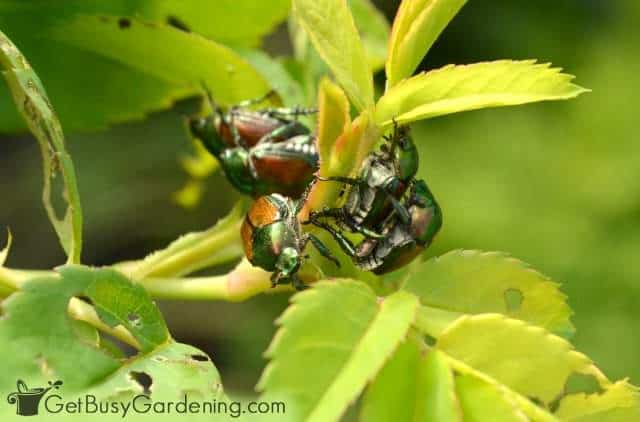
Ehem… They sit on each other because they are mating. Yep, doing it right out in the open. They have no shame.
Yes, JBs can float and swim for a very long time. So when hand-picking, it’s a good idea to add some liquid soap to the water, which will kill them very quickly.
Many types of birds feed on the beetles, including chickens. There are also some types of parasitic wasps, beneficial nematodes, and predatory insects that feed on either the grubs or adult beetles. Skunks, moles/voles, and opossums also love eating the grubs, though they can tear up your lawn and garden digging for them.
The adult beetles are most active during the middle of the day, especially when it’s hot and sunny. They usually start feeding in the late morning, after the dew has dried, and the temperature has warmed up.
No, thankfully. Both the larvae and the adult beetles are harmless to humans and pets, and they do not bite or sting.
Dealing with Japanese beetles in your garden can be very frustrating. But with so many organic options, there’s no reason to use chemical pesticides. Just remember, you’re not going to be able to get rid of them all together. So make controlling them your goal, and you’ll be much less stressed out.
Leave a comment below and tell us how you control Japanese beetles in your garden organically.

MaryKay Moher Knox says
I’m in MN too, this is year 3 for the beetles. They LOVE my Engelmann’s Ivy on my pergola, so it’s difficult to do anything to them up there. Thinking of cutting it back to keep them off the top next year. We have hops growing up the other side, which they don’t like as well. I’m worried they will go crazy in my vegetable garden if they don’t have their favorite Ivy to eat. We waited so long to get that Ivy to give us some shade on the deck and now we can’t even be out there 🙁
Amy Andrychowicz says
Only year three? Lucky you! I’ve been battling Japanese beetles in my garden for at least ten years now. LOL! I have the same problem with my grapevines growing over our pergola. They do some pretty good damage to the leaves, but it doesn’t harm the plant. We haven’t had any issues with Japanese beetles falling on us or anything, and still enjoy sitting under our pergola. I almost feel like since they love the grape leaves so much, they pretty much leave everything else alone. Well, except for the green beans, roses and hibiscus. UGH! In my experience, they seem to like to be high above the ground, and are more attracted to the tallest plants in my garden. I still find them on some of their favorite shorter ones, but it’s not too bad for the most part.
Devin says
I don’t think the soap brand makes a difference. The addition of soap is to break the water tension so they will drowned in the water and not walk on the water. Perhaps dr.bronner because it’s super Concentrated you had the best luck.
Amy Andrychowicz says
Yes, any type of soap will kill the Japanese beetles.
Sophie says
Hi, I have a few questions! The beetles have taken over my green beans. I already put some in a bucket but I’m wondering if they have already laid eggs in the ground in my garden. Do they just lay eggs in grass? My plant beds are raised far above grass level.
Amy Andrychowicz says
Japanese beetles can lay their eggs anywhere in the ground, not just in the grass.
Debbie Koehler says
I have 6 potted flowers and 15 knockout rose bushes,I use my black & decker flex hand held vacuum cleaner to suck them right off the plant, make sure you clean it out so they cant fly away, walla no touching them. I tried baby powder did not bother them at all. They are very annoying insects. I hope they hear the vacuum cleaner coming and leave my yard.
Amy Andrychowicz says
LOL! Sounds like a great, hands off option! How do you vacuum up the Japanese beetles without sucking up the plants and flowers too?
Kwame says
In Portland, Ct., JBs come in full force late June to mid July. A 4-week period, when they sleep all day in the soil, right under the plant they like. They creep out in the dark and start consuming and destroying what you have toiled all spring to plant. Their favorite meal is any sweet/juicy leaf – basil, mint, stevia (best), spinach, kalaloo, soft flowers and their leaves, etc., etc. Hand picking works and really fulfilling, but tedious and never ending, if you have a large garden. Nothing has worked for me so far – in all the years I’ve battled them. This time around I’m going to try diatomaceous powder for the first time to see. Wish me luck – plus, I will be reporting on my results.
Amy Andrychowicz says
I hear you, they are so frustrating! Hand picking does feel like a never ending task. Last year, there were thousands of Japanese beetles on the top of our grapevine that grows over a 10′ tall pergola. Yah, I’m not climbing up there! LOL. Yes, please do let us know how the results of your experiments go this year. Good luck!!
Krystal Erlandson says
I also live in Minnesota, and last year was the worst year yet for Japanese beetles! So bad, that a huge part of me doesn’t even want to plant any flowers this year. My kids don’t want to go outside during the day when they are present, because the JBs are constantly flying at you. We got one of those bag a bug things and we were having to empty it once or twice everyday because the bag was overflowing! Then I read that those traps might be attracting more beetles to the area, which was doing more harm than good!! YUCK! I will definitely be trying out these tips this year!
Thank you!
Amy Andrychowicz says
Yes, I have heard that about the traps too, but I’ve also heard it’s not true… LOL! But definitely worth not using them this summer to see if it’s better for you. It’s funny because I had the worst Japanese beetle problem this year too, but many of my friends and my parents didn’t have any more than they usually do. I wonder if there is are a lot of plants that they’re attracted to in your neighborhood. They love roses, grapevines, beans and Linden trees the most in my yard, so that’s where they are the worst. Maybe you have a lot of Linden trees, or wild grapevines or roses nearby and that’s why it’s so bad in your neighborhood? Ugh, I sure do miss the days when we didn’t have them here in MN! Good luck!
Jane Burmsn says
I have found that they just love my basil! I had never heard of that before. They left my small container garden alone except for the basil. I used insecticide soap and it helps.
Amy Andrychowicz says
I’ve never had problems with Japanese beetles on my basil either. I guess there’s plenty of other stuff for them to eat in my garden, LOL!
Susan Bundlie says
I heard that if you put dead Japanese beetles in a blender with some water and whir them together, you can create a spray that, when used on living JBs, will create a sort of cholera effect in the JB community, killing large numbers of them. I tried it once last summer (using a dedicated blender I bought at Goodwill), but didn’t see much difference. Maybe I should give it another try.
Amy Andrychowicz says
Wow, I’ve never heard of that. Sounds gross, but I guess it’s worth a try. LOL. Someone above mentioned that using dead Japanese beetles has worked to repel other beetles from her yard, so maybe that’s the effect your method would have too. Let me know if it works for you next time.
Bo says
Here’s what I did to get rid of them, and I haven’t seen Japanese beetles for about 10 years, until the very few I saw this year. I bought several traps, set them up all over the yard (I have 6 acres). As I collected them in the bags, I dumped the bags in a 5 gallon bucket of soapy water (just like above). Let the bucket sit in the sun a few days (it will stink!). Get some cheesecloth, cut into squares and double it. Each square doubled should be about 8″. With a slotted spoon, dip out portions of beetles and put some in each square. Tie it up using the four corners, leaving enough at the top, then tie the bags of dead beetles to tree branches all over the yard. Strain off the water into a sprayer and spray affected plants with the dead beetle water (you can add more water to dilute the soap (Dr. Bronners works fine or any dish soap). Leave the cheesecloth bundles in the trees and bushes until they disintegrate. The beetles won’t lay eggs where they sense the death of their comrades…lol. This has worked for me even though my neighbors still had them :).
Amy Andrychowicz says
Wow!! It’s wonderful to hear that you have been able to get rid of Japanese beetles in your yard for the past 10 years!! So encouraging, thanks for sharing!! Will you come and do that around my yard next? LOL.
Jeannie Schroeder says
I I live Missouri. I do not recommend the traps for Japanese beetles. I tried them a couple years ago. Yes they attracted the beetles – every beetle in a 50 mile radius flicked to the traps. But on their way to the trap they all stopped by my garden for a last meal. They almost killed my rose bushes!! And fed on everything else!! I have arthritis in my hands so it is hard for me to pick them off. I don’t like using harsh chemicals!! I have already saw a few of the nasty things this year I’m on a fixed income so can’t afford a lot. HELP!!
Amy Andrychowicz says
Oh no, sorry to hear Japanese beetles have been such a struggle for you. You could try covering your roses with inexpensive tulle fabric, as described in this post… How to Protect Grapes from Birds and Bugs. That will help prevent the JBs from destroying your roses.
Barbara Towle says
Bo,
It is Spring on the island of Oahu and my two huge mature mango trees are suffering. This is the second year the Japanese beetles have ruined mango crop. Beetles destroyed mango flowers, reduced number of mangos and eat 1/8 of each mango. My mangos are falling half eaten and covered with black spots, as well as, immature under sized fruit dropping. I will try your methods. Local government only recommend removing fallen rotting fruit and piles of leaves. I can clear all leaves under the mango trees, but am surrounded by farm land.
Signed,
Missing my beautiful mangos in Hawaii
JEvraets says
Milky spore will work, but not the first year. Come over to my place and you can fill…yes fill your bucket! Picking them off by hand would be utter futility.
Amy Andrychowicz says
I tried beneficial nematodes this spring, which will attack and kill the grubs. So far this year, the JB population is way down in my garden… so maybe the nematodes helped. I thought 50 bugs was a lot two years ago. Last summer, I killed thousands. I would get hundreds in our bucket every night. Yuck! Hope you can get your infestation under control!
chuck says
This year the JBs seemed to be less then the year before. The best way to get rid of them is by hand, with just a half hour in the AM and PM you will be amazed at how the numbers begin to decrease, they like my KIWI , RED raspberries and strawberries. One thing that I’ve noticed is they flock to wild grape and have left my grape vines almost alone. You can use a coffee can with just a little water in it, pick your victim and carefully put the can under the leaf their on,then poke them wth a small stick if you don’t want to touch them. They dont bite!! this can be done better on a windy day with just enough wind to keep the leaf in motion. Their not to afraid of you at first sight , when they raise their bask legs then you know their on to you and they do jump just a little to get away. they do that more than try to fly. when their in large groups then the bucket works best. I let them swim and when they die their compost. they rot like dead fish, but their small…they mate and eat at the same time so you can get two for one, boys are smaller than the females…..have fun , that’s my story and I`M sticking to it
Amy Andrychowicz says
Haha, thanks for sharing your story and tips for how you control JBs in your garden! Good stuff!
Anonymous says
Has anyone tried milky spore? I have been considering it but need to do more research…
Amy Andrychowicz says
I haven’t tried milky spore on Japanese beetles in my yard yet, but others have raved about it. Just remember that it takes a few years to become effective.
Lorraine says
I hear Milky Spore is great. However, not available in Canada, which is where I am 🙁
Amy Andrychowicz says
@Rhonda – That sounds absolutely terrible. If I were you, I would see about spraying your trap nectarine tree when it’s infested with Japanese beetles. It’s not like you’d be able to eat the fruit anyway, but at least you’d kill all those beetles, and maybe slow down the population in your yard.
Rhonda D. says
I really hate these things! We have an old nectarine tree that is a Japanese beetle trap among the apple trees. As long as the nectarine has something on it they leave the apples alone. We've never had fruit from the poor nectarine-they eat every fruit down to the stone then start on the leaves. Ick 🙁
Amy Andrychowicz says
@RandomGardener – Yes, I wear gloves. I started doing it without gloves and then one started crawling on my hand. AHHHH!! I wear gloves now. My husband is really good at it. He holds the bucket under the leaf and then smacks the bug off into the water. His success rate is much higher than mine!
@PlantPostings – They are such a pain! Their larvae is a huge pain for us too. We had major damage to our lawn this spring from the voles digging up the grubs. I wish they could eat the grubs without tearing up the lawn in the process! But at least they’re helping get rid of more Japanese beetles!
PlantPostings says
They are a pain in the neck, aren't they?! I’ll have to try some of these organic ways to get rid of them!
RandomGardener says
I think I’ve seen Japanese beetles on my raspberry plants. Do you wear gloves when catching them? Yuck, I’d hate to touch them with bare hands (:
Lauri says
Can’t you just kill the grubs?
Amy Andrychowicz says
Yes, that is one way to do it. We spray beneficial nematodes in our yard every year to kill the grubs. The problem is Japanese beetles can fly, so unless all of your neighbors are spraying too, you’ll still have them flying over from all the neighbors yards. 🙁