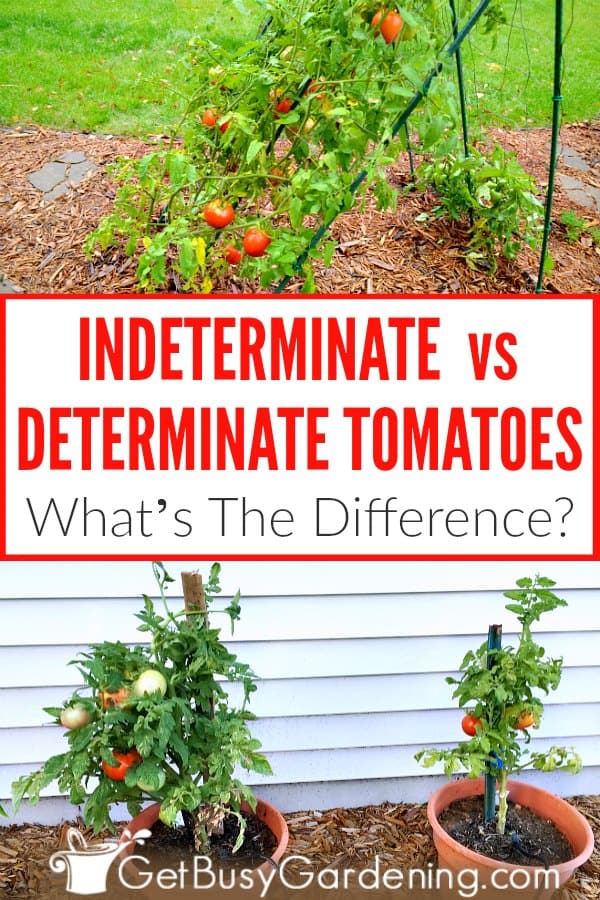
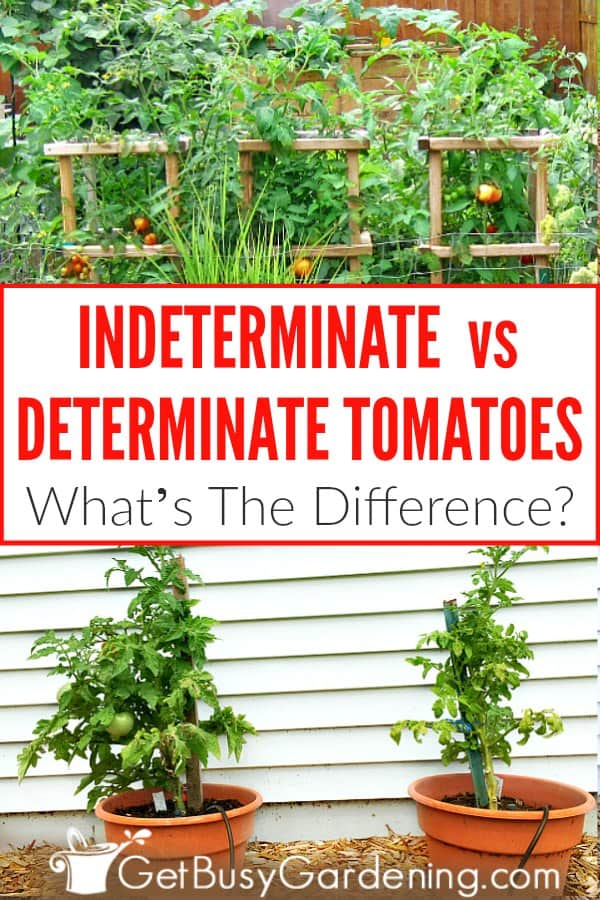
Determinate vs indeterminate tomatoes… what the heck is the difference? In this post, I’ll explain what those terms mean, and how to tell the difference between the two types of tomato plants. Then I’ll discuss the pros and cons of each, and show you how to decide which type to grow.
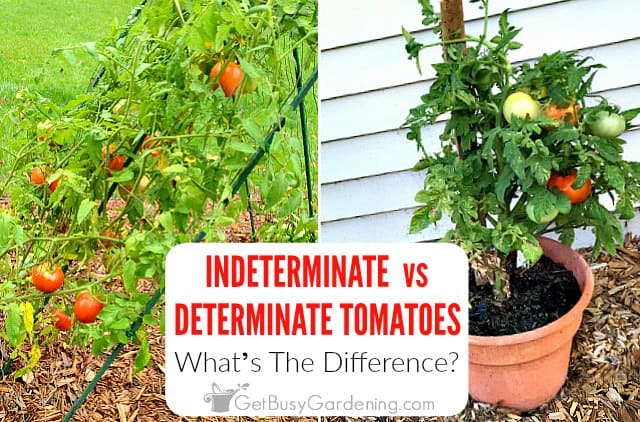

How can you tell the difference between determinate and indeterminate tomatoes? This is a very common question that most new gardeners have when they first start growing them.
The words may sound complicated, but don’t worry. Once you know the difference, you’ll easily be able to tell just by looking at the plants.
Below I’ll discuss determinate vs indeterminate tomatoes, and talk in depth about each type. I’ll also include the pros and cons, and help you decide which one is best for your needs.
Determinate vs Indeterminate Tomatoes
You may have heard the terms determinate and indeterminate in regards to tomatoes and wonder what they mean.
Well, don’t be intimidated. Those are just fancy words used to distinguish between the size and growth habits of the two types of tomato plants.
For me, it’s easy to remember determinate vs indeterminate tomatoes when I think of the meaning of the two words…
- The word determinate means having a determined or maximum size limit. Which makes me think of small, compact plants.
- The word indeterminate means there is no set limit, the size is undetermined. That makes me think of large, vining plants.
So let’s take those simple definitions and relate them to tomato plants…
What’s The Difference Between Indeterminate & Determinate Tomatoes?
The main differences between the two types of tomato plants are…
- Determinate tomatoes are small, bush plants that grow to a certain size. They produce their fruit all at once.
- Indeterminate tomatoes are large plants with long, pliable branches. They produce fruit throughout the growing season.
How To Tell Determinate From Indeterminate Tomatoes
When it comes to figuring out determinate vs indeterminate tomatoes, you can’t tell the difference just by look at the seeds or the seedlings. So it’s important to check the tag or packet before purchasing.
Once the plants mature, it’s easy to tell the difference based on the size of the plant, and the growth habit.
Besides the obvious size difference of the two plants, there is one other distinguishing factor that you may be able to spot…
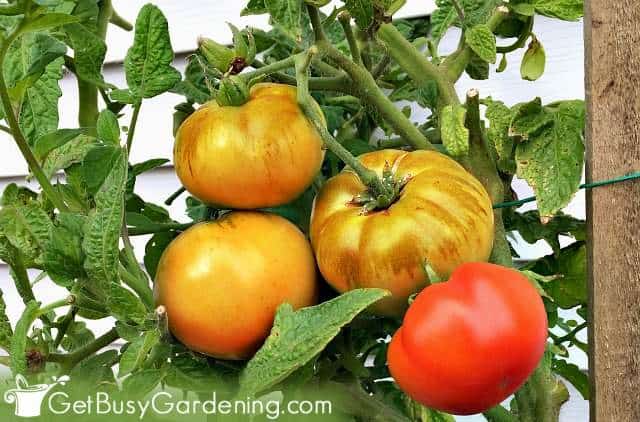
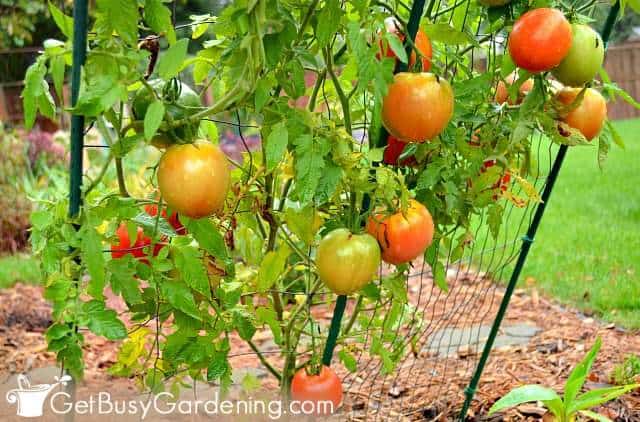
Indeterminate tomatoes will produce fruit all along the stems. While determinate plants will form their fruit on the ends of the branches.
Related Post: How To Grow Tomatoes From Seed & When To Start
Determinate Tomatoes
Since you can’t tell the difference between indeterminate and determinate tomatoes just by looking at the seedlings or seeds, you must read the label to figure it out.
Determinate varieties are usually marketed as “bush”, “patio” or “container” plants since they grow very well in small spaces and pots. But of course you can grow them in your garden too.
Related Post: How To Grow Tomatoes In Pots
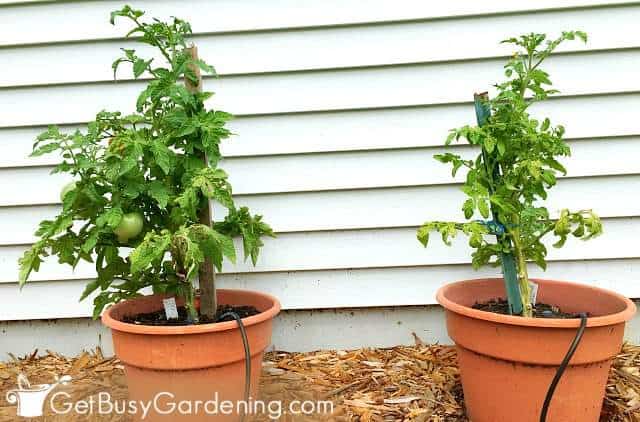
What Does Determinate Tomato Mean?
As I mentioned above, determinate tomatoes will get to a certain size, and then stop growing. So these types of tomato plants don’t grow to be very tall.
These smaller, more compact forms can be planted in the garden, or grown in planters and containers.
They perform very well in pots, which means you can grow them anywhere – like on a patio, deck, or balcony.
How Long Do Determinate Tomatoes Produce?
Determinate tomato plants will stop growing once they begin setting fruit. Then the tomatoes will usually ripen all at once.
The fruits are usually smaller, and the plants aren’t as productive as indeterminate varieties.
Some gardeners see this as a disadvantage, especially those who want to enjoy fresh tomatoes all summer long.
But determinate varieties also tend to have a shorter growing season, which means the tomatoes will be ready earlier.
So, be sure to buy a few different varieties that have various maturity dates, or stagger your plantings. That will help to ensure you have a longer harvest time.
Related Post: Tomatoes Not Turning Red? Try These 5 Tricks
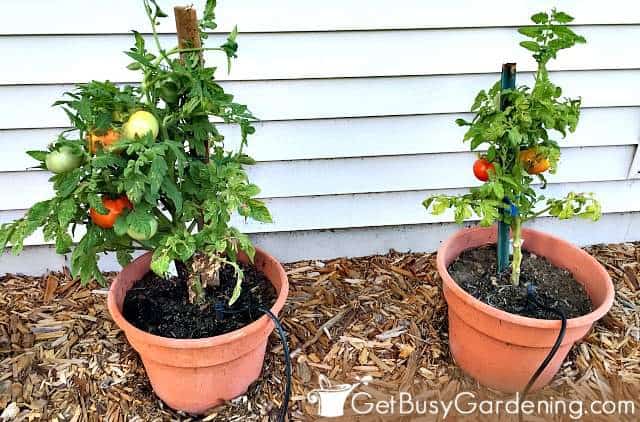
How Big Do Determinate Tomatoes Get?
The full height of the plant depends on the variety you grow, but most determinate tomato plants will grow to be 2-4′ tall.
Some semi-determinate varieties may get slightly taller, but they will still keep their compact form.
Though they don’t grow as tall as indeterminate varieties, determinate tomatoes will still need some kind of support.
Usually a tomato cage or plant stakes are sufficient to keep them from toppling over once they are heavy with fruit.
Determinate Tomato Varieties List
Though the majority of tomato plants are indeterminate, there are more determinate varieties to choose from these days than ever before.
In fact, some common indeterminate varieties have even been bred to be determinate.
Here are a few of my favorite determinate tomato varieties to grow… ‘Glacier Bush‘, ‘Celebrity’, ‘Italian Roma‘, ‘Early Girl Bush’, ‘Red Pride‘, and ‘Super Bush‘.
Indeterminate Tomatoes
Indeterminate tomatoes aren’t always labeled as such, which can make it hard to figure out what you’re buying.
In my experience, any tomato plant that’s not labeled as a patio, bush, or container variety is likely indeterminate.
But you can’t alway make that assumption. So, if the label doesn’t specify, then it’s best to look up the specific variety before purchasing it so you know exactly what you’re getting.
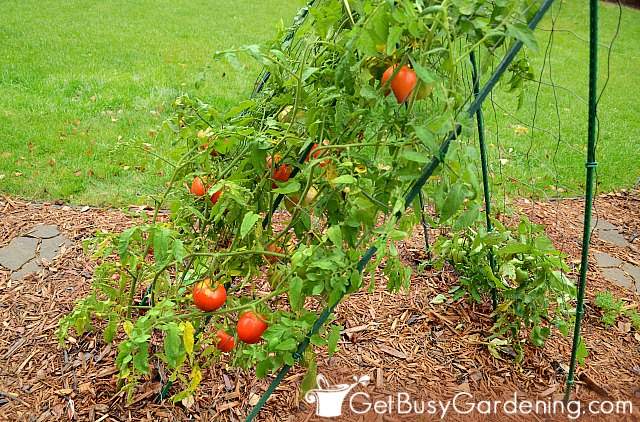
What Does Indeterminate Mean In Tomatoes?
Indeterminate tomatoes don’t have a set size limit. They’ll keep growing until frost kills them.
The plants get very tall, and have long, vining branches which can be trained to grow on a vertical support.
These plants can become huge monsters, and are best suited for a large garden plot where they have plenty of space to branch out.
In this case, you can prune tomato plants heavily to help control their size.
How Long Do Indeterminate Tomatoes Produce?
Indeterminate tomatoes are heavy producers, and will yield much more fruit than determinate varieties.
They usually do take longer to begin producing. But once they get started, they’ll continue going through frost.
The fruits are larger on most indeterminate varieties, but can be much slower to mature.
If you have a short season like I do, be sure to plant them as early as possible to give them plenty of time to mature.
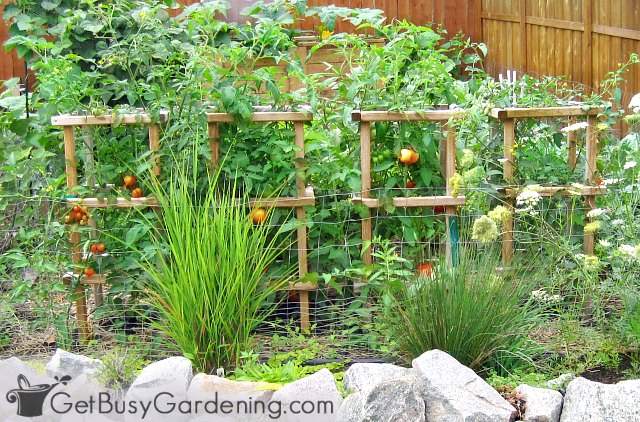
How Big Do Indeterminate Tomatoes Get?
The full size of the plant will vary by type, but indeterminate tomatoes can reach staggering heights. It’s not uncommon to hear of plants reaching 12-15′ tall.
But most plants will only grow to be 6-8′ tall, with compact indeterminate varieties being the smallest.
The plants have long branches that require staking to keep them upright. They’re often referred to as vining plants, even though they aren’t actual vines.
Indeterminate tomatoes are usually grown in sturdy tomato cages. But the pliable branches can easily be trained to grow on a vertical support, like an a-frame or lean-to style trellis.
List Of Indeterminate Tomatoes
When it comes to choosing indeterminate varieties, you’ll have tons of options. Like I mentioned above, most tomato plants are indeterminate.
So, your biggest struggle will be deciding which variety you want to try.
A few of my personal favorite indeterminate tomato varieties are ‘Beefsteak’, ‘Big Boy’, ‘Red Cherry‘, ‘Sweet 100’, ‘Brandywine‘, ‘Early Girl’, and ‘Cherokee Purple‘.
How To Decide Which Type Of Tomato Plant To Grow
Sometimes it can be hard to choose between determinate vs indeterminate tomatoes. They both have their pros and cons, so how do you figure it out? Here are a few factors to help you decide…
Choose determinate tomatoes if you…
- don’t have a large garden plot, and need to grow tomatoes in small spaces
- want to grow tomatoes in containers on your deck or patio
- need them to ripen all at once for canning or cooking
Choose indeterminate tomatoes if you…
- have a large garden to fill
- want to grow them vertically
- prefer to enjoy your tomatoes all summer long
But you don’t have to chose one over the other, you can grow both! I personally like to have a few varieties of both types of tomatoes every summer.
That way, I can enjoy the benefits of each, as well as a constant harvest.
Now that you know the difference between determinate vs indeterminate tomatoes, you’ll be able to make an informed decision of which type to grow.
Just remember, if the plant doesn’t get much taller than 2-4′, then it’s a determinate variety. If it grows to be gigantic, and requires constant staking, then it’s definitely indeterminate.
More About Vegetable Gardening
- How To Decide What To Plant In A Vegetable Garden
- Female -vs- Male Squash Flowers: How To Tell The Difference
- When & How To Plant Garlic In Your Garden
- How & When To Plant Potatoes In Your Garden
- How To Grow Blueberries In Pots Or The Garden
More About Tomatoes
Share your preference of determinate vs indeterminate tomatoes in the comments below.

Sylvia says
Live in Western Australia, only heard the terms determinate and indeterminate today, after I bought three tomato plants. Found I have one determinate and two indeterminate varieties. Frost is not a thing here so should get great crops off all three.
Amy Andrychowicz says
Awesome, so glad I could help you out with those terms! Yes, without frost you should have no problem getting great crops from all three of your tomato plants. Enjoy!
Ernest Burden says
Well I’m confused. I buy small “cherry” tomato plants. They grow bushy and about 3 feet tall, which would lead me to believe they are determinate, but they produce fruit all summer long, and well into fall. I usually harvest until mid October. Which is a characteristic of indeterminate…
Oh well. The tomatoes are yummy either way.
Thanks for the info.
Amy Andrychowicz says
There are lots of hybrids these days, so you probably have one that is both prolific AND bushy. 🙂 The tag should tell you.
Ernest Burden says
Thank you.
Cosmic John says
Thanks for explanasion Amy, i didnt know there was a differance but understand now. I have a allotment in UK sussex. Iam mainly growing BIG BOY in my new plastic greenhouse .iam cloning them to expand crop. Hope to grow late in season…time will tell ha ha . Love n peace yrs John.xx
Amy Andrychowicz says
You’re welcome! Big boy is an indeterminate tomato, as long as it’s not a hybrid version of it anyway. 🙂 Good luck.
Georgina says
I live in the UK (South Coast). Last fall I dried out some seeds from an Asda (Walmart) baby plum tomato. In early Spring I stuck them in a tray with some Marigold seeds – the marigolds failed 6 tiny tomato seedlings started to grow. I hardened them of on our garden bench, so far they have survived flooding and a badger attack!! 3 tiny feisty seedlings survived, as they grew I had no idea what they would be, determinate or indeterminate or if they would revert to whatever they had been pollinated/spliced from. By instinct (after reading the section on determinate-vs-indeterminate tomatoes I am totally amazed how right my instinct was) I nipped out the many of the numerous lower suckers which were growing, cut out huge leaves which were blocking airflow, the plants kept heading for sky; not good as they were planted in a 20 gallon pot. At 6ft I took out all the tips and continued to nip out suckers, new lower branches, huge leaves to give airflow and eventually taking off the flowers that would sadly never be. There are now around 200 slowly ripening baby plum tomatoes; not bad for seeds from a small baby plum tomato from Walmart. Technically free food. Next year I’m going to start them earlier using baby plum and cherry tomao seeds. I’ll let you know how I get on.
Amy Andrychowicz says
Sounds like you definitely have some indeterminate tomatoes there! Awesome story, what a great success! I love getting free food from plants I grew myself. 🙂
Pat Mihm says
I live in Minnesota too, did not know there was such a thing, as two different types of tomatoes. Have been growing them for years. Now a great grandmother, and don’t can like I used to. My granddaughters and son have taken over. Thank you for interesting info,
Amy Andrychowicz says
You’re welcome, glad you were able to learn something new about the two different types of tomatoes! 🙂