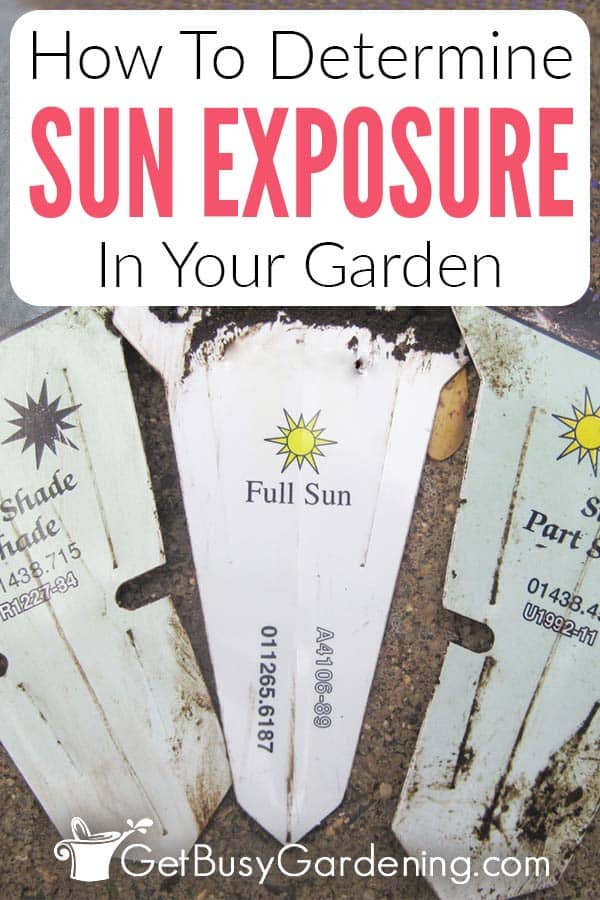
Have you ever planted something in the “perfect spot,” only to watch it get leggy, wilt, or burn out completely? Most of the time, the problem is not realizing how much (or how little) sun your garden actually gets – and it can sneak up on you.
Sunlight patterns shift more than most people realize. They change with the seasons, and also over the years as trees grow, new structures go up, and the landscape evolves.
The good news? Measuring sun exposure is simple – and it helps you choose the right plants that will thrive in your garden. In this post, I’ll show you exactly how to figure it out, step by step.
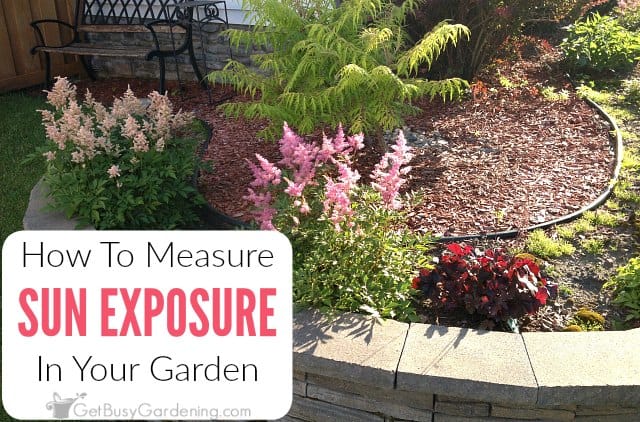

Simple Steps to Track Sunlight in Your Garden
To see how much exposure each part of your garden gets, all you need is a clear, sunny day and a little time.
This simple method will show you the patterns from sunrise to sunset so you’ll easily be able to choose the right plants for each area.
What You’ll Need:
- Paper
- Pen
- Timer to remind you to check each hour (optional)
Instructions:
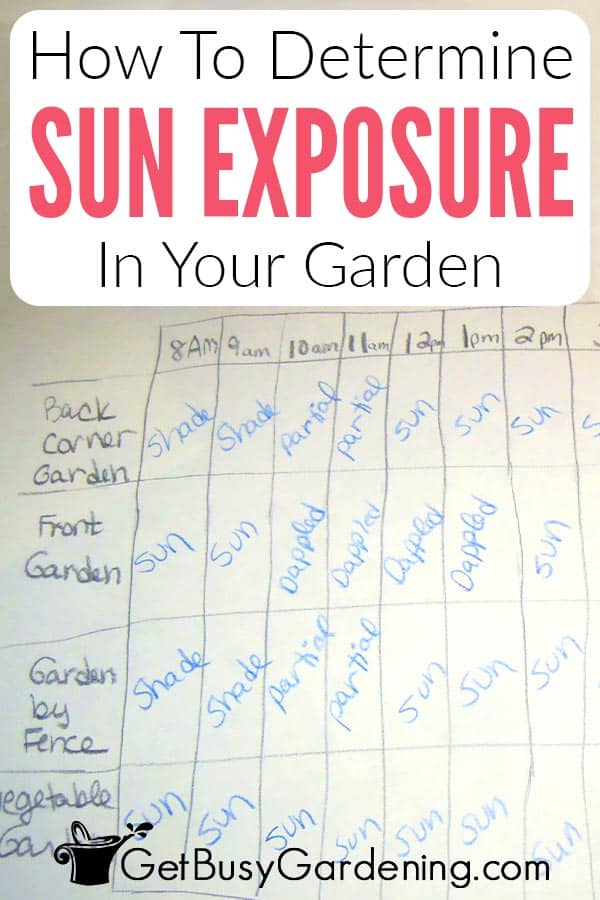
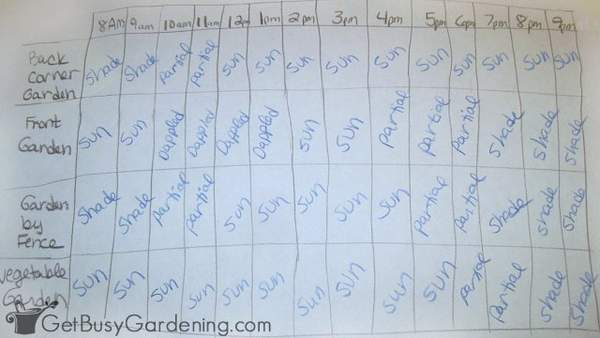
Step 1: Draw your chart – Start by creating a simple table. Draw one column for each hour of the day (e.g. 7AM, 8AM, 9AM…) and one row for each area you want to track.
Step 2: Record the exposure at sunrise – As soon as the sun rises, take a walk through your garden. For each area on your chart, write down how much light it’s getting:
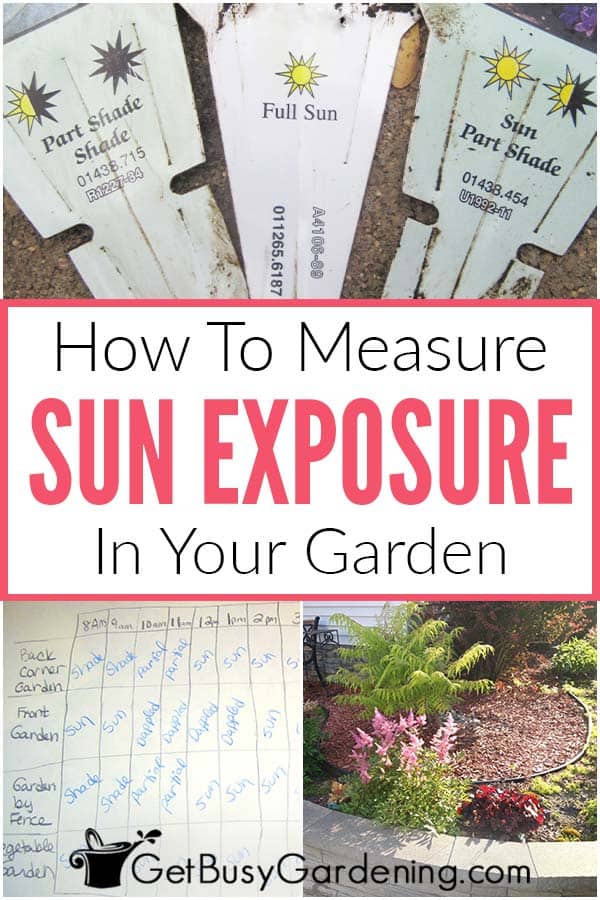
- Full sun (direct, unfiltered light)
- Partial (a mix of sun and shade)
- Dappled (like light through trees)
- Shade (no direct sun at all)
Step 3: Check every hour – Set a reminder to check each garden area every hour and write down the sun exposure at that time. Keep this up until sunset. At the end of the day, you’ll have a chart that looks similar to the photo below.
Step 4: Calculate the total – At the end of the day, tally up how many hours of direct sunlight each area got. Then use this guide to determine the exposure:
- 6+ hours = Full Sun
- 3–6 hours = Partial Sun / Partial Shade
- Less than 3 hours = Shade / Full Shade
- Filtered light all day = Dappled Shade
Related Post: Perennials vs Annuals: What’s The Difference?
Smart Shortcuts & Pro Tips:
- If your garden is large, divide it into smaller sections and track them separately. Sunlight can vary a lot, even within just a few feet.
- Want to go big? Use this method to map your entire front or backyard, or even your whole property.
- Short on time? Snap a photo of each area every hour instead of writing it down.
- For a techy shortcut, try using a garden light meter or set up a time lapse camera to capture the sun patterns automatically.
How to Choose the Right Plants Based on Sun Exposure
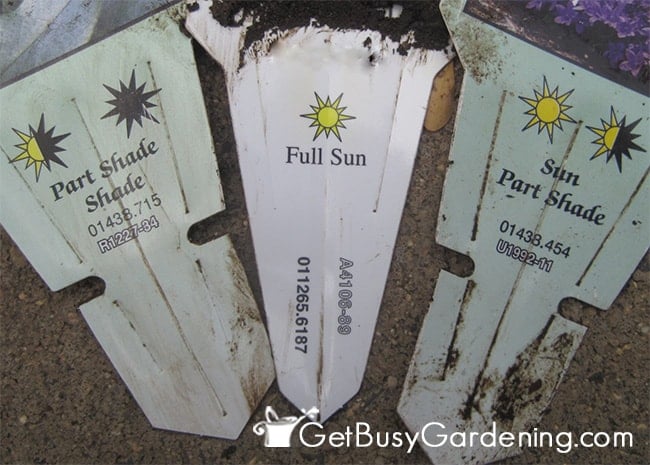
Once you know how much sun each part of your garden gets, picking the right plants is easy – just check the tag.
Most plant labels will tell you exactly what kind of sunlight they need. When you match the plant to the light, you’ll set it up to thrive.
Measure Again Throughout The Year
Remember, sunlight isn’t static – it constantly shifts throughout the year. A garden area that’s shady in spring might get blasted in midsummer when the sun is higher in the sky (and hotter). That’s when shade-loving plants can start to burn out.
Trees also play a big role. A bed that’s full sun in early spring can quickly turn into partial or full shade once the leaves fill in – which will make the sun-lovers grow leggy.
That’s why it’s smart to check the sun exposure a few times a year—especially in spring, midsummer, and fall. You’ll get a clearer picture of how the light moves through your garden all season long.
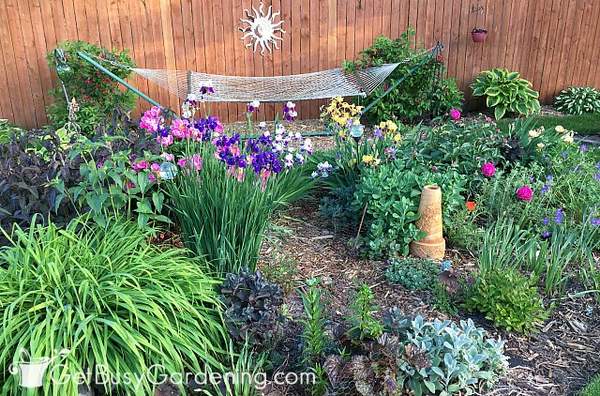
Once you know how to measure sunlight in your garden, picking the right plants becomes a breeze. Just remember to check it a few times a year so you understand the seasonal patterns – and re-check every few years as your landscape changes.
More Information About Garden Planning
- Perennials Made Easy! How To Create Amazing Gardens
- How To Design A Front Yard Foundation Planting
- Annual Flower Garden Design For Beginners
Share your tips for how to measure sun exposure in your garden in the comments section below.

David says
The garden sunlight meter you linked to only gives a measurement of the amount of sunlight at the point in time you happen to be looking at it.
It doesn’t record the sunlight throughout the day or give you information that would let you know if an area has x hours of sunlight each day.
Amy Andrychowicz says
Yes, you’ll still have to create a chart as I show in the article to track the amount of sunlight in that garden area every hour. The gauge just makes it easier to tell the exact amount at any given time.
Alina Kodatt says
This was such an informative and thorough article! I don’t normally leave comments but wanted to just to say thank you!
Amy Andrychowicz says
You’re welcome, thanks for your nice comment. 🙂
Tricia Dikeman says
Great article!! I also live in zone 4b and I am planning to overhaul my gardens in the next few weeks. Is mid september too late to map my sunlight? I’m thinking that the sun is much lower in the sky and it won’t be accurate for the rest of the growing months. What do you think?
Amy Andrychowicz says
It’s a good idea to map out the sunlight a few times during the growing season. Spring, summer, and fall is great!
Heather says
Thank you for an excellent article!! Many of my questions answered in one place. Awesome!!
Amy Andrychowicz says
Wonderful, happy to hear I answered all of your garden sun exposure questions! You’re welcome. 🙂
Serena Williamson says
I have one of those 3 in 1 garden meters but it didn’t really have instructions. How do you use it to determine how much light exposure your plants are getting?
Amy Andrychowicz says
If you have the same light meter as I do, then there is a switch at the bottom where you can change it to be set to either moisture, pH or light. Move the switch to the middle to measure the light. Then place it in the spot where you want to measure the light. The needle should move pretty quickly to show you the light reading. It’s the top bar on the meter, the one that says “Dark” on one side and “Light” on the other, with some numbers under it. That’s the line you want to look at to determine sun exposure. Then you can move it around to the different areas of your garden, and also take readings throughout the day to see how it changes.
Melanie Klar says
Thank you! Good clarification! And if anyone else doesn’t have 1 full day to walk around noting shade and sun, I did it this week by writing on my calendar when I made note of it and spread it over a week so like Monday I did 9 a.m. 10 a.m. 3 and 5 on Tuesday I filled in some more on the hour times and filled it all in by the end of the week. I also took pictures of each area at each time because there are spots within each area that get more or less sun that would be hard to describe exactly where it is but when you see a picture it’s clear.
Amy Andrychowicz says
Wonderful! Thanks for adding your method for tracking the sun exposure in your gardens. Great ideas!
Lovely says
Hi, I loved your article! I was hoping you could answer a question about sun exposure requirements with fruit trees.
I’m a first time gardener, so I was wondering…When a fruit tree requires full sun, does that include early spring when it flowers? There’s plenty of sunlight in the area during the summer, but in the spring there’s only four or five hours. Any thoughts on this?
Amy Andrychowicz says
If the trees are growing just fine and producing fruit, then they’re fine. I think it would be more important for them to be in full sun during the months when they have leaves, since the leaves are what they use for photosynthesis, which generates the energy they need to produce flowers and fruit every year.
Vineta says
I really need to make a garden sun chart, multiple times a year. Seattle’s sun pattern changes dramatically with the seasons, and the plants that I thought would get very little sun are getting a lot more now that the sun is higher in the sky. Thanks for the great idea!
Amy Andrychowicz says
You’re welcome! Yes, I also make sure to measure the sunlight in my garden every few years as trees and other surrounding plants grow and mature.
RS says
Try the app findmyshadow it’s great
Amy Andrychowicz says
Awesome, thanks for the tip! I’ll have to check it out.
Mary Vidrine says
Thank you so much Amy! This puts on paper what I’ve been trying to sort out in my head. My question is similar to the last one. Hope this is not a super old post. My North facing front steps are in the shade right now. It seems to me the plants fried there last summer. So that would mean to me that the sun is further north in the winter.?? Is this correct?
Amy Andrychowicz says
Yes. Definitely measure hours of sunlight at different times during the year. If your shade plants are burning, the that area must get some sun during the middle of summer while the sun is high in the sky (and most intense).
seeingstone says
Will my garden get more sun in summer? I just moved in and I want to till, but I have tree lines on two sides and don’t know how much difference it might be in spring and summer.
Amy Andrychowicz says
The sun is more intense in the summer, and of course is up longer than it is in the fall/winter. So, we definitely get more sun during the summer. You also have to think about your surrounding trees – have any of them dropped their leaves? If so, those will create more shade when they are full of leaves in the summer. If you have an area in mind that is pretty open, and the tree leaf-out is not a problem, then it should be just fine.
Mike says
The sun moves higher in the sky towards the north in the summer. In the winter, the sun is low in the south in the northern hemisphere
Ashlie Milano says
Thanks for explaining this I was so confused. I don't think you could have made it any simpler. I appreciate it!
Amy Andrychowicz says
You're welcome, glad I could help.
Anonymous says
I'm in South Dakota and am working with a garden plot new to me. It has partial tree branch coverage. What is the earliest month, in your opinion, that I could do this?
Amy Andrychowicz says
Wait until the trees have fully leafed out before doing this in the spring. That will give you a pretty good feel for what the sun exposure of your garden will be through the summer. You could do it again at the peak of summer (June/July) to see how it differs, but I don't think you need to wait to plant stuff until then. Keep an eye on it through the summer and modify next year if necessary.
Amy
Amy Andrychowicz says
P.S. I reworded it so hopefully it makes more sense now. Let me know if it still sounds confusing, and thanks again for pointing that out!
Amy Andrychowicz says
RandomGardener – That's a really good point, and my wording is poor on that statement. What I was trying to say is that full sun plants should be in the sun during the peak hours of the day when the sun is at it's highest/hottest. Rather than being in full sun only during say 8am-10am and 4pm-8pm, with no full sun during the peak hours. I guess it's hard to explain. 🙂
Amy
Traci says
Perfect…that is EXACTLY what I needed to know! Thanks!
Amy Andrychowicz says
Wonderful! You’re welcome, glad I could help.
RandomGardener says
Good information! However, when I'm out in the yard, it feels hotter until about 6:30 pm in the summer, so does it not count towards full sun hours?