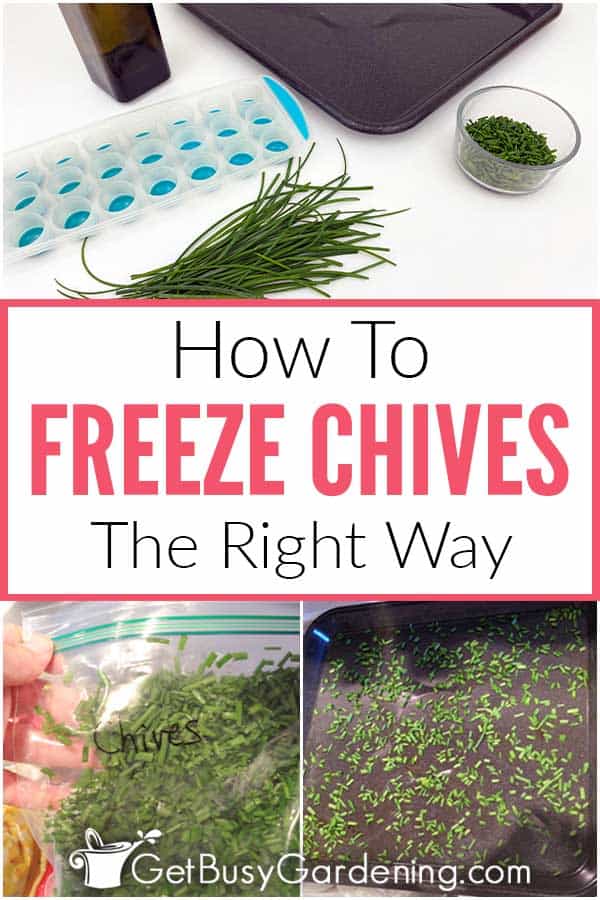
Freezing chives is simple, and doesn’t take much time. In this post, I will show you exactly how to do it the right way for the freshest flavor and easiest use.
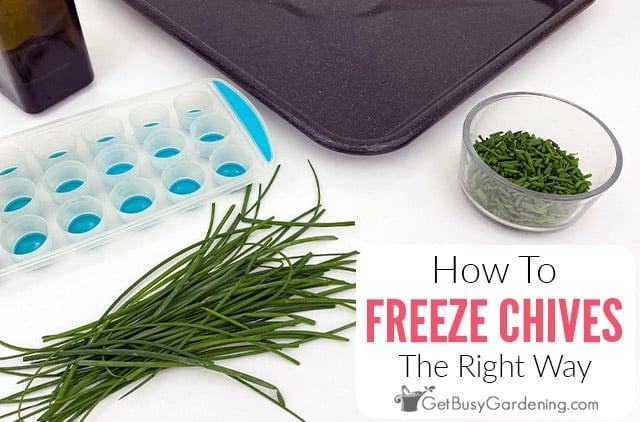

If you love chives as much as I do, then you’ll want to savor that fresh flavor all year long – and freezing them is the best way to do it!
Freezing chives is super easy, and a great way to enjoy them all year round. They hold their flavor and texture very well when frozen, and you can use them in your recipes any time you need them.
There are a couple of different methods you can use to freeze chives. Below I will walk you through the step by step instructions for each.
How To Freeze Chives
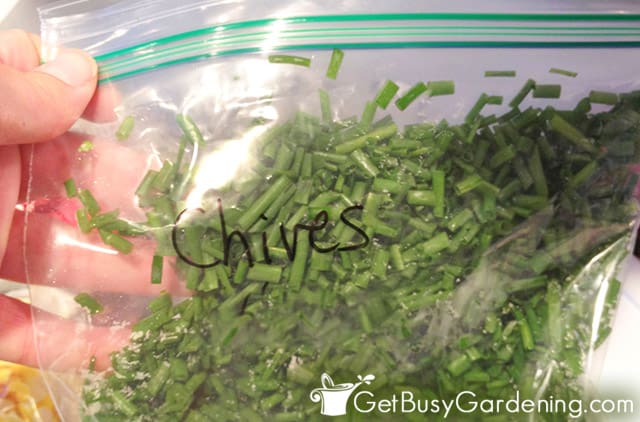
Chives are so simple to freeze that you can just toss them into a baggie, and pop them into the freezer. However, doing this could result in one large frozen clump that is difficult to separate later.
So, for best results, I recommend either flash freezing them, or using ice cube trays. Both methods work great. Below are the steps for how to properly freeze chives.
Related Post: How to Harvest Chives From Your Garden
Flash Freezing Fresh Chives
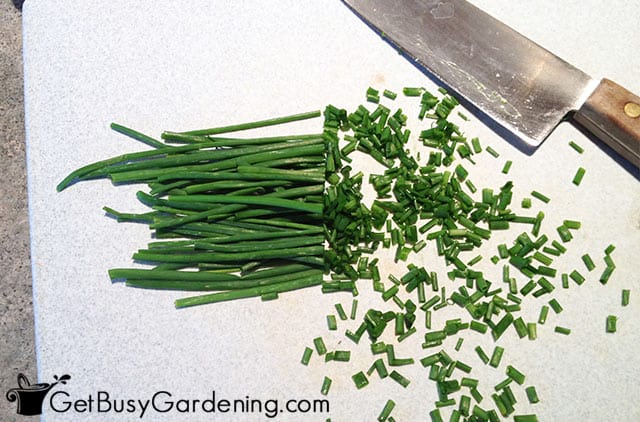
Flash freezing chives before putting them into a baggie will prevent them from sticking together. Before getting started, make sure to chop them up into usable pieces.
Supplies Needed:
- Cookie sheet
- Parchment paper (optional)
- Freezer bag
- Permanent marker
Step 1: Find a cookie sheet – You can use any size cookie sheet you have on hand, just make sure it will fit into your freezer.
Lining it with parchment paper first will keep them from sticking, and make it easier to pour the frozen chives into baggies later.
Step 2: Spread the chives evenly – Spread the chopped chives out on a cookie sheet. Try to space them as best as you can so they aren’t touching each other.
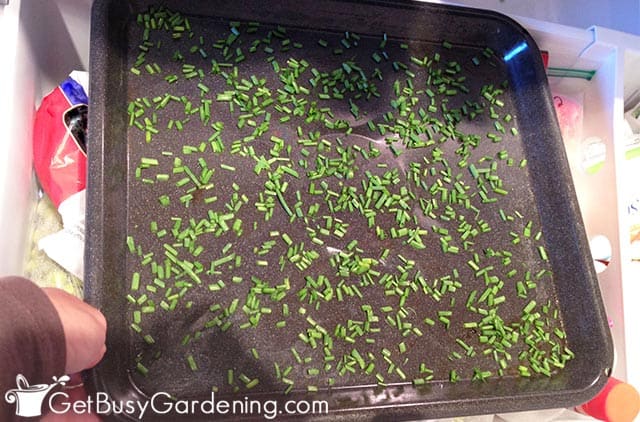
Step 3: Flash freeze them – Place them into the freezer on a level surface for about 10-15 minutes, or until they’re solid.
Step 4: Pour them into a freezer bag – Once frozen, simply pour them into a baggie, or other container of your choice, then put them into your freezer.
Step 5: Mark the container – Use a permanent marker to write the date on the container, and label it so you’ll know what’s in there later on.
Related Post: How To Freeze Herbs Fresh From The Garden
Freezing Chives In Ice Cube Trays
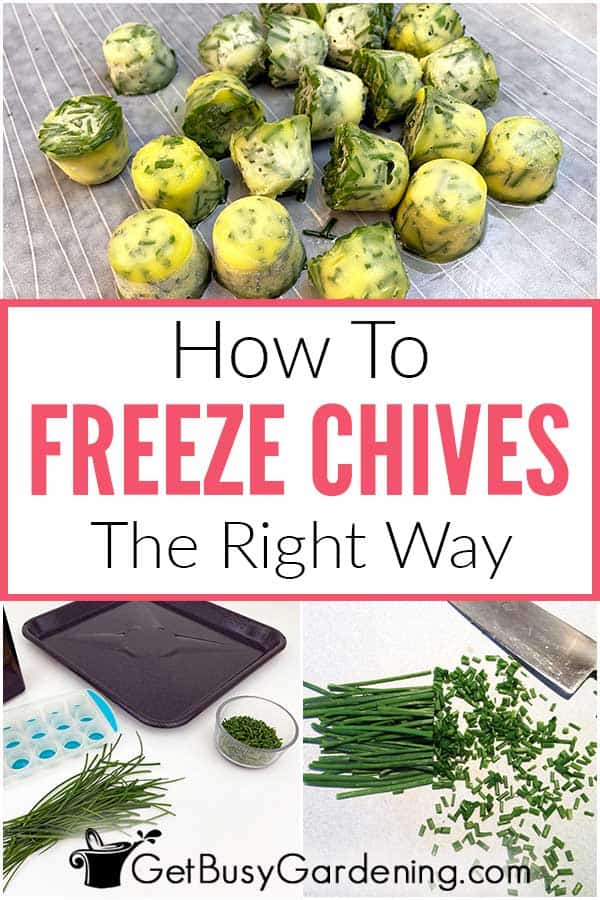
The second way you can freeze chives is by putting them into ice trays then filling them with olive oil.
I love doing this because I can pre-measure out the perfect portions for use in my recipes. Before starting, chop them up into small pieces.
Supplies Needed:
- Ice trays or herb freezer containers
- Water or olive oil
- Plastic wrap (optional)
- Freezer bag
- Permanent marker
Step 1: Choose your tray size – You can use any size tray that you want to freeze herbs in. I use my mini cube trays, which hold exactly one tablespoon. The perfect amount for most recipes.
But if you want larger portions, you can use a regular sized ice tray, or a small herb freezer containers.
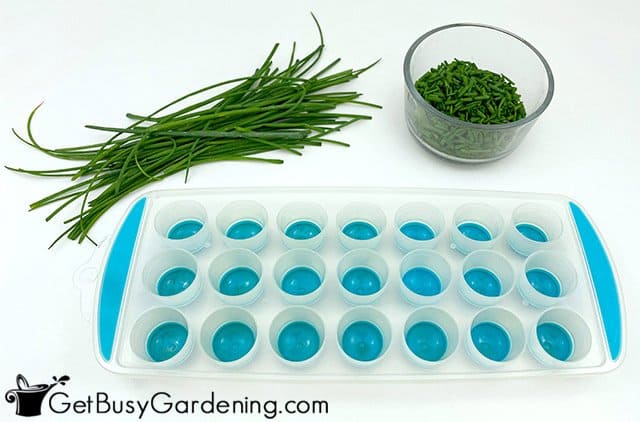
Step 2: Put the chives into the trays – Loosely fill each compartment of your tray with the chopped up chives. Don’t pack them in too tightly, or over fill the cells.
Step 3: Add oil or water – Slowly pour water olive oil or water over the chives to fill the rest of each cell. Keep the liquid a little bit below the top so it won’t overflow when it freezes.
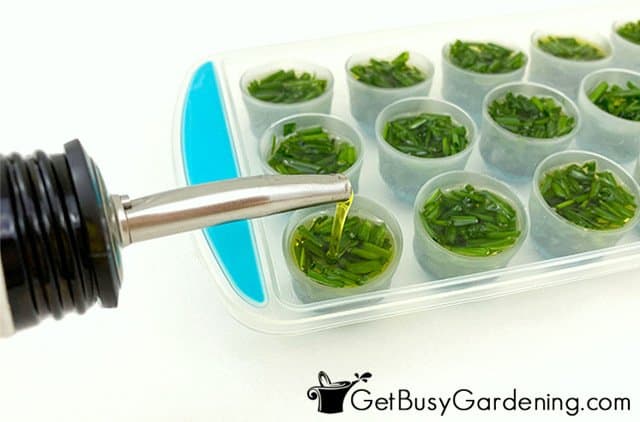
Step 4: Freeze the trays – Place the trays into your freezer on a level surface. You can cover them with plastic wrap if you’re concerned about freezer burn.
It takes 20-30 minutes for them to become solid in my freezer. But times can vary depending on how cold yours is. Check on them after 20 minutes, and leave them in longer if they’re still soft.
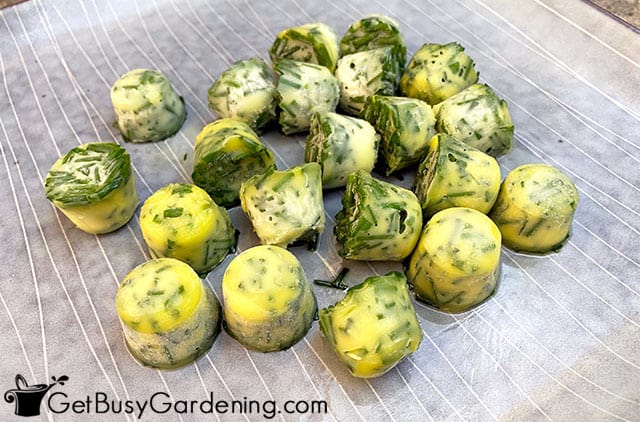
Step 5: Put them into a container – Once the liquid and the chives are frozen solid, pop them out of the trays and put the cubes into a freezer safe container or baggie.
Olive oil melts very quickly, so try to work as fast as you can if you use that instead of water.
Step 6: Label them for later identification – It’s amazing how quickly you can forget what’s in your freezer (guilty!). So make sure you label and put the date on them too using a sharpie marker.
How To Store Chives In The Freezer
Before putting chives into the freezer for the long term, make sure the container you use can be safely frozen.
I prefer freezer bags for mine, but you can use any type of container you want. If you have a problem with freezer burn, then I recommend double wrapping them.
Related Post: How To Grow Chives At Home
How Long Will Frozen Chives Last?
As long as you are using a freeze-safe container, chives can last in your freezer indefinitely. But, for the freshest flavor, it’s best to use them up within one year.
Related Post: How To Prune Chives & Deadhead The Flowers
FAQs About Freezing Chives
Here are some of the most frequently asked questions I get about freezing chives. If yours isn’t listed here, please ask it below in the comments.
Can you freeze chive flowers?
If you want to try freezing chive flowers, then I recommend using the ice cube tray method for best results (in either water or oil). Otherwise, the flowers may turn brown in the freezer.
Can you freeze garlic chives?
Yes! You can freeze garlic chives the same way you would the regular ones. In fact, you can use these methods for any type that you have on hand.
Freezing chives won’t take long, and you will have the benefit of their delicious flavor all year round. Just pull them out of the freezer, and use them in all of your favorite recipes.
More Food Preservation Posts
- How To Dry Oregano At Home In 4 Different Ways
- How To Dry Herbs From Your Garden
- 9 Easy Ways To Preserve Fresh Garden Herbs
- How To Dry Cayenne Peppers To Prepare For Storage
- Freezing Corn On Or Off The Cob
- Freezing Carrots With Or Without Blanching
Share your tips for how to freeze fresh chives in the comments section below.

Beverly Croy says
After flash freezing chives, measure out the amount you most often use at one time
and put them in the snack size baggies. Label the name of herb, date, and amount in each snack baggie on a quart or gallon freezer bag. Insert your snack bags that’s filled with herbs
and close the top, making sure all air is removed from every bag.
So easy!!!
Amy Andrychowicz says
Thanks for sharing your tips for how you freeze your chives!
Crystal Deveau says
Would it be ok to vacuum seal them and then freeze them??
Amy Andrychowicz says
Yes, you can vacuum seal your chives before freezing them. Doing so can help them last longer and prevent freezer burn.
Rachel says
In the flash freezing instructions, you say to freeze them on cookie sheets and then when frozen put them into freezer bags and then into the ice box.
How long will they stay fresh in the fridge/ice box? I would think they wouldn’t last very long before they begin to decay.
Did I misunderstand, and the ice box is actually the freezer?
Thank you.
Amy Andrychowicz says
LOL, sorry for the confusion. You definitely want to put the pre-frozen chives into the freezer, not the fridge.
Norm says
HI! Amy, I’m SO glad i found your web site i live in South Australia & planted Tyme along with chives in the same wok type pot. this autumn my chives have gone crazy but alas they aren’t a winter lover & i know they will die back till my summer comes back.So your method is PERFECT,i do hate waste now my wife has heaps till next summer growth. THANKS heaps. from down under))))))
Amy Andrychowicz says
Awesome, so happy to hear you’ll be able to make use of your chives without any waste! You’re welcome, and enjoy!
Scott says
We started using this method a few months ago when we realized we were growing more than we could eat, and it has become a standard for us. We have flash frozen onion-chives and garlic-chives, and now have them on-hand to throw into scrambled eggs, ground beef, sprinkled on tacos, sprinkled in salads, etc. Awesome!
Amy Andrychowicz says
Yum! I love cooking my eggs with chives. Agreed, flash-freezing them is so easy, and works great!
Denice says
Has anyone used their Food Saver bags to freeze their chives?
Amy Andrychowicz says
I’ve never tried using FoodSaver bags, but I don’t see why they wouldn’t work for freezing chives. 🙂
Linda says
I have used my food saver for basil, rose mary, sage, parsley, and it works great. I’ve still got some from 2020 and when I use it, it’s like I just harvested it. I’ve never tried chives, but I just cut mine and I am about to freeze in my food saver…
LEEE HOOVER says
Going out to cut garlic chives right now!!! Thank you.
Amy Andrychowicz says
You’re welcome!
Kimberly says
Great idea! I’ve dehydrated my chives before and they’re not nearly as flavorful as fresh. I never thought of freezing them!
Amy Andrychowicz says
Yes, fresh chives definitely keep their flavor better when they’re frozen -vs- dehydrated.
Marie says
I seriously had no idea you could even freeze chives! What an awesome tip.
Charlene Asay says
I didn’t know you could freeze chives. Thanks for the tip!
Amy Andrychowicz says
You’re welcome! 🙂
Sam says
Chives are the one thing that thrive well in my garden, I never thought of freezing them – thanks for the tips.
Amy Andrychowicz says
You’re welcome!
Barbara Sanders says
I tried freezing chives the way you indicated but it left my freezer with an onion smell for a very long time. I haven’t tried it yet but I think it would be better to bag them very loosely and then freeze them. Once frozen you could sort of break up the chives by banging the bags on a hard surface to break up any clumps.
Amy Andrychowicz says
Interesting, that has never happened with mine. Thanks for sharing your experience. I wonder if you left them in there too long, did you only flash freeze them for 5 minutes? Also, you could try covering them with plastic wrap, that may help to keep them smell down.
Cheryl says
Barbara…Try using glass canning jars. That’s what I use & no smell
Vera says
I want to vacuum seal the blossoms, have you done that before? And do I have to put in freezer?
Joy says
That was my exact thought. I was going to put mine in a freezer bag and put them in the freezer and about 15 minutes take them out and break them apart and put them back in the freezer and repeat again in about 30 minutes. I will probably double bag mine to make sure they don’t freezer burn .