Squash bugs can be a huge pest, and wreak havoc in your vegetable garden. But it IS possible to get rid of them.
In this post, you’ll learn all about them, including what they look like, their lifecycle, where they come from, what they eat, and the damage they cause to plants.
Then I’ll show you a bunch of organic methods for how to get rid of squash bugs in your garden, and prevent them from coming back.

But they aren’t the only bugs that eat cucurbits, so it’s important to verify that you’re dealing with the right one before you start treating your plants. There are two common types of bugs that plague squash plants, and it’s easy to tell them apart.
If you have insects crawling all over the leaves and fruits, those are squash bugs. On the other hand, if there are white worms inside of the stems, vines, or fruits, those are squash vine borers, and here’s how to get rid of them.
Squash Bugs -vs- Stink Bugs
Stink bugs are another common pest insect that many people mistake for squash bugs. They look similar, and both can emit a stinky odor when you crush them. But here are a few easy ways to tell them apart…
- Body shape – Squash bugs are long, narrow, and oval-shaped. Stink bugs are wide, rounded, and shaped like a shield.
- Feeding habits – Squash bugs feed on cucurbits, while stink bugs will eat a variety of different types of plants.
- Hibernation -Squash bugs typically overwinter in the soil or under plant debris outside. Stink bugs are the ones that try to get into your house in the fall to hibernate.
Related Post: How To Control Garden Pests Naturally
What Do Squash Bugs Look Like?
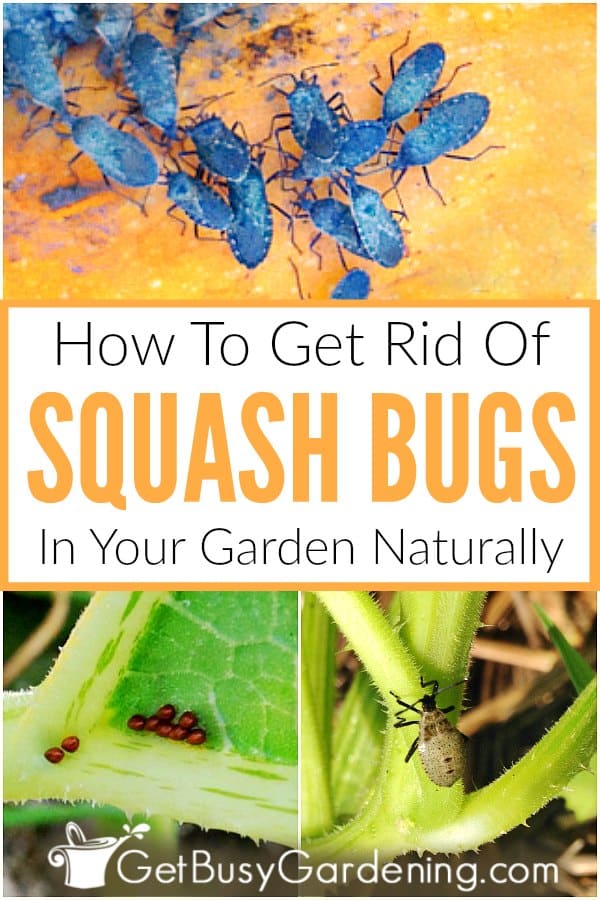
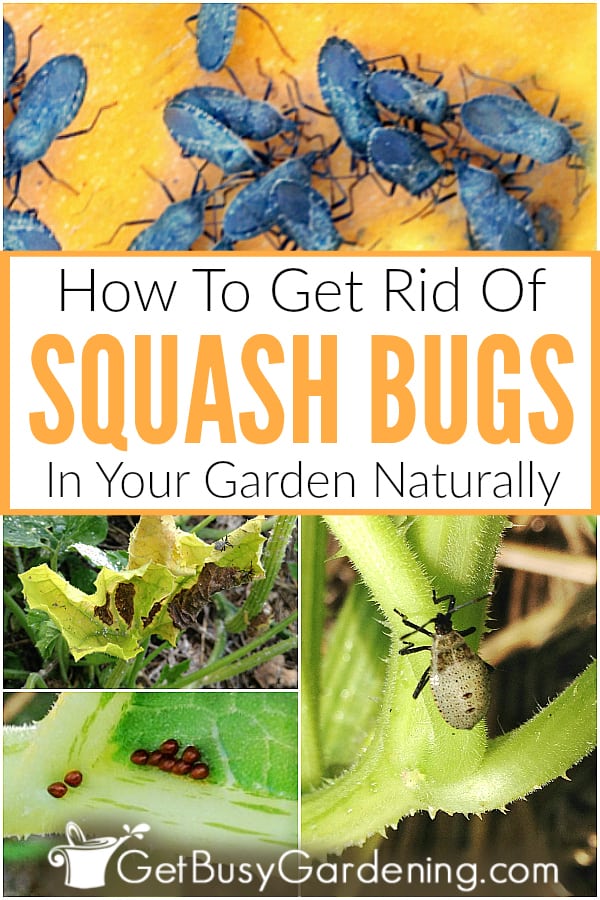
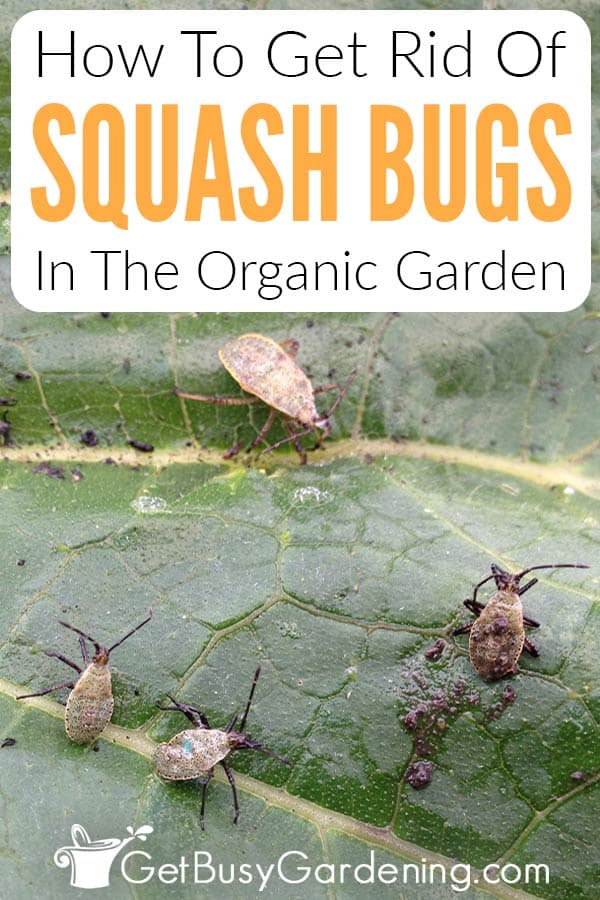
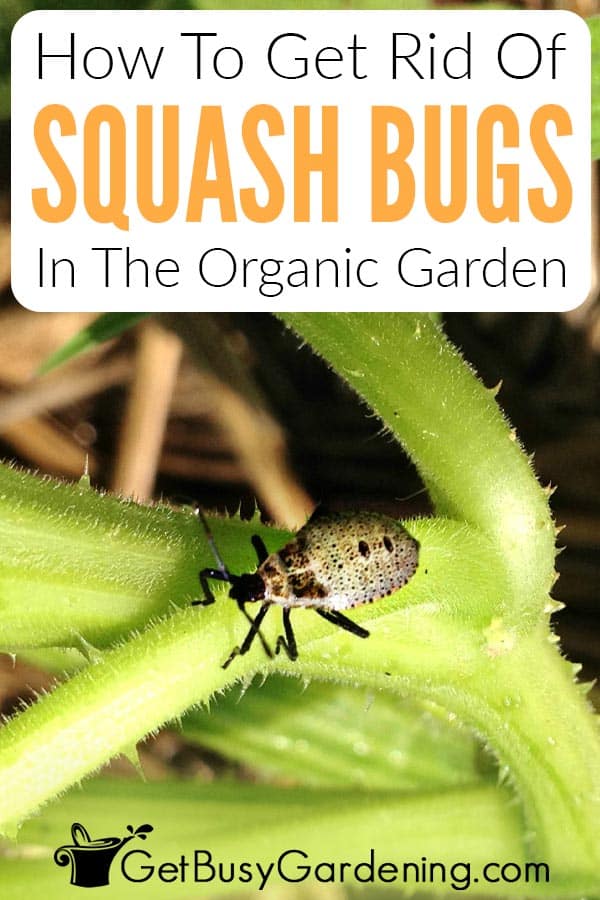
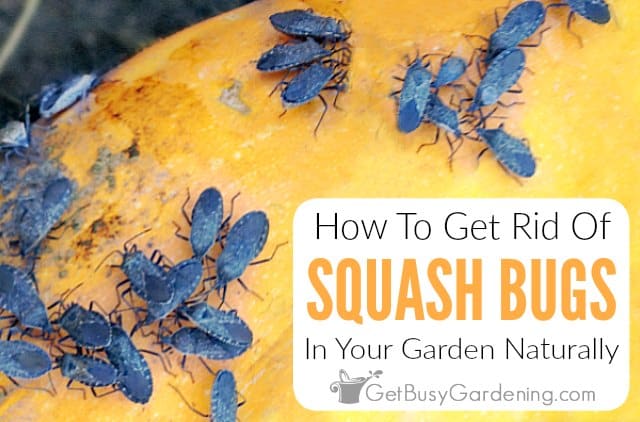
Adult squash bugs are brown or gray colored with flat, oval-shaped bodies. Some of them have an inverted V or diamond shape in the center of their back, and white dots along the perimeter.
Other species have a dark U shaped band across the top, or dots covering their backs. Full-grown adults are just over a 1/2 inch long. They are able to fly, but most of the time you’ll just see them walking around on the plants.
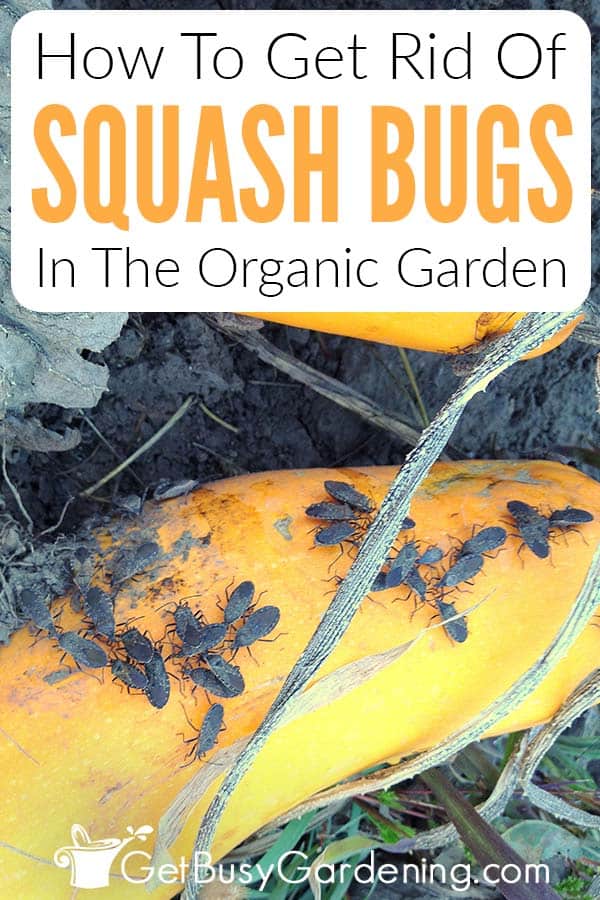
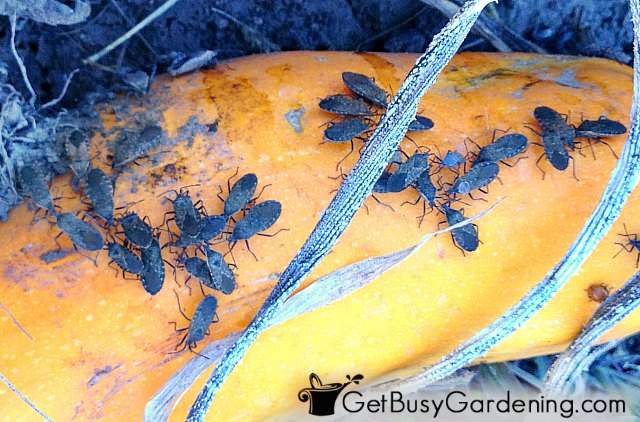
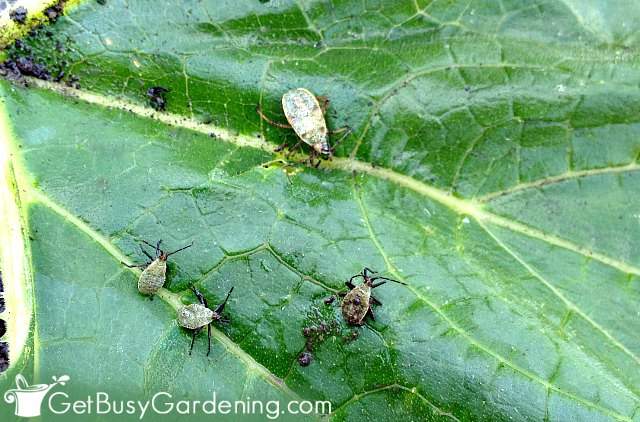
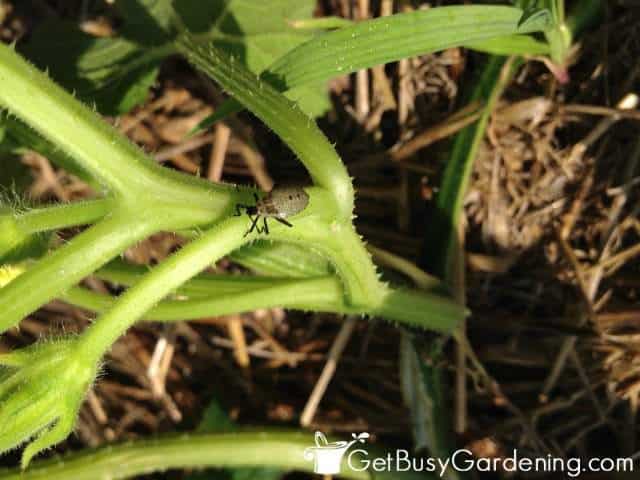
Squash bug babies, called nymphs, are much smaller. They can be anywhere from 1/10″ to 1/2″ long as they mature into adults.
Right after hatching, the nymphs have green bodies, but they turn gray a few weeks later. They have long black legs, and look like weird little spiders. They tend to cluster on the undersides of leaves, and they move very, very fast.
Related Post: How To Grow Summer Squash
The Squash Bug Life Cycle
Before you can get rid of squash bugs, it’s important to understand their life cycle. There are three main stages: eggs, nymphs, and adults.
The adults hibernate under debris in the garden and surrounding areas through the winter. They emerge when the weather warms in early summer to start feeding and mating.
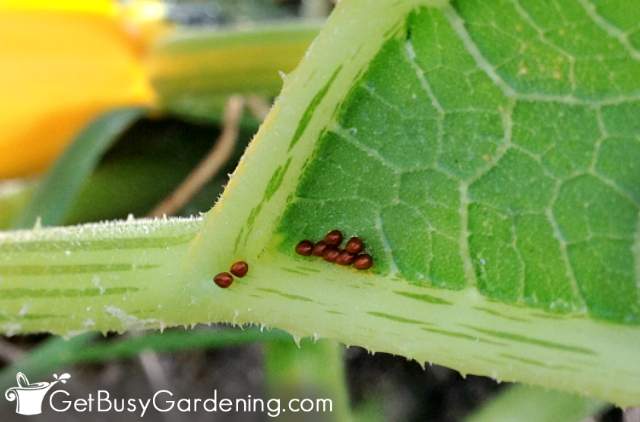
Females will begin laying eggs on nearby cucurbit plants soon after. They lay them in clusters on the undersides of the leaves, usually in a corner where the thickest veins form a V shape.
The eggs will hatch in about ten days, and the babies (called nymphs) will emerge. It takes about six weeks for the nymphs to mature into adults.
The good news is that there’s usually only one generation of squash bugs per year, though they can overlap.
Related Post: How To Grow Winter Squash
Where Do Squash Bugs Come From?
Although you don’t usually see it, adult squash bugs can fly. That means they can travel a long way to find your garden. This is why it can be so challenging to get rid of them.
Since cucurbits are their main host plant, they’re naturally attracted to them. So, if there are squash bugs present in your area of the world, then there’s a good chance they will find your garden.
What Do Squash Bugs Eat?
Squash bugs love to feed on all types of cucurbit plants. This includes all winter and summer squash varieties, like zucchini, pumpkins, and gourds, as well as melons and cucumbers.
Both the adults and the nymphs will feed on all parts of the plant. They usually start with the leaves, and then work their way to the vines, and finally the fruit as the plant starts to die.
Squash Bug Damage To Plants
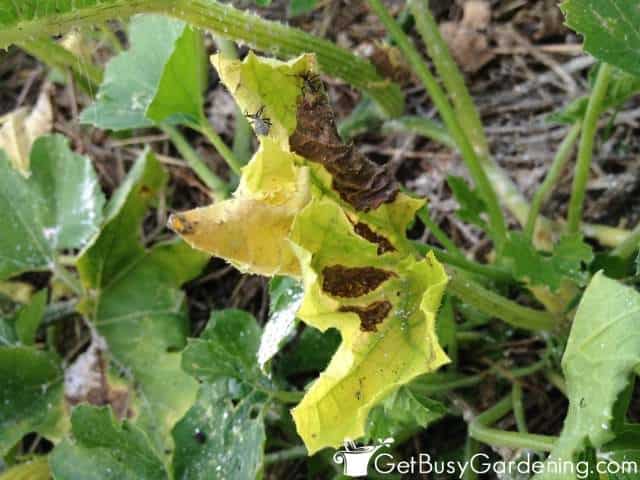
They cause damage to plants by sucking the sap out of the leaves, which will turn yellow, wilt, and then eventually dry up and die. Severe damage can cause the vine to turn black.
Healthy, mature plants can handle a small squash bug infestation without major problems. But a large population can kill a weak or immature plant pretty quickly.
Related Post: How To Grow Cucumbers
How To Get Rid Of Squash Bugs
The good news is that you can indeed get rid of squash bugs for good. I haven’t had them in my home garden for over ten years (knock on wood).
It’s a different story in our community garden plot, since others don’t do anything to prevent the spread. So managing the population is a more realistic goal.
Here are the first steps you should take to control an outbreak:
- Keep a close eye on your plants. Check them regularly for leaves that are turning yellow or brown, which is the first sign of a squash bug infestation.
- If you find a yellowing or browning leaf, inspect it closely, especially the underside. If you see any squash bugs crawling around, then take immediate action.
- Be persistent! If you stay on top of the problem, then they won’t cause much damage (trust me, it sounds harder than it is).
Organic Squash Bug Control Methods
The best way to get rid of squash bugs in your veggie garden is to use natural garden pest control methods, rather than synthetic chemicals.
Below I have listed several organic treatments you can use. Be sure to experiment, and also try combining a few of them to find what works best for you.
Hand Pick The Adults & Nymphs
The best organic treatment for squash bugs is hand-picking them off your plants. They don’t sting or bite, so you can just pick them off with your bare hands. If that freaks you out, then wear gloves.
It’s not hard to do once you get the hang of it – but they can move fast. Like really fast! And they’re elusive little buggers too, so you have to be quick.
Once you catch them, simply drop them into a bucket of soapy water, or just squish them if you’re not too squeamish.
Since they tend to cluster, sometimes it’s easier to remove the infested leaf. Then drop the whole thing into the bucket of soapy water, or step on it to crush the bugs, rather than trying to chase after them.
Once you’re done, you can dispose of the dead squash bugs by dumping them into your compost bin, or somewhere in the weeds.
Capture Them With Duct Tape
If you’re having a hard time catching them, you can try capturing them with duct tape, or any other type of thick tape you have on hand.
Simply roll the tape around your hand, with the sticky side facing out. Then brush it over the eggs, bugs, and nymphs.
Take care not to press too hard, or the tape could stick to the leaves. When you’re done, just toss the bug-covered tape into the trash.
Try Diatomaceous Earth
Diatomaceous earth (DE) is a wonderful product that you can use to kill squash bugs naturally. The fine powder easily sticks to their bodies.
It works best when you sprinkle it directly onto the bugs, rather than doing a broad application. Spreading it everywhere is much less effective, and you’ll just be wasting it.
Use Insecticidal Soap
Soap will quickly kill many of the bugs on contact. But at minimum it will slow them down so they’re easier to catch and hand pick.
You can use a pre-made insecticidal soap, or make your own. My recipe is 1 teaspoon of mild liquid soap to 1 liter of water.
Neem Oil
Another great option that is very effective for longer term control is neem oil. While it will kill many of the squash bugs on contact, it can take some time to get rid of them completely.
So make sure to stay consistent with it. Treat your plants every few weeks until you no longer see any of the bugs or nymphs.
Related Post: How To Use Neem Oil On Your Plants
How To Prevent Squash Bugs
One of the easiest ways to control squash bugs is to keep them from infesting your plants in the first place. Below are a few simple prevention methods to try.
Check For Eggs
The best way to thwart an infestation is to regularly find and destroy the eggs as the squash bugs lay them. It’s easy to spot them when you know what you’re looking for.
Most times you’ll find them in clusters on the undersides of leaves, and in a nook where the larger veins form a V shape. They’re brown or red-ish in color, and oval shaped.
Gently scrape the eggs off with your fingernail or a tool, and then destroy them. Or you can use the rolled up duct tape trick I described above. Check the leaves weekly for new egg clusters so you can get rid of them before they hatch.
Use Row Covers
Putting row covers over your plants can keep the squash bugs from laying their eggs in the first place. Or you could cover your plants with inexpensive tulle fabric instead.
The downfall of using row covers is that it will also keep pollinators out. So, you can either hand-pollinate your squash flowers, or remove the covers once the plants start to bloom.
Try Repellent Plants
Nasturtium is a natural companion plant that can work to repel squash bugs. I tried it out in my community garden one year, and it worked great.
I inter-planted nasturtium flowers in one half of the garden to test it out. Sure enough the cucurbits on that side of the bed never had one squash bug, while the ones in the other half did.
Keep Your Garden Clean
The adults will overwinter under plant debris and other materials in the garden. So, to prevent them next year, be sure to clean out your garden in the fall.
Tilling or turning the soil can also help to kill or expose hibernating squash bugs. You should also burn, toss out, or otherwise destroy dead cucurbit plants in the fall, rather than composting them in your yard.
FAQs About Controlling Squash Bugs
There are lots of different types of beneficial beetles and other predatory insects (like ladybugs and spiders) that feed on insects and their eggs. That’s why it’s so important to only use organic methods to get rid of squash bugs. You don’t want to kill their natural predators in the process.
No. Squash bugs do not bite or sting. They are completely harmless to humans.
Yes. If left untreated, they will eventually kill the plant. It takes much longer for them to destroy a large, mature squash plant. But they can kill small, immature plants pretty quickly.
No, squash bugs don’t die during the winter. They hibernate in plant debris, rocks, or any area that provides protection as a hiding spot until it warms up in the spring.
Yes, Dawn dish soap, as well as other soapy water solutions, will kill squash bugs on contact. I recommend that you test it on a few leaves first before spraying the whole plant, to make sure there’s no damage.
There’s no doubt that dealing with squash bugs is frustrating, and it can be difficult to eliminate them from your garden. But, if you’re diligent in fighting them, and take preventative measures to keep them from coming back, then you absolutely can get rid of them for good.

If you’d like to learn how to make the most of your space and get as much homegrown food as possible, then my Vertical Vegetables book is perfect! It will teach you all you need to know, has tons of gorgeous photos, and includes 23 DIY projects you can build for your own garden. Order your copy today!
Learn more about my Vertical Vegetables book here.
More Posts About Garden Pest Control
Share your tips for how to get rid of squash bugs, or your favorite organic control methods in the comments below.

Charlotte Ross says
You talk about squash bugs overwintering in the garden. How do you find them in the soil to get them out? Also they don’t just lay eggs on the underside. I have found them on top of the squash leaves, on the stems of squash leaves. I’ve recently found them on top of tomato plant leaves and on top cucumber leaves as well!!! It’s not always undersides.
Amy Andrychowicz says
The best you can do is clean out your veggie beds in the fall, and consider tilling the soil. That will help to kill or expose hibernating squash bugs and eggs. Don’t waste your time hunting for them in the soil, there’s no way you’ll ever find them all (if any!). Yes, thanks for pointing out that they can lay eggs on the stems or tops of the leaves too. It’s most common to find them on the undersides of the leaves, and people usually forget to look there, so that’s why I put so much emphasis on it. 🙂
David Dean says
It has been my experience to get rid of Squash bugs is diligence. and when the cucubits finally die/ stop producing, I set the area on fire
Darlene says
I have raised beds should I clean out the beds and buy new soil? and if
I buy new soil every year what for guarantee would I have that the new soil would not have squash bugs in the sole
Amy Andrychowicz says
Replacing the soil in your raised beds will not guarantee the squash bugs will go away. They can overwinter anywhere nearby, and aren’t necessarily just contained to your raised beds. Plus it sounds like a LOT of work (and expensive!), LOL! It’s best to use the remedies I’ve listed above to control the bugs. I’ve successfully eliminated them in my home garden (the community garden is a whole other beast!), so it is definitely possible.
Janelle Richard says
I have heard that Mint deters squash bugs. Dr. Bronners has a Peppermint scented soap…would that be ok to use in my garden? Or would you suggest just using the unscented?
Amy Andrychowicz says
I have heard the same thing, but haven’t tried using mint to repel squash bugs myself, so I can’t speak from experience. You certainly could try using the peppermint scented soap. However, the scented ones contain essential oils. Some plants can be sensitive to having oils sprayed on them. So definitely test it out on a few leaves first, and let it sit for a few days to make sure it doesn’t cause damage before spraying the whole plant. Let me know if it works for you! 🙂
sally says
Last year I had access to sawdust and I covered my potatoe plants with it and had no problems with the squash bugs, I have just started seeing them this year and plan to use sawdust again its like adding compost to my garden!
Amy Andrychowicz says
I’m not sure how sawdust would deter squash bugs, but I guess it’s worth a shot.
Aysel Mercan says
Hello! Thank you for this useful information. I just want to ask one thing. I read a lot about neem oil and almost all of them says it does not harm the bees and beneficial insects. Why do you think it is harmful? Do you have any experience with neem oil killing pollinators?
Amy Andrychowicz says
No, I don’t have any experience with it killing pollinators. However, even though neem oil is organic and all-natural, it is still a pesticide. I have read that it could get into the pollen, and that’s how it could kill pollinators. So I don’t recommend doing any broad applications of any type of pesticide in the garden, just to be safe. If you choose to use it for fighting squash bugs, then take care not to spray your squash plant when there are flowers on it. And, also be sure to direct your spray on the leaves only, since that’s where squash bugs like to feed and lay their eggs.
Steve says
I’ve found an extremely simple and effective way to kill the squash bug adults and babies alike. This method does not drive them away,but will kill then within seconds of contact and, as long as you do this in the early evening to avoid harsh sun, will not harm the plants. I take a small sprayer like the kind used to apply pesticides, put in about a tablespoon of organic dish soap per gallon of water, shake it and then pressure the container and simply spray the bugs I find. The soap cos their breathing ability and they literally suffocate writhing a few short seconds. After losing two years of squash and cucumbers to these nasty critters I find perverse pleasure in watching them die. They literally fall off the plant. I also check daily to find any evidence of eggs and squash them by hand as well.
Amy Andrychowicz says
Awesome, thanks for sharing your method of killing squash bugs. I bet the sprayer pump really make fast work of it, and saves your hands! 🙂
Bea Shoughrow says
This is the best article I have read regarding getting rid of squash bugs! I have tried all of these methods and picking the bugs off and dropping them in a milk carton of soapy water, pulling off the small part of the leaf with the eggs on it and using tape for the baby bugs works great. But, it is amazing how fast that multiply, this is an everyday effort! Thanks everyone for reconfirming my efforts!
Amy Andrychowicz says
Thanks, glad my article helped you! Yes, fighting squash bugs can definitely become a daily routine, which can be so frustrating. But, once you get the upper hand, it shouldn’t be that time consuming. It’s worth the fight for so much yummy squash. 🙂
Christina Edward says
Dumb question but when squash bugs hatch and are young, are they a white colored body? And can the eggs appear to be a red/brown color? My zucchini has recently been invaded by these types and I’m not sure if they are the squash bugs. This is the 1st time in yrs I’m seeing these on my plants. I guess because I live in the country now?
Amy Andrychowicz says
Yes, squash bugs can look white or very light gray when they are babies. The eggs are indeed red/brown (see my photo of squash bug eggs in the post above). I only had a problem one time in my garden at home, and I was able to get rid of them quickly. But our community garden is infested with them. So, I know what you mean. So annoying! I hope you can get rid of them!
dawn l crosley says
try mint to repel squash bugs
Amy Andrychowicz says
Thanks! Do you mean planting the mint around your plants to deter squash bugs, or do you spray some sort of mint concoction repellent onto the plants?
Marlene Stanley says
Hi Amy, the way I get rid of squash bugs is very early in the morning. The bugs are usually mating, I tear off a square piece of duck tape and tap the bugs with the tape, they can’t elude the tape and I’m fast. Then I just fold the tape into small stinky packages and disguard. The duck tape works wonders on the eggs also because it fits right in the angles perfectly. Just press it into place on top of the eggs and pull up the duck tape, the eggs will come off easily without harming the leaves. I just inspect leaves randomly throughout the summer. No squash bugs…happy hunting and enjoy your gardens. Oh, I usually use colorful duck tape so if I drop one on the ground I will notice it easily lol
Amy Andrychowicz says
Oh, I love the idea of capturing the squash bugs with tape. It sounds like it would be really easy to get rid of the eggs too. Great tip, thanks for sharing!
Jim Ferguson says
I use a totally non-chemical method of controlling squash bugs as well as dozens of other pests.I put my one-gallon shop vac on an extension cord and take it to the garden. I can attack and permanently eliminate hundreds of squash bugs per minute just by vacuuming them away. The same trick works wonders on aphids, potato beetles, and many others. Any pest you see you can eliminate. You can knock out a major pest infestation in a matter of minutes. You can dislodge stubborn strains of pests with a brush attachment. The brush is also kinder to the plants.
Amy Andrychowicz says
Haha, wow!! Using a vacuum to eliminate squash bugs… what a great idea! Thanks for sharing, I might have to try this method some time.
Jim Ferguson says
This technique works exceptionally well on the just-hatched immature squash bugs. They stay in small groups after they hatch. You can wipe out a hundred bugs in one second with the vac. One of your subscribers also mentioned that the bugs will migrate to the top of the leaves, away from the ground, when you spray the plant with water. I also found this to be the case. I spray the squash plant and the bugs come out to meet their maker.
Squash bug eggs are brown and are the size of the head of a pin. They are laid in groups of 50 to 100 in an area the size of a quarter. Some people recommend you squash them with your fingernail. I recommend you cut that area of the leaf out – it is far easier for the plant to recover from the edges of the cut than it is for the plant to try and fail to recover a square inch of crushed leaf. Do try to avoid damaging the ribs of the leaf. Scrape the eggs off of the ribs or leave them to hatch and be exterminated by your shop vac death ray.
And be careful because you can damage your plant with a vacuum. I use a brush attachment on the hose end when removing insects from delicate plant structures. The brush attachment I use has 1.5 inch soft bristles which dislodge the insects without letting the delicate leaves get sucked into the hose. Some vacs have a bypass adjustment on the hose that allow you to control the amount of air sucked into the hose end. You might employ that feature if it is available to you.
You use no chemicals, you harm no beneficials, it costs almost nothing, and you get to be up close and personal with your plants.
Amy Andrychowicz says
Awesome, thanks so much for sharing your added tips for vacuuming up squash bugs! I’m totally going to try it some time! I bet my husband would love doing this! 🙂
Dianna says
Vacuuming squash bugs?!? You are a genius!!
Jennifer says
I pulled out my shop vac this summer and have almost eliminated the squash bugs. I thought I was being original. Hahahaha
Dallas Allen says
Yeeeeeeeesssssssss vacccccccuuuuuum! This method works wonders shop vac only???
Betty says
I have a friends who uses a dustbuster for japanese beetles – it does not have terribly strong suction, and works wonders. I imagine would work for squash bugs too…
Rosebudforglory says
And what keeps the vacuum from sucking in the leaves?
Cheryl McCloud says
Can I use last years squash soil in containers that had squash bugs last year or change it
Amy Andrychowicz says
I definitely recommend changing the soil in your containers every year. Pests like squash bugs can definitely overwinter in the soil, and re-infest your plants again the following year. I also wash my containers with soap and water before refilling them with fresh soil.
Sue Gilmore says
I so appreciate this blog! Does it matter what kind of soap you use? Will dish soap be safe for your plants and lethal for squash bugs?
Amy Andrychowicz says
Thanks Sue! Any type of soap will kill squash bugs. If you use a mild dish soap (one without degreasers or detergents), it shouldn’t hurt the plants. You can spot-check it on a few leaves first to make sure. I use Dr. Bronner’s Baby Mild liquid soap, and have never had any issues with it harming any of my plants.
Mike says
We scrape the squash bug eggs first, all the plants. Last year we lost everything to these nasty bugs but so far this year, we’re winning. Bottom and top of leaves and even along the stems. After getting all the eggs we can find, I start gently watering. My wife following close behind with a soft tipped pair of BBQ tongs and an small can of soapy water. Seem squash bugs will run from hiding to the tops of the leaves when sprayed with plain water. Easy for her to grab and drop in the can. Make two trips with the water and tongs some are slower to climb than others.
Amy Andrychowicz says
Thanks so much for sharing your method for hand picking squash bugs and the eggs! I wish you luck in your battle this year, sounds like you already have the upper hand!
Sharon P. says
I have found that if I water the squash with a hose in the evening, getting them really wet, the squash bugs start crawling to the top of the plant. I pick them off and “squash” them, or drop them in soapy water.
Amy Andrychowicz says
Oh, that’s a great tip to help make hand picking the squash bugs easier! I will have to give it a try.
Nan Schut says
Your recipe of Soap, water, and hard work is exactly what I do also in my yearly fight against squash bugs, however, for the eggs I use some masking tape around my hand, sticky side up and “sticky” them off. Works perfect and doesn’t damage leaves.
Amy Andrychowicz says
Using the tape to trap the squash bugs is a great idea, thanks for the tip! I bet they can’t outrun that as fast as simply trying to hand pick them!
Amy says
I have started using a clothing roller for this. I get as many eggs and bugs as possible, then peel off that later, and start again.
Amy Andrychowicz says
Oh wow, great idea for getting rid of as many squash bugs as possible! So the tape doesn’t stick to the plant?
K. Galloway says
One of the ways ive controlled squash bugs, which was given to me by an organic gardener 30 years ago, was to put flower and cayenne pepper in a shaker annd apply liberally to plants. Works good. Also used pyrethrum but need to spray in evening after bees have gone to bed. Its a natural plant base insecticide.
Amy Andrychowicz says
Wonderful, thanks for the squash bug control tips! I love experimenting with new methods, so I’ll give these a try in my garden too.
Astat12 says
How much cayenne to how much water do you use?
Astat12 says
sorry, I meant cayenne to flour
Rosebudforglory says
Do you mean flour as like in baking type flour? Or did you mean what you typed — flower ..which could mean like using daisies blended in water as a natural source of pyrethrum. I’ve never had that work for me and have used a number of different members of the . Chrysanthemum family – even blended them together and no luck.